


Visiting Samos without renting a car is entirely achievable if you base yourself in the island’s better-connected towns and accept some limits on how far you can roam. With planning, you can combine KTEL buses, short taxi hops and walkable coastal paths to reach many of the island’s classic beaches and archaeological sites. The trade-off is that remote coves, mountain villages and much of the far west coast remain difficult to access independently, especially outside the peak summer timetable.
Get the latest updates straight to your inbox!
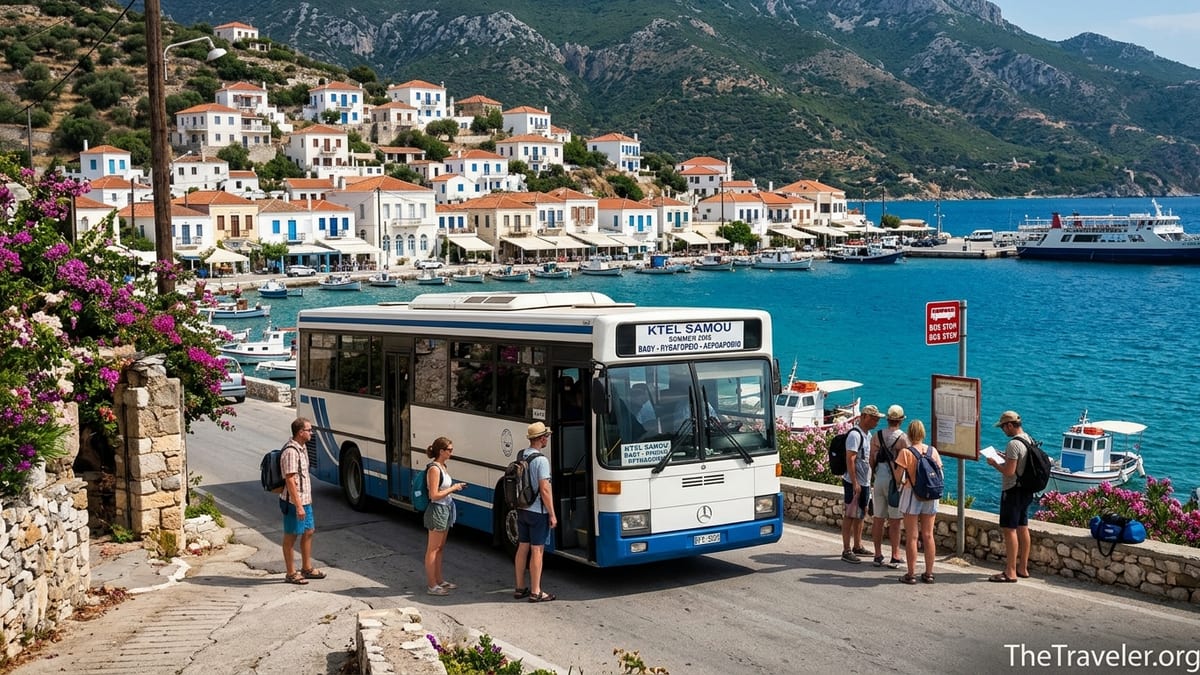
How achievable is a car-free trip to Samos in 2026?
Samos is served by KTEL Samou, the island’s public bus operator, which links the capital Vathy (Samos Town) with Pythagoreio, Kokkari, Karlovasi, the airport, Ireon and several inland villages. Recent 2026 timetable summaries show that Vathy remains the main hub, with multiple daily departures on the core routes in summer. However, services thin out substantially on Sundays and during the shoulder season, so a car-free visit works best between late May and late September when the network is at its most frequent.
Independent travelers can realistically explore the eastern and central parts of the island using buses: the Vathy–Pythagoreio–Airport corridor, the Vathy–Kokkari–Karlovasi spine along the north coast, and the branch to Ireon and the Heraion. These lines also give access, often with a short walk, to beaches such as Gagou, Potokaki, Tsamadou and Lemonakia. By contrast, famous but remote spots including Potami waterfalls beyond Karlovasi, the coves around Mikro and Megalo Seitani, and south-west beaches near Votsalakia are much harder or sometimes impossible to reach on public transport alone.
For a one-week summer stay, a car-free strategy can work very well if you choose a convenient base, accept that some “bucket-list” spots are better tackled on an excursion or by taxi, and remain flexible around bus timings. Outside summer, particularly in April or October, the reduction in services means that visitors who want to range widely or stay out late in the evening will gain significantly more freedom by renting a vehicle.
Understanding KTEL Samos buses: routes, timetables and tickets
KTEL Samou runs the island’s intercity-style buses and publishes its summer timetable each year, most recently updated for the 2026 season. Vathy’s seafront bus station acts as the main hub, with ticket counters and paper timetables on display. An up-to-date independent overview of 2026 services confirms that Vathy has the highest frequency of departures, mainly toward Karlovasi, Pythagoreio, the airport and key inland villages. Exact times vary by year and season, so travelers should always verify them locally just before travel.
Typical summer patterns show several daily buses between Vathy and Pythagoreio, with some continuing to the airport. Historical printed timetables and recent summaries indicate morning, late-morning, early afternoon and late-afternoon departures on weekdays, with fewer services on Saturdays and often only a skeleton service on Sundays. Along the north coast, Vathy–Kokkari–Karlovasi buses also run multiple times daily on weekdays, dropping to a handful of departures at weekends. During the shoulder season, starting around late September, frequencies usually fall, late-evening services are reduced or removed, and some more marginal routes cease altogether.
Most KTEL Samos fares for medium-length journeys remain relatively modest. Recent fare data for comparable routes elsewhere in the North Aegean, combined with 2026 Samos route information, suggests that short hops such as Vathy to Kokkari or Vathy to Pythagoreio typically cost in the region of 2 to 3 euros one way, with longer journeys like Vathy to Karlovasi priced slightly higher. Tickets are usually purchased directly from the driver when boarding, in cash, or from the station counter in Vathy. Card acceptance is gradually improving in Greece, but cash is still strongly recommended on Samos, especially when boarding at roadside stops.
Weekday, Saturday and Sunday services, plus summer vs shoulder season
For car-free visitors, the most important detail is that the timetable is not uniform across the week. On busy corridors such as Vathy–Pythagoreio–Airport and Vathy–Kokkari–Karlovasi, weekday services in high season typically offer several departures in each direction, making day trips practical. On Saturdays, frequencies usually drop slightly, and on Sundays many peripheral routes do not operate at all, while the core links may have only a few buses. Recent traveler reports from Samos confirm that on some past seasons there were no Sunday buses on specific secondary routes, forcing visitors to use taxis between towns even in summer.
The 2026 summer schedule for KTEL Samos, announced through local media in mid-June, concentrates resources on the main tourist areas and airport connections. This pattern fits the broader Greek practice where KTEL operators add extra high-season services from late spring and then scale back again in autumn. Travelers arriving in April or after early October should expect fewer daily departures, potentially just two or three on some routes, and sometimes none on Sunday, which can make spontaneous day trips difficult without a car or taxi.
Because there can be last-minute timetable adjustments, and because printed PDFs are not always fully up to date, the safest approach is to confirm exact departure times either at the Vathy bus station window, by telephone using the numbers printed on the schedule, or through current-season summaries provided by reputable transport information sites. This is particularly important if you are planning a last return bus after sunset, as missing it can mean an expensive taxi ride back to your base.
Airport, ferries and what to expect at bus stops
Samos International Airport sits on the south-east coast near Pythagoreio. Official airport information confirms that there is a public bus stop directly in front of the terminal, operated by KTEL Samos, linking the airport with Pythagoreio and Vathy, often via the inland village of Mytilinioi. Tickets are sold on board by the driver, and summer-season services aim to align with at least some domestic and international arrivals, although the overall frequency remains limited compared with larger islands.
Independent transport guides updated in late 2026 describe a short 3 to 8 minute journey by road from the airport to Pythagoreio, with recent bus fare examples of around 1 to 2 euros and taxi quotes of roughly 10 to 15 euros for the same stretch. A taxi from the airport to Vathy usually costs more, reflecting the longer 20 to 25 minute drive. Several sources emphasize that while buses do exist, the low frequency means that many arriving passengers still opt for a taxi if one is waiting, especially outside the height of the day when buses might run only every few hours.
Vathy’s main ferry port sits within walking distance of the bus station, allowing straightforward transfers between long-distance ferries and island buses, provided the schedules line up. Karlovasi, the secondary port on the north-west coast, also has KTEL services connecting with Vathy, though not all ferry arrivals have matching buses, especially late at night. In practice, travelers with large luggage arriving or departing on early-morning or late-evening ferries often budget for a taxi rather than rely on an infrequent bus.
On the island itself, many bus stops outside the main towns are little more than signed posts on the roadside. Published timetables often list only the primary endpoints, such as Vathy, Kokkari or Karlovasi, without naming intermediate beach or village stops. If you want to get off at an intermediate settlement, the standard practice is to board a bus traveling in the right general direction, tell the driver your intended stop and ask if the bus serves it. Greek KTEL drivers are accustomed to such requests and will usually confirm whether they stop there and call out when you should get off.
Best bases without a car: Vathy, Pythagoreio, Kokkari and Karlovasi
Vathy (often called Samos Town) is the administrative capital and main bus hub. Staying here gives you the best overall access to KTEL routes, with most lines either originating or passing through the seafront bus station. From Vathy you can ride directly to Kokkari, Karlovasi, Pythagoreio, the airport and several inland villages. The town itself is built around a deep bay and has small in-town swimming spots and Gagou Beach within walking distance. Accommodation ranges from simple rooms to mid-range hotels, and prices in high season often remain slightly lower than in the island’s pure beach resorts, which can be helpful for budget-focused solo travelers.
Pythagoreio, on the south coast close to the airport, is one of Samos’s most attractive and popular tourist towns. It offers an atmospheric harbor, a fine small beach area, a cluster of tavernas and bars, and easy access on foot or by a short bus or taxi ride to Potokaki Beach and the island’s main archaeological sites. KTEL buses connect Pythagoreio with Vathy and the airport, and some services continue to Ireon and the Heraion. Accommodation here covers a wide range of guesthouses, apartments and sea-view hotels, with prices in peak season typically a little higher than Vathy but competitive compared with islands like Mykonos or Santorini.
Kokkari, a compact resort village on the north coast, is beloved for its atmosphere and pebble beaches. Buses link it along the main coastal road with Vathy and Karlovasi, giving car-free travelers straightforward access in both directions. Within walking distance of the village are several beaches, and onward buses toward Karlovasi give access to Lemonakia and Tsamadou beaches, often with a short walk downhill from the main road. Kokkari’s hotel and apartment prices generally sit in the mid-range for Samos, and the village has plenty of restaurants and cafes, but ferry and airport access both require a bus or taxi via Vathy or Pythagoreio.
Karlovasi, on the north-west coast, is more spread out and less overtly touristic than Pythagoreio or Kokkari, though it does have its own port and a student population. Buses connect Karlovasi along the north coast road via Kokkari to Vathy; however, frequencies are generally lower than the eastern part of the island. The town provides a useful base if you want to explore the Potami area and western hiking trails, but the lack of dense bus services and the larger spread of neighborhoods means that some visitors still prefer to rent a car here. Accommodation choices are fewer but can be good value, especially outside the absolute peak in August.
Reaching beaches by bus and on foot
Several of Samos’s best-known beaches are reachable with a combination of KTEL buses and walking. Gagou Beach sits just outside Vathy, within comfortable walking distance from much of the town; many visitors simply follow local streets rather than rely on a bus. Potokaki Beach runs west along the coast from the airport and Pythagoreio, and is served indirectly by the Vathy–Pythagoreio–Airport bus line. Older printed bus tables and recent guides show Potokaki as a named stop or destination on some services, but in practice many travelers walk from Pythagoreio or get off the bus near the airport road and walk the final stretch, which can involve roadside sections but is mostly manageable for adults used to summer heat.
On the north coast, Lemonakia and Tsamadou beaches lie west of Kokkari. Buses running between Vathy, Kokkari and Karlovasi travel along the main road above the bays; passengers generally ask the driver to stop at the nearest point to their chosen beach. From these roadside stops, access involves a walk downhill on paved paths or minor roads, which can be relatively steep. The return walk uphill in the afternoon sun can be demanding, so carrying water and planning around the heat is important. Despite the gradient, this arrangement makes Lemonakia and Tsamadou among the more realistic car-free beach options.
Psili Ammos is the name of more than one sandy beach on Samos. The more easily reachable one for car-free visitors lies on the south coast east of Pythagoreio, within reach of bus services that follow the south-coast road out of town. As with other secondary stops, it may not appear clearly in the timetable, so you rely on confirming with the driver and watching for beach signage. Once dropped on the roadside, it is usually a short walk down to the sand, although there may be stretches with limited shade and passing traffic.
Some beaches, especially small coves and western or south-western stretches near Votsalakia, are significantly harder or impossible to reach without a car. Even where an occasional bus serves a nearby village, the onward walk may involve narrow, busy roads without pavements or long distances in high heat. For these, organized boat trips from Pythagoreio or Kokkari and taxi transfers from your base town can be the most practical options for car-free visitors.
Key sights: Tunnel of Eupalinos, Heraion, museums and last-mile transport
The Tunnel of Eupalinos, one of the island’s most extraordinary ancient engineering works, sits inland above Pythagoreio. While exact access details and opening hours can change, recent descriptions place the tunnel site within a short taxi ride or a longer uphill walk from central Pythagoreio. There is no dedicated KTEL bus that drops directly at the entrance, so car-free visitors typically combine a town bus to Pythagoreio with a taxi or organized excursion to cover the last mile. Admission prices for similar archaeological sites in Greece in 2026 suggest a moderate fee per adult, with reduced tickets for students and EU seniors; travelers should confirm the current rate on the spot.
The Heraion of Samos, the sanctuary of Hera and a UNESCO-listed archaeological area, lies near Ireon on the south coast. KTEL buses operate from Vathy and Pythagoreio towards Ireon during the main season, as shown on recent timetables and summaries that list Ireon as a terminus on certain services. From Ireon village, the Heraion site is a relatively short distance away, reachable either on foot along local roads or by a very short taxi ride. Opening hours in summer generally align with the broader pattern for Greek archaeological sites, often from morning until mid-afternoon or early evening, with earlier closing outside high season.
Pythagoreio itself is an archaeological site, with remains of ancient fortifications and monuments integrated into and around the modern town. This makes it particularly attractive for car-free travelers, as you can step from your accommodation onto the harborfront and reach significant historical remains within minutes on foot. Combined with its bus and taxi links to the airport, Potokaki and inland sites like the Tunnel of Eupalinos, Pythagoreio serves as an efficient base for those most interested in history.
In Vathy, the Samos Archaeological Museum showcases finds from across the island, including notable sculptures and artifacts from the Heraion. Its location in the town center makes it easily walkable from most Vathy accommodation and from the bus station, without the need for additional transport. Admission pricing again follows national norms, with standard and reduced tickets; exact current prices should be checked at the entrance. For museum and site visits, car-free travelers should keep in mind that some close on specific weekdays or afternoons, so it is wise to verify hours locally a day in advance.
Reaching Potami waterfalls, western beaches and mountain villages
The Potami area, west of Karlovasi, contains one of Samos’s standout natural attractions: a gorge with a series of waterfalls reached via a scenic walk through woodland and along the riverbed. Authoritative local descriptions emphasize that the most practical starting point is Karlovasi, followed by travel along the coastal road toward Potami Beach and then a walking trail inland. While KTEL buses connect Vathy and Karlovasi, they may not extend beyond Karlovasi town to Potami on a frequent basis, so many visitors either walk or take a local taxi from Karlovasi to Potami and then continue on foot to the waterfalls.
From Potami Beach, reaching the waterfalls requires a hike that includes sections on wooden walkways and, in some cases, wading through cold water or climbing basic ladders, which is not suitable for everyone. A number of recent traveler accounts from 2026 describe the experience as rewarding but physically demanding. For car-free visitors based in Vathy or Kokkari, a realistic approach is to take a morning bus to Karlovasi, use a taxi for the short ride to Potami, hike to the waterfalls and then ensure you are back at Karlovasi in time for a late-afternoon or early-evening bus return. Missing that last bus could result in a long and expensive taxi journey back to your base.
Remote western beaches near Mikro and Megalo Seitani, as well as mountain villages in the island’s interior, present a much greater challenge without a car. KTEL timetables list certain villages with limited services, sometimes just a few departures per week outside summer. Even when a bus reaches a mountain village, hiking trails to nearby viewpoints or additional settlements require good fitness and heat awareness. On the coast, some of the most celebrated secluded coves are reachable only by hiking trails or by sea, which for car-free travelers essentially means committing to multi-hour hikes or joining a boat trip from one of the main tourist harbors.
Because of these constraints, many car-free visitors focus their independent explorations on the more accessible eastern and central regions, then book one or two organized excursions or private boat trips to experience the west. Local agencies in Pythagoreio, Kokkari and Vathy offer day cruises that combine swimming stops at remote beaches with views of the coastline, and there are also tour operators that bundle bus transfers and guided visits to places like Potami or interior villages. These come at a higher cost than public buses but remove the stress of navigating sparse timetables.
Itineraries for three and two days without a car
A realistic three-day itinerary using only public transport and short taxis might look like this. On Day 1, base yourself in Pythagoreio. Start with the town’s harbor and nearby archaeological remains, then visit the Tunnel of Eupalinos via a taxi or organized trip from the town. Spend the afternoon at Potokaki Beach, reached either on foot or by taking a bus toward the airport and asking to get off near the beach. Return to Pythagoreio for dinner on the harbor, then check the evening bus or taxi options if you are staying elsewhere.
On Day 2, travel early by bus from Pythagoreio or Vathy to Ireon and the Heraion. Allow a good block of time to explore the sanctuary and small seaside village, then return by bus in the mid-afternoon. If based in Vathy, you can add a visit to the Samos Archaeological Museum before or after your south-coast excursion, depending on opening hours. Always double-check the last bus back from Ireon, as south-coast routes may have limited evening coverage, particularly outside July and August.
On Day 3, focus on the north coast. From Vathy, take a morning bus to Kokkari. Spend some time in the village, then continue by bus in the direction of Karlovasi, asking to get off at Lemonakia or Tsamadou. Enjoy the beach and be prepared for the uphill walk back to the roadside in the afternoon heat. Later, ride back through Kokkari to Vathy for an evening in town. For those determined to see the Potami waterfalls, a variation is to catch an earlier bus from Vathy to Karlovasi, connect by taxi to Potami, hike, then return via Karlovasi and Kokkari if time and bus schedules allow.
For visitors with only two days on Samos and no car, it is sensible to focus on the easiest car-free destinations. One option is to spend both nights in Pythagoreio. On Day 1, explore the town, its beach and Potokaki, and visit the Tunnel of Eupalinos. On Day 2, use buses to reach Ireon and the Heraion, returning in time to catch a late-afternoon or evening ferry or flight. An alternative two-day plan based in Vathy would emphasize the Archaeological Museum, Gagou Beach, and a day trip to Kokkari and the nearby north-coast beaches, without attempting the more logistically complex western or mountain areas.
Costs, summer conditions and who should still rent a car
In 2026, Samos remains relatively good value compared with more famous Greek islands. Recent fare examples and price ranges suggest that most interurban bus journeys cost only a few euros per person each way, so a solo traveler using buses and walking can often spend less on daily transport than the price of a small rental car’s fuel alone. Short taxi journeys, such as from the airport to Pythagoreio or from Karlovasi to Potami, tend to fall somewhere in the low tens of euros each way, depending on distance and time of day, which is manageable if used sparingly or shared between two people.
Accommodation costs vary by town and month, but general patterns show mid-range double rooms in Pythagoreio, Kokkari and Vathy in high summer often priced in the middle bracket for Greece, with more budget options available in older guesthouses and pensions. Karlovasi can be slightly cheaper due to lower demand. For a couple traveling in July, a realistic daily budget might combine a mid-range room, several bus rides, occasional taxis and meals out without reaching the premium levels of more developed resort islands. Organized day trips, especially boat excursions or guided tours, add to costs but can be planned as one-off splurges.
Summer temperatures on Samos can be high, with strong sun and limited shade along many roadside stretches. Car-free travelers who rely on walking between bus stops and beaches must factor in heat, hydration and footwear. Inland walks to sights like the Potami waterfalls, or uphill returns from beaches such as Lemonakia and Tsamadou, can feel substantially harder in mid-afternoon. Accessibility is also a concern: steep paths, uneven surfaces and sections of road without pavements mean that some routes are not suitable for travelers with mobility difficulties.
Reduced evening services are another significant limitation. In many parts of Greece, KTEL buses wind down operations after early evening, and Samos is no exception. For visitors who enjoy late dinners in distant villages, night-time beach bars away from their base, or spontaneous changes of plan, this can feel restrictive. Carefully noting the time of the last bus back to your town, and having the phone number of a local taxi operator, is essential risk management for car-free travel on the island.
Taking all of this into account, the best towns for travelers without cars rank roughly as follows. Pythagoreio comes first for its mix of atmosphere, airport proximity, walkable beach access and connections to major archaeological sites. Vathy follows closely for its role as bus hub, museum access and generally good value accommodation. Kokkari ranks highly for north-coast beach access and village charm, but requires more bus or taxi use for ferries and the airport. Karlovasi, while useful for reaching Potami and western hikes, sits lower on the list for car-free visitors due to its spread-out layout and more limited bus connectivity, unless you are willing to rely on taxis or guided excursions.
Travelers who can comfortably skip renting a vehicle are those happy to focus on a few well-connected bases, walk to nearby beaches, and use buses primarily along the Vathy–Pythagoreio–Airport and Vathy–Kokkari–Karlovasi corridors. This suits budget-conscious solo visitors, couples who enjoy slow exploration and travelers who dislike driving on narrow mountain roads. By contrast, anyone whose priority is to reach multiple remote beaches, hike deeply into the mountains on their own schedule, or stay in outlying villages while still enjoying late evenings elsewhere will gain markedly more freedom and flexibility by hiring a car for at least part of their stay.