


More news on this day
Carnival Cruise Line has revealed fresh details of Carnival Destiny, the first vessel in its next-generation Ace class, outlining a larger LNG-powered flagship scheduled to enter service in summer 2029.
Get the latest news straight to your inbox!
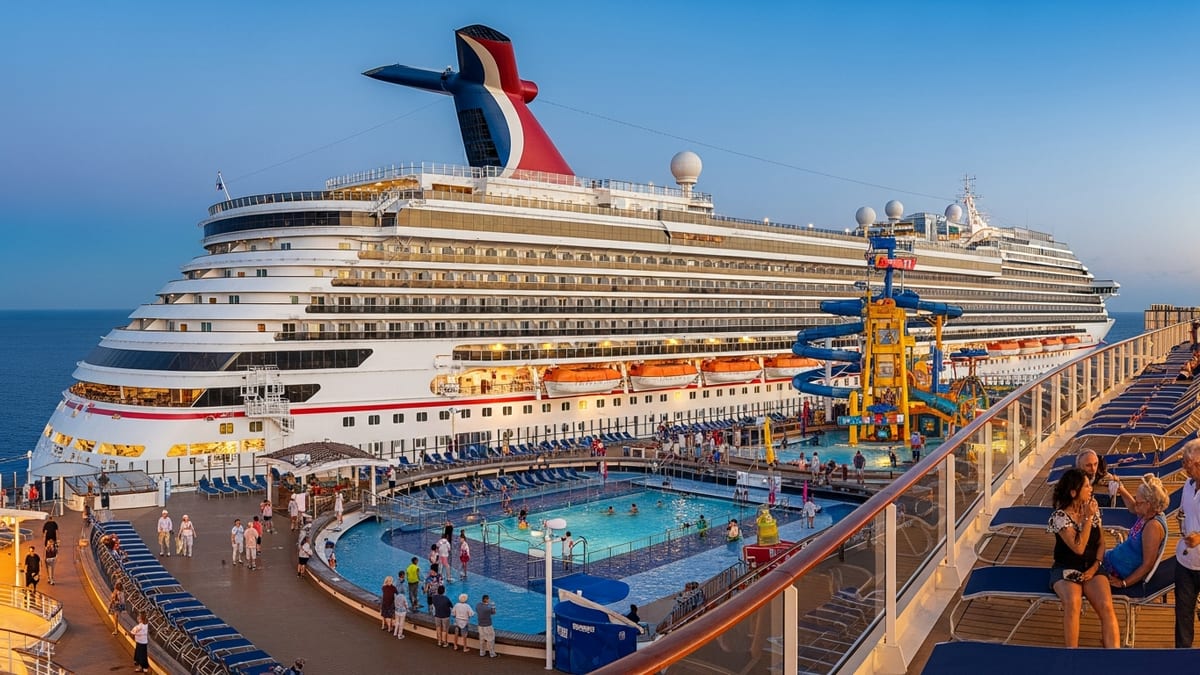
Ace Class Marks New Era in Scale and Design
The Ace class represents Carnival’s most ambitious ship platform to date, with Carnival Destiny expected to become the largest vessel in the fleet by a significant margin. Publicly available information indicates the ship will measure about 230,000 gross tons, making it more than 50,000 gross tons larger than Carnival’s current Excel class flagships.
Construction formally began on July 10, 2026, with a traditional steel-cutting ceremony at Fincantieri’s Monfalcone shipyard in Italy. The event also featured a 3D hologram presentation that offered a first look at the ship’s profile and outdoor spaces, underscoring a design brief that focuses on sweeping ocean views and expansive open decks.
The Ace platform is planned as a three-ship series, with Carnival Destiny due in 2029 and two unnamed sister ships scheduled for delivery in 2031 and 2033. Industry coverage portrays the class as a cornerstone of Carnival’s long-term growth strategy in the global mega-ship segment.
Carnival Destiny Revives a Storied Name
The choice of the name Carnival Destiny draws a direct line to one of the line’s most important earlier ships. The original Carnival Destiny, introduced in the 1990s and later transformed into Carnival Sunshine, was once the largest cruise ship in the world and helped define the brand’s resort-at-sea approach.
By reusing the Destiny name for the Ace class prototype, Carnival is signaling a blend of heritage and innovation. Reports indicate that the company views the new ship as both a nod to its past and a statement about its future positioning among the world’s biggest cruise operators.
Brand watchers note that bringing back such a historically significant name for the new flagship could help build recognition for the Ace class well before bookings open. The move also aligns with a broader trend in the cruise sector of tapping legacy names for next-generation tonnage.
Focus on Ocean Views, Outdoor Spaces and New Experiences
Early imagery and descriptions suggest that Carnival Destiny will place particular emphasis on connecting guests to the sea. Coverage of the initial reveal describes a new design philosophy that increases the number of vantage points over the water and extends outdoor promenades, continuing an evolution seen in earlier Carnival classes.
While many onboard specifics remain under wraps, published information points to a ship that expands on existing favorites such as open-air lounging areas, family attractions and diverse dining concepts. The Ace platform is expected to build on the layout principles of Carnival’s Excel class, but on a larger footprint that allows for more varied venues and potentially new top-deck features.
Additional details about individual restaurants, entertainment offerings and accommodation types are expected to be shared later in 2026. Carnival has indicated through public communications that more comprehensive information on guest experiences will be released as the ship moves through its construction milestones.
Partnership With Fincantieri Reaches New Milestone
Carnival Destiny is being built by Fincantieri, extending a partnership between the cruise company and the Italian shipbuilder that spans more than three decades. Reports on the steel-cutting highlight the fact that the Ace class prototype will be the largest ship ever constructed at the Monfalcone yard, underscoring the scale of the project for both companies.
The shipyard has previously delivered several classes of vessels for Carnival and its sister brands, and industry analyses suggest that the Ace platform will draw on that shared experience while incorporating new technical solutions. The size and complexity of the 230,000-gross-ton design are viewed within the sector as an important reference point for European large-ship construction.
The cooperation also reinforces Carnival Corporation’s broader strategy of working with multiple builders across its brands, while using select yards for its largest and most technically advanced projects. Observers note that the Ace program is likely to be closely watched as a benchmark for future mega-ship contracts.
LNG Power and Competitive Context in the Mega-Ship Market
Carnival Destiny will be powered by liquefied natural gas, continuing a shift toward lower-emission propulsion in the cruise industry. Publicly available technical outlines describe an LNG-based system similar to that used on Carnival’s Excel class, but scaled up for the larger hull, reflecting a wider move among major operators to pair record passenger capacity with more efficient engines.
Analysts have already begun comparing the Ace class to rival mega-ships such as Royal Caribbean’s Icon class and MSC Cruises’ World class. Early assessments emphasize that Carnival Destiny’s projected size puts it into the upper tier of the global cruise market by volume, while its LNG power plant aligns it with recent environmental trends across the sector.
As the first steel sections come together at Monfalcone, the reveal of Carnival Destiny marks a significant moment for Carnival’s fleet development pipeline. With bookings and full itineraries yet to be announced, the Ace class prototype is set to be a focal point of cruise industry attention in the run-up to its summer 2029 debut.