


More news on this day
Rail passengers across east London faced significant disruption on Monday after a trackside fire near Stratford station forced evacuations, halted services through the busy interchange and left key commuter routes suspended while emergency crews made the area safe.
Get the latest news straight to your inbox!
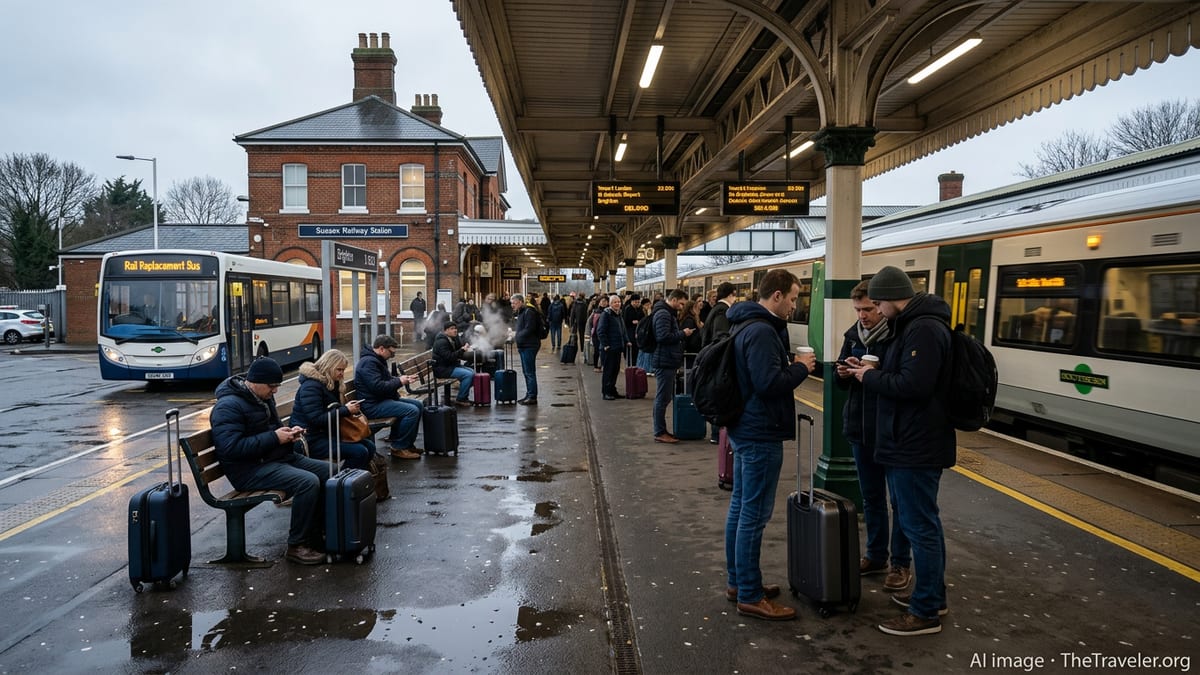
Blaze near tracks forces evacuations and line closures
Reports from London on Sunday 12 July and Monday 13 July indicate that a fire close to the railway at Stratford, one of the capital’s busiest interchanges, led to a rapid suspension of services while the incident was brought under control. Images and eyewitness accounts shared in local coverage describe smoke billowing above the station complex and trains brought to a standstill on approaches into the hub.
According to published coverage, passengers on at least one service approaching Stratford were evacuated from trains and guided back along the tracks to safety. Social media posts referenced an announcement attributing the disruption to an electrical issue, while later public information pointed to vegetation alight near the line as the likely source of the blaze.
By late Sunday, the immediate fire had been contained but rail operations through the affected stretch remained heavily restricted. Trains serving Stratford’s mainline, London Overground and Underground platforms were reported as suspended for several hours, with knock-on delays spreading across wider parts of the east London rail network.
The incident coincided with a series of heat-related rail problems around the capital, adding pressure to networks already operating with adjusted timetables and speed restrictions during warm weather.
Impact on commuters across east and south London
The fire at Stratford followed other recent trackside incidents around London that have disrupted journeys into and out of the city. Over the weekend, National Rail alerts highlighted fires next to the track at locations including Imperial Wharf, Micheldever and Tooting, affecting services operated by London Overground, South Western Railway and Southern on routes linking the capital with Surrey and the south coast.
In east London, separate published reports on Monday detailed a significant blaze near the Weaver line between Wood Street and Walthamstow Central, where a railway embankment and nearby gardens caught fire. That incident prompted evacuations of nearby homes and further rail disruption, illustrating how dry conditions can quickly affect both residential areas and key rail corridors.
While these events are geographically dispersed, the cumulative effect for passengers has been pronounced. Commuters travelling from suburbs in both east and south London into major terminals such as London Bridge, Waterloo and Liverpool Street have faced cancellations, diversions and extended journey times as operators work around blocked or restricted lines.
For many regular users, the Stratford disruption is particularly significant because the station functions as a major interchange, linking National Rail services with the Central and Jubilee lines, the Docklands Light Railway and London Overground. When all modes are interrupted at once, alternative routes across the city rapidly become congested.
Rail operators issue warnings and alternative routes
Public information from National Rail and individual train companies on Monday urged passengers to check live departure boards and journey planners before travelling through affected corridors. Operators have highlighted that some services may start or terminate short of their usual destinations to avoid the most heavily impacted sections of track.
On routes into London from the south, passengers have been advised that they may need to travel on different train companies’ services or change at intermediate hubs such as East Croydon or Clapham Junction, depending on the latest line availability. In some areas, rail replacement buses have been deployed where lines are fully blocked.
Inside the capital, Transport for London journey planning tools are being used by many travellers to identify alternative combinations of Tube, Overground and bus services that avoid closed sections. However, with Stratford and parts of the Overground network affected, spare capacity on nearby lines has been limited at peak times.
Operators have also reminded passengers that tickets are being accepted on reasonable alternative routes in many cases, reflecting established agreements for times when unplanned disruption affects multiple lines simultaneously.
Heat, vegetation and infrastructure under scrutiny
The Stratford blaze and the wider pattern of line-side fires have focused renewed attention on how hot, dry conditions affect rail infrastructure. Trackside vegetation can dry out quickly in warmer periods, increasing the risk that a small spark, falling tree or electrical fault will ignite an embankment close to running lines.
Published background documents on London’s railway procedures show that managing vegetation near tracks, maintaining safe clearances around overhead lines and monitoring drainage and embankment stability are all part of regular maintenance programmes. In practice, however, sudden temperature spikes and prolonged dry spells can still overwhelm preventative work, particularly on busy urban corridors with dense housing backing onto the railway.
Rail industry briefings in recent years have also highlighted the vulnerability of signalling and power systems during extreme weather, with both rails and overhead equipment sensitive to rapid temperature changes. In response, operators often introduce temporary speed restrictions and enhanced inspection regimes, which can reduce capacity even where lines remain technically open.
The recent cluster of incidents in and around London is likely to prompt further discussion about how to adapt the network to more frequent heat events, including investment in modern monitoring systems and targeted resilience upgrades on busy approach lines into major terminals.
What passengers should expect in the coming hours
As of Monday afternoon, live information from rail operators and journey planners indicated that services through the Stratford area were gradually resuming but remained subject to delay and short-notice alteration. Passengers were advised that evening peak travel could still be disrupted as stock and staff were repositioned and signalling checks completed.
Across the broader London and south-east network, residual delays from fires near the tracks at other locations were also expected to continue into the day, particularly on suburban routes where there is limited flexibility to reroute trains. Commuters heading into central London were encouraged to allow extra time and consider avoiding the busiest interchange points where possible.
Travel experts note that, after any major trackside incident, full normal service can take several hours to restore even once lines are technically reopened. Timetables may be temporarily thinned out, with some stopping services altered to prioritise moving long-distance or heavily loaded trains first.
For now, passengers planning to use rail and Tube services in east and south London are being urged to monitor live updates closely, remain alert to platform announcements and be prepared to adjust their journeys as the network continues to recover from the latest fire-related disruption.