


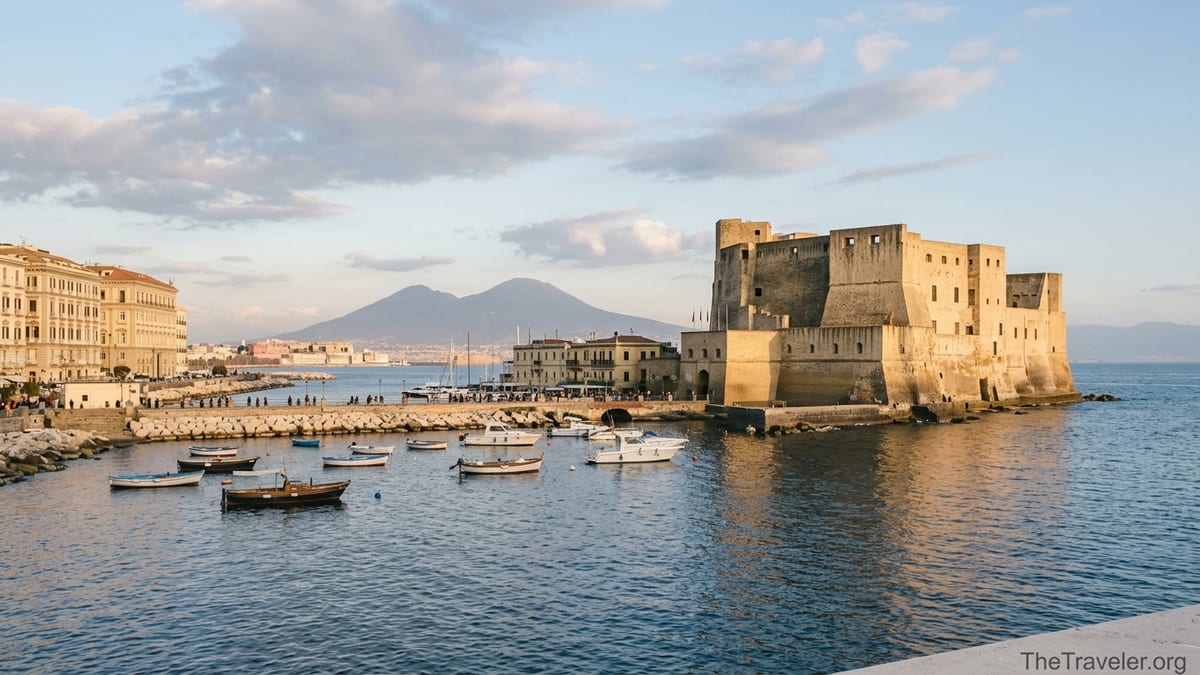
Floating at the edge of the Bay of Naples on a rocky spur once known as the islet of Megaride, Castel dell’Ovo is one of the city’s most atmospheric landmarks. For first-time visitors, it is not just a historic fortress but a spectacular vantage point over Vesuvius, the waterfront promenade, and the tiny fishing harbor of Borgo Marinari below. This guide walks you through how to visit today, what to expect inside, and how to turn a simple castle stop into a memorable Naples moment.
Get the latest updates straight to your inbox!
What Castel dell’Ovo Is and Why It Matters
Castel dell’Ovo, literally the “Egg Castle,” is the oldest standing fortress in Naples, perched on the former island of Megaride and now connected to the city by a short causeway. The current structure largely dates from the Angevin and Aragonese periods, but traces of earlier Roman and medieval uses linger in the fabric of the walls. Its unusual name comes from a medieval legend that the poet Virgil hid a magical egg in the foundations, and that the fate of the castle, and perhaps of Naples itself, depended on the safety of this egg.
For a modern visitor, the castle’s importance is as much about setting as about history. From the upper terraces you get one of the classic panoramas of Naples: the curve of the Lungomare Caracciolo waterfront, the domes and palaces of the city, the volcanic bulk of Vesuvius, and the expanse of the bay. Locals come here at sunset to watch the light sink behind Posillipo, and many visitors find this viewpoint more relaxed and open-air than the busier historic center.
The complex also anchors tiny Borgo Marinari, the compact marina and restaurant quarter that wraps around its base. This mix of stone ramparts, bobbing fishing boats, and waterside dining means you can easily turn a visit into a half day of strolling, photography, and seafood. Even if you are in Naples only briefly, Castel dell’Ovo is one of the easiest and most rewarding sights to fit in.
Because the castle is managed as a civic monument rather than as a private attraction, access is typically free or very low cost when open, and it is often used for cultural events and exhibitions. This creates a different feel from ticketed sites like Castel Sant’Elmo: less of a museum, more of a public space where Neapolitans actually spend part of their day.
Current Visiting Conditions, Hours and Tickets
Before you go, it is important to check whether interior access is currently available. Recent civic tourism information indicates that Castel dell’Ovo has standard opening times roughly from mid-morning to early evening on most days, with slightly shorter hours on Sundays. However, a note circulated in spring 2026 mentions temporary closure for renovation work, while confirming that the surrounding Borgo Marinari and waterfront remain fully accessible. That means conditions can change with ongoing works or safety checks.
Practically, that translates into planning your visit in two layers. First, treat the castle and its causeway as an outdoor landmark you can certainly approach: you can still walk along the Lungomare, cross to Borgo Marinari, and photograph the walls and bay, even during partial closures. Second, if you are hoping to climb the ramparts and access the interior terraces, build in some flexibility and verify the day’s status through local tourist information once you are in Naples, such as at the municipal info points in the historic center or around Piazza del Plebiscito.
When the interior is open under normal conditions, admission is usually free of charge, in line with other municipally managed sites. There is no complex ticketing system or timed-entry requirement, which makes it convenient for spontaneous visits. Unlike Castel Nuovo (Maschio Angioino), which has a clearly advertised ticket price for its civic museum collection, Castel dell’Ovo is more of an open fortress and viewpoint. You simply walk up the ramp at the base and follow the paths through the courtyards and bastions.
Because there is no paid ticket and access sometimes changes for events or maintenance, it is wise not to anchor your only sunset in Naples solely on the assumption you can reach the highest terrace. An example many travelers experience is planning a late-afternoon visit, only to find a portion of the upper level closed for a private event or safety inspection. In that situation, you can still salvage the moment by exploring the marina below and enjoying the same golden-hour light from a café terrace on Borgo Marinari looking back at the castle.
How to Get There and How Long to Stay
Castel dell’Ovo sits at the seaward end of Via Partenope, along the pedestrian-friendly waterfront. From Piazza del Plebiscito, you can reach it on foot in roughly 10 to 15 minutes at a relaxed pace, following Via Santa Lucia down to the sea and then turning left along the Lungomare. Many first-time visitors simply include it in a leisurely seaside walk that starts around Castel Nuovo or the port area and continues along Via Nazario Sauro and Via Partenope.
If you are using public transport, the Municipio or Toledo metro stations on Line 1 are common starting points. From Municipio, the walk to the waterfront and out to Castel dell’Ovo can take 20 minutes or so, partly downhill. Taxis and app-based rides are widely available in central Naples and can drop you near the entrance to the causeway. For example, a short taxi ride from the central station area to the Lungomare near Castel dell’Ovo often runs in the range of 10 to 15 euros, depending on traffic and luggage.
Driving is mainly for those who already have a car. The streets immediately around the Lungomare are frequently restricted or heavily trafficked, especially on weekends or when special events are held along Via Caracciolo. Public parking garages are available in the wider Santa Lucia and Chiaia areas, but for a first-time visitor, it is usually simpler to arrive by foot, metro plus walk, or taxi. Many travelers staying at waterfront hotels between Santa Lucia and Mergellina will find they can see Castel dell’Ovo from their room and reach it within a short stroll.
In terms of timing, plan at least one hour if you can go inside the castle, more if you want to linger on the terraces for photos. A typical first-time visit might look like this: a late-afternoon walk along the Lungomare, 45 minutes exploring the castle’s stairways and viewpoints, and then an early dinner in Borgo Marinari beneath the ramparts. If interior access is limited on the day you visit, you can still allow 30 to 45 minutes for walking the causeway, circling the marina, and enjoying the sea air before heading back toward the historic center.
What to See Inside and Around the Castle
Once you enter the fortress, you move through a sequence of ramps, courtyards, and stone stairways that open onto different levels. These are not richly furnished palace rooms; instead, think of bare, thick walls, arched passages, and open platforms that frame views in every direction. Many visitors find the best spots are the higher bastions that overlook Borgo Marinari on one side and the curve of the bay and Vesuvius on the other. On clear days you can see as far as the Sorrento Peninsula.
You will also notice how the castle’s structure reflects centuries of military adaptation. Look for sloping bastions built to resist cannon fire, arrow slits converted into gun ports, and rough patches of masonry that hint at earlier phases. Occasionally, temporary art exhibitions or cultural events occupy interior halls; these change over time, but they are often included at no extra cost. A traveler in recent seasons might have found contemporary sculpture displayed against the backdrop of the ancient stone, or photography shows highlighting the bay.
A key part of the experience sits outside the castle walls in Borgo Marinari. This compact harbor is lined with small yachts, fishing boats, and a cluster of long-established restaurants. Waterfront places such as Zi Teresa, La Scialuppa, Ciro al Borgo Marinari, and La Bersagliera are typical examples, serving seafood pastas, fried mixed fish, and classic Neapolitan dishes with the castle rising just behind the dining terraces. Prices here range from moderate to upscale by local standards, especially for full seafood dinners with wine, but many visitors consider the setting worth the splurge for one evening.
For travelers on a tighter budget, the area is still enjoyable without committing to a long meal. You can sit for a coffee or an aperitivo at one of the bars around Piazzetta Marinari, or simply walk the small quay and watch the reflections of the castle and boats in the water. In summer, you will often see local families strolling with gelato, couples taking photos with the castle in the background, and small groups gathering before moving on to pizzerias along Via Partenope.
Practical Tips for a Smooth First Visit
Castel dell’Ovo is straightforward to visit, but a few small details can make the experience more comfortable. The paths inside involve slopes and stairs, and the surfaces are often uneven stone. Comfortable shoes with good grip are highly recommended, especially if you plan to climb to the upper terraces. The site is exposed to the elements, so in the middle of a summer afternoon there may be minimal shade and a strong glare from the water. A hat, sunglasses, and a small water bottle will make a significant difference, while in winter months a windproof layer helps on the more exposed ramparts.
Official signage within the castle is functional but not exhaustive. There are some explanatory panels, mostly in Italian and English, but this is not a place where every wall and room is fully interpreted. Many first-time visitors find it useful to read a short background note about the castle’s history before arriving, then enjoy the space as a scenic walk rather than as a museum with a fixed route. If you enjoy context, combining Castel dell’Ovo with a guided walking tour of the waterfront or of the nearby Santa Lucia district can provide additional insight into the evolution of Naples’s shoreline.
There are usually basic services such as toilets available when the interior areas are open, but they may be limited compared with larger museums. For food and drink, assume you will use the options outside the castle in Borgo Marinari or along Via Partenope. For instance, you might grab a slice of pizza or a simple espresso at a café on the Lungomare before or after your visit, or plan a full lunch of spaghetti alle vongole and grilled fish at one of the harbor restaurants below.
Finally, allow for crowds at popular times. On clear weekends and during local holidays, the causeway and harbor can be very busy with Neapolitans out for a stroll. Sunset in particular is a magnet for both visitors and locals. If you prefer a quieter experience, consider coming mid-morning on a weekday, when the light is still beautiful and there is more space on the terraces for photography without waiting for a clear foreground.
Safety, Accessibility and Family Considerations
Compared with dense inner-city streets, the area around Castel dell’Ovo feels open and generally relaxed, especially in daylight. The waterfront promenade is a favored place for families with strollers, runners, and cyclists. Normal urban precautions apply: keep an eye on your belongings in crowded spots, and be cautious of anyone who seems overly insistent in offering unsolicited help with photos or directions. The most immediate physical risk is not crime but uneven surfaces and low walls in some sections of the ramparts, which call for common-sense care.
Families with younger children often find Castel dell’Ovo a pleasant outing because there is room to move and sea views to hold attention. However, there are stairs, parapets, and edges where energetic kids should be closely supervised. A typical real-world example is a child running ahead on the steps toward a viewpoint, only to reach a terrace with a low protective wall; a quick word beforehand about staying next to adults on the upper levels can avoid stressful moments.
Accessibility can be limited in older sections of the fortress. While the approach from the mainland is on a relatively gentle slope, the interior’s historic ramps and stairways were not designed with wheelchairs or mobility aids in mind. Some lower courtyards and viewpoints can be reached without climbing long flights, but the highest bastions generally require stairs. If step-free access is a priority, it is worth checking on the latest arrangements through local tourist information once in Naples and planning to enjoy the castle primarily as an exterior landmark and backdrop while focusing your interior time on more accessible sites in the city.
At night, the castle and Borgo Marinari are attractively lit, and many restaurants operate well into the evening. Couples often choose the area for romantic dinners with a view of the illuminated walls and city skyline. If you are heading back to accommodation in another part of town after dark, pre-check your route, whether by walking along the busy waterfront to a metro station or arranging a taxi pickup from a well-lit spot along Via Partenope or Piazza del Plebiscito.
Fitting Castel dell’Ovo Into Your Naples Itinerary
For many first-time visitors, Castel dell’Ovo works best as a flexible anchor in a day or half day focused on the waterfront. One realistic pattern is to start in the historic center in the morning, perhaps exploring Spaccanapoli and the main churches, then move toward Piazza del Plebiscito after lunch. From there, you walk down to the Lungomare, follow the promenade to the castle, and end with an early evening drink or dinner at Borgo Marinari while the light changes over the bay.
If you have several days in Naples, you might reserve Castel dell’Ovo for a quieter moment between more intense excursions, such as a day trip to Pompeii or the islands. After a morning on trains and archaeological sites, coming back to the city, napping, and then strolling out to the castle for sunset can be a gentle way to reconnect with the sea and city without another structured tour or ticketed attraction.
Travelers with limited time, for example those arriving on a cruise ship with only one day in port, often combine Castel dell’Ovo with other marquee sights within walking or short-transit reach. A typical route might link the castle, Piazza del Plebiscito, Castel Nuovo, and a stop for pizza on Via dei Tribunali. In that context, Castel dell’Ovo offers a rare chance to step out of tight urban streets and onto a wide seafront terrace without leaving the city core.
Because visiting the castle is low-effort and usually free, it is also a good contingency plan. If a visit to another site is disrupted by crowds, weather, or unexpected closures, you can almost always default to a waterfront walk and a look at Castel dell’Ovo as a satisfying, low-stress way to salvage part of the day. Even in less-than-perfect weather, watching waves hit the breakwater around Borgo Marinari with the castle looming above can be atmospheric in its own right.
The Takeaway
Castel dell’Ovo is one of those rare attractions that feels both iconic and unpretentious. It does not demand a ticket booked weeks in advance, nor does it hold you inside for hours. Instead, it offers space, sea air, and layered views of Naples and its history in a compact, accessible package. For a first-time visitor, that combination makes it an essential stop, even if your schedule in the city is brief.
Whether you walk its ramparts at sunset, sit at a harbor table with a plate of seafood while the walls glow above you, or simply pause on the causeway to take in Vesuvius across the bay, Castel dell’Ovo helps orient you to Naples’s deep relationship with the sea. Build a little flexibility into your plan in case of changing access conditions, wear comfortable shoes, and allow yourself the time to linger. In a city known for its intensity, this is one place where you can slow down without stepping away from the story of Naples itself.
FAQ
Q1. Is Castel dell’Ovo currently open to visitors inside?
Interior access can vary due to renovation or events, so it is best to confirm locally through Naples tourist information when you arrive. Even if the inside is partially closed, you can still walk the causeway, explore Borgo Marinari, and enjoy views of the castle from the waterfront.
Q2. Do I need to buy a ticket to visit Castel dell’Ovo?
Under normal conditions, entry to Castel dell’Ovo is free, with no advance ticketing or timed slots. You simply walk up to the entrance and explore the accessible areas. This may change for special exhibitions or events, so always check posted information at the gate on the day of your visit.
Q3. How much time should I plan for a first visit?
If the interior terraces are open, allow about one to one and a half hours to walk through the courtyards and enjoy the main viewpoints. If you add a relaxed drink or meal in Borgo Marinari, the entire stop can easily become a two to three hour experience along the waterfront.
Q4. What is the easiest way to get to Castel dell’Ovo?
For most visitors, walking from Piazza del Plebiscito down to the Lungomare and along Via Partenope is the simplest route, taking around 10 to 15 minutes. If you are farther away, you can combine the metro to Municipio or Toledo with a walk, or take a taxi directly to the seafront near the castle.
Q5. Are there good places to eat near the castle?
Yes, the small harbor of Borgo Marinari at the base of the castle is lined with seafood restaurants and bars. Long-established places such as Zi Teresa, La Scialuppa, Ciro al Borgo Marinari, and La Bersagliera offer waterfront dining, while Via Partenope nearby has additional cafés and pizzerias at a range of price levels.
Q6. Is Castel dell’Ovo suitable for children and families?
Families often enjoy the open spaces, sea views, and lack of heavy ticketing formalities. Children can walk the ramparts and courtyards, but there are stairs, uneven surfaces, and low walls in some areas, so close supervision is important, especially on the upper levels and near edges.
Q7. How accessible is the castle for visitors with limited mobility?
The approach to the castle is on a gentle slope, but many of the most scenic interior areas require climbing historic ramps and stairways. Some lower courtyards and viewpoints may be reachable without many steps, yet full access to the highest terraces is typically difficult for those using wheelchairs or with significant mobility challenges.
Q8. When is the best time of day to visit?
Late afternoon and early evening are particularly rewarding, with softer light over the bay and views toward Vesuvius and Posillipo. Sunset can be beautiful but also busy. For a quieter visit with good light for photography, mid-morning on a weekday is often ideal.
Q9. Is it safe to visit Castel dell’Ovo and the surrounding area?
The waterfront around Castel dell’Ovo is generally lively and feels safe, especially during the day and early evening. As in any city, keep an eye on your belongings in crowded spots and stick to well-lit routes at night. Many visitors and locals walk the Lungomare until late, particularly in warmer months.
Q10. Can I combine Castel dell’Ovo with other nearby sights in one day?
Yes, the castle fits easily into a broader itinerary. You can pair it with Piazza del Plebiscito, the Royal Palace, Castel Nuovo by the port, or a pizza stop in the historic center. Many travelers simply weave Castel dell’Ovo into a longer walk along the Lungomare, making it a flexible highlight rather than a stand-alone excursion.