


Rising from the water on a rocky outcrop in the Bay of Naples, Castel dell’Ovo is one of those places travelers rarely visit just once. Even in years when parts of the medieval fortress are temporarily closed for restoration, visitors still flock to the islet of Megaride to walk its causeway, photograph its honey-colored walls and linger over seafood dinners in the tiny marina below. More than a historic monument, the “Egg Castle” anchors one of the most atmospheric corners of Naples, blending myth, sea views and everyday Neapolitan life in a way that keeps people returning trip after trip.
Get the latest updates straight to your inbox!
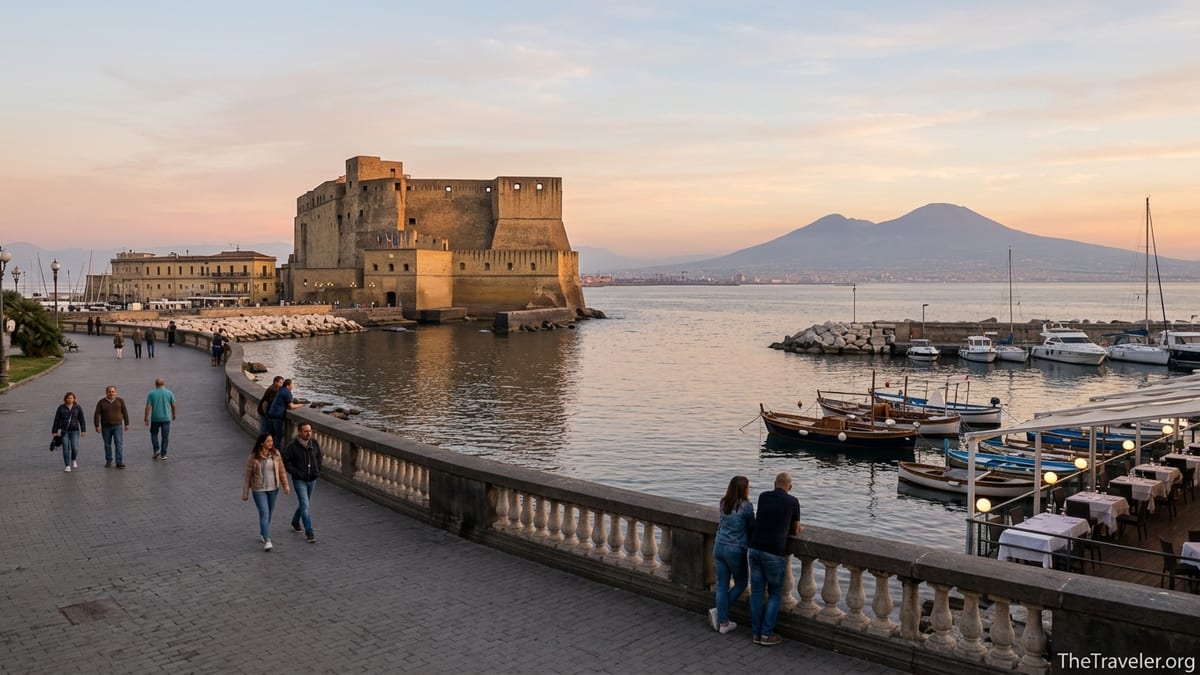
A Castle Woven From Legend and Deep History
Castel dell’Ovo is widely regarded as the oldest surviving castle in Naples, set where the Greeks first landed on the islet of Megaride long before the Roman era. The structure visitors see today is mainly of Norman and later medieval origin, but the site’s history reaches back to a Roman villa and even earlier Greek settlements. That layering is part of the castle’s enduring pull. Walk up from the causeway and you move through centuries, from rough stone ramparts to quiet interior courtyards that once formed part of a royal fortress defending the bay.
The name itself is a reason many travelers are curious to see the castle in person. According to medieval legend, the poet Virgil hid a magical egg in its foundations and prophesied that the fate of Naples would be tied to its safety. Guides and information panels on site usually mention this tale, and visitors with children often use the story as a way to bring the building to life. Even when some of the inner halls are closed for maintenance, the exterior walkways and bastions still make the myth feel tangible, especially in the soft evening light when the castle glows ocher against the sea.
Modern visitor information often highlights another detail that surprises travelers: entry to the castle itself is normally free of charge when open, an anomaly in a country where major historic monuments frequently cost 10 to 20 euros per person. While restoration work has periodically restricted indoor access in recent seasons, the city of Naples typically maintains free public entry, which helps explain why repeat visitors drop by even for a short stroll whenever they are in town.
Each year, more walking tours, food tours and independent travelers include Castel dell’Ovo in their itineraries precisely because it combines this backstory with ease of access. You can walk there in around 15 minutes from Piazza del Plebiscito along Via Partenope, without needing advance tickets or timed reservations. That simplicity encourages those who have already seen Naples’ big museums and archaeological sites to return to the castle area simply to soak up its atmosphere again.
Panoramic Views Over the Bay of Naples
For many travelers, the main reason to keep returning to Castel dell’Ovo is not what is inside, but what you see from its ramparts. Perched just off the seafront promenade, the castle offers sweeping views of the Bay of Naples, with Mount Vesuvius on the horizon and the curve of the waterfront stretching from Mergellina to the old town. On a clear day you can pick out the island of Capri and, further away, the Sorrento Peninsula, while fishing boats and ferries crisscross the water below.
When interior terraces are open, visitors can climb to the upper levels to gain some of the finest freely accessible viewpoints in the city. Even during temporary closures, the approach to the castle along the causeway and the low outer walls provide excellent vantage points. Photographers often time their visits to late afternoon or golden hour, when the sun drops behind the buildings of Chiaia and the bay reflects pink and orange tones. Couples on city breaks frequently stop here with takeaway gelato from nearby Via Partenope to watch the sky change color.
The views also help organize your sense of Naples’ geography. From the castle you can trace the route back towards Piazza Municipio and the cruise terminal, locate the high hilltop of Castel Sant’Elmo above the Vomero district, and see how the modern city has grown around the older core of Spaccanapoli. Many travelers say that on a first trip they visit for the view, and on subsequent trips they come back early in their stay to “recalibrate,” using the panorama as a mental map before plunging again into the narrow lanes of the historic center.
Practical considerations make these vistas especially appealing. There is no need to book a tour or wait in long lines; you simply walk out along the pedestrian seafront, perhaps with a coffee picked up from a bar near Piazza Trieste e Trento, and make your way to the castle. For budget-conscious travelers who might not want to pay for rooftop terraces or hotel bars to get a view, Castel dell’Ovo provides an almost cinematic perspective at no cost beyond the effort of the walk.
Borgo Marinari: Dining and Daily Life at the Water’s Edge
At the base of the castle lies Borgo Marinari, a small fishing quarter turned marina that has become one of the city’s most atmospheric dining and strolling areas. The narrow lanes between low pastel houses, the clusters of wooden boats tied up in the water and the occasional yacht moored beside small fishing vessels create a scene that feels a world away from the traffic of central Naples, even though it is only a short walk from Via Toledo. This contrast between lively waterfront and quiet harbor is one of the reasons travelers come back to this corner of the city again and again.
Restaurants line the edge of the marina, many with terraces facing directly onto the water and the castle walls. Typical menus feature spaghetti alle vongole made with clams from the bay, grilled local fish such as pezzogna or pezzogna-style sea bream, and simple fried seafood plates served with lemon. A two-course meal with wine in a mid-range restaurant here might cost roughly 35 to 50 euros per person, which visitors often judge as reasonable considering the location. Many repeat guests reserve specific tables for sunset, having discovered on a previous trip exactly where they prefer to sit facing Vesuvius or the castle.
Some long-time visitors to Naples return to Castel dell’Ovo as much for these familiar restaurants as for the monument itself. It is common to hear travelers mention a favorite spot in Borgo Marinari where they always eat on their first or last night in the city. Locals may point first-timers towards longstanding establishments around the marina that specialize in traditional, unfussy cooking, noting that even venues with prominent castle views still see regular Neapolitan clientele, which helps keep standards higher than in some tourist-heavy districts.
The village atmosphere extends beyond dining. During the day you might see small groups learning to sail through local yacht clubs, or technicians working on boat repairs along the docks. On summer evenings, young locals gather along the low walls to talk and listen to music, while families stroll with children in strollers. Because Borgo Marinari is surrounded by water and accessed only via the causeway, traffic is limited and the quarter feels more like an island neighborhood than part of a large city, another element that appeals to repeat visitors looking for a calm place to end a busy sightseeing day.
Sunsets, Strolls and the Lungomare Promenade
Castel dell’Ovo sits at a key curve in Naples’ waterfront promenade, so visiting the castle rarely stands alone as an activity. Most travelers fold it into a longer walk along the Lungomare, the broad seafront that runs from the area near the port through Via Partenope and on to Via Caracciolo. This is one of the city’s great urban strolls, and the castle forms both a focal point and a natural pause along the way. People come back to repeat the walk not because they have more information to gather, but because the experience itself is relaxing and memorable.
In the late afternoon and early evening, when the heat of the day has faded, the promenade fills with joggers, families, street musicians and couples out for passeggiata. Visitors often describe the moment when the castle lights switch on and its walls seem to float above the water as a highlight of their stay. You can easily combine a visit to the castle with a simple picnic on the low lava-stone rocks along the promenade, perhaps picking up a slice of pizza al taglio or a paper cone of fried seafood from a takeout spot near Piazza del Plebiscito.
Because the Lungomare is largely pedestrian in this area, it offers a safe and enjoyable environment for travelers of all ages. Families with younger children appreciate the space to run and use scooters, while older visitors enjoy the flat, accessible walkway with ample benches. This is one reason why multi-generational groups often return to the castle area: it is one of the few places in Naples where everyone from grandparents to toddlers can share the same easy coastal walk without worrying about traffic or steep staircases.
For repeat visitors who have already checked off the city’s more intense experiences, such as the underground tunnels or crowded historic streets, the Lungomare and Castel dell’Ovo together provide a gentler way of experiencing Naples. Many stay in hotels or guesthouses facing the bay precisely to be able to step out each evening for a short walk to the castle, watch the lights of the ferries and fishing boats, and feel the sea breeze that softens the city’s otherwise urban energy.
A Base for Exploring the Broader City and Bay
The location of Castel dell’Ovo makes it a practical anchor point for exploring Naples and the wider region, which partly explains why travelers keep gravitating back to this area. On one side lies the historic quarter around Piazza del Plebiscito, the Royal Palace and the San Carlo opera house; on the other, the elegant Chiaia district with its boutiques and cafes. Within a 20 to 25 minute walk from the castle you can reach major shopping streets, the funiculars up to Vomero and several key bus stops used by visitors heading to Mergellina or Posillipo.
Many travelers who return to Naples choose accommodation with at least a partial view of Castel dell’Ovo or the bay around it. Mid-range hotels and guesthouses along Via Partenope and Via Santa Lucia often advertise “castello views” or “sea-view rooms,” and guests frequently mention eating takeaway pizza or pastries on their balcony while watching the castle. This pattern of using the monument as a visual reference point in daily holiday life builds an emotional bond, making it natural for people to wander back even on trips when they do not formally tour the interior.
The castle’s position is also convenient for day trips. Ferries to Capri, Ischia and Procida generally leave from the Molo Beverello and Calata Porta di Massa terminals, which you can reach on foot from Castel dell’Ovo in roughly 20 to 30 minutes, depending on pace. Some travelers mention a routine of walking from their seafront hotel near the castle to the ferry in the cool early morning, spending the day on an island, and then returning in the evening to dine at Borgo Marinari. Over multiple stays in Naples, this pattern can turn the castle area into a kind of home base between explorations.
Even when parts of the fortress are temporarily closed for restoration, local tours and guides often still include a stop at the causeway or the viewpoint next to the castle as part of broader city itineraries. For example, a morning walking tour might start at Piazza del Gesù, continue through the historic center, and finish at the seafront with views of Castel dell’Ovo before guests break for lunch. Travelers who have enjoyed such tours on a first visit frequently return under their own steam on later trips to revisit familiar vantage points and perhaps explore nearby neighborhoods more independently.
Photography, Weddings and the Romance of Place
Castel dell’Ovo and its surroundings have become one of Naples’ most photographed locations, both by visitors and locals. The perspective from the mainland looking out along the causeway, with the castle rising from the water and Vesuvius in the background, appears regularly in travel magazines and social media posts. This visual familiarity brings many repeat visitors back to try capturing their own version of the shot under different conditions: foggy winter mornings, bright spring days, stormy skies or summer sunsets.
The causeway leading out to the castle is also a favorite backdrop for wedding and engagement photos. On weekends, it is common to see newlyweds posing with their photographer while cars briefly stop to let the wedding party step out. Travelers often mention this in trip reports as a charming surprise: you come to see a medieval fortress and instead find yourself watching Neapolitan couples celebrating one of the most important days of their lives. For many visitors, these glimpses of local life unfolding around the monument are as memorable as the architecture itself.
Couples on romantic getaways or honeymoons often choose Borgo Marinari or the Lungomare near the castle for special dinners. Several waterfront restaurants offer candlelit tables with direct views of the illuminated walls and the bay, making them popular for anniversary celebrations. Some travelers return to Castel dell’Ovo years after a first trip specifically to recreate a favorite evening: perhaps an aperitivo of local sparkling wine followed by seafood risotto, with a stroll around the marina afterwards.
Even solo travelers and budget-conscious visitors find the area around Castel dell’Ovo conducive to slow, reflective moments. Sitting on the low stone walls of the causeway with a takeaway espresso or a simple pastry from a nearby bakery costs only a few euros, yet offers a front-row seat to the interplay of light, sea and city. That combination of romance, spectacle and accessibility is rare in a major European port, and it encourages people who have experienced it once to build it into their future itineraries almost automatically.
The Takeaway
Castel dell’Ovo endures in travelers’ memories not only because it is the oldest castle in Naples or because of its legendary magical egg, but because of the complete experience it anchors on the city’s waterfront. History, daily life, food, sea and skyline all intersect on the tiny islet of Megaride, making this one of those rare places where you can feel the essence of a destination in a single, walkable area. Visitors return to watch the same sunset from the ramparts, to dine again in a favorite harbor-side trattoria, or simply to retrace the familiar walk along the Lungomare with the castle as a constant companion.
As Naples continues to evolve and welcome more international tourism, Castel dell’Ovo remains both a symbol and a refuge. Whether the inner halls are fully accessible or partially closed for restoration in a given season, the approach, the views and the life of Borgo Marinari at its base ensure that the area never loses its appeal. For many travelers, no stay in Naples feels complete without at least one visit back to this waterfront stronghold, confirming its place as a site worth seeing not just once, but whenever you find yourself on the shores of the Bay of Naples.
FAQ
Q1. Is Castel dell’Ovo currently open to visitors?
Opening status can change due to restoration work, so it is best to check the latest information from local tourism offices in Naples shortly before you travel. Even when inner rooms are closed, the causeway, exterior views and Borgo Marinari remain accessible.
Q2. Do I need a ticket to visit Castel dell’Ovo?
Entry to Castel dell’Ovo itself is typically free of charge when the interior is open. There is no need to purchase tickets in advance, although guided tours that include the castle area may charge their own fees.
Q3. How much time should I plan for a visit?
If the interior and terraces are open, many visitors spend about one to one and a half hours exploring the castle and enjoying the views. If you add a walk along the Lungomare or a meal in Borgo Marinari, it is easy to spend half a day in the area.
Q4. What is the easiest way to reach Castel dell’Ovo?
Most travelers walk from the city center, following signs from Piazza del Plebiscito or Via Toledo towards the seafront and Via Partenope. From there, a pedestrian causeway leads directly to the castle and Borgo Marinari.
Q5. Are there restaurants or cafes near the castle?
Yes, Borgo Marinari at the base of the castle is lined with seafood restaurants, trattorias and bars, many with outdoor seating facing the water. Additional cafes, gelaterias and pizzerias are scattered along Via Partenope and the nearby streets.
Q6. Is the area around Castel dell’Ovo safe at night?
The Lungomare and Borgo Marinari are generally lively and well-frequented in the evening, especially in warmer months. As in any city, visitors should stay aware of their belongings, but many travelers feel comfortable walking here after dark for dinner or a stroll.
Q7. Can I visit Castel dell’Ovo with children or people with limited mobility?
The causeway and parts of the lower levels are relatively flat, making them accessible for strollers and those with limited mobility. Upper terraces and some interior sections involve steps and uneven surfaces, so accessibility varies depending on which areas are open.
Q8. What is the best time of day to visit for views and photos?
Late afternoon and sunset are particularly popular, as the castle and bay are bathed in warm light and the city skyline begins to glow. Early morning visits, before the waterfront becomes busy, also offer beautiful, softer light for photography.
Q9. Are there guided tours that include Castel dell’Ovo?
Several local guides and tour companies offer walking tours that pass by or include time at Castel dell’Ovo and the Lungomare. These are often combined with visits to nearby sights such as Piazza del Plebiscito, the Royal Palace or the historic center.
Q10. Is Castel dell’Ovo worth visiting if I have limited time in Naples?
Yes, many travelers consider it a high-priority stop, especially because it combines iconic bay views, a sense of history, and a pleasant seafront walk. Even a brief visit to the causeway and Borgo Marinari can provide a memorable impression of Naples and its relationship with the sea.