


If you are loyal to either Cathay Pacific or Singapore Airlines, choosing the right co-branded credit card can make a noticeable difference to how quickly you earn flights, upgrades and lounge access. But the decision is rarely simple. Asia Miles and KrisFlyer miles are earned and burned in different ways, the cards are issued in different markets, and the best option for a Hong Kong-based consultant will not be the same as for a Singaporean family or a U.S. business traveler. This guide walks through how Cathay Pacific and KrisFlyer credit cards actually work in 2026, what kind of traveler each one suits, and how they compare when you look past the marketing slogans and into real itineraries and spend patterns.
Get the latest updates straight to your inbox!
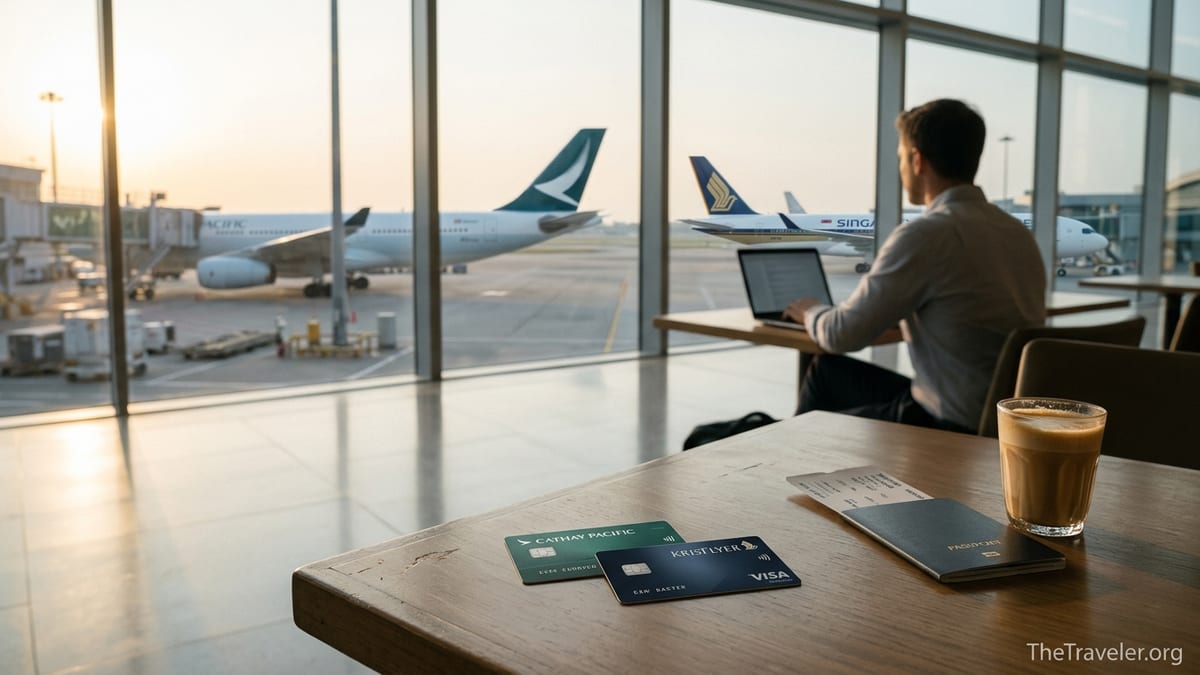
What We Mean by “Cathay Pacific Card” and “KrisFlyer Card”
Before comparing, it is important to clarify what is on the table. Neither Cathay Pacific nor Singapore Airlines has a single global credit card. Instead, each works with banks in specific countries to issue co-branded plastic. When travelers talk casually about a “Cathay Pacific card,” they may mean the Cathay Pacific Visa cards issued by Synchrony Bank in the United States, a Standard Chartered Cathay card in Hong Kong, or newer products in markets such as Canada. Similarly, “KrisFlyer card” might refer to the KrisFlyer UOB Credit Card in Singapore, the higher-end KrisFlyer UOB World Elite in Thailand, or the KrisFlyer SBI Card launched in India.
Because of this, a perfect one-to-one technical comparison is impossible. Instead, this article focuses on how the typical Cathay Pacific co-branded cards and mainstream KrisFlyer cards work in their core markets, and what that means in practice. For Cathay, that usually means earning Asia Miles directly when you spend, boosted by Cathay-linked promotions and Card Linked Earn arrangements. For Singapore Airlines, it often means KrisFlyer miles posting straight into your KrisFlyer account when you swipe in Singapore, or earning bank points that convert to KrisFlyer miles in markets such as the United States where true co-branded cards are limited.
For a concrete frame of reference, imagine three travelers. First, a Hong Kong-based consultant flying Cathay Pacific or other oneworld carriers monthly between Hong Kong, London and Sydney. Second, a Singapore family taking two Singapore Airlines holidays a year to Tokyo and Europe. Third, a U.S.-based tech worker flying to Asia once a year and mixing airlines. The “better” card for each of these people will be very different, even though the airline names on the plastic look prestigious in every case.
Earning Miles: How Everyday Spending Stacks Up
The first major question is how many miles you earn for every unit of currency you spend. Cathay-linked cards typically award Asia Miles directly, with elevated earn rates on Cathay purchases and a lower rate on general everyday spending. For example, a Cathay co-branded Mastercard in one Asia market may offer up to 4 Asia Miles per local dollar on Cathay tickets when booked through the airline website, and around 1 or 1.5 Asia Miles per dollar on day-to-day expenses like supermarkets and online shopping. Some cards go further and award Status Points on top of miles for eligible spending with Cathay, allowing cardholders to climb the Cathay elite tiers more quickly than by flying alone.
In Singapore, the KrisFlyer UOB Credit Card illustrates how co-branded KrisFlyer cards earn. It typically offers a base earn rate on general spend, with elevated earn when you hit certain thresholds of annual Singapore Airlines Group spending, including flights on Singapore Airlines and Scoot, and eligible purchases with KrisShop and related brands. For instance, after you meet a set amount of Singapore Airlines Group spend each card year, your dining, online shopping, online travel and public transport transactions can earn a significantly higher effective miles per dollar rate, though the calculation is layered and miles are credited on a delay.
In practice, this means that a Singaporean who charges S$1,500 a month mostly on dining, groceries and online shopping, and books a couple of family trips on Singapore Airlines every year, can see a strong effective earn rate from a KrisFlyer UOB card once the airline spend requirement is met. By contrast, a Cathay Pacific co-branded card tends to be more straightforward: a fixed earn rate per dollar in different categories, with bonus miles on Cathay tickets themselves. For many travelers, especially those who do not want to track complex spend triggers, the simplicity of the Cathay structure is appealing.
Outside the home markets, the picture changes. In the United States, for example, the Cathay Pacific Visa card earns Asia Miles directly, but analysts note that its earn rates and benefits are relatively modest compared with general travel cards whose points convert to Asia Miles. U.S.-based KrisFlyer fans rarely have a compelling co-branded Singapore Airlines card; instead, they use bank programs such as American Express, Citi or Capital One to earn flexible points and then transfer them to KrisFlyer when they are ready to book. For a U.S. traveler trying to choose between “getting into Cathay” or “getting into KrisFlyer,” the bank-transfer route often matters more than the airline branding on the plastic.
Sign-Up Bonuses and First-Year Value
New card bonuses are often the fastest way to build a usable stash of airline miles. Both Cathay and KrisFlyer co-branded cards periodically advertise welcome offers, tied to a minimum spend within the first few months of card membership. In many cases, though, the headline numbers can be misleading if you do not look closely at the conditions and the timeline for miles to post.
A KrisFlyer UOB promotion in Singapore, for example, might require S$6,000 of eligible spend within the first 90 days to unlock a chunk of bonus miles on top of what you earn from the spending itself. Those bonus miles are credited directly to the linked KrisFlyer account on a schedule set out in the terms, often several months after the spend period closes. Practically, this means you might hit the spend requirement with a summer family trip to Osaka and everyday expenses, but the bonus miles may not show up until later in the year, long after you have returned from the holiday you paid for.
Cathay Pacific co-branded cards in Asia and North America tend to have simpler bonus structures, such as a flat number of bonus Asia Miles after a modest minimum spend in the first few months, occasionally combined with a one-time companion fare discount code or limited lounge pass. For example, a Cathay card might offer a bonus Asia Miles amount when you spend the equivalent of a few thousand local currency units on Cathay tickets or other purchases soon after approval. These offers change frequently and vary by country, so the key is not the exact figure but the pattern: Cathay bonuses are often easier to unlock but may be smaller in absolute terms than the richest KrisFlyer promotions.
For a real-world example, imagine you are a new-to-miles professional in Singapore planning a family trip to Paris. A KrisFlyer UOB welcome offer that rewards S$6,000 of spend within 90 days pairs nicely with air tickets plus initial hotel bookings, and the resulting bonus miles can cover a future regional trip to Bali or Hong Kong. If you instead live in Hong Kong and book a similar Europe trip with Cathay Pacific, a Cathay co-branded card’s welcome bonus combined with 4x miles on the ticket itself can push you close to a one-way upgrade to premium economy on a later long-haul flight, depending on the Asia Miles chart for your route.
Travel Perks Beyond Miles: Lounges, Upgrades and Protections
Miles are only part of the story. Many travelers sign up for airline cards expecting tangible travel perks during their journeys. On the Cathay side, co-branded cards often focus on boosting the underlying Cathay membership program. Some variants allow cardholders to earn Status Points from everyday spending that count toward elite tiers such as Silver or Gold, which come with benefits like priority check-in, extra baggage allowance and access to Cathay Pacific or oneworld partner lounges when flying on eligible tickets. Others may offer occasional lounge passes for Cathay lounges, or priority waitlisting on award tickets.
For frequent regional flyers, these perks add up. Consider a Hong Kong-based consultant who flies Cathay economy between Hong Kong and Singapore every month. With a Cathay card that earns Status Points on spend, combined with actual flight activity, he might reach Cathay Silver earlier than he would using flights alone. That means access to priority queues and select lounges on trips where he is booked in economy, without paying out of pocket for a separate lounge membership. For someone spending heavily on entertainment and client dinners in Hong Kong, routing those transactions through a Cathay co-branded card magnifies the effect.
KrisFlyer co-branded cards, especially in Singapore, tend to lean more heavily on airline-specific perks tied directly to Singapore Airlines. Common benefits include accelerated KrisFlyer Elite status qualification when you meet certain spend targets on Singapore Airlines Group, bonus miles on Scoot, and occasional fast-track offers to move up to higher KrisFlyer Elite tiers. Access to Singapore Airlines’ SilverKris lounges, however, typically depends on your end status level or your cabin class on the day of travel; simply carrying a KrisFlyer credit card does not automatically open the lounge doors in most cases.
Both Cathay and KrisFlyer cards are often bundled with standard credit card travel insurance, covering things such as trip delay, baggage delay and rental vehicle damage when flights or rentals are charged to the card. The details vary widely by issuing bank, so a traveler deciding which ecosystem is “better” should not overlook these non-mileage protections. For example, a Cathay co-branded Visa in the United States might pair airline-focused benefits with Visa Signature travel protections, while a KrisFlyer UOB card in Singapore comes with the bank’s own insurance framework and purchase protection policies.
Redeeming Miles: Value and Availability on Real Routes
Earning miles is meaningful only if you can get value when you redeem them. Cathay’s Asia Miles program and Singapore Airlines’ KrisFlyer program take different approaches to award pricing, partners and availability, and those differences influence which card ecosystem is more attractive. Asia Miles can be redeemed on Cathay flights and oneworld partners such as British Airways, American Airlines and Qantas, covering a broad network through Hong Kong. KrisFlyer miles are most valuable for flights on Singapore Airlines and its low-cost arm Scoot, as well as Star Alliance partners such as Lufthansa, ANA and United.
For a traveler based in Hong Kong, Asia Miles often shine on routes to Europe and North America that connect through Cathay’s hub. A round-trip business class award from Hong Kong to London, for example, will cost a sizable but manageable number of Asia Miles if you book in advance, and you may find multiple daily flight options, including daytime departures and overnight returns. On the KrisFlyer side, a similar business class trip from Singapore to London or Frankfurt may require a comparable volume of KrisFlyer miles, but Singapore Airlines usually reserves the very best suites and first class cabins for its own KrisFlyer members, which can tilt value in favor of KrisFlyer if you are chasing aspirational redemptions.
U.S.-based travelers see another pattern. Asia Miles can be used on American Airlines and Alaska Airlines flights within North America, or for transpacific flights on Cathay itself. KrisFlyer miles can be redeemed for United flights around the United States, or on Singapore Airlines’ services from cities such as New York and Los Angeles to Singapore. In practice, award availability on partner airlines is often limited at peak times. A U.S. cardholder who has earned heavily on a Cathay co-branded card may find that getting a premium cabin seat from San Francisco to Hong Kong during the Christmas holidays is difficult, regardless of miles balance. The same is true for KrisFlyer members outbound from Singapore during Lunar New Year.
One subtle advantage on the KrisFlyer side is that Singapore Airlines tends to make more of its long-haul premium cabin award seats available to KrisFlyer members than to external partners. That means if you are earning KrisFlyer miles via a KrisFlyer co-branded card, you are more likely to get access to the airline’s signature Suites and long-haul business class products using miles. Cathay also offers premium redemptions, but high demand from Asia Miles members around Hong Kong can make seats scarce on popular dates, especially after several years of pent-up travel demand.
Where You Live Matters More Than Many Realize
Perhaps the most overlooked factor in the Cathay versus KrisFlyer card debate is geography. Card availability, fees, bonus structures and even basic earn rates are all country-specific. A Cathay Pacific co-branded card that looks weak in the United States may be highly competitive in Hong Kong, where it plugs into Card Linked Earn to award Asia Miles automatically when you spend at partner restaurants, hotels and retailers without scanning any QR codes. Similar card-linked systems are rolling out in other Cathay markets, making it easier to accumulate miles from daily life rather than only from air tickets.
In Singapore, KrisFlyer credit cards slot into an ecosystem where Singapore Airlines is the default long-haul carrier and KrisFlyer is integrated into shopping at Changi Airport, KrisShop’s online store and frequent Scoot promotions. A Singapore resident with a KrisFlyer UOB card can use the card to pay for public transport, groceries in local supermarkets and school fees, all while progressing towards enhanced miles on dining and online purchases after hitting the annual Singapore Airlines Group spend threshold. The result is a very tight link between domestic financial life and future Singapore Airlines travel.
In India, the relatively new KrisFlyer SBI Card shows how Singapore Airlines is extending this approach. It offers local cardholders expanded ways to earn KrisFlyer miles from rupee-denominated spending, reflecting the importance of India as an origin market for traffic to Singapore and beyond. Cathay, by contrast, has been more selective about local co-branded cards outside of its home base, relying increasingly on partnerships with global banks and card-linked programs to funnel points into Asia Miles. This means that in some countries, it is easier to earn KrisFlyer miles from a true co-branded card, while in others you are better off earning general bank points and transferring them.
For the average traveler, the implication is straightforward: do not compare Cathay and KrisFlyer cards in the abstract. Instead, compare the specific Cathay and KrisFlyer-branded cards that are actually offered in your country, in the currency you earn and spend every month. A Singapore resident choosing between a KrisFlyer UOB card and a global bank’s Cathay-earning card is facing a different decision than a Canadian looking at a Cathay World Elite Mastercard versus a local Visa that transfers to KrisFlyer.
Fees, FX Charges and When a General Travel Card Wins
Annual fees and foreign transaction charges can quietly erode the value of miles you earn. Cathay co-branded cards usually charge a moderate to high annual fee, justified by the promise of Asia Miles and travel perks. In some markets, supplementary cards for family members are free, which can help families concentrate spending on one household account. KrisFlyer cards typically follow a similar pattern in Singapore and other launch markets, with annual fees that may be waived in the first year or upon meeting a spend threshold.
Foreign transaction fees are particularly important for travelers who spend heavily abroad. A Cathay card that charges a few percent on overseas transactions, even while awarding bonus Asia Miles on foreign spend, may be less attractive than a no-foreign-transaction-fee general travel card that earns transferable bank points. For example, a U.S. traveler booking hotels in Tokyo, rideshares in Bangkok and restaurants in Paris throughout the year might save more on FX fees and earn more flexible points with a bank travel card than with a Cathay-branded card, even if the latter earns Asia Miles directly.
Similarly, a Singaporean who frequently spends in Japanese yen or U.S. dollars via an overseas online merchant will want to look closely at the KrisFlyer UOB card’s overseas FX markup compared with alternatives such as UOB’s own non-co-branded miles cards or products from other local banks. If a general bank miles card earns a similar or higher miles-per-dollar rate on overseas transactions without requiring any Singapore Airlines Group spend to unlock higher tiers, it could be a better fit despite the emotional appeal of having the airline logo on the plastic.
In both ecosystems, there is a real argument that for many internationally active travelers, the “better” card is not a Cathay or KrisFlyer co-brand at all, but a high-earning, low-fee general travel card whose points can be transferred either to Asia Miles or to KrisFlyer as needed. That approach gives you flexibility to wait and see which program has better award availability for your actual trip dates before you commit your points.
The Takeaway
When travelers ask which is better, the Cathay Pacific credit card or a KrisFlyer credit card, they are really asking two separate questions: which airline ecosystem better matches my routes and cabin preferences, and which specific card in my country delivers the best combination of earn rates, perks and fees. There is no single winner. For a Hong Kong-based traveler who flies Cathay regularly and spends strongly in local currency, a Cathay co-branded card that earns Asia Miles and Status Points, plugs into Card Linked Earn and occasionally offers transfer bonuses can be extremely powerful.
For a Singapore-based traveler whose family holidays almost always begin on a Singapore Airlines or Scoot flight, the KrisFlyer UOB Credit Card or similar local KrisFlyer cards can deliver better value, especially once you meet the annual Singapore Airlines Group spend threshold that unlocks higher miles earning on everyday categories like dining, online shopping and public transport. In India, Thailand and other growing markets, newly launched KrisFlyer cards may outshine Cathay-linked options simply because they are designed to integrate with Singapore Airlines’ heavy presence and marketing there.
For U.S. and Canadian residents, the reality is different again. Analysts often note that the Cathay Pacific Visa and newer Cathay-branded cards are decent but not exceptional compared with flexible bank cards. Singapore Airlines does not have a widely recommended, strong-value KrisFlyer co-brand in North America, so the practical choice is often between earning Asia Miles via a Cathay card or earning generic bank points and then later deciding whether to move them to KrisFlyer or Asia Miles based on redemption plans. In this context, the bank card can easily be “better” than either airline card.
Ultimately, the right move is to map your real travel over the next two to three years, look at which airline you are more likely to fly long-haul in premium cabins, and then examine the specific Cathay and KrisFlyer cards issued in your country. Run the numbers on your expected annual spend, including how much will realistically go to Cathay or Singapore Airlines themselves. Only then can you decide whether a Cathay Pacific co-branded card or a KrisFlyer card is the true winner for you, or whether you are better off sitting in the middle with a flexible points card that keeps both options open.
FAQ
Q1. Is a Cathay Pacific credit card or a KrisFlyer credit card better for long-haul business class travel?
For long-haul business class, the better option is usually whichever airline you fly most and can reliably find award seats on. If you are based in Hong Kong or regularly connect through Hong Kong, a Cathay card that earns Asia Miles may be more useful. If your long-haul routes start in Singapore or nearby, a KrisFlyer card that feeds directly into KrisFlyer will generally deliver better access to Singapore Airlines’ long-haul business class cabins.
Q2. Which card is better if I live in the United States?
For U.S.-based travelers, neither Cathay nor KrisFlyer co-branded cards are clear standouts. The Cathay Pacific Visa exists but is often outperformed by general travel cards whose points transfer to Asia Miles or KrisFlyer. Most U.S. KrisFlyer fans use American Express, Citi or other bank cards and move points into KrisFlyer only when they are ready to book.
Q3. Do Cathay Pacific credit cards help me earn elite status faster?
Some Cathay co-branded cards in Asia award Status Points in addition to Asia Miles on eligible spending, which can accelerate progress toward Cathay Silver, Gold or higher. In practice, heavy spenders who use their Cathay card for both flights and daily expenses often reach status tiers earlier than flyers who rely on flights alone.
Q4. Do KrisFlyer credit cards give automatic lounge access?
Generally, no. Most KrisFlyer credit cards do not guarantee automatic access to Singapore Airlines’ SilverKris lounges. Lounge entry is usually tied to your KrisFlyer status level or your ticketed cabin class. Some cards may offer limited lounge passes or partner lounge access, but this is not universal and depends on the specific bank and card.
Q5. Which program is better for families who travel economy a few times a year?
For families flying mostly in economy, the better option is whichever airline operates most of your trips. A Singapore family that flies Singapore Airlines or Scoot twice a year will typically find a KrisFlyer card more useful for earning and redeeming miles on those routes. A Hong Kong or Pearl River Delta family traveling mainly on Cathay will get more value from a Cathay card feeding Asia Miles.
Q6. How do annual fees compare between Cathay and KrisFlyer cards?
Annual fees depend on the specific card and country. Many Cathay and KrisFlyer co-branded cards charge midrange annual fees, sometimes waived in the first year or waived with sufficient spend. It is important to compare the fee with your expected annual miles value and any travel perks such as insurance or airport lounge passes.
Q7. Are general bank travel cards sometimes better than either airline card?
Yes. For many international travelers, a high-earning bank travel card with no foreign transaction fees and flexible points can beat both airline cards. You can then transfer points to Asia Miles or KrisFlyer later, once you know which airline has award space for your intended trip.
Q8. Which card is better if I want to redeem for premium cabins like suites or first class?
If your goal is Singapore Airlines Suites or long-haul first class, a KrisFlyer card is generally more attractive because Singapore Airlines releases most of these seats to its own KrisFlyer members. If your aspiration is Cathay Pacific’s long-haul business class or first class products, then a Cathay co-branded card that feeds Asia Miles directly will better support that goal.
Q9. How important are sign-up bonuses when choosing between these cards?
Sign-up bonuses can give you a valuable initial boost and help you experience an award flight sooner, but they are temporary. Over the long term, your regular earn rate, annual fees, and the quality of each airline’s award availability matter more than a one-time bonus.
Q10. If I often fly both Cathay and Singapore Airlines, should I carry both cards?
If you regularly fly both airlines and are comfortable managing multiple loyalty programs, carrying one Cathay and one KrisFlyer card can make sense, especially if you live in Asia and can meet the spend thresholds that unlock higher earn rates. However, some travelers in that situation prefer a single strong bank travel card and keep their options open by transferring points to whichever program looks better at the time of booking.