


Childcare in Italy combines relatively generous public support with large regional and provider-to-provider cost differences. For relocating families, understanding how much childcare will cost from infancy through primary school, and how prices vary between public and private options, is central to assessing the financial feasibility of a move. This briefing outlines typical cost ranges and structural features of Italian childcare that expats should consider when planning relocation.
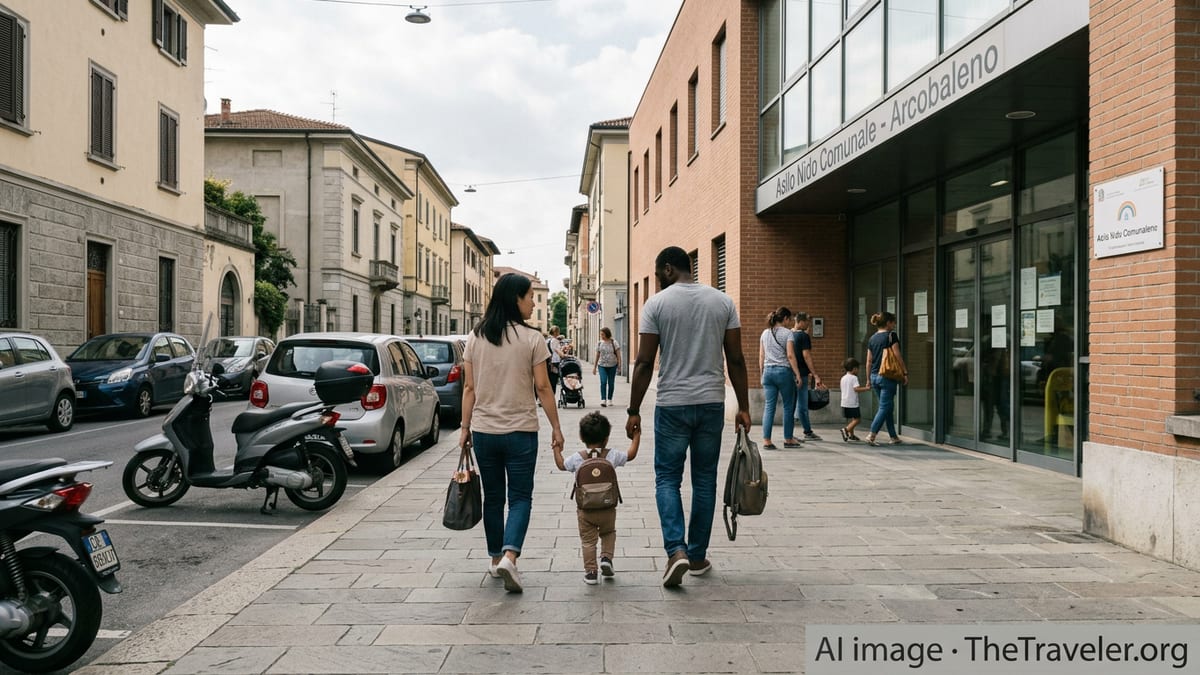
Overview of the Italian Childcare Landscape and Cost Drivers
Italian childcare is split into three broad stages with distinct cost profiles: nurseries for children aged 0 to 3 years (asilo nido), preschool for ages 3 to 6 (scuola dell’infanzia), and school-age services linked to primary school such as canteen, after-school supervision, and summer programs. Nurseries and most early years services are run both by municipalities and private providers, while preschool and primary school are largely public but with paid ancillary services such as meals and extended hours.
For expat families, the most expensive phase is usually the 0 to 3 age bracket, where full-time nursery attendance can represent a significant monthly outlay. From the age of 3, core education in public settings is typically free, and costs are concentrated in meals, extended-day options and occasional private services such as babysitters, nannies or holiday programs.
Across all stages, four key factors drive what a family actually pays: the type of service (public versus private), the child’s age and schedule (part-time versus full-time), the municipality and region, and the household’s declared income, which is used to calculate sliding-scale fees in public services. This means two families with similar needs but different incomes or living in different cities may face substantially different childcare bills.
Italy has expanded childcare subsidies in recent years, and OECD analysis indicates that net childcare costs for a typical two-income or single-earner family are relatively low compared with many other European countries, as public funding often covers a majority of the underlying service cost and parents pay the remainder. However, access to subsidised places is not guaranteed everywhere, and private market pricing can be considerably higher than public tariffs.
Nursery (Asilo Nido) Costs for Children Aged 0–3
Nursery care is where childcare spending is heaviest and where cost differences are most visible. Estimates from sector analyses and municipal tariff tables suggest that average monthly fees for a full-time public nursery place tend to cluster around 300 to 350 euro per child, with substantial variation depending on region and income brackets. In some municipalities, the lowest-income band for residents may pay under 100 euro per month, while the highest band for non-residents or high earners can reach or exceed 400 to 450 euro monthly for full-time care. ([ilmiobusinessplan.com](https://ilmiobusinessplan.com/blogs/news/mercato-infanzia?utm_source=openai))
Private nurseries are typically more expensive. Market reviews indicate common ranges from approximately 350 to 800 euro per month for a full-time place, with premium bilingual or international nurseries in major cities sometimes quoted above 900 euro. Costs tend to rise with longer hours, smaller class sizes, extended-year calendars and additional services such as early drop-off, late pick-up, or specialised educational programs. In some large northern cities, expat families report full-day private nursery fees close to or slightly above 1,000 euro per month at high-end international providers. ([ilmiobusinessplan.com](https://ilmiobusinessplan.com/blogs/news/mercato-infanzia?utm_source=openai))
Many nurseries offer part-time options, which reduce monthly fees by roughly 10 to 30 percent compared with full-time, depending on the provider. For example, tariff schedules from municipal or contracted nurseries often show a standard full-time monthly fee and then a discounted rate for morning-only attendance. Some municipalities structure charges partly on daily meal costs and partly on hours used, allowing families to tailor their schedule to manage expenses. ([proges.it](https://proges.it/wp-content/uploads/2024/07/LA-CARTA-DEI-SERVIZI-ASILO-NIDO-2023-2024.pdf?utm_source=openai))
Parents should factor in that public nursery places are limited in many areas, and waiting lists are common. When a public place is not available, families may need to rely on private nurseries or informal care, which can significantly increase the monthly childcare budget compared with an income-based public tariff. This access issue is especially relevant in regions where nursery coverage is below the national average.
Preschool (Scuola dell’Infanzia) and School Canteen Fees
From age 3 until roughly age 6, most children attend scuola dell’infanzia, which is formally part of the national education system. Public preschool itself is generally free at the point of use, but associated services such as meals and sometimes transport are charged. Local data from national reports indicate that a family using public preschool pays on average around 80 to 90 euro per month for preschool-related costs, largely attributable to school meals, although this average masks wide inter-municipal variation. ([cnos-fap.it](https://www.cnos-fap.it/sites/default/files/rapporti/informazioni_sul_sistema_educativo_n._20_del_19_maggio_2025.pdf?utm_source=openai))
School canteen fees are one of the most important recurring expenses for families once children are in preschool or primary school. Surveys of municipal tariffs and advocacy reports show that a single meal can cost anywhere from about 2.50 euro in lower income bands to over 6.50 euro in more expensive cities and higher brackets. On an annual basis, families in high-tariff cities paying around 6 to 6.60 euro per meal can face canteen bills near or above 1,100 euro per year for one child attending full-time. Conversely, families in lower-cost municipalities or with lower assessed income may pay only a fraction of this, and some municipalities offer total or partial exemptions for low-income households or for third and subsequent children. ([lanazione.it](https://www.lanazione.it/sarzana/cronaca/mense-di-asili-primarie-e-83052eb2?utm_source=openai))
Table 1 outlines indicative canteen cost ranges for public preschool and primary school, based on recent surveys and municipal tariff schedules:
Table 1. Indicative public school canteen cost ranges
Approximate cost per meal: 2.50 to 6.60 euro, depending on municipality and income band.
Approximate monthly cost (20 meals): 50 to 130 euro per child.
Approximate annual cost (9 school months): 450 to 1,170 euro per child.
Expats planning relocation should examine the specific tariff structure of their target municipality, since meal costs can represent a meaningful share of the childcare and education budget, especially when several children are enrolled. It is also important to verify whether non-residents, new arrivals or families without a local income declaration fall by default into higher fee bands until documentation is updated.
Babysitters, Nannies and Home-Based Childcare
Italy has a formal national contract for domestic workers that covers babysitters, nannies and home-based carers. Under this framework, minimum hourly wages for non-resident childcare workers have recently hovered around 7 to 8 euro gross per hour for basic roles, with actual market rates commonly higher, especially in major cities. Media reports on scheduled contract updates suggest minimum hourly pay for babysitters of about 7.10 to 7.50 euro, with expected increases over the next few years. Families frequently pay 9 to 12 euro per hour or more to attract experienced carers, particularly when childcare involves multiple children, non-standard hours, or additional household tasks. ([panorama.it](https://www.panorama.it/attualita/economia/colf-badanti-e-babysitter-dal-2026-aumenti-fino-a-83-euro-al-mese-per-le-famiglie?utm_source=openai))
Online matching platforms that connect families with babysitters sometimes present example hourly rates in the range of 8 to 15 euro per hour depending on experience, city and schedule. At the high end, specialist nanny agencies or English-speaking nannies in international hubs such as Milan and Rome may command substantially higher hourly or monthly rates. For occasional ad hoc babysitting, expat families report day rates of around 60 to 80 euro for full-day care, or daily lump sums of approximately 70 euro for 8 hours of one-on-one care. ([lecicogne.net](https://www.lecicogne.net/en/pricing/?utm_source=openai))
Live-in nannies or combined nanny-housekeeper roles are compensated differently, typically with a monthly gross salary aligned to the national domestic work contract, including board and lodging. Sector analyses for domestic workers suggest that live-in carers employed for more than 50 hours per week can cost families well over 1,000 euro per month in total employer cost once wages, bonuses and contributions are accounted for, with forecasted rises linked to inflation adjustments. ([famkare.it](https://www.famkare.it/blog/costi-badante/stipendio-colf-e-badanti-2025-i-nuovi-importi-dopo-gli-aumenti/?utm_source=openai))
Families should also consider ancillary employer costs such as social security contributions, severance pay accruals and paid holidays when budgeting for regular babysitting or nanny arrangements. Working through a reputable payroll service or consulting a local adviser can help expats estimate full employer costs rather than just net wages paid to the childcare worker.
After-School, Holiday and Summer Childcare Costs
Once children enter primary school, core teaching hours are public and free, but many families require coverage beyond standard school hours and during school holidays. After-school programs (doposcuola) may be organised by schools, municipalities or private associations, and pricing structures vary accordingly. Publicly supported after-school services often charge modest monthly or hourly fees, while private academic support or activity-based programs may charge significantly more.
Indicative ranges for after-school care in larger Italian cities commonly fall between 80 and 200 euro per month per child for a few afternoons per week, with higher prices when services include homework support, language classes or sports activities. Some municipalities coordinate subsidised “tempo pieno” or full-time schedules that extend the school day to roughly 40 hours per week, combining teaching, supervised study and recreation. In these cases, the main incremental cost for families is generally meals and minor contributions, rather than standalone after-school program fees. ([it.wikipedia.org](https://it.wikipedia.org/wiki/Scuola_primaria_in_Italia?utm_source=openai))
Holiday and summer childcare can become one of the largest line items for families without home support. Summer camps (centri estivi) organised by municipalities may be relatively affordable, with weekly fees that are often income-based. Private camps and activity centers can charge higher weekly prices, especially if they offer specialised activities or English-language programs. While systematic nationwide data are limited, anecdotal reports suggest weekly costs that can range from under 100 euro in subsidised settings to several hundred euro per week at private or international camps in major urban areas.
For expats, securing holiday childcare may require advance planning, as spaces in municipal or popular private camps can fill quickly and enrolment procedures can be unfamiliar. Costs can also accumulate quickly over the long Italian summer break, which typically extends from mid-June to early or mid-September, and families often combine camps, time off work, visits from relatives and ad hoc babysitting to cover the period.
Regional Variations and Public Subsidies
Childcare costs in Italy are highly sensitive to regional and municipal conditions. Northern and central regions, as well as metropolitan areas, tend to offer more nursery places and a wider range of services, but also often have higher tariffs in private markets and sometimes in public canteens. Southern regions may have lower listed prices but also fewer public places and less extensive service coverage overall. National statistics indicate that nursery coverage for children under 3 remains uneven, with some areas well above and others well below national targets, which in practice affects both access and what families end up paying. ([ilmiobusinessplan.com](https://ilmiobusinessplan.com/blogs/news/mercato-infanzia?utm_source=openai))
OECD and national analyses indicate that, on average, Italian public budgets cover a substantial share of childcare service costs, with parents paying roughly one fifth and the remainder financed through public funds. This high degree of subsidisation helps explain why net childcare costs for typical households, after accounting for benefits and tax relief, are relatively modest compared with many European peers. Some calculations show net childcare costs approaching zero for certain family types at specific income levels, particularly when subsidies and fee reductions are fully utilised. ([euronews.com](https://www.euronews.com/business/2025/08/24/nursery-and-creche-how-much-do-families-spend-on-childcare-across-europe?utm_source=openai))
However, eligibility rules and the effectiveness of subsidies depend on a family’s legal and fiscal position. Many municipal discounts for nursery and canteen fees are linked to a means-testing system based on an official income indicator. New arrivals without a recent local income declaration may temporarily be assigned to higher fee categories, which can raise short-term childcare costs until documentation is regularised. Furthermore, some subsidies and national-level nursery contribution schemes are accessible only to families that meet specific employment or residency requirements.
Private providers may participate in voucher schemes or accept public contributions, which can lower out-of-pocket costs, but this is not universal. Expats should therefore treat any national average figures with caution and focus on the concrete tariff schedules, eligibility rules and subsidy mechanisms in the city or region where they plan to live.
Budgeting Considerations for Expat Families
For relocation planning, expat families should model different childcare scenarios by age group and by access to public versus private services. A typical cost profile could involve higher expenses during the 0 to 3 period, potentially several hundred euro per month per child for nursery or nanny care, followed by generally lower structural costs from age 3 onwards, with spending concentrated on meals, after-school activities, and intermittent babysitting or holiday programs.
New arrivals should also consider timing. Places in public nurseries and preschools are often allocated on an annual cycle, and it may not be possible to secure a subsidised place immediately after moving. During this initial phase, families may need to rely more heavily on private nurseries, babysitters or part-time home-based solutions, which can temporarily raise the childcare budget. It is therefore prudent to build a contingency margin into the first-year childcare cost estimate.
A practical approach is to gather the following location-specific information before relocation: public nursery and preschool tariffs by income band, eligibility rules and expected waiting lists, typical private nursery and nanny rates in the target city, school canteen and after-school service prices at likely schools, and the scope of national or regional benefits that might reduce net costs once the family is fully registered. Translating these elements into a monthly and annual cash-flow projection will provide a more realistic view of the financial implications of raising children in Italy.
When comparing Italy with other potential destinations, families should also weigh not only headline prices but also the extent of public coverage and net affordability. While gross nursery fees or private nanny rates may appear comparable to those in other European countries, the combination of subsidised public services and tax or benefit support often results in net childcare costs that are relatively favourable for many household profiles, provided that families can secure access to available public places.
The Takeaway
Childcare costs in Italy for expats and families are shaped by a mix of broadly supportive public funding and pronounced regional and provider-level differences. Full-time nursery care for children under 3 is usually the largest expense, with public fees around a few hundred euro per month on average and private options often considerably more expensive, especially in major cities and international settings.
From age 3 onward, the direct cost of core education in public institutions largely disappears, and the main recurring expenses become school meals, after-school programs and holiday childcare. Canteen fees can range widely and create a meaningful annual outlay, particularly for families with more than one child. Babysitters and nannies are regulated under a national domestic work framework, with hourly and monthly rates that continue to rise with inflation and that can significantly affect budgets when used extensively.
For relocation decisions, families should not rely solely on national averages. Instead, they should investigate municipal tariff structures, current nursery availability, private market rates and the conditions for accessing subsidies in their specific destination. With careful planning and realistic assumptions about access and timing, it is possible to build a decision-grade estimate of childcare expenses and to evaluate how Italy compares with other potential locations from a childcare cost perspective.
FAQ
Q1. How much does full-time nursery care typically cost in Italy?
Full-time public nursery care often averages around 300 to 350 euro per month per child, depending on income and municipality, while private nurseries commonly range from roughly 350 up to around 800 euro or more in large cities.
Q2. Is preschool (scuola dell’infanzia) free for children aged 3 to 6?
The educational component of public preschool is usually free, but families pay for services such as school meals and sometimes transport or extended hours, which can amount to around 80 to 100 euro per month on average, with considerable local variation.
Q3. What do school canteen meals cost in Italian public schools?
Canteen prices vary widely by city and income band, from roughly 2.50 euro per meal in lower tariffs to over 6.50 euro in more expensive municipalities, translating into approximately 50 to 130 euro per month per child for regular use.
Q4. How much should expats budget for a babysitter or nanny?
Babysitters paid under the national domestic work framework commonly earn 9 to 12 euro per hour in many urban areas, with minimum contractual rates somewhat lower and premium or specialised nannies costing more, especially in large cities or for English-speaking roles.
Q5. Are childcare costs the same across all Italian regions?
No, childcare costs differ markedly by region and municipality, with northern and metropolitan areas often showing higher tariffs but also more extensive service coverage, while some southern areas have fewer public places and different pricing structures.
Q6. How do Italian childcare subsidies affect what families pay?
Public funding generally covers a large share of underlying childcare costs, and means-tested tariffs plus national benefits can substantially reduce out-of-pocket expenses, particularly for lower and middle income families who access public services.
Q7. What childcare options exist during school holidays and summer?
Families typically use a combination of municipal or private summer camps, after-school providers that extend operations into holidays, and ad hoc babysitting, with weekly costs that range from relatively modest municipal fees to significantly higher prices for private or international camps.
Q8. Do new expat families immediately qualify for reduced childcare tariffs?
Not always. Many discounts are tied to a formal income declaration, so new arrivals without completed local documentation may temporarily fall into higher tariff bands until their status and income details are registered.
Q9. How far in advance should nursery or preschool places be arranged?
Public nursery and preschool admissions usually follow annual application calendars, and waiting lists are common, so families should check local timelines well in advance and be prepared to use private or interim solutions if arriving mid-year.
Q10. Are international or bilingual childcare options significantly more expensive?
Yes, international or bilingual nurseries and after-school programs, particularly in cities like Milan or Rome, often charge at the upper end or above typical private-market ranges, reflecting smaller group sizes, language offerings and additional services.