


Childcare in Portugal has undergone rapid policy changes, with expanded free daycare for young children and ongoing efforts to reduce preschool costs. For expat families evaluating relocation, understanding how fees are structured, what is covered by the state, and where out of pocket payments remain significant is essential for realistic budgeting. This briefing outlines the main childcare options and associated costs, with a focus on current rules affecting foreign residents.
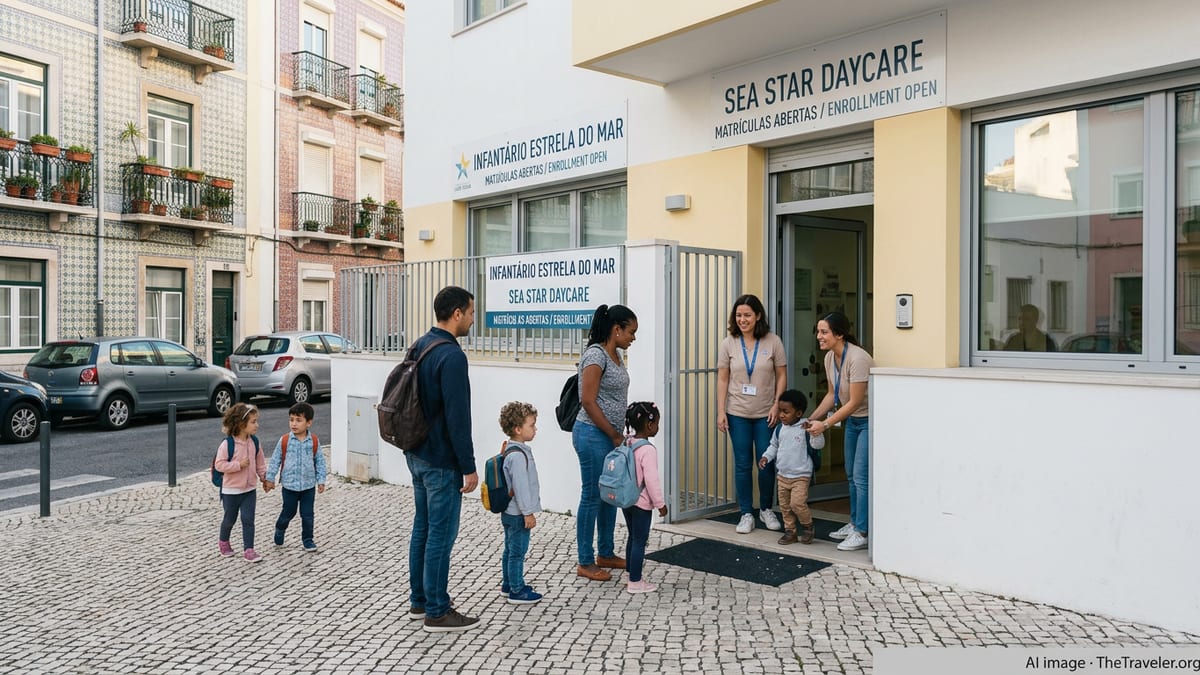
Overview of the Portuguese Childcare Landscape
Formal childcare in Portugal is structured in three broad stages. Creche covers children from around 3 or 4 months up to 3 years. Preschool, known as jardim de infância or educação pré escolar, serves ages 3 to 6 before the start of compulsory basic schooling. In parallel, there are after school and vacation care schemes for primary school children, along with private nannies and childminders that sit outside the mainstream system.
Provision is mixed. Public places are offered directly by the state and by private social solidarity institutions that operate under agreement with social security. Alongside this, there is a large network of fully private daycare centres, kindergartens and international schools, mainly in urban and expat dense areas. Fees, subsidies and eligibility differ between these categories, and expat families often interact with several at once, especially if places in subsidised centres are limited.
Recent education and social policy has focused on expanding free access to early childhood education and care. From 2022 onward, Portugal progressively introduced universal free creche for younger children in approved settings and reinforced the principle that core preschool hours from age 3 should not carry tuition charges. However, implementation is uneven, and private market prices remain relevant for families who cannot secure a subsidised place or who opt for international curricula.
For relocation planning, the key questions are the age of the child, the likelihood of obtaining a public or agreement based place, the family’s income level for means tested fees, and whether an international or bilingual setting is a priority. These factors together determine whether childcare will be a modest, moderate or major line in the family budget.
Cost Structure for Creche (0 to 3 Years)
For children under 3, creche costs are the most variable and can be the most expensive component of childcare for expat families. Policy reforms have made daycare in many centres free of charge for eligible children, but coverage is not yet universal in practice. Free creche applies primarily to children born from late 2021 onwards who attend public daycare, registered social sector centres or private centres that participate in the national programme, subject to available places and correct registration with social security. Families outside these channels face standard fees.
In subsidised creches run by social solidarity institutions, parental contributions are usually income based. Maximum reference monthly fees often fall in a range roughly between 100 and 250 euros per child, with low income households paying substantially less and, in many cases, nothing at all. These amounts can include meals and basic supplies, although charges for extended hours or specific activities may apply. Exact tariffs are set locally and adjusted annually, so expat families must verify current scales directly with prospective centres.
In purely private creches without state agreements, monthly fees are higher and closer to market rates found in other Western European countries. In Lisbon, Porto and coastal hubs popular with expats, typical full time fees for infants and toddlers often sit in a band of approximately 350 to 700 euros per month in mainstream Portuguese language centres. Premium bilingual or international style nurseries can exceed this, sometimes reaching 800 to 1,000 euros per month when meals and extended hours are included. Registration fees and deposits are common and can add the equivalent of one additional month of cost in the first year.
Waiting lists are a critical strategic factor. Demand for free or subsidised creche places exceeds supply in many municipalities, and competition is particularly intense for children under 1 in central urban areas. Families that do not secure a public or agreement based place may need to rely on private centres or informal solutions, pushing actual monthly outlays toward the upper end of the ranges cited above. For relocation planning, it is prudent to assume private market pricing unless a confirmed place in a subsidised creche is obtained.
Preschool and Jardim de Infância Costs (3 to 6 Years)
From age 3, children in Portugal move into preschool settings, generally called jardim de infância. The public policy principle is that preschool education should be free of charge during core hours for all resident children. In practice, public and contracted social sector preschools do not charge tuition for the basic daily schedule, usually around 25 hours per week spread over mornings or standard school days. Families may however pay modest fees for meals, snacks and extended hours outside the free core period.
Where public or social sector preschools charge for ancillary services, monthly contributions are often income related and can range from a nominal amount up to roughly 100 euros per month per child. These fees typically cover school lunches, some materials and supervision during early drop off or late pickup windows. Local municipalities play a role in setting and collecting these charges, and policies can differ between regions. As a result, expat families may see significant variation between municipalities, even when the headline rule of free preschool education is the same nationwide.
Private Portuguese preschools, including those that combine creche and jardim de infância, operate on a fee paying basis. For full time attendance including meals and extended day within private settings, typical monthly fees often fall between 350 and 900 euros, with metro area centres charging toward the higher end of this spectrum. Facilities that offer bilingual programmes, enhanced extracurricular activities or premium infrastructure tend to price above more basic neighbourhood establishments.
International schools with preschool sections constitute a separate cost tier. Annual fees for nursery or kindergarten years in leading international schools in Lisbon, Cascais or Porto frequently range between roughly 6,000 and 12,000 euros per year, paid across 10 or 11 instalments. On a monthly equivalent basis this can translate into 550 to 1,100 euros or more, excluding application charges, capital levies, uniforms and transport. For families planning a full international education pathway from preschool onward, childcare and education become one combined, high value budget line rather than two distinct cost phases.
After School Care and Vacation Coverage Costs
Once children enter compulsory schooling at age 6, preschool costs disappear but childcare needs do not. School schedules typically run from early morning until mid afternoon, leaving gaps for working parents. Portugal addresses this through after school programmes commonly known as ATL, short for atividades de tempos livres, as well as holiday camps and extended school support during breaks. These services can be decisive for expats with full time workloads.
Publicly linked ATL programmes associated with municipal schools often operate on a subsidised, income based fee structure. Typical monthly costs for standard after school coverage on school days might fall in the range of approximately 60 to 150 euros per child in many areas, with lower bands for families on modest incomes. Full day holiday programmes during summer and other vacations may be charged per week or per day, with indicative prices sometimes equating to 100 to 250 euros per week for municipal or not for profit offers.
Private after school and holiday programmes, including those run by sports clubs, language academies and private schools, command higher prices. For daily after school coverage combined with structured activities, families in urban centres might expect fees around 150 to 400 euros per month depending on hours and the type of programme. The upper end of this range is common where services include transport, specialised coaching or bilingual education components.
Relocating families need to factor in the interaction between school location, working hours and available ATL or camp places. Where children attend international schools, after school care is often integrated and priced together with tuition or as an elective package. In state schools, sign up deadlines, local residency priorities and income documentation determine whether families secure subsidised after school care or must rely on higher cost private options, informal carers or schedule adjustments.
Nannies, Childminders and Informal Care Options
Alongside formal creche and preschool provision, families in Portugal can hire individual nannies, live in au pairs or use registered childminders, which are particularly relevant for children under 3 or in areas with creche shortages. These arrangements operate largely on a private contract basis and are more sensitive to local labour market conditions than to national childcare policies.
Hourly rates for experienced nannies or babysitters in major cities are commonly reported in a broad band from around 7 to 12 euros per hour for ad hoc care, with higher rates for specialised skills, multiple children or night time work. Live in nannies usually receive a net monthly salary plus room and board; approximate salary levels for full time positions can be comparable to or above the national minimum wage, so total costs for a standard 40 to 45 hour week may cluster around 900 to 1,300 euros per month or more once social security contributions are included.
Registered childminders and small scale home daycare providers may charge fees positioned between private creche prices and casual babysitting. Some operate under social security or municipal schemes that offer partial subsidies or tax relief, especially where they are formally licensed and audited. For expats, this segment can be harder to navigate due to language barriers and the need to confirm legal registration. Nevertheless, it can provide greater flexibility for children who do not adapt well to larger group settings.
Informal arrangements with neighbours, relatives or unregistered carers exist but carry regulatory and risk considerations. Families who employ domestic staff directly must comply with Portuguese labour and social security obligations. While not unique to Portugal, these compliance factors should be recognised as part of the true cost of in home childcare, over and above the headline hourly or monthly rate negotiated with the caregiver.
Regional Variations and Access Constraints
Childcare costs for expat families in Portugal are strongly shaped by geography. Lisbon, Cascais, the Algarve and parts of Porto present the highest market prices and the greatest competition for subsidised places. In these regions, private creche fees at the upper end of national ranges are common, and international school nursery fees are pitch at the higher end of the European spectrum. By contrast, medium sized inland cities and smaller coastal towns often offer lower private fees and higher probabilities of securing a public place, though international options may be limited.
Access constraints can offset headline affordability. National policies have expanded the right to free creche and preschool, but supply lags, especially in densely populated districts. Reports from parents indicate waiting lists both for public creches and for social sector institutions that participate in the free daycare programme. Preschool capacity is also tight in certain municipalities, and some children are not placed in public jardim de infância at age 3, forcing families to resort to private preschools for at least a transitional period.
For expat families arriving without an established social security record, the timing of registration can affect access. Public and subsidised centres frequently prioritise families based on residence, income brackets, sibling attendance and sometimes length of registration in local systems. Newly arrived households may be lower in priority queues, even when their children are theoretically entitled to free or low cost places. This makes early engagement with municipal education offices and social security advisable as part of relocation planning.
In regions with fewer private options, securing any formal childcare place may be more challenging than in large urban areas with abundant private supply. In these settings, reliance on informal care or reorganised work patterns can be more common. Relocation strategies that emphasise proximity to areas with greater childcare capacity may therefore be beneficial for families with very young children.
Budget Scenarios for Typical Expat Families
Although individual circumstances vary, it is possible to outline indicative monthly childcare cost scenarios to support relocation budgeting. These scenarios assume full time care for one child and do not include tax credits or employer benefits that may apply in specific cases. They are illustrative ranges rather than exact forecasts.
In a best case scenario where a family secures a place in a public or agreement based creche under the free daycare policy and later transitions into a public preschool with subsidised meals and after school care, out of pocket childcare costs might be limited to ancillary charges. Monthly expenses in this situation could be on the order of 50 to 150 euros for meals, modest extended hours and occasional holiday programmes. This level of cost is low by Western European standards but relies on successful access to subsidised services.
A middle scenario for an expat family in a metropolitan area might involve paying private creche fees during the 0 to 3 phase, then moving the child into public preschool and municipal after school programmes at age 3 or 4. For the creche years, a budget assumption of roughly 500 to 800 euros per month would be reasonable in many major urban areas, reducing sharply once preschool begins to perhaps 100 to 250 euros per month for meals, extended hours and after school coverage.
In a premium scenario, where the family chooses an international school or high end bilingual centre from nursery through primary, monthly costs can rise to or above 1,000 euros per child once annual tuition, fees and associated services are averaged. If after school clubs, transport and holiday camps are added within the same institution, the childcare and early education budget can approach or exceed 1,200 to 1,500 euros per month in leading metropolitan international schools.
The Takeaway
Portugal combines relatively generous public support for early childhood education with constrained capacity and a vibrant private market. For expat families, the financial experience depends heavily on whether the child fits into subsidised creche and preschool pathways or whether private and international alternatives must be used. Headline policies around free daycare and free preschool core hours reduce average national costs but do not eliminate out of pocket expenses, particularly in urban areas with tight capacity.
For relocation decisions, families should treat childcare as a major due diligence item rather than assuming that policies guaranteeing free access automatically translate into immediate, cost free places. It is prudent to obtain concrete fee schedules from shortlisted creches, preschools and after school providers, to understand income based contribution scales where applicable, and to check realistic waiting list conditions in the intended municipality. Comparing these findings against the budget scenarios outlined above can clarify whether childcare in Portugal will be a relative cost advantage or a neutral factor compared with the family’s current location.
When planned carefully, Portugal offers the potential for high quality early childhood education at relatively moderate cost, especially once children enter public preschool and primary education. However, during the critical 0 to 3 age window and for families seeking international or bilingual pathways, childcare can still represent a substantial monthly expenditure that merits explicit consideration in any relocation feasibility analysis.
FAQ
Q1. Is daycare really free in Portugal for young children?
Daycare is free for many children in approved public and social sector creches, particularly those born from late 2021 onwards, but coverage depends on available places and participation of centres in national programmes.
Q2. How much should expats budget for private creche in Lisbon?
For full time care in mainstream private creches in Lisbon, a realistic budget range is roughly 500 to 800 euros per month per child, with higher amounts for premium bilingual or international style centres.
Q3. Are preschool and kindergarten free in Portugal?
Core preschool education in public and contracted jardins de infância from age 3 to 6 does not carry tuition fees, but families usually pay modest monthly amounts for meals, materials and extended hours.
Q4. What does after school care cost in Portugal?
Subsidised after school programmes linked to public schools can cost around 60 to 150 euros per month, while private or premium programmes in cities can range from about 150 to 400 euros monthly per child.
Q5. How expensive are international school nurseries and kindergartens?
International schools with early years sections often charge annual tuition in the region of 6,000 to 12,000 euros, which equates to around 550 to 1,100 euros per month before additional fees.
Q6. Are childcare fees income based for expat families?
In public and many social sector creches and preschools, parental contributions are calculated on household income, and expat families who are tax resident and registered with social security can usually access the same scales as Portuguese nationals.
Q7. How difficult is it to find a creche place in major cities?
In Lisbon, Porto and other dense areas, demand for creche places often exceeds supply, leading to waiting lists. Early registration and flexibility on location or schedule improve the chances of securing a spot.
Q8. What are typical nanny costs in Portugal?
In large cities, experienced nannies often charge about 7 to 12 euros per hour for occasional care, while full time live in arrangements can cost around 900 to 1,300 euros per month plus social security contributions.
Q9. Do employers in Portugal help with childcare costs?
Some employers provide childcare vouchers, contributions to creche fees or on site daycare partnerships, but this is not universal and should be treated as a benefit to be negotiated rather than assumed.
Q10. How should families incorporate childcare into a relocation budget?
Families should obtain specific fee quotes from target creches, preschools and after school providers, then model best case, middle and premium cost scenarios to understand the likely monthly range before finalising relocation decisions.