


More news on this day
China’s already congested aviation system has been thrust into fresh turmoil as dozens of flights are cancelled and hundreds more delayed across major hubs including Beijing, Shanghai, Chengdu, Xiamen, Hangzhou, Wuhan, and Kunming, disrupting operations at China Eastern, Air China, XiamenAir and partner carriers and leaving thousands of travelers across Asia scrambling to rebook.
Get the latest news straight to your inbox!
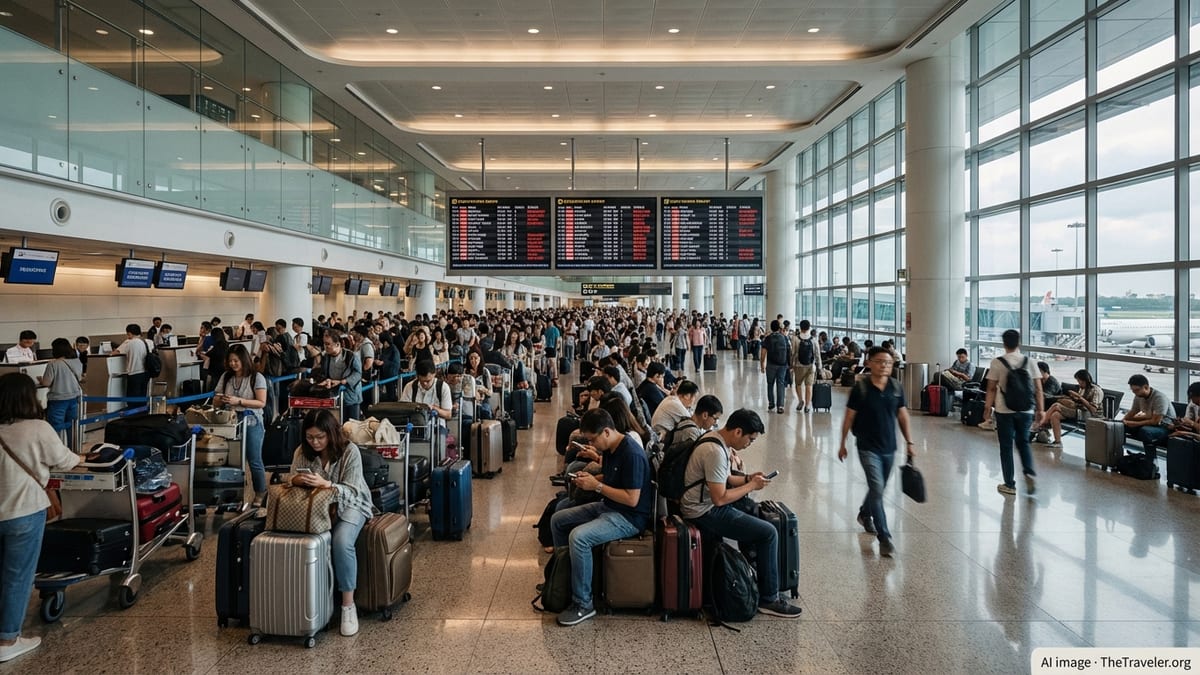
Widespread Disruptions Across China’s Busiest Corridors
Recent operational data and published travel-industry coverage point to a sharp spike in disruption across China’s domestic and regional flight network, with at least 60 flights reported cancelled and more than 300 services facing extended delays in a single 24-hour period. Cancellations and long hold times are concentrated on trunk routes linking Beijing, Shanghai, Chengdu, Xiamen, Hangzhou, Wuhan, and Kunming, the backbone of China’s fast-growing domestic aviation market.
The impact is most visible at Shanghai’s dual-airport system and at Beijing, which together act as critical transfer points for connections across East and Southeast Asia. Real-time tracking platforms show unusually high average delays on key routes, such as Beijing to Chengdu and Shanghai to Wuhan, where some services have run hours behind schedule on multiple consecutive days. Reports indicate that knock-on effects are rippling out to secondary cities as aircraft and crews struggle to get back into position.
While individual long delays are not unusual in China’s congested airspace, the clustering of cancellations and late departures across several major hubs on the same day has amplified the disruption. With limited slack in schedules and heavy reliance on tight connections, a single wave of late inbound flights can cascade quickly across the national network, overwhelming airport facilities and customer-service capacity.
Travel-industry reporting links the current disruption to a combination of operational constraints, stringent airspace management, and weather-related bottlenecks along key corridors. However, detailed breakdowns of responsibility for each cancellation are typically not made public, leaving passengers to piece together what is happening from airline notifications, airport boards, and third-party tracking tools.
China Eastern, Air China and XiamenAir Under Pressure
The latest wave of disruption is hitting some of China’s largest carriers hardest, particularly China Eastern and Air China, which together operate dense schedules across the affected hubs. China Eastern’s Shanghai-centered network and its strong presence in Kunming and Wuhan mean that delays or groundings in one region can quickly spill into others, while Air China’s Beijing and Chengdu operations face similar vulnerabilities when schedules start to slip.
Live status pages for selected China Eastern services in recent days show patterns of repeated long delays on core domestic routes, including Shanghai to Wuhan and Shanghai to Chengdu, with some flights departing many hours behind schedule or being cancelled outright. Comparable data for Air China services between Beijing and Chengdu and on other high-frequency routes highlight elevated average delays, sometimes stretching well beyond typical seasonal norms.
XiamenAir, a key player along China’s southeast coast with bases in Xiamen and a network that touches many of the same cities, has also been drawn into the turmoil. Where XiamenAir shares codes or operates parallel services alongside China Eastern or Air China, aircraft rotations and crew plans can be heavily affected by disruptions at shared hubs such as Shanghai, Wuhan, and Kunming, even when the original problem originated on another carrier’s flight.
Because major Chinese airlines rely extensively on code-sharing, alliance partnerships, and feeder arrangements, cancellations attributed to a single operator can reverberate through multiple brands. Passengers booked under one airline’s code may actually be flying on another’s aircraft, making it especially important to check both the marketing and operating carrier when monitoring flight status.
Stranded Passengers and Crowded Terminals Across Asia
The immediate human impact of this latest aviation crunch is being felt in crowded terminals and overstretched information desks, particularly at Shanghai, Beijing, and Chengdu, where passengers describe long lines for rebooking and limited availability of same-day alternatives. With so many flights either cancelled outright or departing significantly late, available seats on subsequent services are rapidly consumed, forcing some travelers to wait until the following day or reroute via less direct paths.
Transit passengers connecting between China and wider Asia are especially exposed. When a domestic feeder flight into a major hub such as Shanghai or Beijing is cancelled or delayed, it can easily cause travelers to miss onward services to destinations including Japan, South Korea, Southeast Asia, and Oceania. Some passengers have reported being rebooked onto indirect routings via other Chinese cities or even via entirely different carriers, while others have been advised to seek refunds and purchase new itineraries.
Airports such as Kunming and Wuhan, which serve as regional gateways for western and central China, are also feeling the strain as diversions and last-minute schedule changes push facilities closer to capacity. Publicly available airport movement and arrivals data show large clusters of delayed services arriving late into the evening, compressing ground-handling operations and extending queues for baggage, immigration, and ground transport.
Travel forums and social-media posts reflect growing frustration among passengers who report short-notice cancellation messages, limited English-language information, and uncertainty around entitlement to accommodation, meals, or compensation. Variations between airline policies, and between international and purely domestic tickets, further complicate the picture, leaving many travelers unsure what practical assistance they can expect during prolonged disruption.
Why China’s Air Network Is So Vulnerable to Chain-Reaction Delays
Aviation analysts and frequent flyers have long highlighted the structural factors that make China’s air network particularly prone to cascading delays. High reliance on a small number of mega-hubs, tight scheduling on popular corridors, and strict management of airspace all contribute to a system where any shock can have outsized effects. When weather fronts or air-traffic restrictions affect busy regions such as the Yangtze River Delta or the Beijing-Tianjin-Hebei cluster, dozens of aircraft can be forced into holding patterns or ground delays.
Once departures are pushed back, aircraft may miss their next rotation window, creating knock-on delays at their subsequent destinations. Because carriers like China Eastern and Air China run complex banks of connecting flights through their hubs, accommodating late arrivals often means reshuffling departure sequences, swapping aircraft between routes, or consolidating lightly booked services. Each adjustment may avert an outright cancellation but can produce new delays elsewhere in the network.
China’s rapid post-pandemic recovery in domestic air travel has further constrained the system’s flexibility. Demand on many routes has returned to or exceeded pre-2020 levels, while airlines are still fine-tuning fleet deployment and staffing patterns after several years of fluctuating restrictions. High load factors on popular flights limit the ability to move disrupted passengers onto later services, intensifying the sense of gridlock when several flights in a row are affected.
Observers also point to the limited transparency around air-traffic management decisions and real-time capacity as a challenge for both airlines and travelers. Unlike some markets where detailed delay attribution is widely published, disruption in China is often explained only in general terms, making forward planning difficult for passengers with time-sensitive connections and for corporate travel managers overseeing complex itineraries.
What Travelers Need to Do Now
With disruptions continuing to ripple through the system, travelers with imminent flights touching Beijing, Shanghai, Chengdu, Xiamen, Hangzhou, Wuhan, or Kunming are being advised by travel agents and industry commentators to monitor their bookings closely and build extra buffer time into their plans. Checking both the airline’s own channels and independent flight-tracking platforms can provide early warning of schedule changes, equipment swaps, or creeping delays that might jeopardize tight connections.
Where possible, passengers are encouraged to confirm the minimum connection times on their itineraries and consider proactively shifting to earlier feeders into major hubs if long-haul or international segments are at stake. Those booking new trips may wish to favor routes with at least two or three daily frequencies between key cities, increasing the chances of same-day re-accommodation if a particular service is cancelled or severely delayed.
Travelers should also familiarize themselves with the specific conditions of carriage and disruption policies of their operating carrier, which can differ markedly between domestic and international segments and between Chinese airlines and foreign partners. Some airlines may offer hotel accommodation and meal vouchers during overnight disruptions, while others may focus on rebooking and refunds, particularly when cancellations are attributed to weather or airspace constraints.
Finally, passengers are urged to keep essential items such as medication, chargers, a change of clothes, and basic toiletries in carry-on bags rather than checked luggage, in case an overnight stay at or near the airport becomes unavoidable. With China’s main hubs currently operating under heightened strain, practical preparation and flexible planning remain the best tools for travelers hoping to navigate the ongoing aviation turmoil with minimal additional stress.