


More news on this day
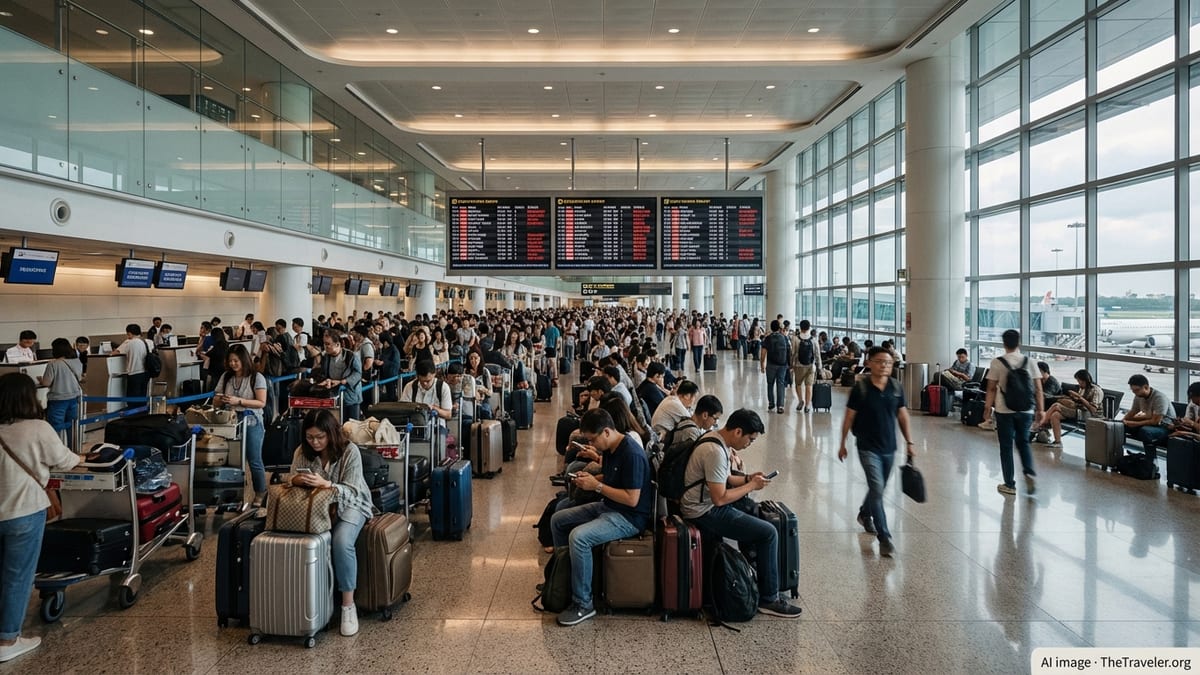
Hundreds of passengers were left in limbo across China’s aviation network as China Eastern, Air China and Juneyao Airlines faced 318 flight delays and 35 cancellations concentrated at major hubs in Guangzhou, Chengdu, Shanghai and Nanjing, snarling terminal operations and triggering scenes of crowding and confusion for travelers attempting to depart on already busy late‑May schedules.
Get the latest news straight to your inbox!
Delays and Cancellations Ripple Through Major Chinese Hubs
Publicly available airport departure boards and tracking platforms for late May show a concentrated wave of disruption across four of mainland China’s most important aviation gateways: Guangzhou Baiyun, Chengdu Shuangliu, Shanghai’s dual hubs at Pudong and Hongqiao, and Nanjing Lukou. Aggregated data indicates at least 318 flights associated with these airports were delayed over a short window, while 35 services were cancelled outright, affecting both point to point journeys and onward connections throughout the domestic network.
China Eastern, Air China and Juneyao Airlines were among the most visibly impacted carriers in the data, reflecting their deep exposure to trunk routes linking Shanghai, Guangzhou, Chengdu and Nanjing. China Eastern’s heavy schedule through Shanghai and Nanjing, Air China’s role on key national corridors, and Juneyao’s focus on Shanghai centered markets meant even relatively targeted cancellations quickly reverberated through their operations.
The timing of the disruption amplified its effects. With travel demand running high in the run up to the summer season, aircraft were operating at elevated load factors, limiting airlines’ ability to re accommodate passengers on alternative departures. Once the initial delays stretched into hours, missed aircraft rotations forced some services to be consolidated or scrubbed, contributing to the tally of cancellations recorded at the four hubs.
Observers note that, while isolated delays are routine in any large aviation system, the clustering of more than 300 affected flights in a compact period highlights how vulnerable China’s busiest airports remain to operational shocks. When problems strike simultaneously at multiple hubs, the knock on effects can spread rapidly across the country’s dense web of domestic routes.
Passengers Stranded in Terminals as Disruptions Mount
The disruption left hundreds of travelers stranded inside terminal buildings as they waited for updated departure information, rebooking options or overnight accommodation. Images and descriptions circulating in Chinese language media and social platforms showed long lines at airline service counters in Guangzhou and Shanghai, crowded seating areas in Chengdu and passengers resting on luggage near closed boarding gates in Nanjing as evening operations slipped behind schedule.
Publicly available reports from recent disruption events in China indicate that when delays exceed several hours, airports often experience pressure on basic services such as seating, food outlets and access to charging points. Similar patterns appear to have emerged during the latest wave, with many travelers facing extended waits while airlines sought replacement aircraft, crews or viable rerouting options through less congested airports.
For passengers traveling on complex itineraries, the impact extended beyond the four named hubs. Missed domestic connections in Shanghai or Guangzhou can cascade into broken links to secondary cities, forcing some travelers to purchase separate high speed rail tickets or seek last minute hotel rooms far from their intended destination. Families and business travelers have reported in previous episodes that such cascading disruptions can turn a routine two hour hop into an overnight or multi day detour.
China’s consumer rules generally provide that passengers on airline initiated cancellations are entitled to a refund or rebooking, and published policies from major carriers outline provisions for meal vouchers or accommodation in some circumstances. However, compensation for delays remains more limited, and information on the ground can be fragmented during fast moving disruption, leaving many stranded travelers unsure of their entitlements as they navigate crowded terminals.
Operational Strains Behind the Latest Wave of Irregularities
While detailed causal information for each affected flight is not immediately available, recent coverage of mainland China’s aviation performance points to a familiar mix of pressures behind large scale irregular operations. Congested airspace in eastern China, tight turnarounds at busy hubs and the knock on effects of adverse weather events in upstream cities often combine to squeeze already busy schedules.
Industry analysis of previous disruption days in February and March highlighted how fast moving storms and low visibility at major airports such as Shanghai Pudong and Chengdu Shuangliu can force traffic management initiatives that slow or temporarily halt arrivals and departures. Once imposed, these constraints typically generate long queues on the ground and in the air, with aircraft and crews arriving late for subsequent legs, particularly on multi sector domestic rotations.
Operational data also underscores the interconnected nature of China’s trunk network. A protracted delay on a morning departure from a city like Chengdu or Nanjing can prevent an aircraft from reaching Shanghai in time for an afternoon bank of departures, requiring airlines to reshuffle aircraft assignments or consolidate lightly booked services. As these adjustments ripple through the day, schedules become increasingly brittle, and modest new disruptions can produce disproportionate impacts.
Analysts have argued in recent commentaries that structural factors, including limited flexibility in airspace allocation and peak hour slot constraints at top tier airports, leave carriers with little margin when irregular operations unfold. Until further reforms or capacity enhancements are implemented, periods of concentrated disruption such as the one affecting Guangzhou, Chengdu, Shanghai and Nanjing are likely to remain a recurring feature of China’s air travel landscape.
China Eastern, Air China and Juneyao Under Spotlight
The latest operational difficulties bring renewed attention to how China Eastern, Air China and Juneyao Airlines manage disruption across their networks. As two of the country’s largest state controlled carriers, China Eastern and Air China dominate traffic flows through Shanghai and Beijing aligned routes, while privately owned Juneyao has built a substantial presence on Shanghai centric and regional services, with additional focus on Nanjing and other eastern cities.
Recent public documents from China Eastern and Air China emphasize investments in digital tools, predictive maintenance and crew planning platforms designed to improve on time performance and resilience during irregular operations. However, periodic spikes in delays and cancellations, including the current wave affecting the four hubs, suggest that these initiatives are still contending with wider system constraints beyond any single airline’s control.
Juneyao’s network structure, which leans heavily on Shanghai as a core hub with spokes to Guangzhou, Chengdu and Nanjing among other destinations, makes the carrier particularly exposed when disruption strikes across multiple eastern and central Chinese cities at once. When banks of arrivals into Shanghai are delayed, departure waves outbound to secondary cities can quickly slide, leaving aircraft and crews out of position for the next day’s schedule.
Despite these challenges, publicly reported traffic statistics indicate that all three airlines have been rebuilding capacity and expanding frequencies as China’s domestic travel rebounds. That growth, while positive for connectivity, also means that terminal congestion and knock on operational pressures are likely to intensify during peak travel periods unless infrastructure, airspace management and contingency planning keep pace.
What Travelers Can Do When Flight Chaos Hits
For passengers caught up in the latest round of delays and cancellations at Guangzhou, Chengdu, Shanghai and Nanjing, travel specialists broadly recommend a series of practical steps based on lessons from previous disruption events nationwide. Checking flight status repeatedly in the hours leading up to departure, not just once, can alert travelers to schedule changes before they leave for the airport and provide more time to adjust plans.
Publicly available guidance from consumer advocates in China and international passenger rights organizations suggests that, when cancellations occur, contacting the airline through multiple channels can be more effective than relying solely on crowded airport counters. Official mobile apps, telephone hotlines and in some cases social media customer service accounts may offer alternative rebooking pathways when front line desks are overwhelmed.
Travel planners also highlight the importance of keeping detailed records during disruption, including screenshots of delay or cancellation notices, boarding passes, receipts for meals and accommodation, and any additional transport costs incurred. Such documentation can be valuable when seeking refunds, vouchers or gestures of goodwill under airline policies or local consumer regulations.
With China’s aviation market expected to remain busy through the summer and into upcoming holiday peaks, the episode of 318 delays and 35 cancellations across the four hubs serves as a reminder that even on short domestic journeys, travelers should factor in the possibility of irregular operations. Allowing extra connection time, considering earlier flights on critical travel days and building flexibility into onward plans can help mitigate the impact when the next wave of disruptions rolls through the country’s crowded skies.