


For many visitors to Great Smoky Mountains National Park, the big question is not whether to go to a high summit, but which one. Clingmans Dome and Mount Le Conte are the park’s two marquee high points, each promising sweeping views, cool alpine air, and a sense of being on the Smokies’ rooftop. Yet the experiences differ dramatically, from how you get there to what you feel when you finally look out over the blue layers of ridges. This guide compares the two in practical, on-the-ground detail so you can decide which summit delivers the better experience for your style of travel.
Get the latest updates straight to your inbox!
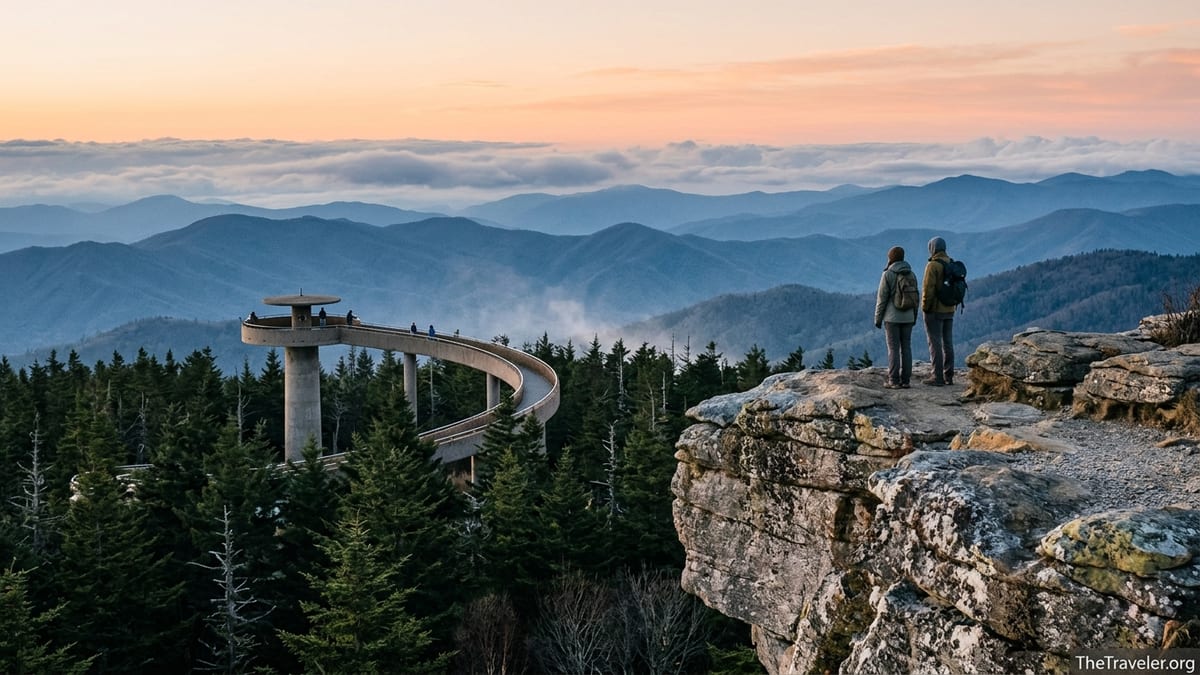
The Mountains at a Glance
Clingmans Dome is the highest point in Great Smoky Mountains National Park, topping out at about 6,643 feet, with a concrete observation tower reached by a short but steep paved path. It sits near the Tennessee–North Carolina state line, accessed via Clingmans Dome Road off Newfound Gap Road. On a clear day, park rangers say you can see as far as 100 miles in every direction, though haze often softens those distant views.
Mount Le Conte, a serrated massif rising above Gatlinburg, reaches roughly 6,593 feet at its high point. It is slightly lower in elevation but more rugged in character. Rather than a drive-up summit, Le Conte is a full-day hike, most famously via the 10-mile round-trip Alum Cave Trail, which climbs more than 2,700 feet and passes landmarks like Arch Rock and Alum Cave Bluffs. Near the top, rustic LeConte Lodge offers the only lodge-style overnight stay on a mountaintop inside the park.
In practice, Clingmans Dome is the Smokies’ most accessible “big view,” ideal for road-trippers, families with limited time, and travelers who prefer short walks over long ascents. Mount Le Conte, on the other hand, is a destination for strong day hikers and overnight guests who want to earn their summit the old-fashioned way, step by step up the mountain.
Choosing between them comes down to your fitness level, how much time you have, and whether you are after a quick highlight or a full-immersion backcountry adventure. Many travelers eventually do both, but if you have to pick just one, the differences matter.
Access, Effort, and Time Commitment
Access is where the contrast is sharpest. Clingmans Dome’s main viewpoint starts with a drive. From Sugarlands Visitor Center near Gatlinburg, you follow Newfound Gap Road for about 13 miles, then turn onto Clingmans Dome Road for another 7 miles to the large parking area. From there, a paved but very steep trail of roughly half a mile leads to the observation tower. Most visitors complete the round trip in 45 to 90 minutes, stopping often at benches as needed.
Mount Le Conte demands a much greater time investment. The most popular route, Alum Cave Trail, begins along Newfound Gap Road and is about 5 miles one way to LeConte Lodge area, with more walking required to reach the best viewpoints at Cliff Top or Myrtle Point. National Park Service guidance and recent trail reports describe it as a strenuous, all-day undertaking for most people. Many hikers budget 6 to 9 hours total, starting at sunrise during busy seasons to secure a legal parking spot and to avoid afternoon storms.
There are also longer options to Mount Le Conte, such as the Trillium Gap Trail (about 6.5 to 8.9 miles one way depending on starting point) or the Boulevard Trail, which connects from the Appalachian Trail near Newfound Gap and can make for a 15 to 16 mile round trip outing. These routes are generally used by experienced hikers or guests heading to LeConte Lodge. By comparison, Clingmans Dome’s paved path can be tackled in casual clothing with a light jacket and a basic bottle of water, though its grade still surprises many visitors.
If your Smokies itinerary includes only a single day in the high country and you are traveling with children, grandparents, or anyone unaccustomed to steep trail hiking, Clingmans Dome is the pragmatic choice. If you want your summit to be the centerpiece of your trip and are comfortable with a demanding uphill climb, Mount Le Conte will feel more rewarding and less hurried.
View Quality and Atmosphere on the Summit
From a pure panorama standpoint, both summits deliver. Clingmans Dome offers a 360-degree view from a raised concrete ramp and circular platform, high above the surrounding spruce-fir forest. The scene on a clear September afternoon might include line after line of blue ridges, with the broad sweep of the Smokies in every direction. Orientation signs help you pick out peaks like Mount Le Conte and Mount Guyot on the horizon.
Mount Le Conte’s views are more varied, and you earn them in pieces rather than all at once. After reaching LeConte Lodge, hikers can follow short side paths to different overlooks. Cliff Top looks west and is famous for sunsets over a sea of ridges, while Myrtle Point faces east, known for its sunrise vistas if you stay overnight. In between, open ledges along the Alum Cave Trail reveal vertical cliffs plunging into forested valleys, giving a more immersive feeling of exposure and relief than the enclosed tower experience at Clingmans.
Atmosphere is where the two summits feel most different. Clingmans Dome’s observation tower often feels like a scenic overlook at a busy highway rest area, albeit with far better scenery. On an October weekend, you might share the platform with hundreds of other visitors, many snapping photos with smartphones, kids eating snacks on the ramp, and tour groups gathering around a ranger talk. It is vibrant but rarely quiet.
Mount Le Conte, particularly near Cliff Top in late afternoon, has a calmer, almost village-like mood. Hikers lounge on flat rocks in hiking boots and windbreakers, boiling water for tea on backpacking stoves or sipping hot chocolate from the lodge dining hall. Even when LeConte Lodge is fully booked, the numbers are modest compared with the crowds at Clingmans. The air feels wilder: no paved structures at the viewpoint, only rocks, low shrubs, and the sound of wind in the spruce-fir canopy.
Trail Experience: Paved Path vs Classic Smokies Hike
Clingmans Dome’s route is technically a trail but behaves more like a very steep sidewalk. The half-mile path from the parking lot is wide, paved, and graded for walking rather than for rugged hiking. In early summer you might pass families pushing strollers partway up before turning back, visitors in flip-flops pausing on benches, and serious hikers continuing up carrying trekking poles out of habit. In winter and early spring, the access road often closes for snow and ice, which can transform the approach into a longer walk or ski from a gate when conditions allow.
By contrast, the journey to Mount Le Conte via Alum Cave Trail is classic Smokies hiking. The trail starts by following Alum Cave Creek through cool hardwood forest, crosses log bridges over clear, rushing water, and then enters Arch Rock, a natural tunnel in the mountainside. Farther up, it passes Alum Cave Bluffs, a giant overhanging rock wall where many casual hikers turn around after about 2.3 miles, treating it as a half-day excursion. Above the bluffs, the path steepens, traverses exposed ledges with hand cables for security, and eventually climbs into the higher spruce-fir zone near the summit.
Trail conditions on Mount Le Conte can vary significantly with season. In April and early May, hikers may encounter lingering ice on shaded ledges, making traction devices and hiking poles genuinely useful. By June, rhododendron and mountain laurel bloom along sections of the trail, while summer thunderstorms can bring sudden downpours and slippery rocks. Autumn offers dry footing and vivid foliage along the lower slopes, but shorter daylight hours make early starts important for day hikes.
If you enjoy the journey as much as the destination, Mount Le Conte’s approach is richer, with natural landmarks spaced throughout the climb and a tangible sense of moving through different ecological zones. If you prefer to save your energy for other parts of the park and just want a powerful view without a long, rocky path, Clingmans Dome’s paved route is more appealing, provided you accept the short but intense uphill grade.
Weather, Seasons, and Crowds
Both summits are high enough that weather can differ noticeably from the valleys below. Temperatures at Clingmans Dome and Mount Le Conte are often 10 to 20 degrees Fahrenheit cooler than in Gatlinburg, and both see frequent fog, wind, and rapid changes in visibility. Travelers who arrive at Clingmans Dome after spending a warm July morning in Pigeon Forge are often surprised to find themselves pulling on fleece jackets and beanies in a brisk breeze at the tower.
Clingmans Dome Road typically opens from around April through late fall, but exact dates depend on conditions and park management decisions. In shoulder seasons and on summer afternoons, clouds routinely blow across the ridge, sometimes reducing visibility at the tower to only a few dozen yards. Many visitors report arriving to a total whiteout, waiting 20 or 30 minutes, and then watching the sky suddenly clear to reveal ridges stretching to the horizon. Flexibility and patience can be rewarded here.
Mount Le Conte’s trails are open year-round, but winter conditions can be serious. Ice on the Alum Cave ledges and deep snow on the Boulevard or Trillium Gap routes can turn an already strenuous hike into an expert-level challenge, and LeConte Lodge itself operates only during a defined season, generally spring through fall. In busy months like June, July, and October, parking at the Alum Cave trailhead can fill very early, often soon after sunrise on weekends. The park now requires paid parking tags for vehicles stopped longer than 15 minutes, so arriving late can mean circling for a legal space or changing plans altogether.
Crowding patterns differ between the two. Clingmans Dome sees large, short-duration surges throughout the day, with bus tours and steady car traffic from mid-morning to late afternoon. Mount Le Conte’s crowds concentrate on the trail corridor itself, especially the lower few miles of Alum Cave, but thin out as you gain elevation and as less-determined hikers turn back at Alum Cave Bluffs. Those who reach the lodge and summit often find more space to spread out, particularly toward evening as day hikers begin descending.
Logistics, Costs, and Comforts
From a budgeting perspective, the good news is that Great Smoky Mountains National Park does not charge an entrance fee. However, since 2023 the park has required parking tags for vehicles staying more than 15 minutes in most parking areas, including those for Clingmans Dome and the major trailheads leading to Mount Le Conte. As of 2025 guidance, these tags are modestly priced and available in daily, weekly, or annual formats purchased online, at visitor centers, or via self-serve kiosks in the park. Travelers should plan ahead rather than assume they can park for free all day.
Clingmans Dome itself is otherwise inexpensive to visit. Many travelers drive up early in the day, use a day parking tag if they do not already have one, walk the tower path, take photos, and then continue along Newfound Gap Road or out to Cherokee for lunch. The main expenses are fuel, parking, and any snacks or souvenirs picked up in gateway towns like Gatlinburg or Bryson City.
Mount Le Conte introduces more logistical decisions and, potentially, higher costs if you choose to stay overnight. LeConte Lodge runs on an advance-reservation lottery system, with bookings often claimed many months ahead. Overnight stays include rustic cabins, family-style meals, and simple amenities like kerosene lamps instead of electricity. Rates are higher than a typical roadside motel, reflecting the cost of supplying a remote mountaintop lodge by pack animals and foot. For budget-conscious hikers, the more economical option is to visit as a day hike or to apply for a separate backcountry camping permit at the LeConte shelter nearby, which has different rules and fees managed by the park.
Comforts also diverge sharply. At Clingmans Dome, there are restrooms near the parking area during the main season, informational exhibits, and the option to return to your car within 15 to 30 minutes if the weather turns bad or someone in your group tires. On Mount Le Conte, once you commit to the trail, you are hours away from your vehicle, with no restrooms or shelters until you reach the lodge vicinity. Water sources can be seasonal, so many hikers carry 2 to 3 liters per person, especially in summer, along with snacks or lunches such as trail mix, sandwiches, and energy bars.
Which Summit Is Better for Different Travelers?
For first-time visitors with limited time, Clingmans Dome is usually the more reliable choice. Imagine a family on a three-day Smokies trip, staying in a mid-range hotel in Gatlinburg. They have small children and grandparents in tow, and their primary park day already includes Cades Cove and a picnic. In that scenario, driving up to Clingmans Dome in late afternoon, tackling the short paved path at everyone’s pace, and taking group photos at the tower gives them big-mountain views without derailing the rest of the itinerary.
For hikers who view the Smokies as a destination for physical challenge and immersion, Mount Le Conte is the far richer experience. A pair of fit adults arriving with proper hiking footwear, daypacks, rain jackets, and a flexible schedule can dedicate an entire day to the Alum Cave ascent, turning the climb into a milestone outing. Many travelers plan their entire trip around a night at LeConte Lodge, timing their reservations to catch late-summer wildflowers or peak fall color, and then spending the evening watching sunset from Cliff Top with a hot beverage in hand.
Romantic travelers and photographers might favor Le Conte for its quieter atmosphere and varied vantage points. The possibility of sunrise at Myrtle Point followed by breakfast at the lodge has a special appeal that a quick stop at a concrete tower cannot match. On the other hand, wheelchair users and visitors with significant mobility limitations will usually find Clingmans Dome and nearby roadside overlooks along Newfound Gap Road to be the more realistic path to high vistas, even though the tower path itself is steep and may still pose challenges.
If you have several days in the area, it is entirely possible to combine both experiences. Some travelers drive to Clingmans Dome during a flexible, partly cloudy afternoon, knowing that if the tower is socked in they can try again the next day. Then, on a separate clear day, they commit to the full Mount Le Conte hike, starting before sunrise and treating the summit as the highlight of the trip. Experiencing both underscores how different the two “top of the park” moments really feel.
The Takeaway
Clingmans Dome and Mount Le Conte are not competitors so much as two complementary ways to stand high above the Smokies. Clingmans Dome is the most accessible route to sweeping views, best for travelers who want a memorable summit moment without dedicating an entire day or training regimen to get there. It fits easily into a road-based itinerary, pairs well with scenic drives and short nature walks, and offers a powerful introduction to the park’s high country.
Mount Le Conte, by contrast, is a summit you earn. Its strenuous trails, iconic Alum Cave landmarks, and rustic lodge culture transform a simple viewpoint into a full narrative: miles of climbing, changing forests, conversations with fellow hikers, and, at day’s end, a sense of genuine accomplishment. For many, that story and effort are what make Le Conte “better,” even though its elevation is slightly lower than Clingmans Dome’s.
Ultimately, the better summit is the one that aligns with your expectations, fitness, and timeframe. If you have only a single afternoon and mixed-ability companions, choose Clingmans Dome and savor the views between drifting clouds. If you can commit a full day and crave an immersive mountain experience with the option of a night in a mountaintop lodge, choose Mount Le Conte. Either way, the ridgelines of Great Smoky Mountains National Park will be waiting, blue and layered, stretching to the horizon.
FAQ
Q1. Is Clingmans Dome or Mount Le Conte better for beginners?
Clingmans Dome is generally better for beginners and casual visitors, since you can drive most of the way and walk a short, though steep, paved path to the tower. Mount Le Conte requires a strenuous, full-day hike with significant elevation gain and uneven terrain.
Q2. How long does it take to hike Mount Le Conte?
Most people hiking Mount Le Conte via Alum Cave Trail should plan on 6 to 9 hours round trip, depending on pace, rest breaks, weather, and how much time they spend exploring viewpoints near the lodge and summit.
Q3. Do I need special gear to visit Clingmans Dome?
You do not need technical gear, but sturdy walking shoes, a warm layer, and rain protection are wise. The paved path is steep, and weather at the summit can be chilly and windy, even when it is warm in Gatlinburg or Cherokee.
Q4. Is there a fee to visit these summits?
There is no entrance fee for Great Smoky Mountains National Park, but a paid parking tag is required if your vehicle is parked for more than 15 minutes at areas like Clingmans Dome or the Alum Cave trailhead. The tag cost is modest and can be purchased daily, weekly, or annually.
Q5. Can children hike Mount Le Conte?
Many families with active, older children do hike Mount Le Conte, but it is a long, steep, and tiring outing. Parents should honestly assess their children’s stamina, start very early, carry plenty of water and snacks, and be prepared to turn around if anyone is struggling.
Q6. When is the best time of year to visit Clingmans Dome?
Late spring through fall is typically best, when the access road is open. Clear days in September and early October often offer the widest views, though fog and haze can appear in any season, sometimes obscuring vistas without much warning.
Q7. How hard is the Alum Cave Trail to Mount Le Conte?
The Alum Cave route is considered strenuous. It includes sustained elevation gain, rocky and sometimes narrow sections, and a few exposed ledges with cables. It is manageable for fit hikers with good footwear and preparation, but it is not a casual stroll.
Q8. Can I stay overnight on Mount Le Conte?
Yes. You can stay at LeConte Lodge in rustic cabins if you secure a reservation in advance, or you can apply for a backcountry camping permit for the nearby shelter. Both options have distinct rules, seasons, and fees that should be researched before your trip.
Q9. Which summit is better for photography?
Clingmans Dome offers a high, unobstructed 360-degree platform that is excellent on clear days, especially for wide scenic shots. Mount Le Conte offers more varied compositions, including cliff-edge viewpoints, lodge scenes, and both sunrise and sunset angles, making it particularly rewarding for photographers willing to hike longer distances.
Q10. If I have time for only one, which should I choose?
If you prefer an easy-access highlight and are traveling with a wide range of abilities, choose Clingmans Dome. If you are fit, enjoy long hikes, and want a deeper, more immersive summit experience, choose Mount Le Conte. Both provide memorable views of the Smokies, but the effort and atmosphere are very different.