


First-time visitors often arrive in Australia with romantic images of sun-drenched beaches, kangaroos by the roadside and endless road-trip freedom. The reality is just as memorable, but it comes with strict biosecurity rules, intense sun, vast distances and local quirks that can quickly trip up an unprepared traveler. Understanding a few common mistakes can save you money, embarrassment and even a brush with the law when you land in Sydney, Melbourne, Brisbane or beyond.
Get the latest updates straight to your inbox!
Underestimating Australia’s Strict Border and Quarantine Rules
One of the biggest shocks for first-time visitors happens before they even leave the airport. Australia has some of the world’s strictest biosecurity controls, designed to protect local agriculture and unique ecosystems. On your incoming passenger card you must declare items such as food, plant material, wooden souvenirs and animal products. Many new arrivals assume that sealed snacks or a ham sandwich from the plane are harmless and do not need to be mentioned. In reality, that sandwich must be declared or binned before you reach the biosecurity inspection area.
Television programs about Australian border security are not exaggerating. Travelers who fail to declare food can be hit with on-the-spot fines in the thousands of Australian dollars, even if the item is a single sausage or a few pieces of fresh fruit. What matters is not only what you bring, but whether you told the truth on the form. For example, a visitor arriving in Sydney with homemade beef jerky and ticking “no” to the food question risks both confiscation and a heavy infringement notice. The same traveler declaring the jerky honestly will usually only have it taken and be sent on their way.
A practical strategy is to keep anything remotely questionable in a separate bag in your carry-on. When you reach the inspection point, hand it over and say clearly that you are not sure if it is allowed. Packaged chocolates and commercially sealed biscuits are often permitted, but rules change regularly and depend on ingredients and origin. Because officers have wide discretion, a polite attitude and full honesty are far more effective than arguing that “this was allowed in another country.” When in doubt, declare or discard.
Another overlooked issue is outdoor gear. Hiking boots caked with mud, camping equipment and even golf clubs can be flagged for inspection. If you have been in rural areas or on farms before flying to Australia, clean your gear thoroughly to avoid delays. You may be asked to open bags so that officers can check the soles of shoes or the treads on hiking poles. A quick scrub with soapy water at home can save you a secondary screening after a long-haul flight.
Mistiming the Seasons and Misjudging the Weather
Many visitors from the Northern Hemisphere forget that Australia’s seasons run opposite to those in Europe and North America. December and January are peak summer, while July is midwinter, even in coastal cities like Sydney and Melbourne. Booking what you think is a “warm July beach holiday” on the Gold Coast might still work, but sea breezes can be brisk and evening temperatures far cooler than expected. Conversely, a Christmas trip to the Red Centre can mean daytime highs well above 35 degrees Celsius, unsuitable for some travelers.
The second mistake is assuming that warm air means gentle sunshine. In much of Australia, especially from Brisbane northwards, ultraviolet radiation is intense. On a summer day in Sydney, the UV index can reach “extreme” levels even when the air temperature sits at a comfortable 26 degrees. Visitors often head to Bondi Beach or St Kilda around midday without a hat or sunscreen because it “doesn’t feel that hot,” and end up with painful burns after less than an hour in the sun.
A practical rule is to treat any forecast mentioning a UV index of 3 or higher as a signal to cover up. In real terms, this means packing a wide-brimmed hat, sunglasses with proper UV protection and lightweight long sleeves, not just a single small bottle of sunscreen from home. Local pharmacies and supermarket chains stock high SPF broad-spectrum sunscreen in large pump bottles that are more cost-effective than repeated purchases of travel-size tubes. Families spending several days on the Sunshine Coast or in Cairns will easily go through a one-litre bottle if they are applying it correctly.
Weather variations across the country can also catch people out. Melbourne is famous for “four seasons in one day,” which is not just a local joke. A visitor might start a morning laneway coffee tour in sunshine and end the day at an AFL match in cold drizzle. Packing only beachwear for a multi-city trip is a common error. Include at least one warm layer and a light waterproof jacket, even if your itinerary is focused on coastal regions.
Misjudging Distances and Treating Australia as a Compact Country
On a map in a guidebook, Australia’s major cities can look deceptively close. In reality, the country is similar in size to the contiguous United States. New visitors frequently underestimate travel times and overpack their itineraries. A common example is the traveler who books three days in Sydney, then plans to “pop over” to Uluru and back, followed by a side trip to the Great Barrier Reef, all within ten days. Once they start searching for flights and connections, they realize that each leg can consume most of a day in transit.
Driving distances are similarly easy to misjudge. A road trip from Sydney to Brisbane is more than 900 kilometers via the coastal highway, typically requiring at least two days if you want to stop in places like Port Macquarie or Byron Bay. Attempting to cover this distance in one go after a long-haul flight is both exhausting and unsafe. The same applies to iconic routes like the Great Ocean Road, where new visitors try to squeeze a multi-day coastal drive into a single rushed outing from Melbourne. They often end up driving in the dark on unfamiliar roads with wildlife on the verge.
Domestic flights are plentiful but not always cheap, especially during Australian school holidays, which differ from those in Europe or North America. A first-time visitor aiming to see Perth, Darwin, Cairns and Hobart in one trip may find that airline fares and connections quickly push their budget beyond expectations. Breaking the country into regions and focusing on one or two areas such as “Sydney plus the Blue Mountains and Hunter Valley” or “Cairns plus the Daintree and Atherton Tablelands” typically leads to a more relaxed and affordable itinerary.
When planning, use actual route distances and realistic speeds rather than defaulting to “it looks close.” Travel forums are filled with stories of visitors who booked non-refundable accommodation in multiple far-flung locations without checking the time required to get between them. Building in buffer days, especially when linking a remote area like the Outback with an international departure city, can prevent frantic last-minute changes if weather or road conditions affect your schedule.
Driving as if You Were at Home
For many first-timers, renting a car seems like the perfect way to explore Australia’s coastlines and national parks. The most obvious adjustment is that Australians drive on the left, but the subtler challenges are what catch people out. After a 15-hour flight into Melbourne or Sydney, jumping behind the wheel immediately is unwise. Jet lag, unfamiliar roads and reversed traffic patterns dramatically increase the risk of accidents, particularly at multi-lane roundabouts or complex intersections.
Road rules also differ more than some visitors realize. In built-up areas, speed limits are heavily enforced, often through fixed cameras and unmarked police vehicles. Fines for speeding, running a red light or using a mobile phone while driving are steep by international standards and can easily exceed the cost of a few nights’ accommodation. Drink-driving limits are strict, and rural roads pose additional challenges ranging from narrow lanes to long stretches with limited fuel or rest stops.
Wildlife is another significant hazard, especially at dawn and dusk in regional areas. Kangaroos and wallabies near roads are not a cartoon stereotype but an everyday reality in much of the country. Travelers driving from Brisbane into the hinterland or along the Stuart Highway in the Northern Territory frequently encounter animals crossing at unpredictable moments. Rental agreements may include exclusions for damage caused at night in remote regions, and getting a vehicle towed from the Outback can involve eye-watering costs. Planning to avoid night driving outside major cities is one of the simplest ways to reduce risk.
Navigation mistakes are common too. Visitors sometimes rely on mobile mapping services without considering patchy coverage in rural zones. In Western Australia or central Queensland, there may be long stretches without signal, leaving drivers uncertain about turns or fuel stops. Before leaving a major town, ask local staff about road conditions, fill the tank and carry extra water. If a local tourism office tells you that a 4WD vehicle is recommended for a particular track, resist the urge to push on in a small rental car simply because “the map says it is a road.”
Confusion About Money, Tipping and Everyday Costs
First-time visitors from North America and parts of Europe often arrive with tipping habits that do not translate neatly to Australia. Service wages are generally higher, and tipping is not an automatic expectation in the same way it is in the United States. Leaving a small tip for exceptional service in a restaurant or rounding up a taxi fare is appreciated, but there is no obligation to add 20 percent to every bill. Trying to press cash on café staff for counter service can create awkward moments rather than goodwill.
On the other hand, everyday prices can be higher than new arrivals expect. A basic flat white coffee in central Sydney or Melbourne commonly costs around 4 to 6 Australian dollars, and a simple pub meal can run from 25 to 35 dollars, depending on location. Visitors who underestimate these costs sometimes burn through their budget in the first few days. Self-catering, even partially, can make a noticeable difference. Booking accommodation within walking distance of a major supermarket chain allows you to buy breakfast items and snacks at local prices instead of relying entirely on hotel minibars and room service.
Public transport ticketing systems also surprise many travelers. In Sydney, an Opal card or a contactless credit or debit card is used to tap on and off trains, buses and ferries. Buying a physical Opal card at the airport train station often requires a larger initial top-up than purchasing in the city, because of private station access fees and minimum balance rules. First-time visitors regularly load far more money onto the card than they need for a short stay, then leave the country with unused credit remaining.
In Melbourne, the Myki system operates across trams, trains and buses. An adult Myki card itself carries a purchase fee, and you then add travel credit. Many visitors do not realize that trams within much of the central business district are free to ride, even without tapping on, as long as you remain within the signposted Free Tram Zone. They buy a Myki at the airport and start tapping immediately, paying for journeys that locals routinely take at no cost. Spending a few minutes at the airport information desk or reading the fare posters near ticket machines can prevent this common waste of money.
Misreading Local Etiquette, Laws and Cultural Norms
Australia is often perceived as relaxed and informal, and in many ways it is. People tend to dress casually, first names are used quickly and a friendly “how’s it going?” is normal when buying a coffee. However, this informality coexists with certain rules that are strictly enforced. One mistake new visitors make is assuming that public drinking laws are loose. In many states and territories, consuming alcohol in public spaces outside clearly marked areas or licensed venues can result in fines, even if you are behaving quietly. Pouring wine at a picnic in a central Sydney park without checking for designated alcohol-free zones is a risk, not a harmless cultural quirk.
Pedestrian rules also differ from some countries. In cities like Sydney and Brisbane, crossing the road against a red “don’t walk” signal is technically an offense and may result in on-the-spot fines when police run targeted operations. Visitors used to crossing wherever and whenever they wish can be surprised to see locals waiting patiently at quiet intersections. The safest approach is to follow the signals, both for your wallet and your wellbeing, especially given the fast-moving traffic on multi-lane roads.
Another cultural misstep involves interactions with First Nations culture and sensitive sites. Many tours now include references to Aboriginal and Torres Strait Islander history, and some locations request that visitors refrain from certain activities. For example, some gorges, rock formations or ceremonial grounds in national parks have viewing platforms but clearly marked signs asking you not to climb or enter particular areas. Ignoring these in search of a better selfie is both disrespectful and likely to attract strong reactions from other visitors and staff. Taking a guided First Nations-led tour in places like Kakadu, the Daintree or around Sydney Harbour can deepen your understanding while ensuring you behave appropriately.
Finally, humor and directness can lead to misunderstandings. Australians often tease friends and even newcomers in a way that is warm but can sound blunt to more formal cultures. If a local jokingly complains about your “terrible” choice of football team or asks why you are “mad enough to visit in January,” they are usually being playful, not rude. Mirroring the tone lightly and not taking things too seriously will make social interactions smoother and more enjoyable.
Overlooking Safety in the Ocean and the Outdoors
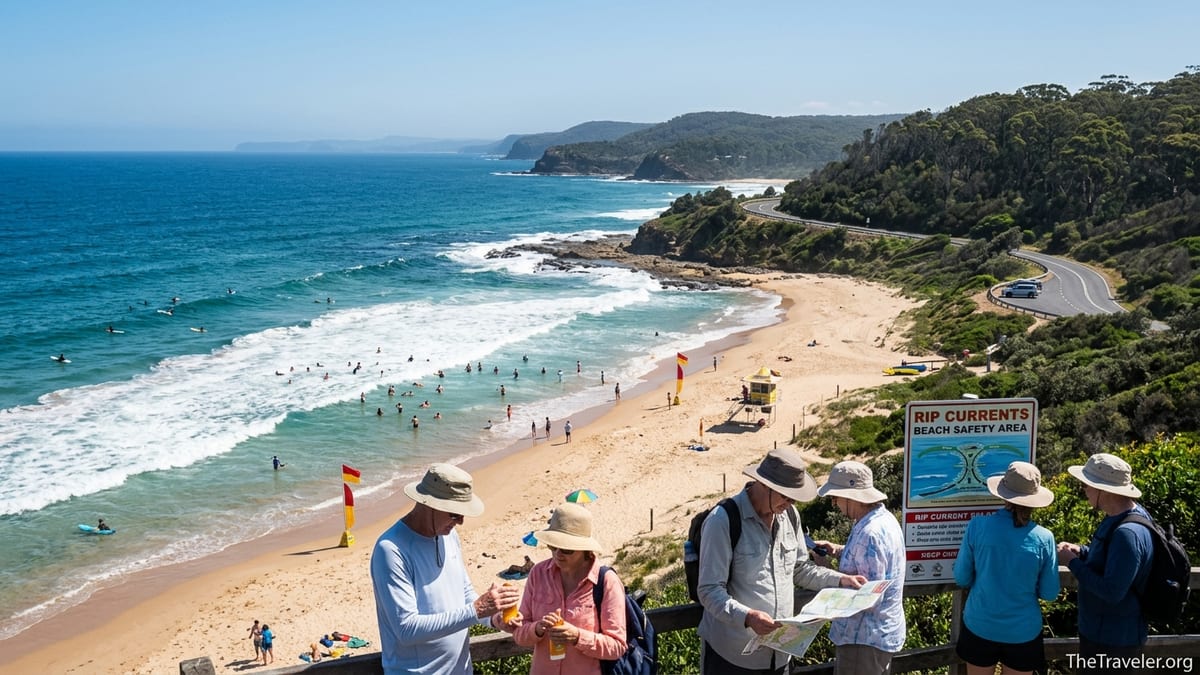
Australia’s beaches are a powerful draw for first-time visitors, but they also present real hazards. Rip currents, which can be hard to spot for inexperienced swimmers, are a leading cause of rescues and drownings. A frequent mistake is to head straight into the surf at an unpatrolled beach or outside the red-and-yellow flags that mark the area watched by lifeguards. Travelers who are confident swimmers in hotel pools sometimes underestimate how quickly they can be pulled away from shore in strong surf at Bondi, Surfers Paradise or smaller regional beaches.
Following the basic rules goes a long way. Swim only where lifeguards are on duty, between the flags, and pay attention to the color-coded warning signs at the beach entrance. If you arrive at a picturesque cove with no flags, no lifeguards and only a couple of other people, treat it as a place for photos and paddling at the edge rather than a full swim. In northern Queensland and parts of Western Australia, stinger nets may be installed during marine stinger season, and warning signs for jellyfish should be taken seriously. Local advice from surf clubs, accommodation staff or visitor centers is more reliable than copying what a handful of other tourists are doing.
Inland, the risks shift to heat, dehydration and getting lost. Bushwalking in national parks like the Blue Mountains, Grampians or Flinders Ranges can be superb, but trails are often longer and steeper than they appear on a simplified tourist map. New visitors frequently set off with a small bottle of water, no hat and no plan for changing weather. Mobile reception may vanish within a few minutes of leaving the car park, and temperatures can rise suddenly in exposed areas. Carrying sufficient water, telling someone where you are going and checking track conditions with rangers are standard precautions, not overreactions.
Wildlife safety extends beyond snakes and spiders, which are often high on visitors’ minds. More commonly, tourists get into trouble by approaching animals for photos. In coastal areas with resident seal colonies or at feeding points where wild birds gather, standing too close can result in bites and scratches. In the north, crocodile warning signs near rivers and estuaries are not optional. Travelers who ignore barriers to get closer to the water for a picture are putting themselves in genuine danger. Understanding that many Australian animals are best admired from a distance will keep your experience memorable for the right reasons.
The Takeaway
Exploring Australia for the first time is an opportunity to experience vast landscapes, distinctive wildlife and a confident, multicultural society. The same features that make the country so compelling also underpin many of the mistakes new visitors make: underestimating the sun and distances, misunderstanding strict biosecurity and road rules, or being caught off guard by local etiquette. None of these pitfalls need to derail your trip.
With realistic expectations and a willingness to adapt to local conditions, you can move smoothly through border control, navigate cities and outback roads, and enjoy beaches and bushwalks safely. Take Australia on its own terms rather than treating it as a warmer version of home. Plan conservatively, ask questions when in doubt and give the environment and local cultures the respect they demand. Your reward will be a richer, more relaxed journey that feels far less like damage control and far more like the adventure you imagined.
FAQ
Q1. Do I really need to declare a small amount of food when I arrive in Australia?
Yes. If the arrival card asks about food, plant material or animal products, you must declare anything that might fit those categories, including snacks. Officers may allow some items to pass and will simply confiscate others, but failing to declare can lead to significant on-the-spot fines.
Q2. Is tipping expected in Australian restaurants and bars?
No. Tipping is not mandatory and is less common than in North America. Locals might leave a small tip or round up the bill for outstanding service, but there is no expectation that you add a fixed percentage every time you eat out.
Q3. How strong is the sun in Australia compared with Europe or North America?
In many parts of Australia the ultraviolet index regularly reaches “very high” or “extreme” levels in summer, meaning unprotected skin can burn in minutes. Even on cooler or partly cloudy days, UV can be intense, so using sunscreen, hats and protective clothing is strongly recommended.
Q4. Can I drive long distances right after landing from an international flight?
It is possible but not advisable. Jet lag, reversed traffic patterns and unfamiliar roads make driving immediately after a long-haul flight risky. Many visitors choose to stay near the airport or in the city for at least one night before starting long road trips.
Q5. Are Australian beaches safe for swimming?
Most popular beaches are safe if you follow local guidance. Always swim between the red-and-yellow flags where lifeguards patrol, obey warning signs and avoid entering the water at unpatrolled or closed beaches, especially if you are not familiar with rip currents.
Q6. Is it easy to get around Australian cities with public transport?
Yes. Cities like Sydney, Melbourne and Brisbane have extensive train, tram, bus and ferry networks. The main challenge for visitors is learning the local smartcard systems such as Opal or Myki and understanding fare zones and caps, which can usually be clarified at airport information desks or station help points.
Q7. Can I camp or hike anywhere I like in the Australian bush?
No. Camping and hiking are generally restricted to designated areas within national parks, state forests and private campgrounds. Trails, fire regulations and access rules are clearly signposted, and ignoring them can damage fragile environments and result in fines or rescue costs if things go wrong.
Q8. What should I do if I see wildlife on or near the road?
Slow down, stay alert and avoid swerving suddenly, which can cause more serious accidents. In rural areas, it is often safest to reduce night driving. If you hit an animal, follow the advice in your rental agreement and contact local wildlife rescue services if it is safe to do so.
Q9. Are there areas in big cities that tourists should avoid at night?
Australian cities are generally safe by global standards, but normal big-city precautions apply. Stick to well-lit streets, avoid heavy intoxication in unfamiliar neighborhoods and use licensed taxis or reputable rideshare services late at night. Hotel staff can give up-to-date, area-specific advice.
Q10. How many regions should I try to visit on a two-week trip?
For a first visit of around two weeks, focusing on one or two main regions usually works best, such as Sydney with nearby mountains and wine country or a combination of Melbourne and the Great Ocean Road. Trying to see every major city and remote landmark in a single trip often leads to rushed travel and higher costs.