


Australia is a country where surf beaches, tropical reef, vast desert and cosmopolitan cities can all fit into a single itinerary. Distances are large and seasons vary sharply between north and south, but with a bit of planning you can link Sydney’s harbor, Melbourne’s laneways, the Great Barrier Reef and the Red Centre into one coherent trip. This guide focuses on the best things to do in Australia right now, with concrete examples and on-the-ground details that help you turn a dream route into a bookable journey.
Get the latest updates straight to your inbox!
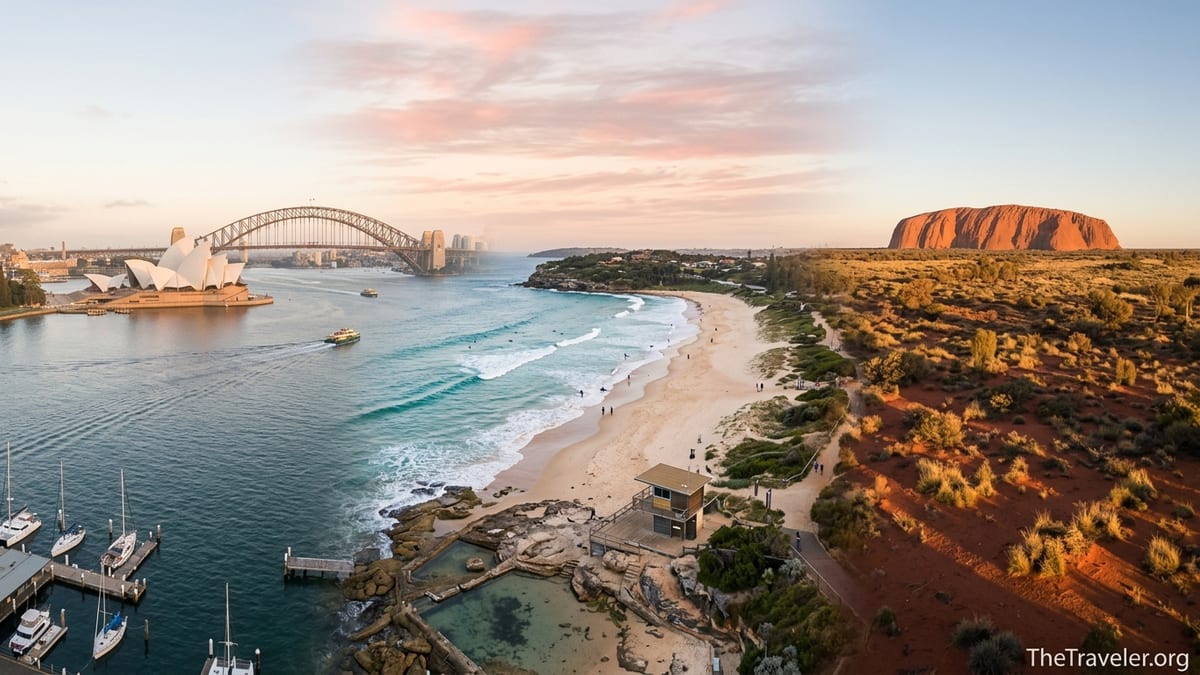
Sydney: Harbor Icons, Beaches and Blue Mountains
For many visitors, Sydney is the first stop and the best introduction to urban Australia. The city’s compact center makes it easy to walk between the Sydney Opera House, Circular Quay and The Rocks in a single morning. Spending on-the-ground time here generally starts with the water: a public ferry from Circular Quay to Manly, which costs roughly the price of a local commuter ticket, doubles as a sightseeing cruise past the Heads and under the Sydney Harbour Bridge. Time your trip for late afternoon to watch the light change on the Opera House sails as you glide back into the harbor.
To understand Sydney’s beach culture, plan at least half a day around the Bondi to Coogee coastal walk. This undulating clifftop path is about 6 kilometers and threads past Bondi, Tamarama, Bronte and Clovelly beaches, with frequent staircases down to the sand. Many visitors simply join locals and grab a flat white from a Bondi cafe, then walk one or two sections rather than tackling the entire route. In summer, arrive by 8 am to avoid the strongest sun and crowded mid-morning period, and budget for a simple beachfront breakfast, which in 2026 typically runs from around 20 to 30 Australian dollars for coffee and a main dish.
From Sydney, the easiest way to get a taste of the Australian bush is a day trip to the Blue Mountains. Katoomba, the main hub, is about two hours away by train from Central Station, so you can leave after breakfast and still have time to see the Three Sisters rock formation and take short walks to lookouts over the Jamison Valley. Scenic World offers a cableway, a steep funicular-style railway and elevated boardwalks through the forest if you prefer a low-effort way to experience the landscape. Expect combined attraction tickets in the ballpark of 50 to 70 Australian dollars per adult, with discounts if you book online or through local tour companies.
Travelers who want a more structured experience in Sydney can join small-group walking tours in The Rocks that delve into the city’s colonial history, or book a late-afternoon harbor cruise that includes canapes and drinks rather than a full meal. As of 2026, mid-range harbor cruises usually start around 90 to 150 Australian dollars for a couple of hours on the water, far less than bucket-list activities like climbing the arch of the Harbour Bridge, which often run several hundred dollars per person. Choosing a mix of free walks, self-guided ferry rides and one or two paid experiences keeps costs manageable without sacrificing the essentials.
Melbourne and the South: Culture, Coastlines and Wine
Melbourne is Australia’s cultural capital and offers a very different feel to Sydney. The city center is famous for its laneways lined with cafes, street art and small boutiques. A practical way to explore is to follow the free City Circle tram route for an overview, then get off around Flinders Street or Bourke Street and wander on foot. Coffee culture here is serious: independent cafes in neighborhoods like Fitzroy, Collingwood and Carlton compete for the best flat white, so it is easy to build a morning around sampling specialty espresso and browsing local design shops.
Sports and arts are central to Melbourne’s identity. Depending on your dates, you might plan a trip around the Australian Open tennis in January, an Australian Football League match at the Melbourne Cricket Ground in winter, or exhibitions at institutions like the National Gallery of Victoria. Ticket prices vary widely, but entry to the main NGV gallery is free for permanent collections, which makes it a good value activity on a rainy afternoon. Many visitors pair this with an evening in the Southbank precinct, where you can find mid-range restaurants serving everything from modern Australian cuisine to regional Chinese and Italian, typically with mains starting from around 30 Australian dollars.
Outside the city, two classic road trip options give you easy access to southern Australia’s landscapes. The Great Ocean Road, starting roughly 90 minutes’ drive from Melbourne, traces dramatic coastal cliffs, surf beaches and the limestone stacks of the Twelve Apostles. Rather than attempting it in a rushed day trip, most travelers now opt for one or two nights in towns like Lorne or Apollo Bay, which breaks the driving into manageable sections and allows time for short walks to waterfalls in the Otway Ranges. Alternatively, head northeast into the Yarra Valley or Mornington Peninsula for cool-climate wineries, day spas and farm-to-table restaurants, many of which accept walk-in tastings for a modest fee.
If you are combining Melbourne with other parts of Australia, use it as your gateway to the cooler southern states. Autumn and spring are particularly comfortable for walking and outdoor dining, while winter brings cozy laneway bars and fewer crowds on the Great Ocean Road. Flights between Melbourne and Sydney are among the busiest domestic routes in the country, so you can often find competitive fares if you book several weeks ahead and avoid peak holiday dates.
The Great Barrier Reef and Tropical North Queensland
The Great Barrier Reef is one of Australia’s headline attractions and stretches for more than 2,000 kilometers along the Queensland coast. Most first-time visitors base themselves in Cairns, Port Douglas or one of the islands such as Fitzroy or the Whitsundays. Cairns offers the widest range of day trips and is a major domestic hub: direct flights from Sydney generally take around three hours, and airlines like Qantas, Virgin Australia and Jetstar operate multiple services per day on this route. Once in Cairns, you can walk the compact waterfront, with its free public lagoon pool, and compare reef tour options at the many travel desks dotted along the Esplanade.
Day cruises to the outer reef typically cost in the region of 250 to 350 Australian dollars per adult, which usually includes snorkeling equipment, lunch and environmental levies. Some operators add extras like guided snorkel tours with a marine biologist, introductory scuba dives or glass-bottom boat rides for an additional fee. Families often gravitate toward large pontoon-style platforms at sites such as Moore Reef, which provide changing rooms, shaded seating and semi-submersible viewing areas, making it easier for less confident swimmers to enjoy the coral without spending all day in the water.
For a more relaxed and close-to-shore option, consider staying on Fitzroy Island or Green Island, where fringing reefs begin just off the beach. Here, you can rent a mask and fins for a modest day rate and snorkel in sheltered bays whenever conditions are favorable. Travelers who want to combine reef and rainforest in one base often choose Port Douglas, about an hour’s drive north of Cairns, which offers boutique lodges and easy access to both the reef and the Daintree Rainforest. While accommodation prices fluctuate seasonally, expect mid-range hotel rooms in high season to start somewhere around 250 to 300 Australian dollars per night in the most sought-after areas.
Timing matters in the tropics. The dry season, roughly from May to October, usually brings lower humidity, clearer water visibility on the reef and fewer marine stingers, though operators often provide stinger suits whenever there is any risk. If your visit falls in the wetter summer months, build flexibility into your schedule: book reef trips with changeable dates so you can shuffle them to the clearest day, and plan backup activities such as visiting the Cairns Aquarium or exploring indigenous cultural centers in case heavy rain or wind cancels boat departures.
Red Centre and Outback: Uluru, Kata Tjuta and Beyond
No list of the best things to do in Australia is complete without the Red Centre. Uluru-Kata Tjuta National Park, in the Northern Territory, protects one of the country’s most recognizable natural landmarks and a site of profound cultural significance for the Anangu people. The majority of visitors fly into Ayers Rock Airport from cities like Sydney or Melbourne, then use the shuttle buses or walking paths between the airport, the main resort complex at Yulara and the park entrance. Entry fees apply per person for a multi-day pass, and there are separate charges for guided tours and activities inside the park.
The most rewarding way to experience Uluru is at ground level. A popular itinerary is to join a guided sunrise base walk one morning, which might include storytelling about Tjukurpa, the traditional law and culture of the local people, and visits to waterholes and rock art sites. Another morning or evening can be devoted to Kata Tjuta, a group of domed rock formations roughly 40 to 50 kilometers away, where the Valley of the Winds and Walpa Gorge walks traverse rugged terrain and give sweeping views over the desert. Summer temperatures can be extreme, so in hotter months, local authorities sometimes close longer trails later in the day for safety; plan to start walks at or before dawn, carry several liters of water per person and wear sun protection.
Many travelers complement their time on the trails with after-dark experiences. The Field of Light installation near Uluru, for example, spreads thousands of solar-powered glass spheres across the desert floor, which gradually illuminate after sunset. Packages usually bundle this with transfers, a simple dinner or drinks and access to designated viewing areas overlooking the rock. While the price is relatively high for a few hours, the combination of starlit desert sky and the silhouette of Uluru is often described as a highlight of an Australian trip.
If you want a deeper look at the outback, you can extend your journey beyond Uluru. Classic overland routes such as the drive between Alice Springs and Adelaide or segments of the Great Inland Way link small towns, roadhouses and national parks where red dirt, big skies and long straight roads define the landscape. This style of travel demands planning: hire companies often restrict standard rental cars from unsealed roads, fuel stops can be several hundred kilometers apart, and summer heat places extra stress on vehicles and travelers alike. For many visitors, a guided multi-day outback tour in a small group provides a simpler and safer way to witness the country’s interior.
Wildlife, Rainforests and Coastal National Parks
Beyond the big-name icons, some of the best Australian experiences happen in national parks and wildlife reserves. In tropical North Queensland, the Daintree Rainforest north of Cairns is one of the world’s oldest continuously surviving rainforests. Organized day tours from Cairns or Port Douglas typically combine a guided boardwalk through the forest, a crocodile-spotting cruise on the Daintree River and a visit to Cape Tribulation, where rainforest slopes reach down to the Coral Sea. Many operators limit group sizes and include hotel pickups, lunch and environmental levies, making the logistics straightforward even if you do not have a rental car.
Further south, New South Wales and Victoria host a chain of coastal and mountain parks that can fit neatly into a road trip. In New South Wales, you can walk clifftop tracks in Royal National Park just south of Sydney or explore beaches and headlands in areas like Jervis Bay, known for its pale sand and clear water. In Victoria, Wilsons Promontory offers granite peaks, sweeping beaches and resident wombats that sometimes graze on the grassy flats near campgrounds at dusk. Always observe wildlife from a respectful distance and follow local advice about not feeding animals; fines for disturbing or feeding native species can be significant.
Wildlife-focused experiences are available across the country, from kangaroo and koala sanctuaries near Brisbane and Adelaide to penguin viewing platforms on Phillip Island, a couple of hours from Melbourne. These centers vary in their conservation credentials, so it is worth prioritizing operations that participate in rehabilitation or research programs and avoid venues that offer direct contact with adult wild animals. Entry fees to reputable sanctuaries typically range from around 30 to 60 Australian dollars per adult and often fund on-site veterinary care and habitat restoration.
When planning for wildlife and nature, check seasonal patterns. For instance, some whale watching cruises operate from locations like Hervey Bay or Sydney only during specific migration months, while bushfire risk can close trails in certain parks at short notice during the peak of summer. Having a loose plan with at least one alternative destination or indoor activity in each region gives you flexibility when conditions change.
Practical Planning: Distances, Visas and Budgeting
Australia’s sheer size shapes every itinerary. Flights between major cities are often the most time-efficient way to get around, and you should expect travel days to eat into your schedule. For example, flying from Sydney to Cairns for the Great Barrier Reef or from Melbourne to Uluru usually takes about three hours in the air, plus airport transfers and check-in time. Where possible, book morning flights and avoid scheduling major activities on arrival days, especially if you are adjusting from long-haul international time zones.
Entry requirements depend on your nationality but most short-stay visitors need some form of visa or electronic authority. Travelers from the United States and several other countries commonly use an Electronic Travel Authority, while many Europeans use an eVisitor authorization. Both systems are applied for online or via official mobile apps and allow multiple short visits over a set validity period. Processing is often quick, but approvals are not guaranteed, so apply well before you commit to non-refundable flights or accommodation and always consult the latest information from official immigration and foreign affairs sources in the months leading up to your trip.
In terms of budget, Australia is typically on the higher side compared with Southeast Asia but can be managed with smart choices. Mid-range hotel rooms in central Sydney or Melbourne often start around 220 to 300 Australian dollars per night, though prices increase during major events and school holidays. Eating out in city centers generally means mains from roughly 25 to 40 Australian dollars at casual sit-down restaurants, while takeaway bakery items, fish and chips and Asian food courts in shopping arcades offer cheaper options. Self-catering at least some meals, especially in apartment-style accommodation with kitchenettes, can significantly reduce costs on longer trips.
Transport passes and careful routing also help. In cities, use rechargeable smartcards like Opal in Sydney or myki in Melbourne to cap daily public transport spend and avoid relying on taxis or rideshares for every journey. When booking domestic flights, compare flying in and out of different cities to avoid backtracking. For example, an itinerary that starts in Melbourne, continues to Uluru, then Cairns and finishes in Sydney may cost a little more in flights but saves days of overland travel, allowing you to see the Great Barrier Reef, the outback and two major cities in as little as two and a half to three weeks.
The Takeaway
Australia rewards travelers who balance ambition with realism. It is possible to fit Sydney’s harbor, Melbourne’s laneways, the Great Barrier Reef and Uluru into a single journey, but only if you accept that each segment deserves several nights and at least one buffer day for travel. Rather than trying to tick off every region, focus on two or three contrasting areas that match your interests, whether that is food and wine in the south, tropical reef and rainforest in the north or long drives into the interior.
On the ground, the best experiences are often the simplest: sunrise walks along Bondi Beach, a quiet moment on a Daintree boardwalk listening to birdsong, or watching the colors shift across Uluru at dusk. By combining headline attractions with smaller, everyday encounters and keeping an eye on logistics and seasonality, you can craft an Australian trip that feels both iconic and personal. Use the examples and estimates in this guide as a framework, then adjust the details to match your own pace, budget and appetite for adventure.
FAQ
Q1. How long do I need for a first trip to Australia?
For a first visit that includes one major city, the Great Barrier Reef and the Red Centre, plan on at least two and a half to three weeks, not counting long-haul travel days.
Q2. What is the best time of year to visit Australia?
There is no single best month. April to May and September to early November usually offer pleasant weather in southern cities, while May to October suits the tropical north and reef.
Q3. Do I need a visa or Electronic Travel Authority to enter Australia?
Most short-stay visitors require an eVisitor or Electronic Travel Authority, obtained online before travel. Requirements vary by nationality, so always check current official guidance.
Q4. Is it realistic to see Sydney, the Great Barrier Reef and Uluru in one trip?
Yes, if you are prepared for several domestic flights and allow at least two to three nights in each destination, plus travel days between them.
Q5. How expensive is Australia compared with North America or Europe?
Prices are broadly comparable to major cities in Western Europe or North America. Accommodation and tours can be costly, but you can save with self-catering, public transport and free outdoor activities.
Q6. Can I drive between major destinations instead of flying?
You can, but distances are very long. For instance, driving between Sydney and Cairns takes several days, so most visitors fly between key hubs and save road trips for regional loops.
Q7. Is the Great Barrier Reef still worth visiting?
Despite environmental pressures, many reef areas remain vibrant, and responsible operators work within marine park rules. Conditions vary, so choose reputable tours and be flexible with dates.
Q8. How should I budget for tours and activities?
As a guide, allow a few hundred Australian dollars per person for a full-day reef trip, and smaller amounts for walking tours, museum visits and short excursions in each city.
Q9. Is it safe to swim at Australian beaches?
Yes, if you follow local advice. Swim between the red and yellow flags at patrolled beaches, heed lifeguard warnings and only swim where stinger or shark safety measures are in place.
Q10. How far in advance should I book flights and accommodation?
For high season or complex itineraries, start booking three to six months ahead. In shoulder seasons, a few months is usually enough, but popular reef trips can still sell out.