


Just west of Naples, where volcanic hills tumble into the sea, the remains of ancient Baiae lie scattered across cliffs and, remarkably, on the seabed itself. Once the Riviera-style playground of Roman emperors, Baiae is now split between an on-land archaeological park and a protected underwater site visited by boat, snorkel or scuba. Many visitors to Naples wonder whether it is worth carving out a precious day here when icons like Pompeii, Herculaneum and the Amalfi Coast all compete for time. The answer depends on what you enjoy. For travelers who like quieter sites, dramatic coastal scenery and unusual experiences, Baiae can be one of the most memorable outings from Naples.
Get the latest updates straight to your inbox!
What And Where Is Baiae, Exactly?
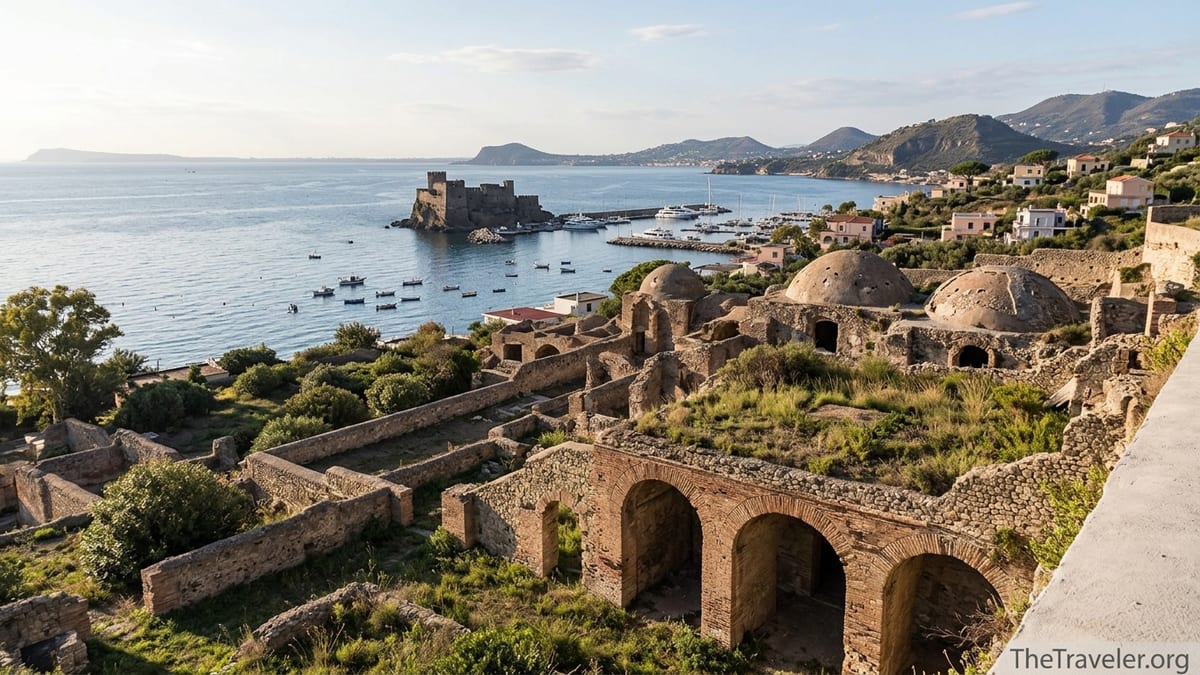
Baiae (Baia in Italian) sits in the Phlegraean Fields, a volcanic area just beyond the western suburbs of Naples. In Roman times this was the Bay of Naples’ glamorous end: steam vents, hot springs and a mild climate turned it into a resort of lavish villas, bath complexes and private harbors. Over centuries, slow volcanic subsidence caused part of the ancient shoreline to sink several meters, so today a slice of the Roman city lies underwater a short distance from the modern marina.
For visitors, “Baiae Archaeological Park” usually means two related attractions. The first is the Parco Archeologico delle Terme di Baia on the hill above the coast, a terraced complex of ruined bathhouses, courtyards and villa remains managed as part of the wider Phlegraean Fields Archaeological Park. The second is the Submerged Archaeological Park of Baia just offshore, a protected marine area where sections of Roman streets, mosaics and villa foundations sit beneath a few meters of clear water, accessed only with authorized operators.
The area is compact enough that you can see the hilltop ruins, the small modern marina and the Aragonese castle that houses the Archaeological Museum of the Phlegraean Fields within a short walk. From central Naples, most travelers reach Baia in about 45 to 60 minutes by a combination of local train and a brief taxi or bus ride, or around 40 minutes by car, depending on traffic.
Because Baiae is far less famous than Pompeii or Herculaneum, it tends to attract fewer tour buses. That gives the site a distinctly local feel. On weekdays outside peak summer, you may share the upper terraces mainly with Italian school groups and a handful of independent travelers, while the marina below feels like an ordinary small harbor that just happens to launch boats over an ancient Roman suburb.
What You Actually See On Land
The on-land Baiae Archaeological Park is built on steep volcanic slopes, tiered like a giant stone amphitheater facing the sea. Paths lead through the skeletal remains of bath complexes that once used geothermal heat to supply hot pools and steam rooms. Today you walk beneath large brick domes, through barrel-vaulted corridors and across open terraces, with frequent views over the Bay of Naples. Many visitors describe the setting as more dramatic than they expected, especially on clear days when the outline of Capri or the Sorrentine Peninsula appears on the horizon.
Individual structures within the park are partly reconstructed, so you need some imagination, but certain details are striking. In the so-called Temple of Diana and Temple of Mercury (actually vast bath halls, not temples), you can stand under soaring cupolas and see how the Romans engineered acoustics and light. In other sectors, fragmentary floor mosaics and marble revetments hint at the luxury enjoyed by Rome’s elite here. The park also offers plenty of vantage points where you can look down toward the castle, the marina and, knowing the history, mentally map where the drowned Roman shoreline lies just beyond.
A major advantage of Baiae over more famous sites is the human scale of a visit. Instead of spending six hours crisscrossing a huge city of ruins, most people feel they have done the upper Baiae park justice in about 90 minutes to two hours. That makes it ideal if you tire easily in the heat or are traveling with children who may only tolerate a limited dose of archaeology before needing gelato and the beach.
Entry fees can change, but as of mid‑2026 access to the Baiae Archaeological Park is generally in the low single-digit euro range for a standard adult ticket, with reductions for EU youth and free admission for children and various categories of residents. In practice, many travelers opt for a combined ticket that covers Baiae, Cumae, the Flavian Amphitheater in Pozzuoli and the Archaeological Museum in the castle over two calendar days, which often costs only slightly more than a single-site ticket and offers good value if you are interested in the broader Phlegraean Fields.
The Underwater City: How Visits Work In Reality
The underwater portion of Baiae is what makes the destination unique. Sections of Roman villas, colonnades, garden layouts and even mosaic floors now rest about five meters below the surface in a protected marine area. You do not swim out on your own. Instead, visits are tightly controlled and must be arranged through licensed operators based in Baia, Bacoli or nearby Pozzuoli, typically either as a glass-bottom boat outing, a snorkeling tour or a guided scuba dive.
A typical glass-bottom boat tour lasts around one hour. Boats depart from the small harbor at Baia and slowly cruise pre-set routes, pausing over key sites while guides point out visible features. Through the viewing windows, guests can make out column bases, sections of Roman roads and, in places, recognizable black-and-white mosaic patterns. This option is especially popular with families, non-swimmers and those visiting outside the warmest months, since you stay dry the entire time and tours often run from late spring through autumn, weather permitting.
Snorkeling excursions are the next step up in immersion. Several local dive centers and operators offer roughly two to three hour outings that include boat transport, mask, snorkel, fins and a guide who swims with the group. Prices often fall somewhere between the cost of a simple boat tour and a full scuba package, and many programs welcome beginners as young as early teens. Because the water is relatively shallow and usually calm, even first-time snorkelers can float above mosaicked floors and sculpted garden bases while the guide explains what you are seeing.
Certified scuba divers can book guided dives that explore specific underwater routes such as the so-called Villa with Prothyrum Entrance or the Sunken Nymphaeum of Claudius. Depths generally remain modest, often under eight meters, so these are relaxed dives focused on observation rather than technical challenge. Many dive shops in Baia offer packages of one or two guided dives with full gear rental for a price comparable to a half-day dive trip in other European coastal regions. Because access is regulated, advance reservations are strongly recommended, particularly in July and August and on weekends when Neapolitans head to the coast.
Comparing Baiae With Pompeii, Herculaneum And Other Day Trips
Deciding whether Baiae is worth a slot in your Naples itinerary often means comparing it to better-known excursions. Pompeii is immense, dramatic and justifiably world-famous, but it is also one of the busiest archaeological sites in Italy. On peak days in spring and summer, its main streets can feel crowded from mid-morning onward. Herculaneum is more compact and better preserved, yet still popular, especially with cruise excursions and organized tours.
Baiae, in contrast, remains a niche destination. You are unlikely to find yourself shoulder to shoulder with large tour groups for long. Instead, you may hear mostly Italian around you, and locals outnumber tourists in the cafés near the marina. If your ideal day involves a quieter, more contemplative encounter with Roman remains, plus sea views and the option to swim or dive, Baiae has a distinct appeal. For travelers who prefer ticking off icons, though, it will not replace Pompeii as a first priority.
From a time-management perspective, Baiae also combines well with other Phlegraean sites. With a two-day combined ticket, for example, you could spend one morning at the Baiae Archaeological Park, then continue to the Flavian Amphitheater in Pozzuoli, one of Italy’s largest Roman arenas, and perhaps walk down to the bradyseismic ruins of the Macellum (Temple of Serapis). The next day, you might visit the acropolis and cave sanctuary at Cumae, one of the oldest Greek settlements in Italy. Doing this circuit gives you a broader picture of the region’s layered Greek and Roman history than a single day at Pompeii alone.
If you are weighing Baiae against coastal destinations like Sorrento or the Amalfi Coast, the comparison shifts. Baiae and the Phlegraean Fields feel more low-key and less polished, with working harbors and somewhat rough-around-the-edges infrastructure. You will not find the same density of boutique hotels and upscale restaurants, but you also avoid some of the crowds and higher prices. For travelers interested in geothermal landscapes, small-town beaches and archeology rather than cliffside glamour, Baiae can be a refreshing alternative.
Practicalities: Getting There, Timing And Conditions
Reaching Baiae from central Naples is relatively straightforward but requires a bit of planning. The most common public-transport route is to take the Cumana railway from Naples’ Montesanto station toward the western suburbs, riding past districts like Fuorigrotta and Pozzuoli toward the Baia or Fusaro area. From there, you may need a short local bus or taxi ride to reach the archaeological park and marina, depending on current station operations and your exact stop. Total travel time from the historic center is typically 45 minutes to an hour each way, though delays are always possible on commuter lines.
Those who prefer less juggling of local transport often choose a taxi or rideshare directly from central Naples to Baia, which usually takes about 40 minutes outside rush hour. Another option for confident drivers is a rental car, though parking near the marina and archaeological site can be tight on summer weekends. Whichever method you choose, it pays to check operating hours for both the hilltop park and any underwater tours you have booked, then build in buffer time so you are not rushing from train to pier.
Seasonal conditions strongly influence the experience. The on-land site is mostly exposed, with limited shade on some terraces, so mid-day summer visits can feel punishingly hot. If you are visiting between June and early September, aim for the first opening hours of the morning or late afternoon and bring water, sunscreen and a hat. In cooler months from November to March, the upper park can be windier and, on rainy days, a bit slippery in places, but crowd levels are very low and the soft light suits photography.
For the underwater park, water temperatures in the Bay of Naples are generally most comfortable for snorkeling and casual swimming from late May through early October. Outside that window, glass-bottom boat tours remain an option, but many operators reduce or suspend snorkeling outings in winter. Authorized dive centers typically run scuba excursions longer into the shoulder seasons for guests prepared to use thicker wetsuits. Sea conditions can cause last-minute cancellations at any time of year, so it is wise to schedule your underwater tour for the first available day in your Naples stay, giving yourself flexibility to rebook if weather turns.
Who Will Love Baiae, And Who Might Skip It
Baiae tends to delight travelers who enjoy connecting the dots between landscape and history. If you are fascinated by how geology shapes human settlement, you will likely appreciate the way volcanic activity, geothermal springs and coastal subsidence all left their imprint here. Standing in a ruined bath hall cut into volcanic rock in the morning and then floating above drowned mosaic floors in the afternoon makes that story unusually tangible.
It is also a strong choice for visitors who have already seen the headline sites. If this is your second or third trip to the Bay of Naples and you have done Pompeii, Herculaneum and Vesuvius, Baiae offers something refreshingly different without feeling like a repeat. The same goes for certified divers looking for a distinctive yet easy dive: depth and currents at Baiae are generally beginner-friendly, so the focus is on the archaeology rather than challenging conditions.
Families can find Baiae appealing as well. The upper park is not huge, so children do not face endless streets of ruins, and you can break up the visit with a stop at the seaside or a boat tour. Many glass-bottom boat operators welcome children, and some snorkeling trips accept participants in their early teens, provided they are comfortable in the water. The underwater aspect tends to capture young imaginations more than another set of stone walls.
On the other hand, Baiae may underwhelm travelers with limited time on a first visit to Naples. If you have only two full days in the city, most people will prioritize Pompeii or Herculaneum instead. Likewise, if you are not particularly interested in Roman history or archaeological sites and are primarily seeking food and nightlife, you might get more out of exploring neighborhoods like Spaccanapoli, the Spanish Quarter or Chiaia instead of heading west to the Phlegraean Fields.
The Takeaway
So is Baiae Archaeological Park worth visiting during a trip to Naples. For travelers who value quieter, atmospheric sites, coastal scenery and unusual experiences, the answer is very often yes. The combination of a terraced Roman spa complex carved into a volcanic hillside and a sunken quarter of the ancient resort accessible by boat, snorkel or scuba is something you will not find elsewhere in the Bay of Naples. Add in the chance to explore nearby Pozzuoli, Cumae and the castle-top museum, and Baiae becomes the anchor for a rewarding day or even a full two-day circuit of the Phlegraean Fields.
At the same time, Baiae is not a universal must-see. If this is your first and perhaps only visit to the region and you are choosing between Baiae and iconic sites like Pompeii, the classic ruins still make more sense for most itineraries. The visitors who tend to come away raving about Baiae are those who either have time to spare beyond the big names, or who specifically seek out offbeat, less crowded corners of famous destinations. If that sounds like you, setting aside a day for Baiae can be one of the most memorable decisions of your Naples trip.
FAQ
Q1. How long do I need to visit Baiae Archaeological Park from Naples?
Most visitors spend about 90 minutes to two hours at the hilltop Baiae Archaeological Park itself. If you add a glass-bottom boat or snorkeling tour of the underwater park plus travel time from Naples, plan on a half day at minimum. Combining Baiae with Pozzuoli or Cumae turns it into a relaxed full-day outing.
Q2. Is Baiae a good alternative to Pompeii if I only have time for one site?
For a first-time visitor with limited time, Pompeii still offers a broader, more iconic snapshot of Roman urban life. Baiae is better seen as a complementary experience or an off-the-beaten-path choice for those who value quieter sites and the novelty of the underwater ruins. If you must pick just one and have never been, most travelers choose Pompeii.
Q3. Do I need to book underwater tours at Baiae in advance?
Yes, advance booking is strongly recommended, especially in summer and on weekends. Access to the submerged archaeological park is regulated and only authorized operators can enter, so spaces on glass-bottom boats, snorkeling trips and scuba dives can sell out. Booking at least several days ahead, and longer in peak season, gives you more options for times and languages.
Q4. Can non-swimmers still enjoy the underwater archaeological park?
Non-swimmers can absolutely experience the underwater site via glass-bottom boat tours, which keep you dry while still offering clear views of submerged columns, foundations and mosaics. Guides typically provide commentary on what you are seeing. If you are comfortable with a life jacket and floating, some operators may also accommodate very cautious snorkelers, but boat tours are the easiest option.
Q5. What should I wear and bring for a day at Baiae?
For the on-land archaeological park, wear comfortable walking shoes with good grip, a hat and sun protection, especially in summer, as much of the site is exposed. For underwater activities, operators usually provide necessary gear, but bringing your own swimsuit, quick-dry towel and, if you have them, personal mask and snorkel is practical. A light jacket is useful on boat rides outside the hottest months.
Q6. Is Baiae suitable for children and older travelers?
Yes, with some caveats. The upper archaeological park includes slopes and stairs, so very young children and visitors with mobility issues may need to take it slowly. Glass-bottom boat tours are generally child-friendly and less demanding than snorkeling or diving. Older travelers who are steady on their feet and comfortable with a few inclines often enjoy Baiae’s manageable scale compared with huge sites like Pompeii.
Q7. How much does it cost to visit Baiae and the underwater park?
Ticket prices can change, but entry to the hilltop archaeological park is usually in the low single-digit euro range for adults, with reductions and free categories available. Combined tickets covering multiple Phlegraean sites offer good value if you plan to see more than one. Underwater experiences are priced separately by private operators: glass-bottom boat tours are typically in the budget to moderate range per person, while snorkeling and scuba packages cost more, comparable to typical half-day boat or dive trips along the Italian coast.
Q8. When is the best time of year to visit Baiae?
Spring and autumn are ideal, with milder temperatures for walking the archaeological terraces and generally pleasant sea conditions for boat or snorkeling trips. Summer brings long daylight hours and warm water but also heat and more local visitors on weekends. Winter can still be rewarding for the on-land park and coastal views, though some underwater activities may be limited and you will want a jacket against wind and rain.
Q9. Can I visit Baiae on my own, or do I need a guided tour?
You can easily visit the on-land Baiae Archaeological Park independently by public transport or car, using posted signs and any printed or digital guides you bring. The underwater park, however, is only accessible with licensed operators for safety and conservation reasons. Many travelers choose to explore the upper site on their own, then join a small group boat, snorkeling or diving tour for the submerged section.
Q10. Is Baiae safe for solo travelers?
Baiae and the surrounding Phlegraean area are generally safe for solo travelers who take standard city precautions. Daytime visits to the archaeological park and marina are straightforward, and staff at the sites and local operators are used to receiving independent visitors. As in Naples itself, keep an eye on your belongings on public transport, avoid poorly lit areas at night and confirm schedules so you are not caught out late waiting for infrequent trains or buses.