


Armenia is a compact, welcoming country where Soviet-era apartment blocks sit beside ancient monasteries and snow-capped mountains frame cafe-lined streets. For first-time visitors, though, questions about safety, borders, prices and logistics often come before the fun of planning hikes in Dilijan or wine tastings in Areni. This guide brings together the latest practical information and on-the-ground details to help you plan a smooth, informed first trip to Armenia.
Get the latest updates straight to your inbox!
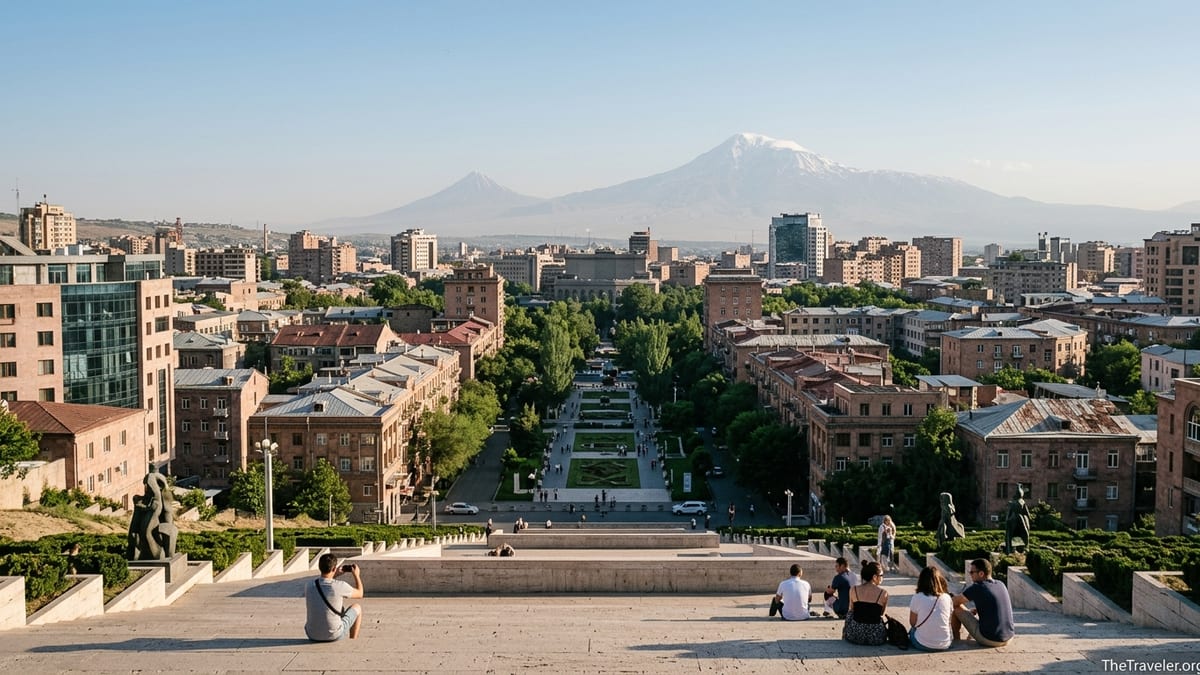
Why Armenia Belongs on Your Itinerary
Armenia is one of the easiest introductions to the Caucasus. Yerevan, the capital, feels more like a big town than a sprawling city. Central streets around Republic Square and the Cascade are walkable, packed with outdoor cafes, wine bars and dessert shops. Even in peak summer, the city rarely feels overwhelmed by tourism in the way some European capitals do.
Travelers are usually drawn by Armenia’s deep history. This is one of the world’s oldest Christian countries, and that heritage shows in clifftop monasteries like Geghard and Tatev, and in the Hellenistic Temple of Garni that looks like a piece of classical Greece dropped into a mountain gorge. You can visit several thousand-year-old sites on simple day trips from Yerevan.
Costs are relatively low compared to Western Europe. A filling sit-down meal in a casual Yerevan restaurant can still come in around what many travelers would pay for a sandwich and coffee at home. Taxis within the city commonly cost a few dollars for cross-town journeys, and museum entrance fees remain modest. This makes Armenia attractive for budget and midrange travelers who want value without sacrificing comfort.
Finally, Armenia is manageable in size. In one week you can see Yerevan, Lake Sevan, the forested town of Dilijan, some wine country and a monastery or two, without feeling rushed. Roads have improved significantly on the main tourist routes, and smartphone-based taxi and navigation apps reduce the friction that used to come with language barriers.
Entry, Visas and Safety: What First-Timers Need to Know
Most visitors either do not need a visa or can apply online. Citizens from the European Union, the United States, the United Kingdom, many Latin American countries and several others are visa-exempt for short visits; they simply receive a stamp on arrival. Many nationalities that do require a visa can use Armenia’s official e-visa system operated by the Ministry of Foreign Affairs. The portal currently offers short-stay options around 21 days and longer options around 120 days for tourism, family visits and business. Processing typically takes a few business days, so applying at least a week before departure is prudent.
Because visa rules and temporary exemptions are updated from time to time, always check the official Armenian MFA or e-visa website shortly before you travel, especially if you hold a non-Western passport or plan a longer stay. Border officers may ask to see proof of onward travel and accommodation, but in practice many tourists are simply asked about the purpose and length of their stay before receiving an entry stamp.
On safety, Armenia is generally considered one of the safer countries for travelers. Street crime against foreigners is relatively rare, particularly in central Yerevan where police presence is visible and locals are used to visitors. Standard urban precautions still apply: keep valuables zipped, avoid flashing large amounts of cash, and be more cautious late at night around empty parks or underpasses.
The main security caveat is regional tensions. Although active fighting is not a daily reality in Yerevan or main tourist areas, the situation around borders with Azerbaijan has been volatile in recent years, and some countries issue specific advisories against travel near those frontiers. First-time visitors typically stay well away from border zones. Before you go, read your government’s latest travel advice and avoid any excursions that would put you near disputed areas.
Getting In and Around: Airports, Transport and Everyday Costs
Most travelers arrive via Zvartnots International Airport outside Yerevan. The airport is relatively small and straightforward. After passport control and baggage claim, you will find ATMs, currency exchange booths and counters selling local SIM cards. Buying an eSIM or physical SIM on arrival makes it easier to use taxi apps and online maps right away.
To reach central Yerevan, the cheapest option is the airport bus (currently line 201), which costs the equivalent of well under 1 US dollar and runs to Republic Square during daytime hours. It is basic but safe, and locals use it frequently. Many first-time visitors, especially at night or with luggage, choose app-based taxis. Local apps such as GG and Yandex Go work similarly to Uber: you set your pickup, see a price estimate in Armenian dram and pay either in cash or by card depending on the app settings. In 2026 typical fares from the airport to central Yerevan are in the range of roughly 2,500 to 4,000 dram for a standard car, sometimes a bit higher at peak times, which usually comes to under 10 US dollars.
Be aware of unmetered taxis that wait directly outside arrivals and quote much higher prices to tourists. Reports of visitors being asked for 20 to 60 thousand dram for the same journey still surface. If you prefer not to use an app, agree clearly on a price before getting into any taxi, and use the usual airport-to-city range as your benchmark. Another option is a pre-booked private transfer arranged through your hotel or a transfer company. Those typically cost more than an app taxi but offer a fixed, pre-agreed rate and a driver waiting with a sign in the arrivals hall.
Within Yerevan, public transport consists of buses, minibuses and a small metro system. As of mid-2026, single rides on city buses and the metro remain inexpensive, with flat fares generally around the cost of a small coffee. Payment can be made in cash to the driver or attendant, or via modern systems such as QR tickets and contactless cards at metro stations and some buses. For most visitors, however, taxis remain the most convenient option. A 10-minute ride across central Yerevan may show up in the GG app at around 800 to 1,500 dram, which many travelers find cheaper than public transport at home.
When to Go and How Long to Stay
Armenia has four distinct seasons. Spring, from roughly April to early June, is one of the most comfortable times to visit. Yerevan temperatures are warm but not yet scorching, mountain roads are mostly clear of snow, and hillsides around monasteries like Khor Virap and Noravank are green. This is a good window for first-timers who want to combine city time with light hiking and day trips.
Summer, especially July and August, can be very hot in Yerevan, with daytime temperatures often above 30 degrees Celsius. Locals adapt by shifting social life later into the evening. You will find families strolling around Republic Square at 10 p.m., and cafe terraces busy well past midnight. If you travel in summer, consider staying in accommodations with air conditioning and spending the hottest hours in museums, underground wine bars or malls. Higher-altitude destinations such as Dilijan, Jermuk and areas around Lake Sevan are significantly cooler and make refreshing escapes.
Autumn, from late September through October, is arguably the best all-round season. Grape harvests take place in wine regions such as Areni and Vayots Dzor, while forests around Dilijan turn shades of gold and red. Weather is still pleasant enough for outdoor dining in Yerevan, and skies are often clear, giving postcard views of Mount Ararat from vantage points like the Cascade. Winter can be cold and snowy, especially outside the capital, but it brings its own appeal for those interested in skiing at Tsaghkadzor or seeing monasteries under a layer of snow.
For a first trip, many visitors allocate 5 to 7 days, which allows three or four nights in Yerevan plus one or two overnight trips. With a week you could spend three nights in Yerevan, two in Dilijan’s forests and one near Lake Sevan or in wine country. If you only have a long weekend, base yourself in Yerevan and join organized day tours to Garni, Geghard and Khor Virap to get a taste of Armenia’s landscapes and heritage.
Yerevan Essentials: Neighborhoods, Food and Culture
Most first-time visitors stay in or near central Yerevan, often around Republic Square, Northern Avenue, the Opera area or near the Cascade. From any of these areas you can walk to many key sights: the History Museum and National Gallery on Republic Square, the patterned steps of the Cascade complex, the Opera House and Swan Lake, and the popular Vernissage market where artisans sell carpets, jewelry, and carved wooden items. Side streets are dotted with wine bars pouring Armenian vintages from regions like Vayots Dzor, and cafes serving strong Armenian coffee in traditional small pots.
Typical daily costs in Yerevan are manageable. As a rough guide, a cappuccino at a modern cafe might cost in the range of 1.50 to 3 US dollars. A simple lunch of khorovats (barbecue), salad and soft drink in a casual restaurant may come in around 7 to 12 dollars per person, while a more elaborate dinner with shared starters, mains and local wine can still feel reasonable by Western standards. Public drinking water fountains, called "pulpulaks," are scattered across the city and safe for most visitors, which reduces spending on bottled water in summer.
Yerevan has a lively cultural scene despite its small size. In the evening, locals gather on the steps of the Cascade to watch the sun set behind distant hills, often with Mount Ararat visible on clear days. The adjacent Cafesjian Center for the Arts exhibits contemporary art in the cascade structure itself. The Armenian Genocide Museum and Memorial, set on a hill above the Hrazdan gorge, offers a sober and important look at modern Armenian history, and many visitors set aside a morning to visit.
First-time visitors are often struck by the contrast between Soviet-era architecture and new glass-fronted developments. Do not be afraid to explore residential side streets. Many courtyard cafe-bars sit behind unassuming doors off main avenues, and conversations with owners or staff can be among the most memorable moments of a trip. While English is increasingly spoken among younger Armenians and in tourism-facing businesses, learning a few words of Armenian or Russian goes a long way in daily interactions.
Beyond Yerevan: Classic Day Trips and Short Routes
Armenia’s small size makes it easy to explore beyond the capital. One of the most popular day trips combines the pagan Temple of Garni and the rock-hewn Geghard Monastery. Garni sits on the edge of a dramatic gorge; its single colonnaded building is a unique survivor from the first century. A short drive farther into the mountains brings you to Geghard, partly carved into the rock and often filled with choral singing that shows off its acoustics. Visitors can join shared minivan tours from central Yerevan, hire a taxi via an app for the day, or book a private driver through a local agency.
Another frequent excursion is to Khor Virap, a monastery with one of Armenia’s most photographed views: its chapel and walls with Mount Ararat rising behind the nearby border. On clear mornings the snow-capped peak appears very close, even though it now lies across the frontier. Many tours combine Khor Virap with Noravank Monastery in a red-rock canyon and a stop in Areni wine region, where family wineries welcome guests for tastings of dry and semi-sweet wines made from local grapes.
For cooler air and forest scenery, Dilijan National Park in the northeast is a favorite. The town of Dilijan has guesthouses, boutique hotels and hiking trails leading to monasteries such as Haghartsin and Goshavank. Travelers often arrive by shared minibus from Yerevan’s northern bus station or by pre-arranged transfer, then use local taxis to reach trailheads. Lake Sevan, one of the world’s largest high-altitude lakes, lies about an hour’s drive from the capital. In summer, city residents flock to its pebbly beaches and simple fish restaurants serving freshly grilled trout or whitefish.
If you have more time, consider a southern route through Vayots Dzor and Syunik provinces toward the town of Goris and the cable car to Tatev Monastery. Known as the Wings of Tatev, this long aerial tramway carries visitors over a deep gorge to a sprawling monastery complex with panoramic views. Many travelers overnight in Goris or a nearby village guesthouse to break up the journey and explore cave dwellings and small churches in the surrounding hills.
Money, Connectivity, Etiquette and Practical Tips
The local currency is the Armenian dram. ATMs are widespread in Yerevan and present in most larger towns. Cards are accepted at many hotels, restaurants and supermarkets in the capital, but smaller guesthouses, markets and village shops may still prefer cash. It is sensible to carry a mix of small and medium dram notes for taxis, local buses and small purchases. Currency exchange offices in central Yerevan generally offer better rates than kiosks in airports or remote towns.
Mobile coverage is good across most populated areas and main roads. Many travelers either purchase a local SIM from major providers at the airport or use an eSIM package activated before arrival. Data packages are relatively affordable compared to Western Europe and North America, which makes it easy to use online maps, translation apps and taxi services throughout your trip. Wi-Fi is widely available in hotels and cafes in Yerevan and other tourist towns, although speeds can vary.
Armenians tend to be warm and direct. Simple gestures of respect go a long way. Dress codes at major monasteries are generally relaxed, but covering shoulders and avoiding very short shorts is appreciated, especially when services are in progress. When entering a church, it is customary to speak quietly and avoid flash photography. If you are invited into someone’s home, bringing a small gift such as chocolates, fruit or a bottle of wine is considered polite.
Tipping practices are evolving. Some Yerevan restaurants add a service charge, while others do not. Leaving around 5 to 10 percent in cash at sit-down restaurants or rounding up small taxi fares is common but not obligatory. In markets, modest bargaining is acceptable, but aggressive haggling over small amounts is not typical and can feel disrespectful. If a price feels too high in a tourist-oriented shop, you can politely ask for a better price or simply move on.
Border Realities and Regional Combinations
First-time visitors should be aware that Armenia’s land borders with some neighbors are closed. The frontiers with Turkey and Azerbaijan remain shut to regular travel. This means you cannot cross overland directly from Armenia into those countries as a tourist. Instead, most overland travelers combine Armenia with Georgia, whose border to the north is open and well-used. Buses and shared taxis connect Yerevan with Tbilisi in around six to seven hours, and there are also periodic train services, whose schedules and prices vary by season.
Because of political tensions, travelers who enter or exit certain disputed regions via Armenia risk future problems entering Azerbaijan. Immigration authorities there have, in the past, refused entry or questioned travelers whose passports showed evidence of such visits. Even if stamps are no longer issued, online photos and trip records can still prompt questions. If you plan to visit both Armenia and Azerbaijan on the same broader trip, it is wise to research current policies and consider starting with the country that has stricter entry rules.
Land borders with Iran to the south are open to traffic, and some adventurous travelers transit between the two countries by road, often as part of longer overland routes. However, infrastructure, security perceptions and visa requirements for Iran are very different from Armenia, so this is less common for casual first-time visitors. For most people on an initial trip, combining Armenia with Georgia via a simple Yerevan–Tbilisi loop is the most straightforward regional plan.
When crossing any land border, allow extra time. Queues can build up on busy weekends or holiday periods, and procedures may be slower than at modern airports. Carry printed or easily accessible copies of your hotel bookings and onward transport confirmations. Having a small amount of both currencies on either side of the border can make buying snacks, water or onward bus tickets much easier, especially at smaller crossings.
FAQ
Q1. Do I need a visa to visit Armenia for tourism?
For many nationalities, including citizens of the EU, United States and United Kingdom, short tourist visits are visa-free. Others can use Armenia’s official e-visa system for stays typically ranging from about 21 to 120 days. Because rules change, always confirm your status and any temporary exemptions on the official Armenian Ministry of Foreign Affairs or e-visa website shortly before you travel.
Q2. Is Armenia safe for solo travelers and women?
Armenia is generally considered safe for solo travelers, including women. Central Yerevan is lively late into the evening, and violent crime against tourists is rare. Usual city precautions still apply, such as avoiding very dark, isolated areas at night, keeping your phone and wallet secure, and using reputable taxi apps rather than unmetered cars that approach you at the airport or bus stations.
Q3. How much should I expect to pay for a taxi from Yerevan airport to the city center?
With local taxi apps such as GG or Yandex Go, a standard ride from Zvartnots International Airport to central Yerevan typically falls in the rough range of 2,500 to 4,000 Armenian dram, usually under 10 US dollars. Unofficial taxis that wait outside arrivals often quote higher prices, sometimes several times the usual rate, so using an app or pre-booked transfer helps you avoid overpaying.
Q4. What is the best time of year to visit Armenia for a first trip?
Late spring and early autumn are the most comfortable periods for a first visit. From April to early June and again from late September through October, temperatures in Yerevan are pleasant, roads to mountain monasteries are generally clear, and you can enjoy both city life and countryside without extreme heat or cold. Summer is hotter but good for those planning to spend time at Lake Sevan or in higher-altitude towns like Dilijan.
Q5. Can I drink tap water in Armenia?
Many locals drink tap water in Yerevan and other towns, and the city also has numerous public drinking fountains known as pulpulaks, which are commonly used. Most healthy visitors tolerate the water without issues, but if you have a sensitive stomach or are traveling in very remote areas, you may prefer filtered or bottled water. Carrying a refillable bottle is convenient, especially in summer.
Q6. Is English widely spoken in Armenia?
English is increasingly spoken in Yerevan, especially among younger people and in hotels, restaurants and tour companies. In smaller towns and rural areas, you are more likely to encounter Armenian and Russian as the main languages. Learning a few basic phrases, or using a translation app offline, will make interactions smoother and is often appreciated by locals.
Q7. How expensive is Armenia compared to Western Europe or North America?
Overall, Armenia is more affordable than most Western European countries and North America. Restaurant meals, local transport and entrance fees to cultural sites are usually lower. For example, a simple sit-down lunch with a main dish and drink might cost what a single takeout meal does in many large Western cities. However, imported goods, high-end international hotel chains and some specialty activities can approach Western prices.
Q8. Can I use credit cards, or do I need to carry cash?
Credit and debit cards are widely accepted at midrange and upscale hotels, many restaurants and larger supermarkets in Yerevan and other tourist centers. Smaller guesthouses, family-run eateries, rural shops and markets may only accept cash in Armenian dram. It is wise to withdraw some cash at an ATM on arrival and carry smaller notes for taxis, public transport and small purchases.
Q9. Is it easy to visit Georgia from Armenia on the same trip?
Yes, combining Armenia with Georgia is common. The land border between the two countries is open, and buses, shared taxis and trains connect Yerevan with Tbilisi. The journey usually takes around six to seven hours by road. Many travelers spend a few days in each capital and add side trips such as Dilijan and Lake Sevan in Armenia, and Kazbegi or Kakheti in Georgia.
Q10. Are there areas of Armenia that first-time visitors should avoid?
Most major tourist destinations, including Yerevan, Dilijan, Lake Sevan, Garni, Geghard, Khor Virap and Tatev, are routinely visited without issues. First-time travelers are generally advised to avoid border areas with Azerbaijan and any zones subject to particular security advisories from their home government. Before your trip, check recent travel advice for Armenia and follow local guidance about areas that may be restricted or sensitive.