


Armenia has been on many travelers’ wish lists for its monasteries in misty gorges, smoky barbecue joints, and café culture in Yerevan. Yet headlines about the 2023 Nagorno Karabakh crisis and shifting regional politics have left many wondering whether it is still a wise choice in 2026. The reality on the ground is more nuanced than the news ticker. For most international visitors, Armenia remains a safe, rewarding and relatively affordable destination, but it is important to arrive informed and with realistic expectations.
Get the latest updates straight to your inbox!
The 2026 Big Picture: Is Armenia Still a Good Bet?
From a traveler’s standpoint, Armenia in mid 2026 is a country in transition rather than a country in crisis. The fighting connected to Nagorno Karabakh took place outside Armenia’s main tourist zones and has not affected day to day life in Yerevan, Dilijan, Tatev, or Lake Sevan. There is no active war on Armenian territory today, and visitors walking through Yerevan’s Republic Square in the evening will find families with strollers and street musicians, not soldiers on patrol.
Tourism numbers did wobble after 2023, with a modest decline in 2024 before recovering again in 2025, as reported by Armenia’s Tourism Committee. Visitor flows are also diversifying, with more travelers now arriving from Europe, the Middle East, and East Asia, not only from Russia. On the ground, that means menus in English are more common, staff in boutique hotels are used to first time visitors, and tour agencies in central Yerevan have reoriented to small group cultural and hiking trips rather than only regional package tours.
For an international traveler choosing between Armenia and a more established European destination, the trade off looks like this: Armenia offers deeper novelty, gentler prices for most things, and a sense of discovering a place still figuring out its modern identity, at the cost of some rough edges in infrastructure and less predictability. If you are comfortable with a bit of ambiguity and want a place that still feels real and unscripted, Armenia remains well worth the journey.
That said, it is essential to understand that Armenia’s borders with Azerbaijan and Turkey remain closed. Overland arrivals are currently practical from Georgia and Iran only, and any itinerary that depends on hopping by land to Baku or eastern Turkey is no longer realistic. For most visitors, this is a planning detail rather than a safety issue, but it does affect route design.
Safety on the Ground: What Travelers Actually Experience
Ask frequent visitors about Armenia’s biggest safety concern and many will point not to crime or conflict, but to the roads. Within Yerevan, petty crime like pickpocketing occasionally occurs in busy spots such as the evening crowds at Republic Square’s musical fountains or at the Vernissage flea market, but violent crime against tourists remains rare by global standards. Many travelers compare their sense of personal safety in central Yerevan to that in cities like Vienna or Seoul, especially at night.
Outside the capital, small towns such as Dilijan, Goris, and Gyumri tend to feel even more relaxed. In places like the village of Tatev, where visitors come mainly for the monastery and the Wings of Tatev cable car, it is not unusual to see children walking home at dusk and elderly residents offering rides to tourists caught in the rain. Solo travelers, including many women, report being more likely to be fussed over by guesthouse owners than harassed in the street.
Where you do need to pay attention is when renting a car or joining long transfers. Armenia’s mountain roads can be narrow and poorly lit, with patchy guardrails and occasional aggressive overtaking. Winter snow in high passes, such as along the route to Jermuk or around Lake Sevan, can complicate driving for those unused to mountain conditions. If your budget allows, consider hiring a local driver for intercity legs or joining reputable small group tours that use professional drivers familiar with the routes.
Geopolitically, Armenia’s leadership has shifted further away from Russia and toward closer cooperation with the European Union and other partners. The frontline with Azerbaijan is far from typical tourist itineraries, and visitors who stick to Yerevan, the main north south corridor, and classic monastery circuits will not pass near militarized areas. It remains wise to avoid border regions with Azerbaijan unless you are with a trusted local operator and to check your embassy’s latest guidance before travel, but for most itineraries, the conflict is something you read about in the news, not something you feel in the streets.
Costs and Value: What a Trip Really Costs in 2026
Armenia is no longer the ultra cheap destination it once was, particularly in Yerevan, where an influx of foreign residents after 2022 has pushed up rents and restaurant bills. Still, compared with Western Europe, it remains good value for quality. As of early 2026, midrange hotel prices in Yerevan average around 60 to 70 US dollars per night, with many four and even some five star properties often available for under 80 dollars outside peak dates. Simple guesthouses in the regions typically range from 20 to 40 dollars per room including breakfast.
On the food front, a sit down lunch of khorovats (grilled meat), salad, lavash bread, and a soft drink at a casual place off Northern Avenue might cost 7 to 10 dollars per person. A more polished dinner with wine at a modern bistro in the Saryan Street wine bar district, like In Vino or a contemporary Armenian kitchen nearby, is likely to land around 20 to 30 dollars per person, depending on your wine choice. Espresso based coffee at third wave cafés such as The Green Bean or Aztag typically runs 2 to 3 dollars, similar to prices in Central Europe but with ample cafes to linger in for hours.
Transport remains relatively inexpensive. A Yerevan metro ride is only a small fraction of a dollar and city buses are similarly low cost, though routes can be confusing for first timers. A taxi ride across central Yerevan booked through local ride hailing apps usually costs between 1.50 and 4 dollars, depending on traffic and distance. Private day trips from Yerevan to popular sites like Garni and Geghard monasteries start at roughly 40 to 60 dollars for a car and driver booked through a tour agency, while small group tours on fixed itineraries are often in the 30 to 50 dollar range per person.
Overall, many visitors find that a comfortable daily budget in Yerevan lands around 70 to 120 dollars per person including midrange accommodation, meals at a mix of casual and nicer places, local transport, and entrance fees. In the countryside, that figure can drop significantly if you stay in family run guesthouses and eat primarily local food. Backpackers staying in dorms, using public transport, and self catering can still manage on substantially less, especially if they avoid imported alcohol and high end restaurants.
Culture, Food and Daily Life: Why Armenia Still Feels Special
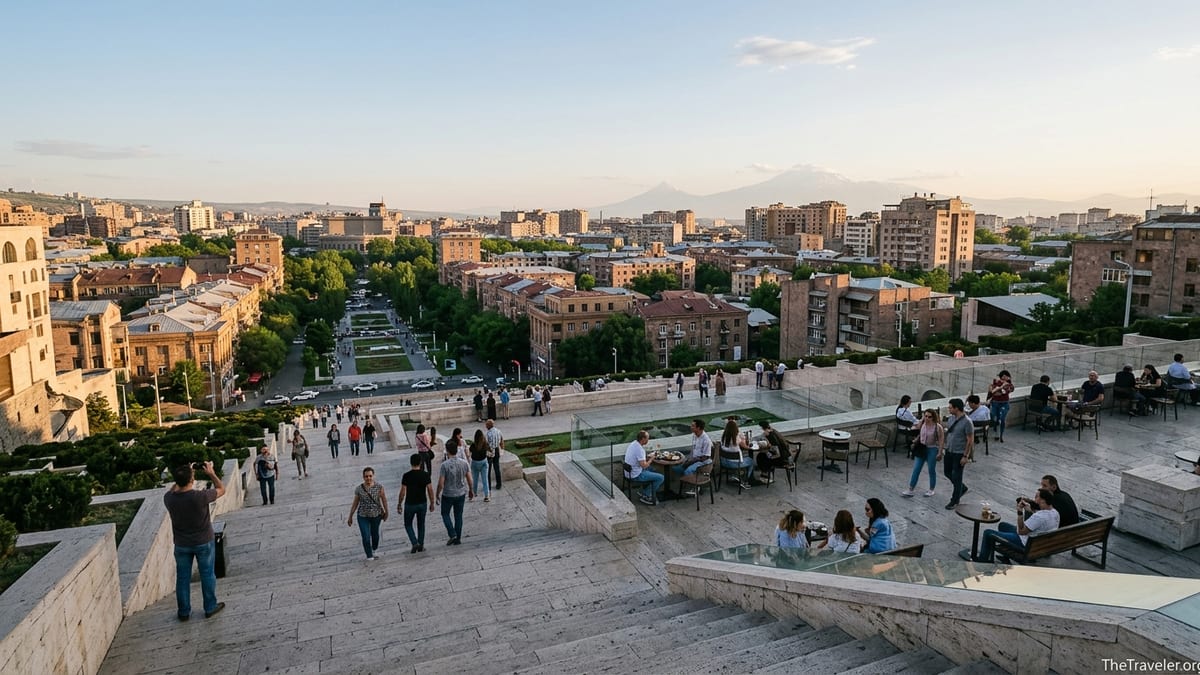
Armenia’s greatest draw remains its culture: a deep Christian heritage interwoven with older pagan traditions, and a contemporary urban scene that feels distinctly Armenian rather than copy pasted from elsewhere. Nowhere is this clearer than in Yerevan, a pink tuff stone city where you can spend a morning at the Matenadaran manuscript museum studying medieval illuminated texts, then wander to Cascade for public art and people watching, before an evening of jazz in a basement bar.
For many travelers, food is the moment when the country comes alive. A classic introduction is a feast at a garden restaurant on the outskirts of the city, where platters of tolma (stuffed grape leaves), fresh herbs, grilled vegetables, and pork or lamb khorovats arrive to the table alongside carafes of pomegranate wine or local whites from regions like Vayots Dzor. In villages near Areni or around Lake Sevan, it is still possible to be invited into a family’s home for homemade mulberry vodka and still warm lavash pulled from a tonir oven, an experience that feels less curated than home stays in more tourist saturated destinations.
Armenia’s creative scene has also grown more confident. Yerevan’s Kond district, once overlooked, is slowly turning into a hub of small galleries, murals and pop up studios, even as parts of it remain crumbling and lived in. Gyumri, the country’s second city, markets itself as a cultural capital, with a growing cluster of studios in old brick warehouses and film themed cafés reflecting its cinematic history. Travelers who stay longer than a weekend and look beyond the headline monasteries often comment that Armenia feels like a place on the cusp of change, with a new generation negotiating how to balance tradition with modern, outward looking aspirations.
The hospitality that Armenia is famous for remains tangible, although some visitors also notice an undercurrent of fatigue linked to recent crises and the arrival of large numbers of displaced people. Expect warm welcomes in guesthouses and from small business owners, but also be prepared to encounter taxi drivers or market vendors who are frank about economic hardship. For many visitors, hearing those stories is part of understanding the country today.
Practicalities: Visas, Borders and Getting Around
Visa rules vary widely by nationality, but Armenia continues to maintain a relatively open stance toward tourists. Citizens of many countries, including much of Europe, North America, and parts of Asia, can enter visa free for short stays. Others can obtain an electronic visa through the official Armenian government portal in a matter of days, with the e visa accepted at the international airport in Yerevan and at official land crossings with Georgia and Iran. Because visa arrangements evolve, travelers should verify current requirements with Armenian consular sources or reputable travel advisories before booking flights.
Overland access remains straightforward through Georgia. Many travelers combine Tbilisi and Yerevan, using the train that runs between the cities in season or taking shared taxis and minivans that cover the journey in five to seven hours, depending on the route. The Bagratashen border crossing between Georgia and Armenia is busy but generally efficient, and the road onward to Vanadzor and Yerevan is one of the main arteries of the country. The land border with Iran is also open and used by a mix of traders, truckers, and a trickle of adventurous tourists, especially motorcyclists and overlanders, though it is a longer and more logistically involved route for most visitors.
Once in Armenia, moving around is relatively simple, especially if you are willing to rely on local drivers. Yerevan has a compact center that is walkable for many sights. The single line metro runs north south and can be a useful supplement for reaching stations such as Republic Square or Sasuntsi Davit. For day trips and intercity travel, most tourists either book rides through their accommodation, use local ride hailing apps for shorter rural journeys, or join organized tours. Marshrutkas, or minibuses, still serve most routes and depart from specific bus stations, but deciphering timetables can be an adventure for non Russian or non Armenian speakers.
It is worth noting that Armenia introduced updated legislation on tourism safety and standards entering into force in late 2024 and 2025. The law clarifies responsibilities for tour operators and guides, including requirements around information provision and safety on difficult routes. In practice, this is leading to more certified guides for hiking routes such as those in Dilijan National Park and the mountains around Aragats, although enforcement varies and travelers should still ask operators about equipment, insurance, and contingency plans for remote excursions.
Risks, Scams and Ethical Concerns
While Armenia is generally safe, travelers should be aware of a small but predictable set of annoyances. In central Yerevan, some high profile restaurants around Republic Square and the most touristy stretch of Northern Avenue are known to charge significantly more than comparable places one or two streets away. That does not always mean you are being scammed, but it does mean that a bowl of khashlama stew or a glass of wine can cost double simply because of the address. Checking menus before sitting down and asking locals for recommendations can help avoid budget surprises.
Taxi scams are less common than in some neighboring countries thanks to widespread use of app based rides. However, drivers who approach you directly at the airport arrivals hall or outside major sights may offer prices well above what an app would quote. A typical app based ride from Zvartnots International Airport to central Yerevan in 2026 might cost between 6 and 10 dollars, so a driver quoting 25 or 30 dollars is relying on your lack of information. Using official airport taxi desks or ride hailing apps is generally safer and cheaper.
As with any destination, there are also ethical considerations. Many of the most powerful sites in Armenia are places of trauma. The Armenian Genocide Museum in Yerevan, memorials connected to the Soviet period, and more recent monuments highlighting the displacement from Nagorno Karabakh ask visitors for a degree of sobriety. Posing for playful photos at these locations or treating them as just another Instagram backdrop can be deeply hurtful to locals. Similarly, travelers should avoid any attempt to visit sensitive border areas without permission, both for safety and out of respect for communities still dealing with the consequences of conflict.
Finally, Armenia is socially conservative in some respects. While Yerevan has a small but visible LGBTQ community and a handful of queer friendly bars, attitudes outside the capital can be more traditional. Same sex couples should be prepared for stares if openly affectionate in smaller towns, though outright hostility is uncommon. Solo women and visible minorities usually report curiosity rather than aggression, but as always, listening to local advice about neighborhoods and late night transport is wise.
Who Will Get the Most out of Armenia Right Now?
Armenia in 2026 is best suited to travelers who value culture, landscapes, and human encounters over polished infrastructure. If your ideal trip involves all inclusive resorts and seamless high speed trains, you may find the country frustrating. But if you are drawn to crumbling monasteries perched above dramatic gorges, evenings spent in wine bars talking politics with locals, and spontaneous invitations to backyard barbecues, Armenia still feels rich and rewarding.
Hikers and nature lovers will find particular joy. Trails around Dilijan, such as the routes between Parz Lake and Goshavank monastery, have improved waymarking compared with a few years ago, and community based guesthouses give direct economic benefits to local families. The drive to Tatev, especially if combined with the record breaking Wings of Tatev cable car, pairs dramatic scenery with cultural depth. Those who enjoy slow travel can base themselves for a week in a place like Gyumri or a village near Areni, taking time to learn about local wine production or simply adjusting to the slower rhythms of rural life.
Short city break travelers can also have a satisfying experience. A four day stay in Yerevan allows time for key sights like the Matenadaran, Cascade, Vernissage, the Genocide Memorial, and a day trip to Garni and Geghard. Add in café hopping along Tumanyan Street, a night listening to live music at a jazz club, and a couple of long dinners with Armenian wine, and you will leave with a strong sense of place, even if you do not venture far into the regions.
Where Armenia may be more challenging is for travelers with very limited mobility. While newer hotels and public buildings in Yerevan have improved accessibility, many historic sites involve stairs, uneven ground, and steep paths. Rural guesthouses often lack elevators or adapted bathrooms. Infrastructure is slowly improving, but visitors who rely on wheelchairs or other mobility aids should plan carefully with local operators experienced in accessible tourism and be prepared for some limitations in what can be comfortably visited.
The Takeaway
So, is Armenia still worth visiting today for international travelers? For most, the answer is yes, provided you come with awareness of the context and a flexible mindset. Day to day safety in the main tourist areas remains high, the country offers strong value for money in accommodation and food, and its cultural and natural attractions are as compelling as ever. The combination of ancient monasteries, a modernizing capital, and villages that still run on neighborly hospitality creates a layered travel experience that is hard to replicate elsewhere.
At the same time, Armenia is not a frictionless destination. Geopolitical tensions on its borders, a recent history of conflict related displacement, and uneven infrastructure shape both local life and visitor experience. Respecting those realities, and traveling in ways that support local communities rather than treating the country as a cheap backdrop, is part of being a responsible guest.
If you are comfortable navigating a few practical challenges and want to understand a corner of the Caucasus that is working to redefine its future, Armenia in 2026 remains a deeply worthwhile place to visit. Go for the monasteries and mountain views, stay for the conversations over coffee and the feeling of being welcomed into a small country with a big sense of identity.
FAQ
Q1. Is Armenia safe to visit right now given the situation with Azerbaijan?
For typical tourist itineraries focused on Yerevan, Lake Sevan, Dilijan, Tatev and similar areas, Armenia is generally considered safe in 2026. The front line with Azerbaijan is far from these routes, and there is no active fighting in the main tourist zones. Travelers should avoid border areas with Azerbaijan, keep an eye on official advisories, and book trips to remote regions with reputable local operators.
Q2. How expensive is Armenia compared with Western Europe?
Armenia is noticeably cheaper than Western Europe for most visitors, though central Yerevan has become pricier in recent years. A comfortable midrange budget in the capital might be around 70 to 120 US dollars per person per day including lodging, meals, local transport and entrance fees, with costs falling further in the regions if you stay in guesthouses and eat local food.
Q3. Do I need a visa to visit Armenia as a tourist?
Many nationalities, including most Europeans and North Americans, can enter Armenia visa free for short stays. Others can usually apply online for an electronic tourist visa. Because rules change, you should always check the latest information from Armenian consular services or government sources before booking tickets.
Q4. Is it easy to combine Armenia with Georgia in one trip?
Yes. Many travelers visit both Tbilisi and Yerevan on the same journey. Overland connections between the two capitals are straightforward, using either a seasonal train or shared taxis and minibuses that cross the border via Georgia’s southern crossing points. Most tour agencies in Yerevan can arrange private transfers if you prefer more comfort.
Q5. What about solo female travelers in Armenia?
Solo female travelers commonly report feeling safe in Armenia, especially in central Yerevan and main tourist towns. As elsewhere, normal precautions apply, such as choosing licensed taxis or ride hailing apps at night and being cautious with alcohol. In smaller communities, curiosity about solo women is more common than harassment, and many guesthouse owners keep a protective eye on their guests.
Q6. Is Armenia LGBTQ friendly for visitors?
Yerevan has a small LGBTQ community and a few discreet queer friendly spaces, but Armenian society overall is relatively conservative. Same sex couples are unlikely to face problems if discreet, particularly in tourist areas, though open public affection may draw attention. Outside the capital, attitudes tend to be more traditional and low profile behavior is advisable.
Q7. When is the best time of year to visit Armenia?
Late April to June and September to mid October are often considered the most pleasant times, with mild temperatures and good visibility for mountain views. July and August can be hot in Yerevan, though cooler in highland areas. Winter appeals to some visitors for snow landscapes and quieter sites, but travel can be affected by icy roads and limited public transport schedules.
Q8. Can I drive myself in Armenia or should I hire a driver?
You can rent a car and drive yourself, especially if you have experience with mountain roads and defensive driving. However, local driving habits, variable road quality and winter conditions mean many visitors choose to hire a driver for intercity routes. For short visits focused on classic sights, combining Yerevan taxis, organized day trips and occasional transfers with drivers is often the least stressful option.
Q9. What should I wear to visit monasteries and churches?
Dress is generally modest but not strict. For most churches and monasteries, shoulders and knees covered are appreciated, and a scarf for women can be useful, especially in more traditional rural sites. Closed toe shoes or sturdy sandals help with uneven paths and stone steps. Flashy, revealing outfits are best kept for city bars rather than religious sites.
Q10. Is tap water safe to drink in Armenia?
Many locals in Yerevan and other cities drink tap water, and you will see public fountains, called pulpulaks, used daily. Sensitive stomachs may prefer bottled or filtered water, at least for the first few days. In rural areas or when hiking, it is wise to treat spring or stream water with a filter or purification tablets unless a trusted local specifically vouches for the source.