


More news on this day
Construction work at Montreal’s Pierre Elliott Trudeau International Airport has led to intermittent odours in parts of the terminal complex, prompting minor slowdowns and additional checks, but publicly available information indicates there is no health risk associated with the smells.
Get the latest news straight to your inbox!
Temporary smells linked to major infrastructure works
Reports from travellers and local media describe a strong, chemical-like odour at times in the public areas of Montreal’s main airport, coinciding with large-scale redevelopment of access roads, parking structures and terminal-adjacent buildings. The smells have been most noticeable near construction zones and connecting corridors where ventilation patterns have temporarily changed.
Publicly available project documentation shows that Aéroports de Montréal (ADM) is in the middle of a multi‑year upgrade that includes new multi‑level parking facilities, redesigned drop‑off zones and improved access to the future REM light‑rail station. Construction phases involve demolition, concrete pouring, waterproofing and utility relocation, all activities that can generate short‑term odours from solvents, sealants and building materials.
Environmental assessments associated with the current access and parking redevelopment indicate that air‑quality impacts from the work are expected to be localized and temporary, with mitigation measures such as dust control, equipment maintenance and monitoring of fumes. These documents characterize odours as a potential nuisance rather than a source of significant long‑term exposure.
ADM has previously used similar language in federal filings for other projects at Trudeau airport, stating that construction activities are not likely to cause significant adverse environmental effects when standard controls on air quality and noise are applied. The current situation with intermittent smells has been framed in the same way: an operational irritation during an intense building phase, rather than a health emergency.
Delays concentrated in security and road access
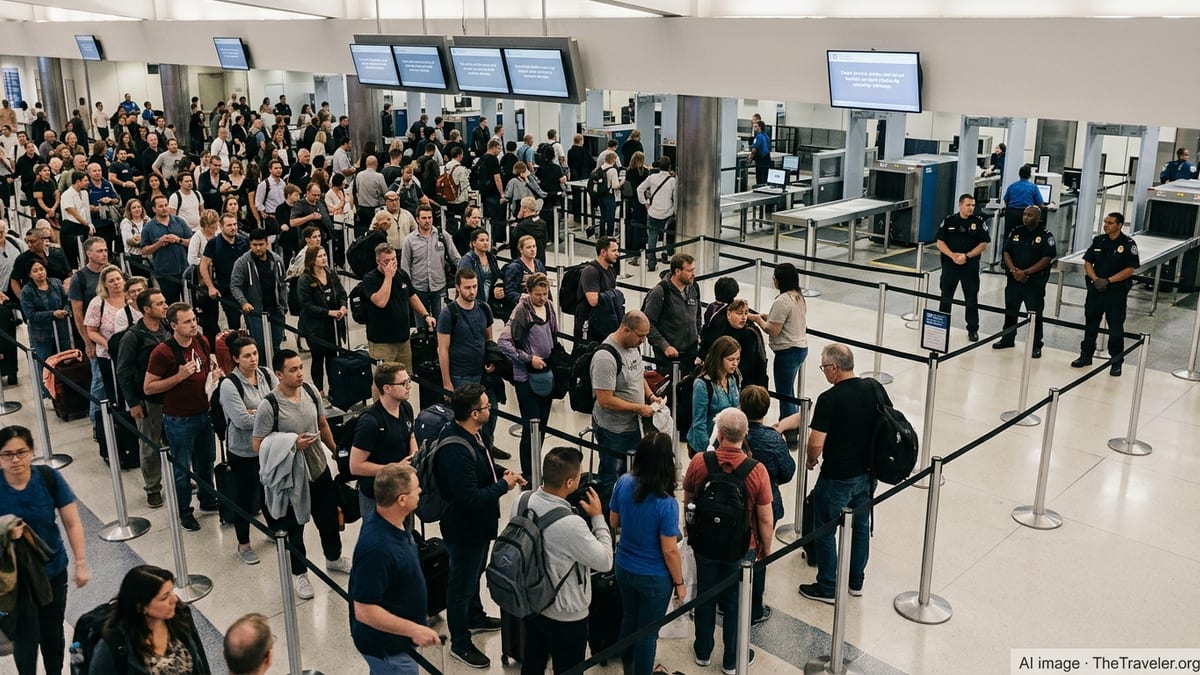
The most visible impact for travellers has been delays at security checkpoints and along terminal access roads, rather than inside aircraft cabins. When odours become pronounced in certain interior areas, staff have temporarily slowed the flow of passengers to allow for checks of ventilation and to redirect people away from the most affected spots.
On the curbside and in the parking complex, lane reductions and work equipment already contribute to congestion during peak hours. The need to pause or reroute vehicle and pedestrian flows when odours are investigated has at times added to the bottlenecks, particularly in the morning and late‑afternoon rushes typical of summer travel.
Passenger accounts shared on social media platforms describe waits that are longer than usual at security screening and check‑in, though still within ranges commonly seen during busy travel seasons. Some travellers have also noted confusion when access routes change with little warning as crews move between phases of demolition and construction around the terminal.
Available information suggests that flight operations themselves have remained broadly stable, with most disruption occurring on the ground side of the airport campus. Airlines are continuing to advise passengers to arrive early at Trudeau, especially while high summer traffic coincides with the most intensive construction work on access infrastructure.
ADM points to air‑quality controls and monitoring
According to publicly available information, ADM has emphasized that the odours do not indicate a health hazard for passengers or employees. The operator has referred to air‑quality controls already in place for major projects at the site, including requirements to manage emissions from machinery and to monitor dust and fumes in work areas.
Environmental notices filed for recent developments at Trudeau airport outline a range of mitigation measures for air quality, such as limiting idling of construction vehicles, using low‑emission equipment where possible and adjusting work methods when strong smells occur. These same principles are being applied to the current works affecting terminal approaches and connected structures.
Health‑risk assessments that underpin recent infrastructure approvals at YUL treat construction odours as an annoyance threshold rather than a toxic exposure, provided concentrations remain below established regulatory limits. The current episode is being presented within that framework, with emphasis on observation, ventilation adjustments and, when necessary, brief pauses in passenger flows.
ADM has also highlighted its experience managing other large projects at Trudeau airport, including new aircraft parking stands and expansions of baggage handling and passenger areas. Those projects similarly required controls on air emissions and worker safety plans, which are now being adapted to the more constrained environment of terminal‑adjacent construction.
Travellers advised to allow extra time and follow on‑site guidance
For passengers planning to travel through Montreal in the coming days, the main practical recommendation from publicly available guidance is to build in extra time. With both construction and peak‑season demand affecting the airport, earlier arrival allows a buffer for any temporary slowdowns linked to odour checks or route changes.
Travellers are also being encouraged, through airport communications and airline advisories, to pay attention to on‑site signage and staff directions. Detours around closed corridors, modified drop‑off points and temporary partitions can change from week to week as crews move equipment and open up new sections of the project.
Those particularly sensitive to smells may wish to spend less time in transitional spaces such as parking garages, walkways and landside concourses close to active works. Once inside the main, fully ventilated terminal zones past security, passengers generally report that odours are less noticeable and that operations feel closer to normal.
While no specific end date has been given for the current phase of construction around terminal access, project descriptions indicate that major improvements to parking, drop‑off areas and connectivity are expected to come online in stages over the next few years. Until then, occasional odours and the related precautionary delays are likely to remain part of the travel experience at Trudeau airport.