


More news on this day
Passengers at Copenhagen Airport faced a fresh wave of disruption as 189 delayed flights and 13 cancellations rippled across Europe, snarling schedules for carriers including SAS, Ryanair and KLM and stranding travelers bound for major hubs such as London, Amsterdam and Frankfurt.
Get the latest news straight to your inbox!
Knock-on Delays Hit Key European Gateways
Operational data from traffic trackers and passenger-rights monitoring sites indicate that a concentrated period of disruption at Copenhagen quickly spread beyond Denmark on Friday, as late departures and missed slots cascaded into major European gateways. Flights linking Copenhagen with London, Amsterdam, Frankfurt and other hubs experienced mounting knock-on delays as aircraft and crews fell out of position.
Published coverage of recent operations at Copenhagen shows how even limited local disruption can have an outsized impact on onward connections. On several days in late June, waves of delays at the airport generated dozens of late departures and a handful of cancellations tied to the Danish hub, with the effects visible throughout northwestern Europe as evening rotations slipped further behind schedule.
The latest episode follows that pattern. Once early departures from Copenhagen began operating behind schedule, aircraft scheduled to return to the airport later in the day carried the delay with them, reducing the room for recovery and increasing the risk of missed connections. With many of these flights feeding into congested airspace over London, Amsterdam and western Germany, small schedule deviations quickly translated into longer waits at gates and on tarmacs.
Air-traffic flow management measures and capacity constraints at several European hubs added another layer of complexity. Publicly available information suggests that congestion around busy morning and afternoon banks in London, Amsterdam and Frankfurt magnified the impact of delays originating in Copenhagen, leaving passengers facing extended waiting times even on flights that technically remained “on schedule” for departure.
Multiple Airlines Caught in the Disruption Web
Airlines with significant operations into and out of Copenhagen, including Scandinavian carrier SAS, low-cost operator Ryanair and Dutch flag carrier KLM, were among those most exposed to Friday’s disruption. Their schedules rely heavily on fast turnarounds and tight connection windows, which are especially vulnerable when a hub begins the day with delayed departures.
Recent punctuality statistics for Copenhagen highlight how quickly performance can deteriorate for individual airlines when conditions tighten. While SAS and KLM typically achieve high completion rates on routes to and from the Danish capital, monitoring by airport and independent data providers shows that both carriers have faced episodes of longer average delays during recent periods of strain, particularly during peak travel times.
Ryanair’s pan-European point-to-point model offers some insulation from hub-based disruption, but the carrier remains exposed when aircraft serving Copenhagen are scheduled on multiple legs across the day. Tracking tools show that when a morning flight from Copenhagen leaves late, subsequent segments on that aircraft often depart behind schedule as well, affecting passengers far from Denmark.
Other airlines operating through Copenhagen, from major network carriers to regional operators feeding into larger hubs, also reported delays on routes linked to the airport. Publicly available timetables and performance summaries suggest that some smaller carriers managed to maintain higher punctuality, but many still recorded increased average delays compared with normal patterns when the disruption peaked.
Stranded Passengers Face Long Queues and Rebooking Challenges
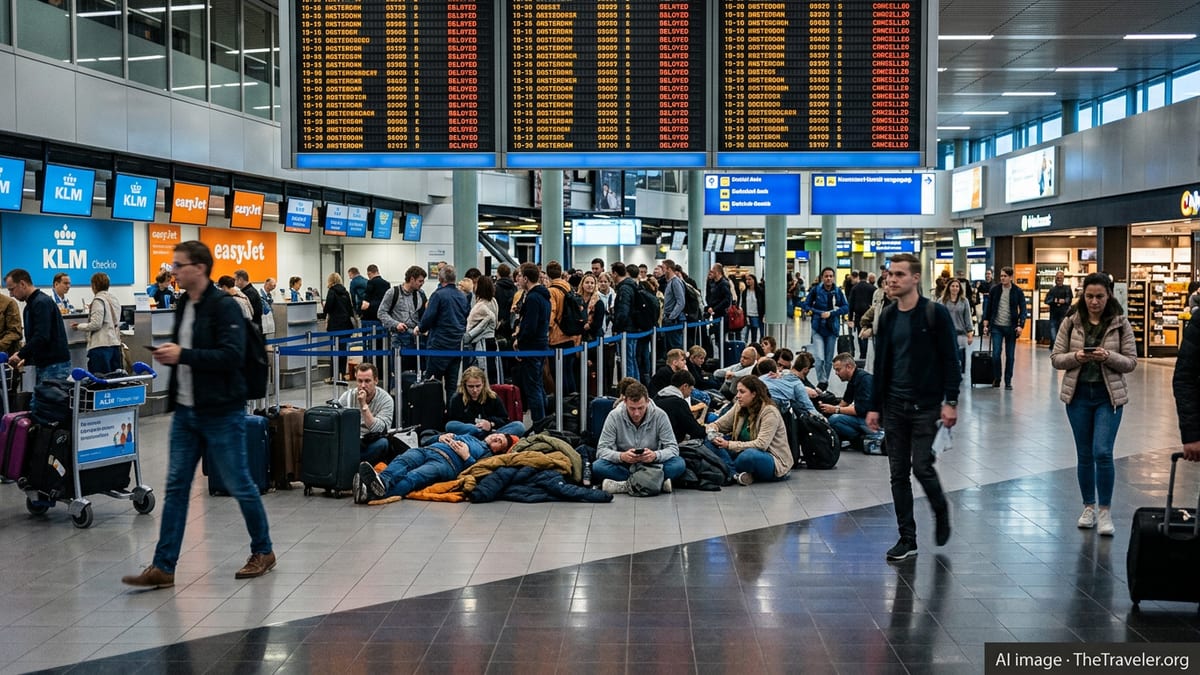
For travelers caught up in Friday’s disruption, the immediate impact was felt in crowded departure halls, extended security and check-in lines and uncertainty over rebooking options. Witness accounts shared on social media platforms and travel forums described departure boards filled with delayed flights and repeated gate changes for services to major European hubs.
The combination of 189 delayed flights and 13 cancellations placed considerable pressure on airline customer service desks and digital rebooking tools. With school holidays under way in parts of Europe, spare seats on alternative flights were limited on many routes, forcing some passengers to accept next-day departures or complex multi-stop itineraries in place of previously non-stop services.
Travelers connecting onward beyond London, Amsterdam and Frankfurt faced further complications. When inbound flights from Copenhagen arrived significantly late, minimum connection times were often breached, requiring manual rebooking and, in some cases, overnight accommodation. Reports on passenger-rights platforms indicate that some travelers struggled to secure clear information about their options during peak disruption periods.
Airport services, including food outlets and seating areas near heavily affected gates, also came under strain as travelers waited for updates. While core operations at Copenhagen continued, passengers reported that the overall experience deteriorated sharply during the height of the disruption, with limited quiet space and limited access to power outlets in crowded waiting areas.
Weather, Capacity and Tight Schedules Under Scrutiny
Although no single cause has been formally identified for the latest wave of problems, recent analyses of operations at Copenhagen and other European hubs point to a familiar mix of factors: fluctuating weather conditions, constrained staffing and infrastructure, and airline schedules that leave little margin for error. Aviation analysts note that similar patterns were observed during earlier bursts of disruption at the airport in June.
In those earlier events, published assessments suggested that a combination of peak-season congestion on the ramp and in air-traffic control, lingering staff shortages from previous years and dense timetables contributed to a fragile operating environment. Once delays began to accumulate, the lack of spare capacity on the ground and in the air left airlines few options to recover their schedules quickly.
Airports across northern Europe, including Copenhagen, London, Amsterdam and Frankfurt, have also faced periods of reduced capacity due to runway works, terminal adjustments and airspace management measures. Industry observers say that while these constraints are often temporary, they can exacerbate the impact of even minor operational issues, particularly on days of heavy traffic.
The pattern seen on Friday reflects this broader structural challenge. With many flights operating near capacity and crews rostered to the limit of legal duty times, disruption in one corner of the network can rapidly spread. In such conditions, even a relatively modest number of cancellations at a single hub can translate into hundreds of delayed flights across the wider region.
What Travelers Can Do When Disruption Strikes
Passenger-rights organizations advise travelers passing through Copenhagen and other busy European hubs to monitor flight status closely and build extra time into itineraries, especially when connecting to long-haul services. Many carriers, including SAS, Ryanair and KLM, provide real-time updates through their websites and mobile applications, along with self-service tools for rebooking in the event of delays or cancellations.
In the European Union, most flights departing from or arriving at airports such as Copenhagen, London, Amsterdam and Frankfurt fall under the bloc’s passenger-protection framework. Under certain conditions, travelers on significantly delayed or cancelled flights may be entitled to assistance such as meals, refreshments and accommodation, as well as potential financial compensation, depending on the cause and length of the disruption.
Experts on consumer travel rights emphasize that documentation is crucial. Passengers affected by events like Friday’s disruption are encouraged to keep boarding passes, booking confirmations and any written notifications from airlines, as these can be important when submitting claims later. Screenshots of delay times and gate changes can also help to establish the extent of the disruption.
With summer travel ramping up, observers expect European hubs including Copenhagen to remain under pressure in the coming weeks. While airlines and airports continue to adjust staffing and schedules to cope with demand, the events surrounding the 189 delays and 13 cancellations at Copenhagen highlight how quickly operations can unravel, and how important it is for travelers to stay informed and prepared when flying through the region.