


The United Arab Emirates has positioned itself as one of the most active startup and innovation hubs in the Middle East, underpinned by a rapidly expanding coworking and flexible office market. For potential relocators evaluating the UAE as a base for entrepreneurial or startup activity, understanding how coworking spaces integrate with the broader startup ecosystem is essential. This briefing assesses the current landscape, geographic distribution, operating models, and how these factors influence the practical experience of founders, remote workers, and early stage teams considering a move to the UAE.
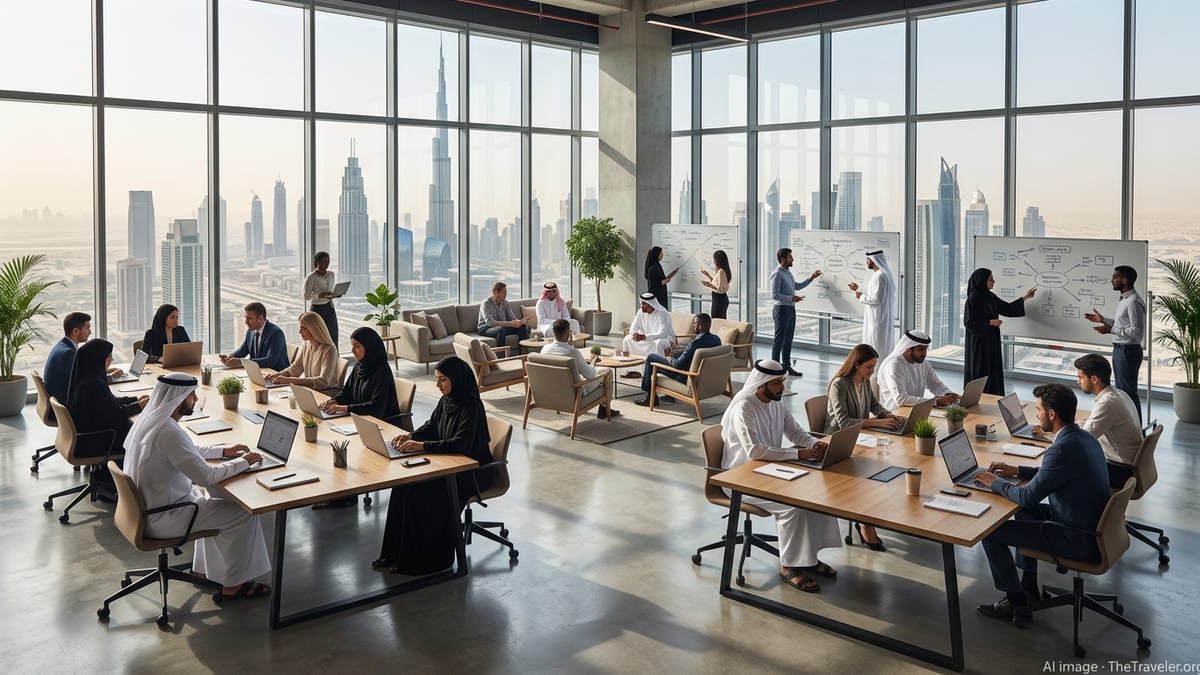
Scale and Structure of the UAE Coworking and Flexible Office Market
The UAE’s flexible office and coworking market has grown into a substantial segment of the country’s commercial real estate. Recent market research estimates the flexible office space market at around USD 1.2 billion in the mid 2020s, with forecasts suggesting high single digit annual growth through 2030. This expansion is linked to post pandemic hybrid work patterns, the influx of foreign-founded startups, and the country’s efforts to attract remote professionals.
The market is moderately concentrated, with global operators such as Regus, IWG, WeWork and Servcorp active in prime locations, while regional brands and local collectives fill more specialized niches. In parallel, several free zone authorities and government backed innovation hubs offer their own coworking style environments, blending real estate with soft-landing services for startups. For relocation planning, this means that coworking options range from purely commercial desks to highly curated ecosystems integrated into sector specific clusters.
Pricing varies widely by emirate, location, and service bundle. Desk memberships in secondary locations or suburban districts can be significantly cheaper than those in Grade A towers in central business districts. Many operators now combine traditional hot desking, dedicated desks and small private suites under one membership framework, which is particularly relevant for startups that expect to grow headcount quickly after arrival.
Another structural characteristic of the UAE market is its strong regulatory and infrastructure foundation in free zones. Many startup centric coworking spaces are physically located within free zones that provide company registration, licensing and other administrative functions in the same building or complex, reducing friction for new entrants that need to become operational quickly after relocation.
Geographic Distribution: Dubai, Abu Dhabi and Emerging Secondary Hubs
Coworking and startup activity in the UAE is strongly concentrated in Dubai and Abu Dhabi, with these two emirates accounting for the majority of flexible office capacity and most high profile innovation hubs. Dubai hosts a dense network of coworking facilities in areas such as Business Bay, DIFC, Dubai Marina, Jumeirah Lakes Towers, and the Dubai World Trade Centre district. Many are situated within or adjacent to established technology and media clusters like Dubai Internet City and Dubai Media City, creating a natural interface between global corporations and startups.
Abu Dhabi’s coworking landscape is somewhat smaller in absolute terms but strongly anchored by large, government backed platforms. Hub71, located in the Abu Dhabi Global Market area on Al Maryah Island, is the best known example. It offers coworking style workspaces embedded within a curated community of tech startups, investors and corporate partners. Additional flexible office capacity is emerging around Yas Island and newer mixed use districts as Abu Dhabi’s office market expands and occupiers favor flexible terms.
Secondary emirates such as Sharjah and Ras Al Khaimah are gradually developing their own coworking and startup offerings, although on a more limited scale. Market analyses indicate rising interest and new openings in Sharjah in particular, often tied to university linked innovation centers and smaller free zones. These locations may appeal to cost sensitive or niche sector startups, but founders should expect thinner networks, fewer large scale events, and a smaller pool of specialized mentors and investors compared with Dubai and Abu Dhabi.
From a relocation perspective, the geographic concentration implies that professionals who rely heavily on in person networking, investor access and frequent ecosystem events will usually find Dubai and Abu Dhabi more advantageous, while those prioritizing lower workspace costs and quieter environments may consider secondary emirates alongside occasional commuting to the main hubs.
Operator Types, Facilities and Membership Models
Coworking spaces in the UAE can be broadly grouped into three categories: international commercial operators, local and regional coworking brands, and ecosystem based hubs operated or supported by free zones, universities or government initiatives. International brands typically emphasize standardized fit outs, corporate grade meeting rooms, and extensive business services, making them attractive for remote teams of multinational companies and later stage startups needing predictable standards across cities.
Local operators and themed coworking spaces often focus on particular user segments such as creative industries, female entrepreneurs or early stage founders. Examples include women focused coworking environments in Dubai’s business districts and boutique spaces aimed at media, design and content production professionals. These spaces may offer specialized studios, podcast rooms or event areas that are not always present in generic corporate coworking chains.
Ecosystem driven hubs such as those in major free zones combine workspace with acceleration programs, mentorship, demo days and direct links to regulators. These hubs often offer subsidized or incentive based desk pricing for selected startups, including discounted or partially covered membership fees for fixed periods. While places in structured programs can be competitive, successful applicants may access a package that includes office space, legal setup, and investor introductions, which significantly alters the cost benefit equation for relocating founders.
Membership models usually include flexible hot desk use, fixed dedicated desks, small private offices and larger managed suites. Contracts mostly run from month to month up to one year, with deposits typically lower than those required for traditional leases. Many providers promote “hybrid” deals where a small private office can be supplemented by access to common hot desks for visiting or part time staff, a format particularly relevant for distributed startup teams or founders splitting time between the UAE and other markets.
Integration of Coworking with the UAE Startup Ecosystem
Coworking spaces in the UAE are closely intertwined with the broader startup ecosystem. The country consistently ranks within the global top tier of startup ecosystems by multiple international indices, with Dubai and Abu Dhabi both included in global city rankings and the UAE as a whole placed in the top three in the Middle East and North Africa. This reflects not only funding volumes but also density of support infrastructure, where coworking hubs function as physical anchors.
Government backed initiatives and free zones actively use coworking facilities as intake points for new founders. Hubs like Hub71 in Abu Dhabi or startup campuses in Dubai’s innovation districts host accelerator cohorts, thematic sprints and regulatory sandbox programs that require founders to be physically present for at least part of the year. Workspace seats, therefore, are often bundled with program participation, simplifying early relocation decisions because the location, community and basic office infrastructure are predetermined.
The UAE’s event calendar reinforces the linkage between coworking and ecosystem development. Global technology and startup events held annually in Dubai and Abu Dhabi attract large numbers of visiting founders and investors, and many coworking spaces temporarily adapt by offering short term passes, event themed networking sessions and pop up offices. For relocators, this pattern means that certain months of the year offer denser networking opportunities and heightened investor presence inside coworking communities.
Another integration point lies in sector specialization. Fintech, Web3 and digital asset startups often cluster in specific regulatory environments such as Abu Dhabi Global Market or Dubai’s virtual asset regimes, where coworking providers are co located with relevant regulators and financial institutions. Similarly, media and content startups gravitate towards media oriented free zones, where studios and production facilities are available within or near coworking campuses.
Funding Environment and Its Impact on Coworking Demand
The UAE has recorded some of the highest levels of startup funding in the Middle East over recent years, with annual venture capital flows reaching into the low billions of US dollars. Although funding volumes have been affected by global venture slowdowns, the country continues to attract a disproportionate share of regional investment transactions, particularly in fintech, e commerce, logistics technology and enterprise software. This funding environment has direct implications for coworking demand and stability.
In periods of strong funding, early stage firms scale headcount quickly and often upgrade from hot desks to private offices within coworking centers. Operators in prime districts report waiting lists or tight availability for larger units when funding cycles peak, especially in Dubai’s central business areas and Abu Dhabi’s main financial district. For relocating teams planning aggressive hiring, early engagement with preferred coworking providers and flexibility around exact location can mitigate the risk of space constraints.
Conversely, funding slowdowns or consolidation periods tend to push startups toward leaner arrangements. Some teams downsize to smaller offices or revert to hot desking, while others adopt hybrid modalities with partial remote working. This dynamic supports overall resilience in the coworking market, as reductions in one customer segment are often offset by the arrival of new early stage ventures attracted by more favorable pricing or incentives.
Founders considering relocation should note that some government backed hubs and accelerators link office space access to performance milestones or funding readiness. In such cases, loss of program eligibility may require a shift to standard commercial coworking terms. Incorporating this possibility into medium term planning can help avoid disruption if a startup’s trajectory diverges from initial expectations.
Regulatory and Free Zone Ecosystems Surrounding Coworking Hubs
Although broader regulatory and visa topics fall outside the primary scope of this briefing, it is important to understand that many UAE coworking spaces are embedded within free zones that define how startups operate day to day. Technology focused zones such as Dubai Internet City, Dubai Silicon Oasis and various free zones in Abu Dhabi function as both licensing authorities and hosts for coworking or incubation facilities. The choice of coworking location may therefore determine which regulator, set of commercial rules and sectoral permissions a startup interacts with.
Some free zones are highly specialized, targeting media, financial services, healthcare, industrial technology or academic collaboration. Coworking spaces within these zones often cater to corresponding sectors, attracting tenants who benefit from proximity to regulators, anchor corporations and research institutions. This spatial clustering can be advantageous for sector specific startups that need frequent engagement with partners or oversight bodies, but it can also narrow the general networking mix compared with more generic city center coworking hubs.
Relocating founders should evaluate not only desk cost and aesthetics, but also the licensing, reporting and compliance frameworks associated with each coworking location. In practice, operators often bundle advisory support or partnerships with company formation firms, helping newcomers interpret local requirements. However, these services vary significantly across providers, and the most attractive physical spaces may not always correspond to the most appropriate regulatory environment for a particular business model.
In addition, several free zones maintain their own startup or innovation platforms, where subsidized coworking or lab style facilities are allocated through competitive application processes. For eligible startups, these programs can reduce effective workspace costs and accelerate ecosystem integration, but acceptance timelines and criteria should be factored into relocation schedules.
The Takeaway
For professionals and founders evaluating a move to the UAE, coworking spaces are not simply real estate options but core infrastructure elements of a highly active startup ecosystem. The market is sizable, diversified and growing, with a clear concentration in Dubai and Abu Dhabi and emerging activity in secondary emirates. International operators, local coworking brands and government backed hubs collectively provide a spectrum of environments that range from purely commercial desk rental to deeply integrated innovation campuses.
Decision making should take into account several intertwined factors: sector focus and proximity to relevant clusters, the degree of community and program support desired, expected team growth, and the regulatory frameworks linked to specific free zones. For many relocating startups, aligning coworking choice with sector specific hubs and accelerator programs can offer a structured path into the UAE market. Remote workers and smaller teams may prioritize flexible memberships, lower cost locations and access to shared amenities across multiple sites.
Overall, the UAE offers a mature coworking landscape and a comparatively well resourced startup ecosystem relative to its regional peers. While conditions and incentives evolve, the country’s sustained emphasis on entrepreneurship and innovation suggests that coworking and flexible office infrastructure will continue to expand, providing relocating founders and knowledge workers with a broad and adaptable set of options.
FAQ
Q1: Are coworking spaces in the UAE suitable for early stage foreign founded startups?
Yes, many coworking spaces, particularly those linked to free zones and startup hubs, are designed with early stage foreign founded startups in mind and provide flexible contracts, shared services and access to soft landing support.
Q2: Which emirate offers the densest concentration of coworking spaces and startup activity?
Dubai currently has the highest density of coworking spaces and startup related infrastructure, closely followed by Abu Dhabi, which focuses more on curated tech ecosystems anchored by large hubs.
Q3: How do coworking costs in secondary emirates compare with Dubai and Abu Dhabi?
Coworking costs in emirates such as Sharjah and Ras Al Khaimah are generally lower than in prime districts of Dubai and Abu Dhabi, although the range of services and ecosystem depth is also more limited.
Q4: Do UAE coworking spaces typically include access to meeting rooms and event areas?
Most established coworking operators in the UAE include meeting room access, event spaces and basic services such as reception, printing and high speed internet within their membership packages or as add ons.
Q5: How important are free zones when choosing a coworking space in the UAE?
Free zones are important because many coworking spaces are located within them, and the chosen zone often determines licensing rules, sector permissions and the overall business environment for the startup.
Q6: Can remote employees on global teams effectively use UAE coworking spaces?
Yes, UAE coworking spaces are widely used by remote employees and distributed teams. Many providers offer short term passes, hybrid memberships and regional access across multiple sites.
Q7: Are there sector specific coworking hubs for industries like fintech or media?
Yes, sector specific hubs exist, particularly in fintech, Web3, media and content creation, often embedded in specialized free zones and paired with relevant regulators and corporate partners.
Q8: How volatile is demand for coworking space in the UAE’s startup ecosystem?
Demand fluctuates with funding cycles but remains generally robust. During funding peaks startups tend to upgrade to larger offices, while slowdowns push some teams back toward leaner hot desk arrangements.
Q9: Do government backed startup programs in the UAE include coworking access?
Many government backed programs and accelerators bundle coworking access or subsidized office space with mentorship and support, although eligibility depends on selection into specific initiatives.
Q10: What should relocating founders prioritize when selecting a coworking space in the UAE?
Founders should prioritize alignment with their sector, proximity to key partners or investors, the regulatory environment of the associated free zone, expected team growth needs, and the level of community support offered.