


More news on this day
A Canadian Pacific Kansas City (CPKC) freight train derailed in Regina, Saskatchewan, sending 13 cars off the tracks and triggering an operational and safety response as rail investigators and company crews worked to stabilize the site and restore service along the busy corridor.
Get the latest news straight to your inbox!
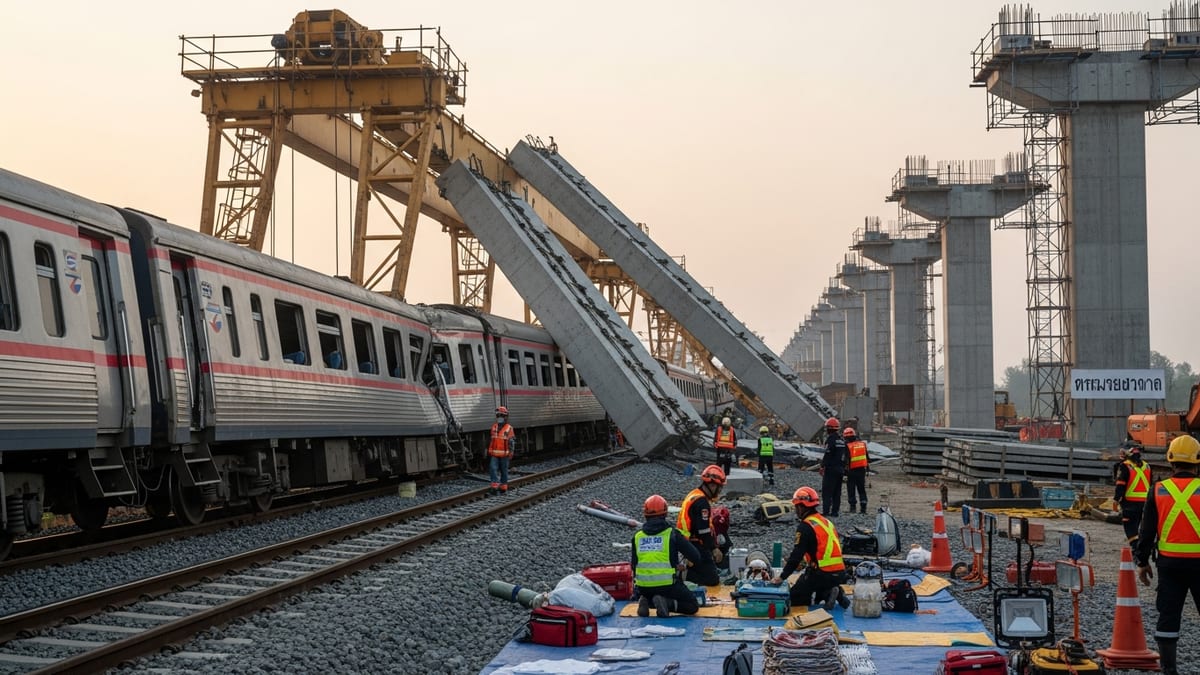
Derailment Near Key Rail Corridor in Regina
Initial reports indicate that the derailment occurred on a section of track linked to CPKC operations in the Regina area, a long established hub for freight movements across the Prairies. Thirteen rail cars left the track, some coming to rest at angles along the right of way while others remained upright but displaced from the rails.
Publicly available information shows that the incident involved a freight consist moving through a rail yard and main line interface near the city, an area where multiple tracks, switches and yard movements converge. The location is part of the wider Regina rail network that supports grain, intermodal and general merchandise traffic.
There were no immediate indications of serious injuries, and early reports suggest that the derailment was confined to railway property. The event nevertheless prompted a rapid response from railway emergency teams, track crews and safety personnel focused on securing the cars, assessing cargo and examining potential infrastructure damage.
The derailment temporarily disrupted rail traffic in and around Regina, with some trains held or rerouted while crews worked to clear the affected section. Operators and logistics firms that depend on the corridor are expected to feel short term impacts as schedules are adjusted and congestion is managed.
Cars, Cargo and Environmental Risk Assessment
According to published coverage of similar CPKC derailments in Western Canada, railways typically move a mix of covered hoppers, tank cars and boxcars through Prairie corridors, often carrying agricultural products, manufactured goods and, on some routes, hazardous materials. In the Regina incident, the priority for responders was to identify the type of cargo in each of the 13 derailed cars and to determine whether any posed environmental or public safety risks.
Early information circulating locally suggests that most of the affected cars remained intact and upright, reducing the likelihood of significant product release. Standard railway protocols call for a car by car inspection to check for breaches, valve damage or leaks, and to confirm that placarded hazardous materials are either not involved or remain contained.
Environmental assessments in such situations typically include soil and drainage checks around the derailment zone, particularly near ditches, culverts or low lying areas where any spilled product could accumulate. The Regina rail network crosses industrial and residential zones as well as open land on the outskirts of the city, so planners pay close attention to runoff patterns and nearby infrastructure.
While no large scale evacuation was reported in connection with this incident, rail safety observers note that the presence of dangerous goods on national freight corridors continues to be a central theme in public debate. Communities along the line often look closely at each derailment, regardless of severity, as a test of the railway’s emergency preparedness and transparency.
Investigation Focus: Track, Equipment and Operations
Investigators examining derailments of this type generally review three main areas: the condition of the track and roadbed, the mechanical state of the rolling stock, and operating conditions such as train handling and speed. In previous Canadian Transportation Safety Board reports on derailments involving Prairie freight trains, worn rail, track geometry issues and broken components have been recurring factors.
In Regina, the derailment site lies within a complex yard and main line environment, where switches, crossovers and curved segments can place additional stresses on wheels and track. Detailed inspections typically involve ultrasonic or visual assessment of rails, measurements of gauge and alignment, and checks for internal defects that might not be visible from the surface.
On the equipment side, wheel sets, bearings, couplers and suspension components are examined for signs of overheating, fatigue or sudden failure. Railways maintain extensive inspection regimes, but derailments occasionally point to isolated equipment problems or to systemic issues that require changes in maintenance schedules or technology.
Operational analysis normally covers train handling data, such as throttle and braking patterns, train length and weight distribution, and any unusual events recorded by on board systems. Review of dispatch records and yard procedures helps determine whether the train encountered unexpected conditions, such as a misaligned switch or conflicting movement, in the moments before the cars left the rails.
Impact on Travelers and Regional Connectivity
Although the derailed train in Regina was a freight movement, disruptions of this kind can ripple through wider transportation networks. Passenger services that share portions of the corridor may need to slow through work zones or temporarily reroute, extending journey times. Highway level crossings near the derailment zone can also be affected if blocked by immobilized rail equipment or by intensive track work.
For travelers across the Prairies, freight rail performance has an indirect but significant influence on supply chains, from fuel and food distribution to construction materials that support tourism related infrastructure. When incidents occur near major centres like Regina, logistical planners often adjust trucking schedules, intermodal connections and warehouse operations to offset delays on the rails.
Tourism operators and hospitality businesses that depend on reliable freight shipments for supplies can experience short term challenges after a derailment, particularly if it occurs during peak travel seasons. However, railways typically prioritize reopening at least one main line track as quickly as conditions safely allow, limiting the duration of bottlenecks on key east west and north south routes.
As the investigation progresses and more details become available, regional stakeholders are likely to track how quickly regular service is restored and whether any long term infrastructure upgrades are proposed for the Regina corridor.
Rail Safety Record and Public Expectations
National statistics published by Canadian transportation agencies show that derailments remain a recurring but closely monitored aspect of freight rail operations, with incident rates fluctuating year to year. In Saskatchewan and neighboring provinces, most derailments occur at low speed on yard or siding tracks, often resulting in equipment damage but limited broader impact.
At the same time, recent high profile derailments involving CPKC in Western Canada and the northern United States have maintained public attention on issues such as train length, inspection technology and the transport of hazardous materials. Advocacy groups and some municipal leaders regularly call for tighter safety standards, more frequent track inspections and improved communication with affected communities after any incident.
CPKC and other major railways have responded in recent years by highlighting investments in track renewal, advanced defect detection systems and training for emergency response teams. Independent investigations often examine whether such measures were present and effective at a given location, and may recommend additional actions when shortcomings are identified.
The Regina incident adds to the broader discussion about how best to balance the efficiency of long haul freight rail with the expectations of residents who live and work near busy lines. As findings emerge from the review of the 13 car derailment, they are likely to inform ongoing debates over infrastructure priorities, risk management and community engagement along one of Canada’s most important freight corridors.