


At the airport kiosk, the Travelex Money Card can look like the perfect solution. Load foreign currency before you fly, tap like a local overseas, and forget about worrying over “bad rates” or card fraud. Yet buried in the small print and real customer experiences is a different story: a maze of exchange markups, inactivity charges and awkward rules that can make this product far more expensive than it first appears. Understanding those hidden costs before you buy can easily mean saving hundreds of dollars on a long trip.
Get the latest updates straight to your inbox!
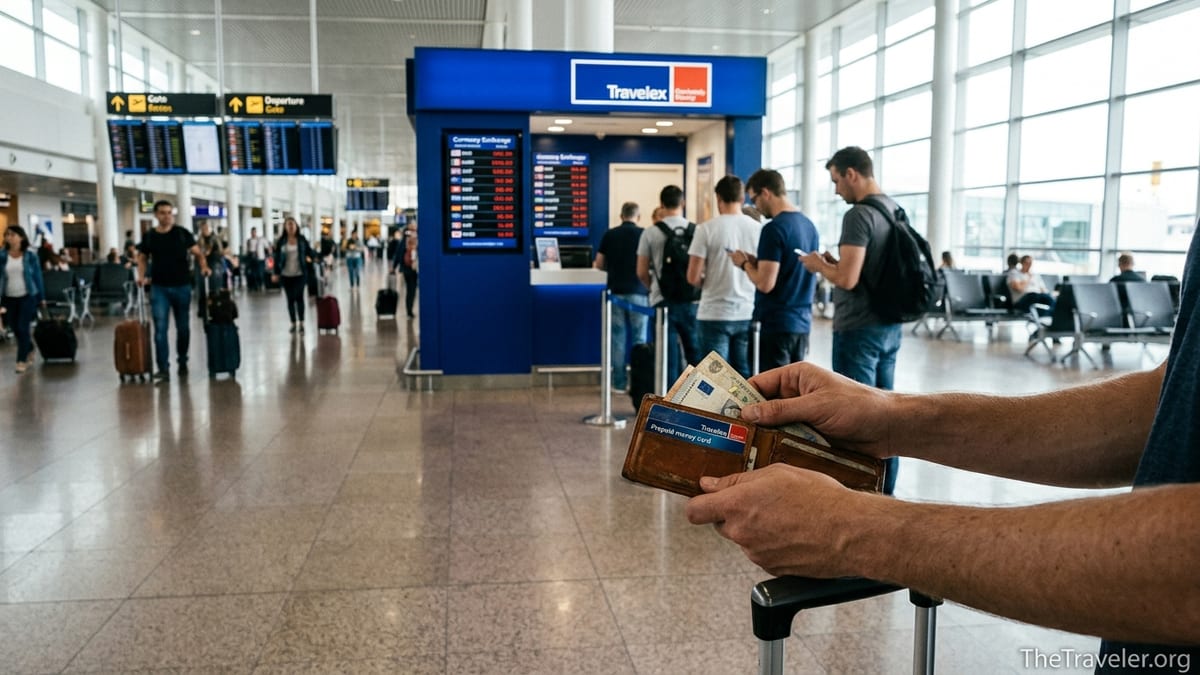
How the Travelex Money Card Actually Works
The Travelex Money Card is a prepaid Mastercard you load with one or more currencies before you travel. In markets such as the United Kingdom, Europe, Australia and New Zealand, you can usually choose major options like US dollars, euros, British pounds, Australian dollars and a handful of others. In theory this lets you “lock in” an exchange rate ahead of time and then spend abroad without extra charges every time you tap or insert your card.
Once loaded, the card behaves a lot like a debit card. You can pay in stores, online and at restaurants wherever Mastercard is accepted, or withdraw cash from overseas ATMs. The Travelex marketing pitch stresses peace of mind: the card is not linked to your bank account, there are app controls to block or top up, and replacement cards can often be issued if yours is lost or stolen while you are away.
On the surface the fee table looks friendly. The most recent Travelex Money Card terms in markets like the UK describe no Travelex fee for card purchases or ATM withdrawals in supported currencies, plus free internal currency transfers between wallets and no load fee when topping up in foreign currency. That presentation encourages travelers to assume that once they have paid an upfront spread when buying their foreign currency, the rest of their trip spending is basically free of friction.
The real cost kicks in whenever your spending pattern does not perfectly match the card’s design. The moment you use the card in a currency that is not on your wallet list, or when you run out of the “right” currency and the card has to dip into another balance, the provider applies an extra foreign exchange fee on top of Mastercard’s rate. Combine that with airport kiosk spreads and a few structural fees and you can end up paying far more than a straightforward debit or credit card from your home bank.
The Quiet Bite of Exchange Rate Markups
The single most important hidden cost on a Travelex Money Card is the exchange rate spread. Travelex sets its own retail rates when you initially buy or top up the card, and those can be several percentage points worse than the mid-market rate you might see on a currency site. That difference is not labeled as a fee, but it is effectively the main way the company earns money from each transaction.
Consider a US traveler flying to Paris with 1,000 US dollars to convert into euros for a Travelex Money Card at a major airport. If the real interbank rate on the day is around 1 USD to 0.92 EUR, 1,000 dollars should translate to roughly 920 euros. In practice, Travelex might offer a rate closer to 0.86 or 0.87, which reduces the card load to around 860 to 870 euros. The 50 to 60 euro gap, worth roughly 55 to 65 US dollars, is the exchange spread. It appears nowhere as a line-item charge, yet you have already given up that money before you have even boarded the plane.
The same effect appears again if you move money between currency wallets or if the card has to cover a purchase by dipping into a secondary currency balance. Travelex’s own fee schedules in markets like the UK show that when you spend in a currency your card does not hold, or when your primary currency runs short, the card converts using the Mastercard foreign exchange rate plus a foreign exchange fee of about 5 to 6 percent. On a 300 dollar hotel bill in a currency your card does not support, that extra spread alone can cost you the equivalent of 15 to 18 dollars.
Real travelers frequently report this pain in hindsight. A New Zealand customer reviewing the product described buying a card for a trip to Dubai, only to find it would not work reliably in local terminals and that switching the money back into their home currency on return meant a “significant amount” lost to spreads and charges that had not been fully spelled out at sale. Other reviewers from Australia and Europe talk about being drawn in by promises of “competitive” exchange rates, then later comparing the actual rates they received with what their bank or an online multi-currency account would have charged and realizing the difference ran into hundreds of local dollars on a long trip.
Fees That Do Not Show Up Until Later
Alongside exchange spreads, the Travelex Money Card comes with a set of explicit fees that often feel invisible at the point of purchase. One of the most complained-about is the inactivity fee. Current Travelex fee tables for markets like the UK state that if you leave a positive balance on the card unused for 12 months, a monthly inactivity fee of around 2 pounds or the local currency equivalent begins to apply until the balance is drained or goes to zero.
For a casual traveler who takes one big overseas trip then leaves the card in a drawer, this can become an expensive surprise. Imagine a Canadian on a once-in-a-decade family trip to Europe who loads the equivalent of 2,000 euros on a card and returns home with 150 euros unspent. If they forget about the card entirely, those 150 euros may be steadily eaten away by inactivity deductions over the following years. Several reviewers in markets like Australia mention discovering that a balance they believed was safely parked for a future holiday had been dramatically reduced by these monthly inactivity charges.
Cash-out or closure fees are another common pain point. In some regions you can cash out an unused balance in-store, with the exact fee determined at the branch, while calling card services to withdraw funds may incur a fixed fee in the range of 6 pounds or the local currency equivalent. If you try to convert leftover foreign currency back to your home currency at a Travelex counter instead, you effectively pay another exchange spread as the rate for buying back foreign notes or card balance is worse than the rate you originally received.
There are also occasional negative-balance or “shortfall” fees. The UK terms, for example, list a shortfall fee of around 10 pounds if a transaction and associated authorisations push your card balance below zero. This can happen if a hotel or cruise ship places a large temporary hold for incidentals and the final bill comes in slightly higher, or if offline transactions take time to settle. For a traveler who assumed a prepaid card could never slip into the red, that is an unwelcome complication.
When Merchants and ATMs Make It Even Worse
Even if the Travelex Money Card itself had no headline charges, the way overseas merchants and ATMs operate can add brutal extra costs. A classic example is dynamic currency conversion, where a foreign merchant or ATM offers to charge your card in your “home” currency rather than the local one. In practice this often means an exchange rate that can be 5 to 10 percent worse than the network rate from Mastercard, on top of whatever spread or foreign exchange fee Travelex already applies on the card.
Imagine a US traveler in Rome using a Travelex card loaded in euros to pay a 50 euro restaurant bill. The terminal may detect that the card is issued by a US-based program and offer to charge 58 US dollars instead of 50 euros. If the true network rate would have made that 54 dollars, the traveler is effectively handing 4 extra dollars to the local processor, with no benefit. Reviewers on travel forums consistently advise always choosing to pay in the local currency when prompted, but first-time users of prepaid travel cards often do not understand this subtlety in the moment.
ATMs can behave in similar ways. Private operators at airports, in tourist zones or at metro stations often display big on-screen warnings that your home bank might charge you fees, while hiding their own poor exchange rate in a separate detail screen. Travelers have reported withdrawing the equivalent of a few hundred dollars from branded ATMs where the actual rate they received was several percent worse than the interbank rate, in addition to any fee the ATM owner or Travelex might charge.
When you combine dynamic currency conversion with the Travelex Money Card’s own foreign exchange fee on unsupported currencies, the hit to your budget can be stark. For example, a Canadian cardholder with balances in US dollars and euros might use the Travelex card to withdraw 20,000 Japanese yen from an ATM in Tokyo where none of those currencies are supported. The transaction will be converted from yen to one of the card’s wallets at the Mastercard rate plus roughly 5 to 6 percent, then the ATM operator may apply its own rate or fixed withdrawal charge. The end result could be 10 percent or more lost on a single cash withdrawal compared with a low-fee debit card from a domestic bank that refunds ATM fees and uses near-interbank rates.
Real-World Scenarios Where Costs Escalate
The full picture of Travelex Money Card costs emerges when you follow a few realistic trip scenarios. Consider a US couple on a three-week honeymoon through London, Paris and Barcelona. At JFK airport they load 3,000 dollars to get 2,700 euros onto a Travelex card, accepting a spread of about 10 percent relative to the mid-market rate. In London they pay in pounds, a currency not loaded on their card, so each dinner or theater ticket is converted from pounds to euros via Mastercard plus a foreign exchange fee of around 5 to 6 percent. Several bars present terminals that default to charging their card in US dollars, and in the hurry of paying they simply press “OK,” adding another few percentage points of dynamic currency conversion on top.
By the time they return home, they have perhaps 250 euros left on the card, which they do not bother to cash out. A year later, inactivity fees begin nibbling away at that balance. If they forget the card entirely until the next big trip several years down the line, there is a genuine risk that the remaining balance has evaporated into monthly charges. When they finally compare their effective exchange rate and total fees against what they would have paid using a no-foreign-transaction-fee credit card and a bank debit card for ATM withdrawals, the difference might easily run into several hundred dollars.
Or take a New Zealander visiting the United Arab Emirates for a work project. They buy a Travelex Money Card with UAE dirhams at Auckland Airport, based on a rate that is a few percent worse than the mid-market. On arrival in Dubai, they discover that some local merchants either cannot process the card or run transactions as offline authorisations, leading to declines and confusion. At the end of the trip they swap the remaining dirhams back to New Zealand dollars at a Travelex counter, where the buy-back rate is again tilted in Travelex’s favor. In feedback posted online, such travelers often describe the combined effect of adverse exchange rates in both directions as “hidden” or “unexpected” costs that make the card poor value overall.
Another common story involves multi-country backpackers. A student from Canada might load euros and pounds for an extended tour of Europe, then decide to add a side trip to Croatia or Hungary where the local currencies are not supported on the card. Every hostel stay, rail ticket or grocery run in those countries then triggers foreign exchange fees on unsupported currencies, plus whatever extra damage dynamic currency conversion or ATM markups add. In contrast, the same traveler using a modern multi-currency account from a fintech provider that tracks near the mid-market rate, or a mainstream credit card with no foreign transaction fees, would likely see significantly lower combined costs.
When a Travelex Card Might Still Make Sense
Despite these pitfalls, the Travelex Money Card is not entirely without merit. For some travelers it can still play a useful role, provided you understand and accept the trade-offs. One scenario is for individuals who have difficulty opening a traditional bank account or obtaining a credit card. A prepaid travel card can offer a way to carry funds securely abroad without large quantities of cash, and can be easier to qualify for than a line of credit.
Families traveling with teenagers or students may also find value in the budgeting and control features. Parents can load a fixed amount in euros or dollars onto a Travelex card for a semester abroad or a group school trip, monitor spending via the app and top up if necessary. In this context the priority may be predictable daily limits and the ability to shut the card down quickly if it is lost, rather than squeezing every last percentage point out of the exchange rate.
There are also travelers who strongly prefer to decide their exchange rate in advance. Someone planning a big purchase overseas, such as a wedding dress in Italy or photography gear in Tokyo, might accept paying a premium spread to lock in today’s rate in case their home currency weakens before the trip. While the Travelex Money Card does not guarantee interbank-level pricing, it does allow you to know the rate you are agreeing to at the moment of loading the funds.
The key is to treat the Travelex Money Card as a niche tool rather than your default travel wallet. If you choose to use it, load only the currencies you know you will spend, avoid unsupported currencies entirely, plan to drain the balance before you come home and keep careful records of the fees and rates you are accepting. For most travelers, especially those comfortable with online banking, there are usually cheaper primary options.
Smarter Alternatives for Paying Abroad
To see the hidden cost of a Travelex Money Card in context, it helps to compare it with other realistic ways to pay abroad. Many mainstream banks in the United States, United Kingdom and Europe now issue debit cards that use network exchange rates with modest or even zero foreign transaction fees, particularly on premium accounts. Some US banks and brokerages refund ATM charges worldwide, meaning that a withdrawal in Bangkok or Berlin costs little more than it would at home, provided you always decline dynamic currency conversion on foreign machines.
Fintech providers add another dimension. Multi-currency accounts and cards from companies like Wise, Revolut, N26 and others often use near-mid-market rates with small transparent markups, and they support dozens of currencies that Travelex cards do not. For a traveler hopping between the UK, eurozone, Thailand and Japan in one long journey, being able to hold local currencies in a single digital wallet and convert between them at low spreads can make a significant difference over weeks or months.
Traditional credit cards with no foreign transaction fees are another powerful tool. Popular US-issued travel cards, for example, typically rely on the card network’s competitive exchange rate and do not add the 3 percent foreign transaction fee that still appears on many older products. While you should not use a credit card for large cash advances because of immediate interest and cash fees, using one for hotel bills, car rentals and restaurant tabs in local currency can be considerably cheaper than relying on a prepaid travel card with baked-in exchange spreads.
Even old-fashioned foreign cash can be a better deal if sourced wisely. Ordering currency from your home bank before departure or withdrawing local currency from a major bank ATM on arrival often costs less than buying airport Travelex cash or loading a Travelex card at kiosk rates. For example, a US traveler heading to Tokyo might compare buying yen at a Travelex desk inside Los Angeles International Airport with withdrawing yen from a local bank ATM in Japan using a low-fee debit card. The latter often wins by several percentage points once both exchange rates and commissions are factored in.
The Takeaway
The core problem with the Travelex Money Card is not that it is unusable. It is that the way it makes money is largely invisible to casual buyers. High exchange spreads at load, foreign exchange fees on unsupported currencies, inactivity and cash-out charges, and the compounding effect of dynamic currency conversion and ATM markups can quietly turn a card marketed as fee-free into an expensive way to access your own funds abroad.
If you are considering a Travelex Money Card, start by reading the most recent fee and terms document for your country, line by line. Pay particular attention to the foreign exchange fee on currencies the card does not support, the conditions under which inactivity fees begin, and what it costs to close the card or withdraw your balance at the end of the trip. Then compare those numbers with the total cost of using a modern bank debit card, a reputable multi-currency account, or a no-foreign-transaction-fee credit card instead.
For many travelers, the combination of a primary credit card without foreign transaction fees for purchases and a low-fee debit card for ATM withdrawals in local currency will deliver better value with fewer surprises than a prepaid travel card. The Travelex product can still have a role as a secondary or backup option, particularly for budgeting or for those who cannot access other financial tools, but it should be chosen with eyes wide open rather than as an impulse add-on at the airport counter.
In practical terms, the hidden cost of using a Travelex Money Card abroad is often measured not just in money but in hassles: declined transactions, confusing rate screens at ATMs, unexpected charges months later and the time spent chasing customer support to resolve issues. By understanding how these cards work and comparing your options before you travel, you can keep more of your budget for the experiences that actually matter.
FAQ
Q1. Is a Travelex Money Card cheaper than using my regular bank card abroad?
In many cases it is not. Once you factor in exchange rate spreads when you load the card, foreign exchange fees on unsupported currencies, and potential inactivity or cash-out fees, a low-fee bank debit card or a credit card with no foreign transaction fees is often cheaper overall for typical travelers.
Q2. What is the biggest hidden cost of a Travelex Money Card?
The largest hidden cost is usually the exchange rate markup when you load or convert currencies. Travelex sets retail rates that are typically several percent worse than the mid-market rate, and that gap effectively acts as an invisible fee on every dollar or euro you put onto the card.
Q3. How do inactivity fees work on the Travelex Money Card?
In markets like the UK, if you leave money sitting on the card and do not use it for a 12-month period, Travelex begins charging a small monthly inactivity fee against the remaining balance. Over time this can erode or even wipe out leftover funds if you forget the card exists.
Q4. What happens if I use the card in a currency that is not supported?
When you spend in a currency that is not one of the supported wallets, or if your balance in the local currency runs out, the card converts from another wallet using the Mastercard rate plus a foreign exchange fee that can be around 5 to 6 percent. That is on top of any ATM or merchant charges.
Q5. Can I avoid dynamic currency conversion charges with a Travelex Money Card?
Yes, but only by being careful. Whenever an overseas terminal or ATM offers to charge your card in your home currency instead of the local one, you should choose to pay in the local currency. This lets the Mastercard network handle the conversion and helps you avoid the extra markup that dynamic currency conversion usually adds.
Q6. Are ATM withdrawals free with a Travelex Money Card?
Travelex often advertises no fee for ATM withdrawals in supported currencies, but that does not mean withdrawals are truly free. The ATM owner can still charge its own fee, and if the withdrawal taps a currency you do not hold, or you accept dynamic currency conversion, you will also pay through poorer exchange rates and foreign exchange markups.
Q7. What is the best way to use a Travelex Money Card if I already have one?
If you already hold a card, try to load only the currencies you know you will use, always pay and withdraw in local currency, avoid unsupported currencies, and plan your spending so that your balance is close to zero by the time you return home. After the trip, cash out or close the card promptly so inactivity fees do not eat away at any leftover funds.
Q8. How does a Travelex Money Card compare with modern fintech multi-currency accounts?
Many fintech providers use exchange rates that are much closer to the mid-market rate and charge clearly disclosed small markups. They also support a wider range of currencies and often have low or no fees for card spending abroad. In head-to-head comparisons, these accounts usually beat prepaid travel cards like the Travelex Money Card on total cost for frequent or multi-country travelers.
Q9. Is there any situation where a Travelex Money Card might be a good choice?
It can make sense for travelers who cannot get a regular credit card, for parents who want to give teenagers a controlled spending tool on a school trip, or for people who strongly value locking in an exchange rate ahead of time, even at a premium. In those cases the card’s budgeting features and separation from a main bank account may outweigh the extra cost.
Q10. What should I do before deciding whether to buy a Travelex Money Card?
Before buying, read the latest fee and terms document for your country closely, check how good the current exchange rate is versus the mid-market rate, and compare those figures to the costs of using your existing debit and credit cards abroad. If your bank offers a card with no foreign transaction fee and reasonable ATM terms, or if you are comfortable opening a multi-currency account with a reputable provider, you may find you do not need a Travelex card at all.