


Dealing with immigration offices in Germany is a central operational factor for any relocation decision. The local foreigners’ authorities, commonly referred to as Ausländerbehörden, control residence permits, extensions, some work authorisations, and many status changes once a person is inside the country. Their procedures, capacity constraints, and communication style significantly influence how predictable and manageable a move to Germany will be for non-EU nationals and their employers.
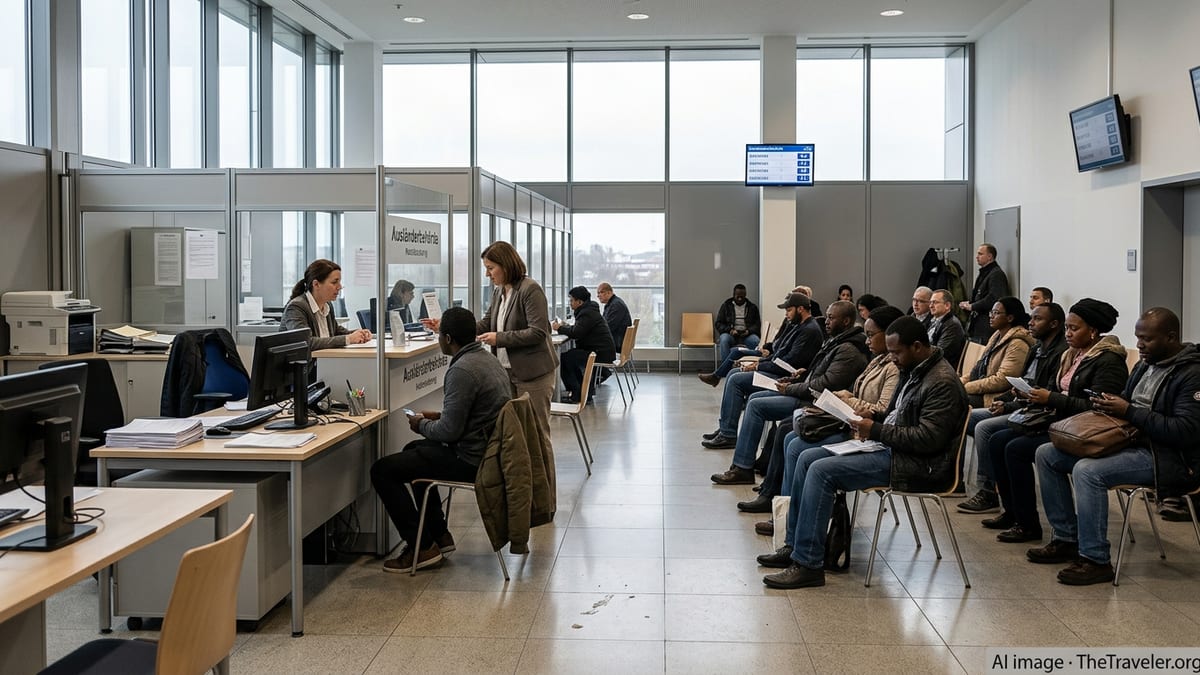
Structure and Role of German Immigration Offices
Germany’s immigration administration is fragmented across federal, state, and municipal levels. While embassies and consulates handle most entry visas abroad, the approximately 550 local Ausländerbehörden inside Germany are responsible for residence permits, renewals, certain work permissions, permanent residence, and naturalisation intake in many regions. These offices operate under federal law but are funded and staffed by states and municipalities, which leads to pronounced regional variation in capacity and service quality.
For residents, this means that the experience of dealing with immigration offices depends heavily on place of residence. Large cities with high numbers of international workers and students, such as Berlin, Frankfurt, Hamburg, and Munich, tend to have heavy demand, complex internal structures, and longer backlogs. In contrast, smaller towns and rural districts often process similar applications more quickly, simply because case numbers are lower and appointment systems are less congested.
Functionally, immigration offices manage a wide range of processes: first residence permits after arrival, renewals and status changes, registration of family members, documentation of EU family rights, and in some states naturalisation appointments. They also coordinate with central agencies such as the Federal Printing Office for residence cards and with labour authorities when work permissions are involved. Understanding this institutional role is essential for assessing how their performance can impact relocation timelines.
Applicants generally interact with these offices through scheduled appointments, written applications submitted by post or email, or increasingly through online portals. However, the degree of digitalisation and user-friendliness of these channels differs substantially between municipalities, and traditional paper-based workflows remain widespread in 2026.
Appointment Systems, Waiting Times, and Backlogs
The most critical operational factor for many relocating individuals is not the legal framework itself but the time required to obtain appointments and decisions at the immigration office. In practice, there are often two distinct waiting periods: the delay until an appointment can be secured and the processing time between the appointment and receipt of the residence card. Various reports and user experiences indicate that in busy cities, waiting several months for an appointment has become common, particularly for work-related and student cases in metropolitan areas.
Public communications by universities, municipalities, and advisory organisations repeatedly highlight prolonged processing times, sometimes triggered by local events such as office relocations or temporary staff shortages. In some cities, appointments for standard residence-permit renewals are reported to be booked out several months in advance, and there are accounts of applicants waiting three to six months or more for a first appointment in heavily burdened offices. At the same time, smaller or less congested regions may still deliver appointments within weeks for comparable case types, underlining the strong regional disparity.
After the appointment, the issuing of the physical residence card involves an additional production and delivery phase through the Federal Printing Office and local authorities. Even when the legal decision is positive, the card may only arrive after several weeks, and disruptions such as strikes or technical issues at the printing facility have occasionally extended this period. For relocation planning, this means that even a timely appointment does not guarantee immediate access to the final document required for international travel or certain administrative steps.
Overall, for complex urban locations, a realistic planning horizon for a standard residence-permit renewal or change of purpose should often be counted in months rather than weeks. High-demand cities can exhibit cumulative timelines that stretch from initial contact request to card delivery over half a year or more in individual cases, whereas more efficient regions may finalise equivalent procedures in significantly shorter periods.
Regional Disparities and Capacity Constraints
Germany’s federal and municipal structure leads to considerable differences in how immigration offices are organised and resourced. Some states have consolidated naturalisation or specialist immigration functions into central offices, while others operate through district-level administrations with their own policies on appointments and communication. This creates a patchwork of practices in which the same federal residence legislation can be implemented with very different user experiences.
Evidence from applicant reports, court filings, and media coverage points to serious backlogs in certain metropolitan areas, especially for naturalisation and long-term residence permits. There are documented cases of administrative courts receiving large numbers of inactivity lawsuits against immigration authorities that failed to decide within legally expected timeframes. At the same time, commentators frequently note that similar applications processed in nearby rural districts can move forward more quickly because those offices face lower workloads.
Several structural factors contribute to these disparities. Demographic trends indicate that a substantial proportion of staff in municipal administrations is approaching retirement in the coming years, while efforts to recruit new personnel have not fully compensated. Combined with rising immigration and new legal entitlements, this has led to capacity bottlenecks in high-demand locations. Additionally, the uneven pace of digitalisation means that some offices remain reliant on manual processes and physical files, limiting their ability to scale efficiently.
For relocation planning, this implies that the city or district of residence in Germany materially affects how smooth dealings with the immigration office will be. Employers and individuals who are flexible in choosing location may find that settling in less congested districts yields shorter administrative timelines, although this needs to be weighed against labour market and lifestyle considerations that are outside the scope of this analysis.
Digitalisation, Communication Channels, and Transparency
Digitalisation of immigration procedures has advanced in recent years but remains incomplete. At the external level, Germany introduced a national online portal for many long-stay visa applications lodged at embassies and consulates, allowing digital submission for employment, study, training, and family reunion categories. Internally, however, local immigration offices inside Germany vary widely in their adoption of electronic appointment systems, online forms, and digital communication with applicants.
Many Ausländerbehörden now require appointment booking through online portals, but available time slots can disappear within seconds in busy offices, leading to significant frustration. Others rely on communication via static web forms or dedicated email addresses, with applicants receiving automatic replies that their request has been received and will be processed in order. Telephone hotlines exist in numerous cities, including central service numbers designed to route callers to the competent authority, yet long waiting times and limited reachability are often reported.
Transparency about expected processing times is inconsistent. Some immigration offices and universities publish explicit warnings that longer processing times must be anticipated due to special circumstances or heavy workloads. In contrast, other offices provide little or no public data, and applicants may be told only that no status information will be given during the normal processing period. In some lines of procedure, it is standard policy that status enquiries are not answered until a broadly defined average processing time has passed, which can leave applicants uncertain for months.
From a relocation perspective, this environment requires a tolerance for ambiguous timelines and imperfect communication. Although gradual digitalisation is improving appointment booking and information access in some locations, applicants should not assume uniform, responsive, or fully online processes throughout Germany in 2026. In many districts, success still relies on a combination of online requests, careful document preparation, patience with delayed replies, and occasional in-person visits when possible.
Procedural Patterns, Bottlenecks, and Legal Timeframes
Across Germany, dealings with immigration offices follow some recurring procedural patterns. For many case types, applicants must first secure an appointment or submit a complete set of documents by post or email. The office then examines the file, may request additional documents, and finally issues a decision that is formalised in a residence card or written notice. At each stage, missing information, incomplete forms, or unresolved legal questions can generate additional delay.
German administrative law provides that authorities are expected to decide within a reasonable time, and for some procedures there are more specific target periods derived from sectoral rules or judicial practice. In many immigration-related matters, a period of around six months is often treated as an upper boundary for what is considered reasonable in straightforward cases, although shorter indicative periods may apply in particular contexts. If no decision is issued after an extended delay, applicants can, in principle, pursue an inactivity lawsuit before an administrative court to compel a decision, irrespective of whether that decision is positive or negative.
In practice, bottlenecks frequently arise at the appointment allocation stage and at internal processing queues. Offices may have more applications than staff time available and can be further constrained by security checks, coordination with other authorities, or external factors such as high application numbers for new citizenship rules. Court rulings have clarified that structural understaffing and workload alone do not justify unlimited delays, but legal recourse requires time, legal knowledge, and often professional representation, which not all applicants can readily mobilise.
Another recurring feature is that immigration offices often distinguish sharply between regular and emergency procedures. Some cities maintain limited walk-in or emergency slots for imminent expiry of permits, urgent travel needs, or employment start dates. However, the threshold for what counts as an emergency can be high, and clients may still face long waiting periods even in such priority tracks. For relocation feasibility assessments, this means that relying on emergency appointments as a strategy is risky and should be considered a last resort rather than a planning tool.
Operational Risks for Relocating Individuals and Employers
Dealing with immigration offices in Germany introduces a set of operational risks that non-EU nationals and their employers need to factor into relocation decisions. The most immediate risk is loss of predictability: when appointment availability and processing times are uncertain, it becomes difficult to coordinate employment start dates, housing commitments, family moves, and international travel. This can be particularly problematic for time-sensitive projects and global mobility programs that rely on precise deployment schedules.
Second, extended backlogs can impact legal stay and work continuity. While German law provides temporary rights in certain circumstances, such as fictional extensions of existing permits when a renewal application is lodged in time, these interim statuses may not be clearly understood by all third parties. Delays in receiving updated residence cards can limit the ability to travel outside the Schengen area, complicate onboarding with banks or landlords, or introduce hurdles when interacting with authorities in other countries.
Third, long waiting periods and perceived inaccessibility of immigration offices have led some applicants to seek legal remedies. In metropolitan areas, there are documented increases in lawsuits challenging excessive delays in naturalisation and other residency decisions. While such actions can eventually force an authority to decide, they involve legal costs and uncertainty. From an employer’s standpoint, frequent resort to litigation to move immigration files forward is a signal of structural administrative strain, which might affect the attractiveness of specific German locations for large-scale recruitment.
Finally, the psychological burden should not be underestimated. Continuous uncertainty about residence status, combined with limited communication and opaque timelines, is reported to create significant stress for many foreign residents. Although this factor is difficult to quantify, it can influence employee satisfaction, retention decisions, and the perceived overall quality of the relocation experience in Germany.
Practical Strategies to Navigate German Immigration Offices
Although structural issues cannot be fully avoided at the individual level, certain strategies can reduce friction when dealing with German immigration offices. A first principle is early action. Because appointment queues can extend for months in some districts, it is advisable to request renewal or change-of-status appointments as soon as local guidance allows, often several months before permit expiry. Many offices explicitly recommend early contact and warn that late applications may not be processed in time.
Meticulous document preparation is equally important. Local immigration offices frequently emphasise that missing or incorrect documents slow down processing and can result in repeat appointments. Using official checklists when available, ensuring that translations and certifications meet German standards, and bringing printed copies of key documents to appointments can limit avoidable delays. For companies managing multiple relocations, centralised document templates and standard operating procedures can help maintain consistency across cases.
Where feasible, choosing residence in less congested administrative districts can lead to more manageable dealings with immigration offices. However, such decisions must be coordinated with labour law, social security, and tax considerations, as well as actual work locations. In some cases, employers may partner with relocation or legal service providers who maintain up-to-date knowledge of local office practices, appointment systems, and escalation pathways.
If delays become excessive, specialised immigration lawyers can advise on formal complaints or inactivity lawsuits. German administrative courts have confirmed that authorities cannot justify extreme processing delays solely by referencing staff shortages or high workloads. Individuals who document their communications with the immigration office and maintain proof of timely applications are better positioned to pursue remedies if required. Nevertheless, litigation should be seen as a backup mechanism rather than a standard part of relocation planning.
The Takeaway
For potential movers and international employers, dealings with immigration offices in Germany represent a critical, often underestimated dimension of relocation feasibility. While Germany offers a complex but relatively transparent legal framework for residence, the day-to-day interaction with local Ausländerbehörden is shaped by fragmented structures, uneven digitalisation, and in some locations significant backlogs. The resulting appointment bottlenecks and long processing times can severely affect deployment schedules, legal certainty, and user experience.
The overall picture is one of strong regional divergence. In less congested districts, procedures may still function relatively smoothly, albeit with traditional, paper-heavy processes. In major cities and some high-demand regions, however, applicants increasingly face multi-month waits, limited communication, and unpredictable outcomes. Legislative reforms intended to modernise immigration policy interact with these administrative constraints, sometimes increasing demand faster than offices can expand capacity.
Relocation decisions involving Germany should, therefore, incorporate a realistic assessment of interactions with immigration offices: expected lead times of several months in busy locations, the need for proactive appointment management, and the potential requirement for legal support in cases of excessive delay. For individuals and employers able to plan early, centralise documentation, and remain flexible about location, dealing with German immigration offices is manageable but rarely effortless. For those requiring short-notice moves into congested urban centres, the administrative environment can be a decisive constraint.
FAQ
Q1. How far in advance should a residence permit renewal be initiated with a German immigration office?
Many immigration offices recommend initiating renewal several months before permit expiry. In congested cities, requesting an appointment three to six months in advance is often advisable to account for limited slot availability and subsequent processing time.
Q2. Is it normal to wait months just to get an appointment at an Ausländerbehörde?
In some large cities with high demand, reports of waiting several months for a first appointment are common, especially for work and student permits. In smaller districts, appointments can still be available within weeks. Regional variation is substantial.
Q3. Do immigration offices in Germany provide clear information about expected processing times?
Practices differ widely. Some offices, universities, and municipalities publish general warnings or indicative processing times, while others provide almost no data and decline to answer status queries during what they consider the normal processing period.
Q4. Can long processing times affect the ability to travel while living in Germany?
Yes. While legal stay may be covered by interim provisions once a timely renewal application is submitted, delayed issuance of the new residence card can restrict international travel, particularly to and from non-Schengen countries, until the physical card is received.
Q5. Are dealings with immigration offices generally easier in smaller towns than in big cities?
Often they are. Smaller or rural immigration offices usually handle fewer cases and may offer shorter waiting times for appointments and decisions. However, this is not guaranteed and depends on local staffing and organisation.
Q6. How digitalised are German immigration offices in 2026?
Digitalisation has progressed but remains uneven. Many offices use online appointment systems and accept applications or documents electronically, yet paper files, in-person signatures, and postal communication are still common in numerous districts.
Q7. What happens if an immigration office does not decide on an application for a long time?
If an authority fails to decide within a legally reasonable period, applicants can, in principle, file an inactivity lawsuit at an administrative court to compel a decision. Courts have held that chronic understaffing alone is not a sufficient justification for extreme delays.
Q8. Do emergency appointments significantly reduce the risk of status gaps?
Emergency appointments exist in some cities for urgent situations, but access is limited and criteria can be strict. Reliance on emergency slots should not replace early planning, as availability is not guaranteed and waiting times may still be substantial.
Q9. How important is document completeness when dealing with German immigration offices?
Completeness is critical. Missing or incorrect documents frequently cause postponed decisions, repeat appointments, or additional correspondence. Using official checklists where available and preparing certified translations and copies in advance reduces avoidable delays.
Q10. Should employers factor immigration office performance into location decisions in Germany?
Yes. For organisations moving multiple employees, the capacity and reliability of local immigration offices can materially affect deployment timelines and employee experience. Large cities may offer strong labour markets but also more pronounced administrative bottlenecks.