


More news on this day
Passengers traveling through Seeb International Airport in Muscat on June 5 are facing widespread disruption as Oman Air cancels four flights and reports multiple delays across regional and long-haul routes, snarling connections on some of the Middle East’s busiest corridors.
Get the latest news straight to your inbox!
Four Oman Air Cancellations Spark Regional Ripple Effect
Publicly available flight-monitoring data and regional aviation coverage indicate that at least four Oman Air services scheduled from Muscat on June 5 have been cancelled, triggering missed connections and rebookings for hundreds of travelers. The affected flights include departures to key Gulf and Middle Eastern hubs, amplifying the impact across onward networks.
The cancellations involve services touching Saudi Arabia, Kuwait and other Gulf gateways that function as connection points for traffic into Egypt, Malaysia and wider Asia. With many carriers in the region already operating stretched schedules, the removal of several Oman Air rotations is contributing to a tighter seat supply on short notice.
Industry trackers show that some of the cancelled services had been operating regularly in previous weeks, underscoring the sudden nature of the disruption. While Oman Air’s published information emphasizes safety and schedule integrity, the abrupt changes are leaving many passengers dependent on same-day rebooking, overnight layovers or alternative routings via neighboring hubs.
The timing is particularly difficult for travelers who rely on Muscat as an intermediate stop between Europe, the Indian Subcontinent and Southeast Asia. Many itineraries are constructed around tightly timed connections through Seeb International Airport, meaning one cancellation can cascade into missed onward flights as aircraft and crews fall out of position.
Delays Spread Across Saudi, Egypt, Oman, Kuwait and Malaysia Routes
Beyond the outright cancellations, Oman Air’s network is experiencing rolling delays on routes linking Muscat with cities in Saudi Arabia, Egypt, Oman’s domestic network, Kuwait and Malaysia. Flight-status boards and independent tracking sites show departure and arrival times slipping by one to several hours on a growing list of services.
Connections into major Saudi gateways, including flights that feed Jeddah and Riyadh, have been hit with knock-on delays as aircraft arrive late into Muscat. Some sectors are operating but with significantly altered timings, forcing connecting passengers to be rerouted or accommodated on later flights when minimum transfer windows are no longer met.
Services involving Kuwait are especially sensitive following recent operational disruptions and temporary suspensions reported at Kuwait International Airport. While some regional routes have been restored or partially resumed, the network remains fragile, and any new delay or aircraft rotation issue in Muscat can quickly affect flights carrying Kuwait-bound passengers.
Longer-haul itineraries between Muscat and Southeast Asia, including those serving Malaysia and other high-demand markets, are also facing schedule pressure. Aviation schedule aggregators show adjustments in block times and departure slots, reflecting efforts to recover punctuality across the network while dealing with displaced aircraft and crews.
Travelers Confront Long Queues, Missed Connections and Rebookings
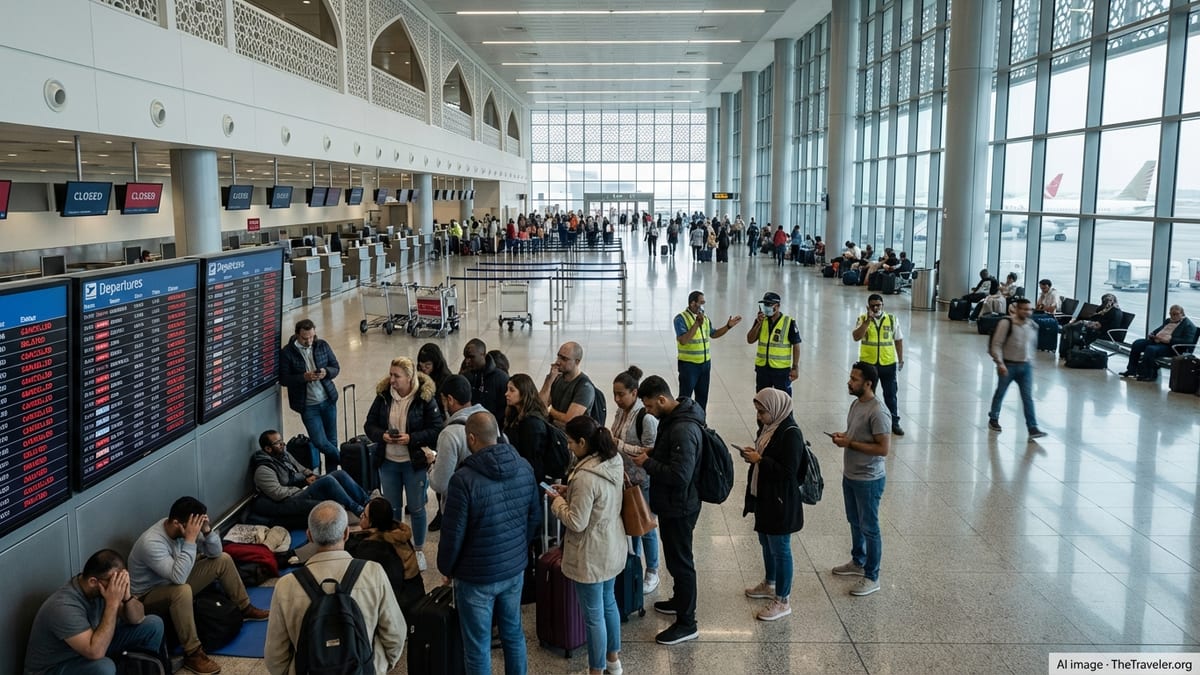
Passenger accounts on social media, travel forums and community discussion boards describe lengthy queues at Muscat’s terminals as travelers attempt to rebook disrupted journeys. Some report waiting several hours to secure new itineraries, particularly when onward sectors to Europe or Asia have limited remaining availability.
Recent posts referencing Muscat highlight concerns about tight connection windows in the current regional environment, where even relatively small schedule changes can have outsized consequences. Travelers transiting between Europe and Asia via Oman Air say that missed connections are forcing unexpected overnight stays in Muscat or rerouting through alternative hubs such as Doha, Abu Dhabi or Riyadh.
Others note that rebooking options are complicated by earlier suspensions or reductions on certain Gulf routes in response to regional security developments and constrained airspace. With some flights to neighboring Gulf capitals temporarily limited or operating on revised schedules in recent months, Muscat’s role as a transfer hub has become both more important and more vulnerable to disruption.
Despite the turmoil, forum posts and recent travel reports suggest that core airport operations at Seeb International Airport remain functional, with security, immigration and baggage handling generally described as orderly. The primary challenge for many passengers appears to be the combination of last-minute schedule changes and high demand for a limited number of remaining seats on alternative departures.
Operational Strain in a Region Already Under Pressure
The latest disruption at Seeb International Airport comes against a backdrop of heightened operational strain across Gulf and wider Middle Eastern aviation. Recent weeks have seen intermittent suspensions, diversions and delays at several regional airports following security incidents, airspace restrictions and broader geopolitical tensions.
Previous service updates from airlines and logistics providers have flagged Oman, Saudi Arabia and Kuwait among the markets where flight patterns and ground operations remain subject to rapid change. Schedules that looked stable only days earlier have, in some cases, been revised with minimal notice as carriers respond to evolving risk assessments and regulatory directives.
Oman Air, which positions Muscat as a growing hub between Europe, the Indian Ocean and Asia, has already faced a series of adjustments to its Gulf network over the past year. These have included temporary suspensions on select routes and modified frequencies, often introduced at short notice and communicated through online travel advisories and schedule bulletins.
Analysts tracking the region’s aviation sector note that airlines are operating in an environment where route planning, crew rostering and aircraft deployment can be disrupted overnight. The latest cancellations and delays at Muscat illustrate how even a mid-sized hub can experience outsized turbulence when broader regional pressures converge on a single operating day.
What Passengers Can Do if Their Oman Air Flight Is Affected
Travel experts and consumer advocates generally advise passengers affected by the current disruption to monitor their bookings closely through airline apps, email notifications and third-party flight-tracking tools. In recent months, several travelers have reported discrepancies between real-time messages and what appears in booking systems, making it important to verify the latest status from multiple channels.
Those with imminent departures from Muscat or inbound connections through Seeb International Airport are being urged in public travel advice to arrive early at the airport where possible, given the potential for longer check-in and customer service queues during irregular operations. For transit passengers, building in additional buffer time between connecting flights is increasingly seen as prudent when traveling through the region.
For itineraries involving Saudi Arabia, Egypt, Kuwait, Malaysia or other onward destinations, rebooking onto alternative routings or partner carriers may be necessary when same-day Oman Air options are limited. Travel-planning platforms show that some passengers are opting to connect via alternative Gulf hubs or to break their journey into separate tickets to regain flexibility.
As conditions remain fluid, publicly available advisories stress that schedules are subject to further change throughout the day. Travelers booked on Oman Air in the coming days are being encouraged by widely shared guidance to check their flight status repeatedly in the run-up to departure, to keep contact information up to date within their reservations and to retain receipts for any additional expenses in case they are eligible for reimbursement under applicable fare rules or local regulations.