


More news on this day
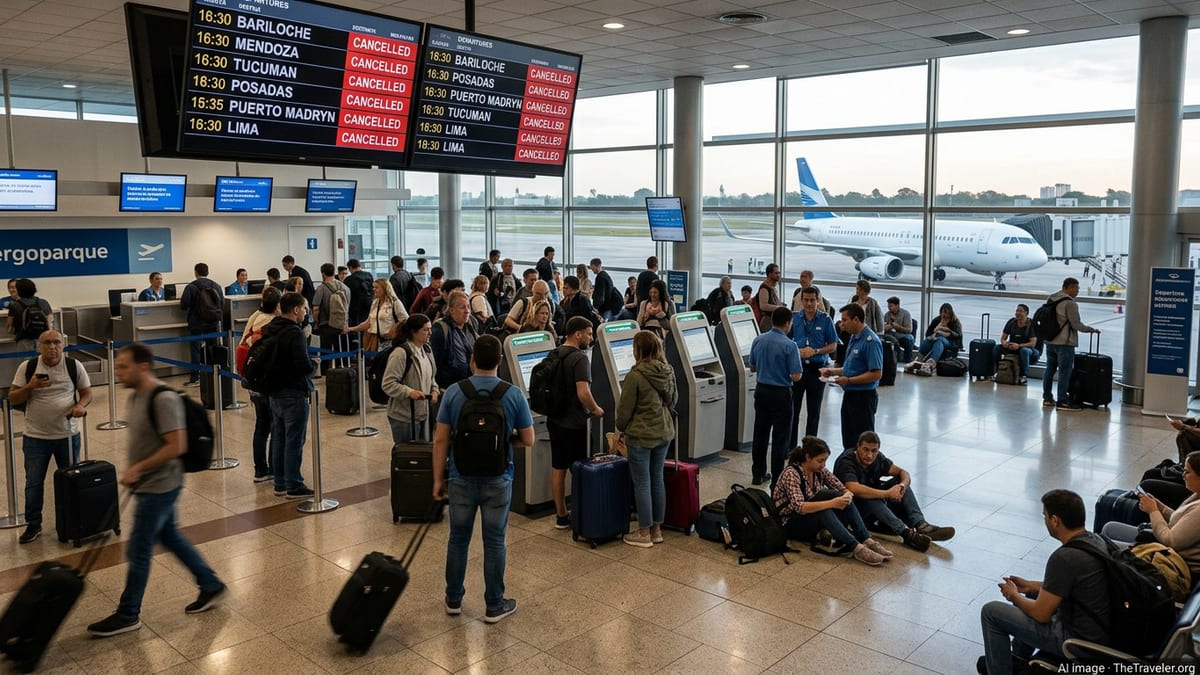
Travelers passing through Buenos Aires’ Aeroparque Jorge Newbery on May 29 faced fresh disruption as airport operation boards showed 37 delayed flights and five cancellations affecting services operated by Aerolineas Argentinas, Flybondi, JetSMART and other carriers across Argentina and nearby international routes.
Get the latest news straight to your inbox!
Operational Strain Adds New Turbulence to Busy Hub
The latest disruption hit Aeroparque on one of its typically heavy weekday travel days, with delays rippling across morning and afternoon departure banks. Publicly available flight-tracking data for services into and out of the centrally located airport indicated prolonged ground waits on multiple routes linking Buenos Aires with provincial cities such as Córdoba, Comodoro Rivadavia and Puerto Iguazú, along with regional connections to Brazil.
Reports from local travel media and live airport boards pointed to a cluster of 37 delayed flights over the course of the operating day, combined with five outright cancellations. The affected services were concentrated among Aerolineas Argentinas, which uses Aeroparque as a primary hub, low cost competitor Flybondi, and JetSMART Argentina, alongside codeshare or partner operations marketed by other airlines but flown by these carriers.
The pattern follows a series of recent disruption episodes at Aeroparque, where waves of delays and cancellations have periodically coincided with peak travel periods. Coverage in Argentine outlets and regional travel publications has highlighted how relatively small operational shocks, such as aircraft rotation issues or scheduling bottlenecks, can quickly cascade into missed connections and stranded passengers at the compact city airport.
Aeroparque Jorge Newbery’s role as a key domestic and short haul international gateway amplifies the impact when its schedules falter. Located close to downtown Buenos Aires, the airport functions as a critical connector between the capital and major tourism and business destinations, meaning irregular operations can affect not only local travelers but also those linking on to longer haul flights via other hubs.
Flybondi, JetSMART and Aerolineas Argentinas Under Spotlight
The disruption again places operational performance at Flybondi and JetSMART under scrutiny, alongside the larger state owned flag carrier Aerolineas Argentinas. Publicly available statistics and recent consumer commentary have repeatedly pointed to punctuality challenges at the low cost operators, particularly when aircraft utilization is stretched and schedule buffers are thin.
Flybondi, an ultra low cost carrier with a growing presence at Aeroparque, has faced a steady stream of criticism over frequent schedule changes and cancellations on domestic routes. Independent tracking initiatives and passenger forums have catalogued days when a significant share of the airline’s flights were delayed or canceled, fueling debate about whether its business model leaves too little room to absorb operational shocks.
JetSMART Argentina, which also operates a point to point low cost network from Aeroparque using Airbus A320 family aircraft, has generally been viewed as more reliable but still vulnerable when a single aircraft or crew issue arises. Travel community posts in recent months describe instances where a single disruption led to cancellations and same day rebookings cascading across multiple flights due to the compact size of the fleet.
Aerolineas Argentinas, meanwhile, accounts for a substantial share of Aeroparque traffic and connects Buenos Aires to dozens of destinations across Argentina and nearby South American cities. When the flag carrier experiences delays at its Aeroparque hub, the effects can quickly propagate across the network, impacting travelers continuing to or from secondary cities as well as those crossing borders to Brazil, Chile and other neighboring markets.
Passengers Face Missed Connections and Scramble for Alternatives
The cluster of 37 delays and five cancellations translated into long lines at check in counters and service desks as passengers sought rerouting, refunds or overnight accommodation. Travel reports from the May 29 operating window describe travelers missing onward domestic segments and international connections after late arriving flights landed beyond planned transfer times.
Regional leisure routes were among those affected, including links from Aeroparque to Patagonia, the northwest provinces and popular destinations such as Bariloche and Iguazú. Disruption on these corridors can be particularly challenging given the limited same day alternatives and the importance of precise timing for tours, hotel check ins and onward ground transport.
Some affected travelers reportedly turned to intercity buses as a last resort, booking overnight coach services from provincial cities back to Buenos Aires when same day flights were no longer available or affordable. Others attempted to switch between airlines at short notice, sometimes paying significantly higher walk up fares to secure a replacement seat on competing carriers.
The disruption also had knock on effects beyond Argentina’s borders. Delays and cancellations at Aeroparque can interfere with itineraries involving regional international sectors to cities such as Rio de Janeiro, São Paulo and Santiago, especially when passengers stitch together separate tickets on low cost carriers and full service airlines that do not offer protected connections.
Regulatory Debate and Performance Data Backdrop
The latest operational problems at Aeroparque come against a broader backdrop of public debate in Argentina over airline reliability, consumer protection rules and the growth of low cost carriers. Official and semi official statistics compiled in recent years show notable variations in on time performance and cancellation rates among airlines serving the domestic market, with some operators drawing particular attention from travelers and advocacy groups.
Publicly available information from airport service providers and aviation authorities has highlighted how fast rising low cost traffic has changed the operating environment at hubs like Aeroparque. High aircraft utilization and tight turnaround times can keep fares low but may also reduce resilience when weather, technical or staffing issues arise, leading to larger waves of delays and cancellations when something goes wrong.
Consumer groups and online communities have increasingly focused on whether existing compensation and rebooking frameworks provide sufficient protection when flights are disrupted. Discussions often center on refund processing times, the availability of alternative transport, and obligations for meals or accommodation when passengers are stranded overnight away from home.
At the same time, travel analysts note that punctuality challenges are not limited to any single carrier and that broader factors, including infrastructure constraints and air traffic management, can also contribute to irregular operations. The concentration of multiple airlines and dense schedules at Aeroparque means that any systemic bottleneck is quickly felt across the airport’s departure and arrival banks.
What Travelers Can Do as Irregular Operations Persist
With Aeroparque continuing to experience periodic waves of delays and cancellations, travel experts consistently recommend that passengers build extra time into itineraries involving domestic Argentina segments, particularly when connecting to or from long haul flights. Booking through itineraries on a single ticket, where possible, can help ensure that missed connections are handled under one carrier’s rebooking policies.
Travelers are also encouraged by industry guidance to monitor flight status closely through airline apps and airport information screens on the day of travel, rather than relying solely on original booking confirmations. Same day schedule adjustments, retimings and equipment changes are now common enough in the market that last minute checks can provide crucial early warning.
Flexible planning can further reduce the impact of irregular operations. Where budgets allow, choosing flights earlier in the day and avoiding the tightest possible connections can leave more room to recover if an initial segment runs late. Some travelers also opt for full service carriers on critical legs, even at a higher fare, when the cost of a missed connection or lost night of accommodation would be significant.
As Aeroparque Jorge Newbery continues to balance rapid traffic growth with limited physical space and complex airline operations, the latest episode of 37 delays and five cancellations underscores how quickly disruption at Buenos Aires’ city airport can ripple across Argentina’s wider travel network and into neighboring countries.