


Delhi’s Indira Gandhi International Airport (DEL) is India’s busiest hub and a major transit point between domestic India flights and long-haul international routes. The good news: connections generally work smoothly if you understand how the three terminals fit together, what happens to your bags, and how much time you realistically need. This guide walks you step by step through T1, T2 and T3 transfers, including the free shuttle, immigration, security and minimum connection times that actually work in 2026.
Get the latest updates straight to your inbox!
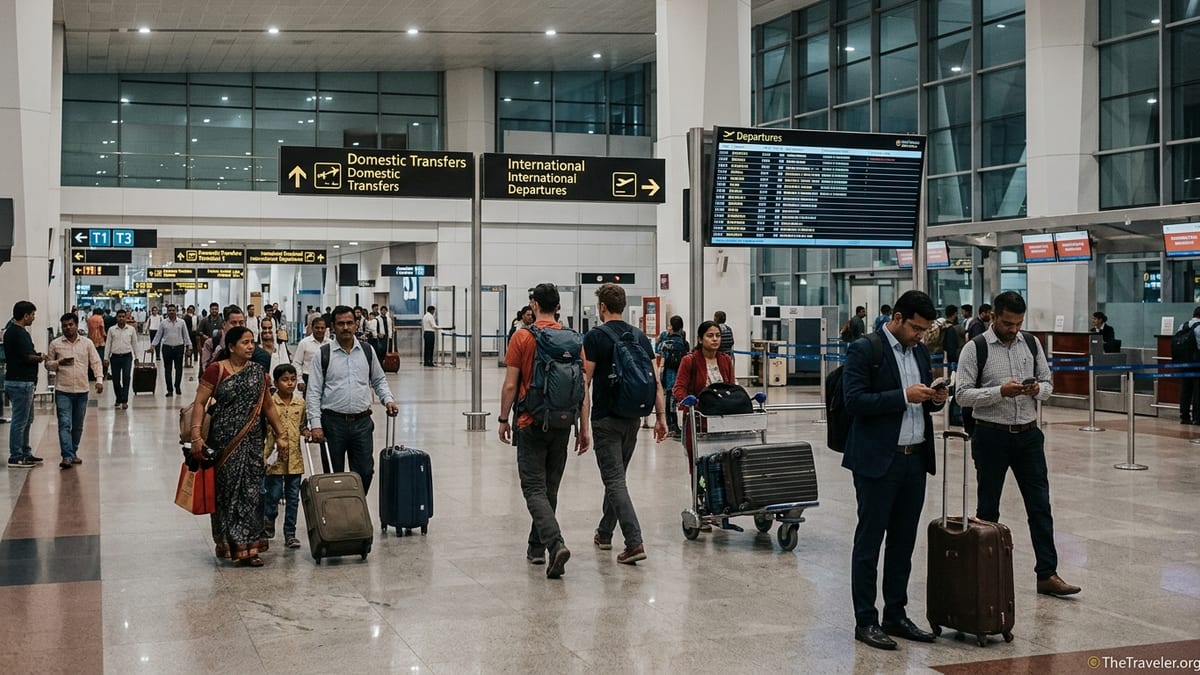
Know Your Terminals: T1, T2 and T3 in 2026
Indira Gandhi International Airport has three passenger terminals in regular use: Terminal 1 (T1), Terminal 2 (T2) and Terminal 3 (T3). All international flights use T3. Domestic flights are spread across all three terminals, with most low-cost carriers such as IndiGo and SpiceJet concentrated at T1 and a mix of Air India, Vistara, Akasa and some IndiGo operations using T2 and the domestic wing of T3. This split is important because any domestic to international connection involving T1 will require a landside terminal change.
T3 is the flagship building that handles all international arrivals and departures, plus a large share of domestic flights on full-service airlines. T2 is a smaller domestic terminal located physically between T1 and T3, used mainly for overflow and selected routes. T1 is dedicated to domestic flights and sits about 7 to 8 kilometres by road from T3. Although the three terminals are part of the same airport, they are not connected by an internal train; you must use shuttle buses or road vehicles to move between them.
For example, a common itinerary in 2026 might be Mumbai to Delhi on IndiGo arriving at T1 and then Delhi to London on British Airways or Air India from T3. Another might be a domestic feeder flight on Air India to T3 followed by a long-haul journey to North America, Europe or Australia. Understanding which terminal you land at and which terminal you depart from is the starting point for planning your transfer time and route.
The most reliable way to confirm your terminals is to check both your airline’s booking page and your e-ticket close to the travel date. Terminals in Delhi have shifted more than once as the airport expands, and while airline and airport websites keep up with these changes, older forum posts and blogs may not. Always verify again a few days before you fly, especially if you booked your tickets months in advance.
How Inter-Terminal Transfers Work: Free Shuttle & Other Options
Delhi Airport operates an inter-terminal shuttle bus that connects T1, T2 and T3. As of mid 2026, airport and airline guidance indicates that this shuttle is free for transit passengers who can show a same-day boarding pass. Services typically run roughly every 10 to 20 minutes around the clock, though waits can be a little longer late at night or during off-peak hours. Actual travel time between T1 and T3 is usually 15 to 25 minutes, depending on traffic and any intermediate stop at T2.
In practice, you will first follow signs to "Inter Terminal Transfer" or ask uniformed security staff where to wait. At T3, the bus waiting area is near the arrivals forecourt; at T1 and T2, staff can direct you to the shuttle boarding point under the terminal flyover. You show your boarding pass, receive a simple paper slip or a nod of approval from staff, and board the bus. Seats are basic and luggage storage is limited, but most passengers manage with cabin bags on their lap and checked bags on the floor.
Many travellers prefer to stick with the official shuttle for safety and simplicity, but it is not the only option. App-based taxis such as Uber and Ola, and metered or prepaid airport taxis, can drive you between terminals in roughly 10 to 15 minutes in light traffic. However, you pay an airport access fee plus the fare, and at busy times queues can easily add another 20 minutes. Taking a taxi usually makes sense only if you have substantial luggage, mobility issues, or the shuttle queues are very long.
Walking between T2 and T3 is physically possible and often quoted as around 10 to 15 minutes, but you are walking outdoors along the roadside environment, not in a climate-controlled connector. With checked baggage, heavy carry-on or in hot weather, this can be uncomfortable. For most passengers, the shuttle remains the most practical option for all terminal combinations, and it is the method airlines assume when they set their minimum connection times.
Baggage, Immigration and Security: What Actually Happens
The biggest source of confusion at Delhi is what happens to your checked baggage when you connect between domestic and international flights. In simple terms, if your journey is booked on a single ticket and your bags are tagged through to your final international destination, they may be transferred automatically during an international to domestic or domestic to international connection within T3. However, in many real-world cases, especially when a terminal change is involved, you will still need to collect your bags, clear customs, and recheck them.
For a typical domestic to international connection via T3 on separate tickets, the process works like this. You land at T1 or T2, disembark and follow signs to baggage reclaim. After picking up your luggage, you walk out through the domestic arrivals area to the landside curb, locate the inter-terminal shuttle bus, and ride to T3. Once at T3, you enter the departures hall, go to your international airline’s check-in counter to drop your bags and get a boarding pass if needed, then proceed through outbound immigration and security before heading to your gate. At each stage, you must show your passport, ticket and sometimes your baggage tags.
For international to domestic connections, you typically arrive at T3, clear immigration, collect your checked baggage from the international carousel, pass through customs and then either recheck with your domestic airline in the T3 departures hall or transfer to T1 or T2 if that is where your domestic flight leaves from. Even when your airline sells you a through-ticket from, for example, New York to Delhi to Jaipur, Indian rules mean your bags often must be presented to customs at your first point of entry, which is Delhi. After customs, some full-service carriers may have a dedicated domestic transfer counter in the arrivals area where you can drop bags and receive a fresh boarding pass.
Security screening is repeated every time you re-enter the secure area of a different terminal. If you move from T1 arrivals to T3 departures, you will go through full security again at T3, with the usual rules about laptops, liquids and cabin baggage. International departures at T3 also include immigration checks that can be quick in the middle of the night but quite busy in evening peaks, when large waves of long-haul flights leave for Europe and North America. Factoring in realistic queues at immigration and security is essential when you plan your connection time.
Domestic to International: T1, T2 and T3 Connection Scenarios
Most domestic to international transfers at Delhi fall into three broad patterns: domestic arrival at T3 followed by international departure from T3, domestic arrival at T2 followed by international departure from T3, and domestic arrival at T1 with onward international flight from T3. Each has a different risk profile and recommended minimum connection time, especially if you are traveling on separate tickets.
When both flights use T3, your life is simplest. You arrive on a domestic flight, disembark and follow signs either to transfer counters or to the arrivals hall, depending on whether your airline supports airside domestic to international transfers. On a single ticket with checked-through baggage, you may be able to remain airside and go directly to security and immigration for your international flight, which can make a 2 to 2.5 hour layover comfortable in ordinary conditions. On separate tickets, or if you need to reclaim your bags, you should treat it as a fresh international departure and allow at least 3 hours.
If you land at T2 and leave internationally from T3, you can usually take the inter-terminal shuttle or, if travelling light, consider the short walk. Realistically, many travellers report 10 to 20 minutes from stepping outside T2 to reaching T3 departures, once you factor in waiting for a shuttle. With checked luggage and separate tickets, you should still aim for an overall layover of 3 to 3.5 hours, because delays at baggage reclaim and evening road congestion can quickly eat into your buffer. On a single ticket with an airline like Air India or Vistara, schedules often build in 2.5 to 3 hours as a legally acceptable connection.
The most demanding scenario is a domestic arrival at T1 and an international departure from T3, particularly on separate tickets. Here you must leave T1, possibly queue briefly for the shuttle, ride the bus for 15 to 25 minutes, then enter T3, check in, clear immigration and pass through security. Travellers who have done this run recently report that 3 hours is the realistic lower limit if everything goes well and your incoming flight is on time. If your domestic flight tends to be delayed or you are traveling during the evening peak, a 4 hour layover provides a more comfortable margin.
International to Domestic: Clearing India and Heading Onward
International to domestic transfers at Delhi always begin in T3, where all international flights arrive. After landing, you will pass through immigration, collect your checked bags at the baggage carousel and then proceed through customs. The key fork in the journey is what happens next: if your domestic connection also leaves from T3, you can usually follow signs for domestic transfers or simply exit into the arrivals hall and walk upstairs to departures. If your domestic flight leaves from T1 or T2, you must move to the correct terminal before you can check in again.
On a single ticket with a full-service carrier, such as an Air India international arrival connecting to a domestic Air India or Vistara flight, the airline may tag your bags to your final Indian destination and provide boarding passes for both flights at your origin. Even so, you will often still collect your baggage in Delhi for customs and then hand it over again at a domestic transfer counter or standard check-in. Connection windows sold by airlines on such itineraries are commonly about 2.5 to 3 hours within T3 and 3 to 4 hours when a transfer to another terminal is required.
For separate tickets, for example a London to Delhi flight on a European carrier followed by a low-cost domestic flight on IndiGo from T1, you assume all the risk if your first flight is late. Once you have cleared immigration and customs at T3, you must find the inter-terminal shuttle or a taxi, travel to T1, check in from scratch and clear domestic security. In real-world terms, many seasoned travellers will not book anything less than a 4 hour layover in this situation, and 5 hours is not unreasonable if your inbound long-haul has a history of delays.
If your onward domestic flight departs from T2, the process is similar but the transit time between terminals is shorter. Some passengers choose to walk to T2, but if you are tired after an overnight long-haul, the shuttle or a short taxi ride can be more comfortable. Again, allow at least 3 hours for single-ticket itineraries requiring a terminal shift and around 4 hours for separate bookings, particularly if your arrival is around midnight or during early-morning rush when queues at immigration can form in waves.
Realistic Minimum Connection Times You Can Trust
Airlines and the airport publish Minimum Connection Times (MCT), which are the shortest layovers they consider valid for selling a through-ticket. However, these figures assume everything runs smoothly and do not account for late arrivals, long taxi times, slow baggage delivery or queues at immigration and security. From a traveller’s point of view, more conservative, real-world numbers are safer, especially when flights are on separate tickets.
Within T3, domestic to international or international to domestic connections on a single ticket are commonly scheduled at about 2 to 2.5 hours. Many frequent flyers consider this workable but tight during the evening or early-morning peaks. A more comfortable personal minimum is 3 hours, especially if you are traveling with family, carrying checked luggage, or need extra time for currency exchange or duty-free shopping. On separate tickets, aim for 3 to 4 hours even when both flights use T3.
For any transfer that involves moving between terminals, such as T1 to T3, T3 to T1, T1 to T2, or T2 to T3, the airport and experienced travellers increasingly recommend at least 3 hours and ideally closer to 4. That extra hour covers small but cumulative delays: 10 minutes waiting for a bus, 15 minutes of heavier-than-expected traffic on the loop road, a slow-moving check-in queue, and another 15 to 20 minutes at security. If you are buying non-refundable tickets or need to protect a once-a-day long-haul service, adding even more buffer can save significant stress.
As a concrete example, imagine a domestic IndiGo flight scheduled to land at T1 at 11:45 pm and an international departure from T3 at 4:00 am. On paper this 4 hour and 15 minute layover looks ample. In practice, if the domestic flight lands 30 minutes late, bags take 20 minutes to appear, and the shuttle or taxi takes about 20 minutes door to door, you still reach T3 around 1:30 am, leaving plenty of time to check in and clear formalities. By contrast, trying to make a 3 hour T1 to T3 connection on separate tickets leaves much less margin for these ordinary, everyday delays.
Practical Tips to Make Your Delhi Connection Smoother
A few practical habits can make the difference between a smooth Delhi connection and a missed flight. First, whenever possible, book your entire journey on a single ticket with one airline or alliance. This ensures your itinerary respects official connection times and places the responsibility for misconnection on the airline, not you. Even a slightly higher fare can pay for itself if your incoming flight is delayed and the airline has to rebook you on the next international departure.
Second, travel with realistic expectations about queues and walking distances. T3 in particular is a large terminal where gates for wide-body flights can be a ten-minute walk from security, and the domestic and international wings occupy different parts of the building. Wearing comfortable shoes and keeping carry-on luggage manageable is more than a comfort issue; it directly affects how quickly you can move between checkpoints and gates, especially if you are switching from T2 or T1.
Third, make use of ground staff. At every stage of the transfer process in Delhi, from stepping off a domestic flight to boarding the shuttle to re-entering T3, uniformed airline staff, airport information desks and security officers are used to dealing with connecting passengers. If you are unsure about where to go for the inter-terminal shuttle, need to confirm whether your bag is checked through, or are worried about a tight connection, asking for help early increases the chances that staff can prioritize you where possible.
Finally, keep all your documents readily accessible: boarding passes for every leg, baggage tags, passport and any visa or e-visa paperwork. Many travellers now store boarding passes in their mobile wallet apps, but it is still sensible to carry printed copies, especially when moving between terminals. Shuttle staff, security and check-in agents will all ask to see proof of your onward travel, and having to dig through bags or re-open email at each checkpoint can slow you down at the worst possible moment.
The Takeaway
Connecting from a domestic flight to an international departure at Delhi’s Indira Gandhi International Airport is very manageable as long as you know which terminals you are using, understand that almost all international flights operate from T3, and build in realistic time for baggage, immigration, security and inter-terminal travel. Internal transfers within T3 are the simplest, while moves between T1, T2 and T3 require extra margin and careful planning, especially on separate tickets.
In real-world terms, aim for at least 3 hours when your connection stays within T3 and 3 to 4 hours when changing terminals, stretching that to 4 or more hours when you hold separate tickets or are connecting from a long-haul arrival to a low-cost domestic carrier. Use the free inter-terminal shuttle or a short taxi ride, expect to clear immigration and security again when moving between domestic and international flights, and lean on airport staff for directions when in doubt. With this approach, Delhi can function as a smooth and efficient gateway rather than a stressful obstacle on your journey.
FAQ
Q1. Do I need a visa to transfer from domestic to international at Delhi if I only change terminals?
Even if you are only connecting, you normally enter India when you clear immigration at Delhi, especially for domestic to international transfers that require a landside terminal change. That usually means you need whatever visa or entry permission India requires for your nationality. Pure airside international to international transfers, where you never leave T3’s secure area, are sometimes possible without a visa, but domestic to international connections via T1 or T2 do not fall into that category.
Q2. Is the inter-terminal shuttle at Delhi Airport free and 24 hours?
The official inter-terminal shuttle that connects T1, T2 and T3 is generally free for passengers with a same-day boarding pass and is described by the airport and airlines as operating 24 hours a day. In practice, the frequency is higher at busy times and drops late at night, so you should still allow extra time and not assume the bus will appear immediately.
Q3. How much time should I allow for a T1 to T3 domestic to international connection on separate tickets?
For a domestic arrival at T1 and an international departure from T3 on separate tickets, a layover of 4 hours is a sensible target. This allows for minor delays, baggage reclaim, the shuttle ride and full check-in, immigration and security at T3. Attempting the same connection in 3 hours is sometimes possible but leaves little room for anything to go wrong.
Q4. Can I walk between T2 and T3 instead of taking the bus?
You can physically walk between T2 and T3 in roughly 10 to 15 minutes, but the route is outdoors and not as comfortable with luggage or in hot weather. Many travellers still prefer the shuttle or a short taxi ride, particularly after long international flights, even though the walk is technically feasible.
Q5. If both of my flights are on Air India, will my bags be checked through at Delhi?
If you are flying on a single Air India ticket from a domestic origin to an international destination via Delhi, your bags are often tagged to your final destination. However, you may still be required to collect them at Delhi for customs and then recheck them, especially if you change terminals. Always confirm the exact procedure at your origin airport check-in desk.
Q6. Is a 2.5 hour layover enough within T3 for domestic to international?
A 2.5 hour layover within T3 for a domestic to international connection on a single ticket can work if flights are on time and queues are moderate. That said, many experienced passengers prefer a 3 hour or longer window, particularly in the evening peak or when traveling with checked luggage, children or elderly family members.
Q7. What happens if my incoming domestic flight is delayed and I miss my international connection?
If both flights are on a single ticket and operated by the same airline or alliance, the airline is usually responsible for rebooking you on the next available service, subject to their conditions. If you are traveling on separate tickets, however, the second airline has no obligation to help, and you may have to buy a new ticket, which is why longer buffer times are strongly recommended.
Q8. Are there transit hotels or lounges I can use during a long layover at Delhi?
T3 houses several pay-per-use lounges and an airside transit hotel, which you can access after you have cleared immigration and security for your next flight. These facilities are especially useful for overnight layovers or long daytime waits between an early domestic arrival and a late international departure.
Q9. Do children and elderly passengers need more connection time at Delhi?
Children, elderly travellers and anyone with reduced mobility typically move more slowly through the airport and may need extra assistance at security and immigration. In such cases, adding at least an extra hour to the general recommendations, especially when changing terminals, can make the experience far less stressful for everyone involved.
Q10. Can I leave the airport between my domestic and international flights in Delhi?
If you have a valid visa and sufficient time, you can technically leave the airport area between flights, but traffic around Delhi can be unpredictable. For most domestic to international connections, especially on the same day, it is more practical and safer to remain at the airport, use lounges, restaurants or shops, and focus on ensuring a relaxed, on-time boarding for your onward flight.