


Few airports confuse first-time visitors as much as Delhi’s Indira Gandhi International Airport. With three different terminals, split domestic operations, and frequent airline reshuffles, it is very easy to show up at the wrong building. This guide breaks down Delhi Airport’s Terminal 1, Terminal 2 and Terminal 3 in clear, practical terms so you know exactly where to go, how to transfer, and what to do if you get it wrong.
Get the latest updates straight to your inbox!
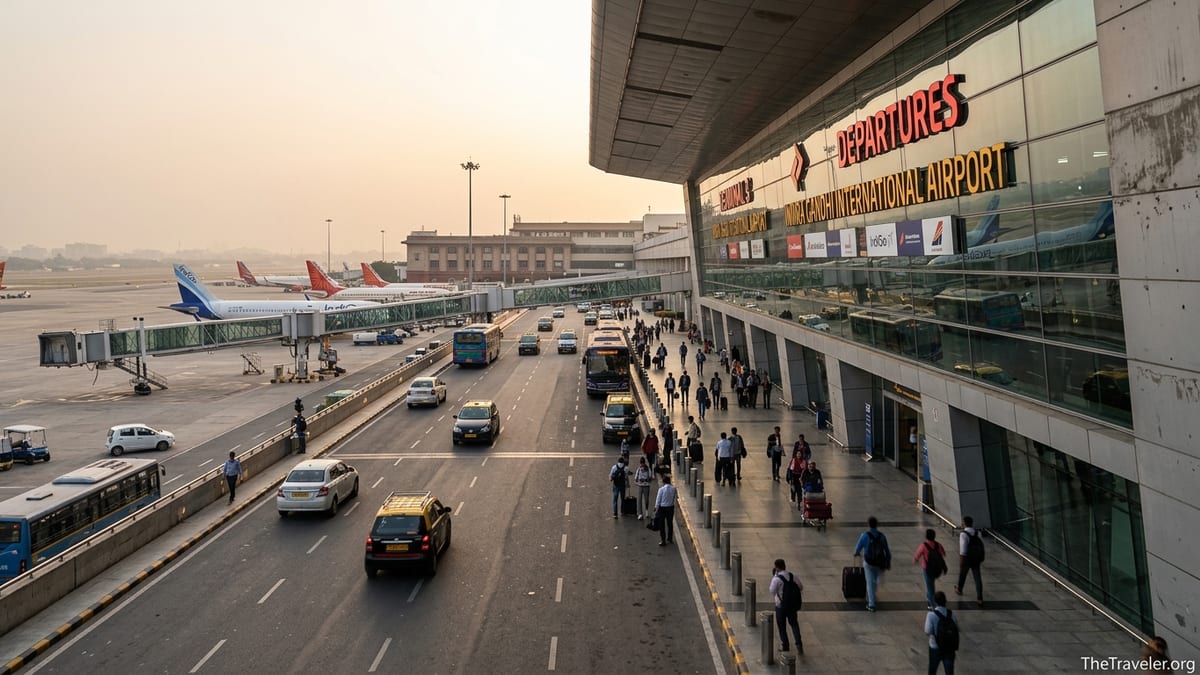
Delhi Airport in a Nutshell: How the Terminals Are Organized
Delhi’s Indira Gandhi International Airport (DEL) is a single airport complex on the southwestern edge of the city, but it feels like three different airports. Terminals 1, 2 and 3 are separate buildings spread across the same campus, connected by internal roads and a free shuttle bus. You cannot walk between them in a few minutes the way you might in a compact European airport. In normal traffic, a road transfer between Terminal 1 and Terminal 3 easily takes 15 to 25 minutes, and in rush hour it can take longer.
The basic rule is simple. All international flights use Terminal 3. Domestic flights use either Terminal 1, Terminal 2 or Terminal 3 depending on airline and sometimes even flight number series. Terminal 1 is the main low-cost domestic terminal. Terminals 2 and 3 together handle most full-service domestic flights plus every international departure and arrival.
For a typical example, a passenger flying from Mumbai to Delhi on IndiGo and then on to London on British Airways will likely arrive into Terminal 1 or 2 and depart from Terminal 3. Another traveler flying from Bengaluru to Delhi on Air India and then on to Leh on a separate Air India ticket might remain within Terminal 3 or have to connect between Terminal 3 and Terminal 2 depending on the specific domestic flight.
Because airlines periodically reshuffle their Delhi operations, it is essential to check your terminal a day or two before travel on your airline’s app or booking page. A flight that used Terminal 1 last year might now depart from Terminal 2 or 3, especially around seasonal schedule changes in late March and late October.
Terminal 1 (T1): The Low-Cost Domestic Workhorse
Terminal 1 sits on the northeastern side of the airport campus and is dedicated to domestic flights, primarily low-cost carriers. It has been heavily used by IndiGo and SpiceJet, and in recent seasons also by other budget-focused services. The building has been expanded and modernized, but it still feels busier and more compact than Terminal 3, especially in the morning and late evening departure banks.
Most passengers using Terminal 1 are flying between Delhi and major Indian cities such as Mumbai, Bengaluru, Hyderabad, Kolkata, Ahmedabad and Pune. A common real-world pattern: office workers flying Delhi to Mumbai on an early morning IndiGo flight for a same-day business trip, or families taking a budget SpiceJet flight to Goa for a long weekend. Check-in, security and boarding are geared to high volumes and quick turnarounds rather than luxury amenities.
Inside Terminal 1 you will find standard services like ATMs, basic restaurants and coffee chains, and a handful of domestic lounges that can be accessed with certain credit cards or paid entry. Prices tend to be slightly above city levels. For example, a simple meal at a branded fast-food outlet might cost the equivalent of 5 to 7 US dollars, and a cappuccino from a well-known chain around 3 to 4 US dollars. Seating can be tight at peak times, so if you are traveling with older relatives or small children, arrive early and secure seats near your gate.
One important operational detail is that many IndiGo domestic flights now use specific terminals based on flight number ranges, with large blocks assigned to Terminal 1 and others to Terminal 2 or 3. That means two Delhi to Mumbai flights on the same day, both on IndiGo, can easily depart from different terminals. Always check the terminal printed on your boarding pass or displayed in the airline app and do not assume that “IndiGo always uses T1.”
Terminal 2 (T2): The Flexible Overflow Domestic Terminal
Terminal 2 sits physically between Terminals 1 and 3 and functions as a flexible domestic terminal. The airport operator uses T2 to relieve pressure from Terminal 1 and Terminal 3 during busy periods or after airline reshuffles. As a traveler, you should think of Terminal 2 as “domestic only, but subject to change.”
In practice, this means airlines may move certain flights or entire flight number ranges to Terminal 2 for a season or more. For example, parts of IndiGo’s domestic network have been assigned to Terminal 2, often flights in a particular number block such as the 2000- or 3000-series. Air India has also shifted a portion of its domestic departures to Terminal 2 according to recent schedule changes, while keeping other domestic and all international flights at Terminal 3. These shifts are announced in airline press notes and reflected in booking confirmations, but many travelers still miss the change and show up at the wrong building.
Terminal 2 is smaller than Terminal 3 but generally calmer than Terminal 1. Think of it as a mid-range experience: not as many premium lounges as T3, but a more relaxed feel compared with T1’s intense budget-carrier crowds. Facilities include check-in counters, security, standard food outlets, and basic shopping. Transit times can still be significant, though. If you are connecting between T2 and T3 on separate tickets, you should allow at least 2.5 to 3 hours between flights to comfortably reclaim bags, transfer by shuttle, re-check in and clear security again.
Because Terminal 2 is used as a balancing tool, a concrete example illustrates how this affects real passengers. Imagine a traveler who has flown Delhi to Srinagar multiple times on a particular IndiGo flight that always used Terminal 1. After a terminal reshuffle, that exact flight number is reassigned to Terminal 2. If the traveler books the same flight a year later and heads automatically to T1 out of habit, they may find themselves at the wrong terminal and facing a 20-minute shuttle bus ride plus another security check, with all the stress that entails.
Terminal 3 (T3): The Main International and Full-Service Hub
Terminal 3 is the flagship of Delhi Airport and handles every international departure and arrival along with many domestic flights for full-service carriers and selected low-cost operations. It is the largest terminal by far, connected to the city by the dedicated Airport Express metro line and serving long-haul routes to cities such as London, New York, Toronto, Sydney, Dubai, Singapore and dozens of others.
If you are flying into India from overseas, you will arrive at Terminal 3 regardless of airline. British Airways, Lufthansa, Emirates, Qatar Airways, Singapore Airlines, Air India, IndiGo international flights and almost all other foreign and Indian carriers use the international side of T3. The terminal houses immigration, baggage claim, customs and one of the largest duty-free shopping areas in the country. Expect a typical immigration processing time of 20 to 45 minutes during busy waves, with longer waits possible on holiday weekends.
On the domestic side, Terminal 3 also handles many Air India, Vistara and Akasa Air flights, plus certain IndiGo domestic departures depending on flight number ranges and operational needs. For instance, a Delhi to Chennai flight on Air India is likely to operate out of T3, while a Delhi to Kochi flight on IndiGo might use either T1, T2 or T3. This mixed use makes Terminal 3 an important domestic hub for travelers connecting to international flights. A common itinerary is a domestic leg such as Jaipur to Delhi on Air India, arriving into T3, followed by a same-ticket connection onward to Europe or North America, also from T3, allowing a seamless through-check of baggage.
Facilities in Terminal 3 are closer to what international travelers expect from a major hub: multiple lounges including airline-branded and independent options, a wide range of restaurants from Indian regional cuisine to global fast-food chains, currency exchange counters, and plenty of seating. Prices for food and drink are roughly comparable to other large international airports, and you can easily spend 10 to 15 US dollars per person on a full meal at a mid-range sit-down outlet. Showers are available in some lounges and at selected fee-based facilities, which can be valuable if you are transiting overnight.
Domestic vs International Flights: Which Terminal Do You Need?
The most important distinction at Delhi Airport is domestic versus international, but the line is not as simple as “domestic equals Terminal 1.” The reality is more nuanced and closely tied to airline strategy. All international flights, whether outbound or inbound, operate from Terminal 3. That includes foreign carriers like Emirates and United Airlines, and Indian carriers such as Air India and IndiGo on their international routes. So if your flight involves crossing a border, plan on using T3.
Domestic flights are split across all three terminals. Low-cost carriers like IndiGo and SpiceJet have a strong presence at Terminal 1, but also operate selected services from Terminal 2 and Terminal 3 depending on demand and airport allocation. Full-service domestic flights on Air India and Vistara typically use Terminal 3, with some Air India domestic services redirected to Terminal 2 based on recent changes. Newer entrants such as Akasa Air generally operate from Terminal 3, but assignments can shift as the airline grows.
In practical terms, this means two passengers on different domestic flights can have very different experiences on the same evening. One traveler on a budget Delhi to Patna flight might be dropped off at Terminal 1 by a rideshare driver, queue at a crowded security checkpoint, and board from a bus gate. Another traveler on a Delhi to Kochi flight with a full-service carrier might be taking the Airport Express metro directly into Terminal 3, checking baggage all the way to an onward international destination, and relaxing in a branded lounge before boarding from a jet bridge.
Whenever you book a domestic flight involving Delhi, especially if you are connecting to an international sector, treat the terminal as a key part of your planning. Check not only that you have enough time between flights but also whether your domestic and international legs use the same terminal. A domestic-to-international connection at T3 on one through-ticket is easy. A self-constructed connection that requires moving from T1 to T3 with checked bags during evening rush hour is much riskier.
Getting Between T1, T2 and T3: Distances, Shuttles and Realistic Timings
The three terminals at Delhi Airport are separated by internal roadways, and at ground level they feel further apart than they look on a map. Terminal 1 sits at one end of the campus, with Terminals 2 and 3 clustered together at the other end. The road distance between T1 and T3 is roughly 7 to 8 kilometers via airport roads, while T2 is positioned in between. You cannot walk this route with luggage in any practical way; a vehicle transfer is essential.
The primary option is the free inter-terminal shuttle bus operated by the airport. Buses run regularly throughout the day, with announced intervals of around 10 to 20 minutes depending on time of day and operational demand. In reality, travelers report that waiting times can vary. For example, during a late evening bank of flights a passenger might wait 5 to 10 minutes for a bus, while at quieter midday periods the wait could be closer to 20 minutes. The ride itself takes roughly 15 to 20 minutes between T1 and T3 in normal traffic, plus time for intermediate stops at T2.
If you are connecting on one ticket and your bags are checked through, some airlines provide specific inter-terminal transfer arrangements, including designated shuttle points inside the secure area or at special counters. For instance, passengers with a domestic leg operated by Air India and an onward Air India or partner international flight may be directed to official transfer desks and a dedicated shuttle, reducing the number of times you need to handle your baggage. If you are on separate tickets or using different airlines, you should assume you need to exit to landside, collect your bags, and then follow signs for the inter-terminal shuttle outside arrivals.
Real-world experience suggests using conservative buffers. Imagine you land at Terminal 1 from a domestic city at 15:15 and need to catch an international flight from Terminal 3 at 18:45 on a separate ticket. You will have about 3.5 hours. Deplaning, baggage collection and exiting T1 might take 30 to 45 minutes. Waiting for and riding the shuttle can easily consume another 30 to 40 minutes, especially if traffic near the terminal is heavy. You still need to check in, drop bags and clear immigration and security at T3. In this scenario you may make the connection, but it will not feel leisurely. For separate tickets that involve a terminal change, many seasoned travelers aim for at least 4 to 5 hours of buffer.
Metro and City Access: Reaching the Right Terminal from Delhi
Delhi’s metro system offers two main options for reaching the airport area: the Airport Express line and the Magenta line. The Airport Express line connects New Delhi railway station to the airport station serving Terminals 2 and 3. It is fast, air-conditioned and built specifically with airport travelers in mind. Trains typically cover the distance from central New Delhi to the airport in about 20 minutes, and services run roughly every 10 to 15 minutes during most of the day.
If your flight departs from Terminal 3, the Airport Express is a very convenient option. You can board at New Delhi metro station, ride directly to the IGI Airport station for T2/T3, and then walk via underground or covered passages to the departure level. Many international travelers use this route when arriving into Delhi as well, especially if they are heading to hotels near Connaught Place or to the railway station for onward train journeys. Luggage trolleys are usually available near station exits, and the walk to check-in is clearly signed.
For Terminal 1, the better match is the Magenta line of the Delhi Metro, which has a dedicated station named for Terminal 1. Trains on this line connect T1 with neighborhoods such as Hauz Khas and Kalkaji, and with other metro lines for onward connections. A typical route from southern Delhi might involve riding the Yellow line to Hauz Khas, changing to the Magenta line and alighting at the Terminal 1 station. From there, an enclosed walkway and shuttle connections lead to the terminal building. Total travel time from inner south Delhi to T1 via metro is commonly in the 35 to 50 minute range depending on transfers.
If you prefer road transport, app-based taxis and airport prepaid cabs are widely available. From central Delhi locations such as Connaught Place, a car ride to Terminal 3 can take around 30 to 45 minutes in moderate traffic, and longer at peak rush hours or during special events. Fares vary by service and surge pricing, but a mid-range app-based ride from the city center to T3 typically costs in the ballpark of 6 to 10 US dollars equivalent. Always specify your exact terminal in the app, as drivers see different pick-up zones for T1 and T3 and may head to the wrong side of the airport if you simply enter “Delhi Airport.”
Wrong-Terminal Mistakes: How They Happen and What to Do
Showing up at the wrong terminal is one of the most common and stressful errors at Delhi Airport, especially for travelers who have flown through the city years earlier and assume the layout has not changed. The typical scenario involves a passenger who knows that a certain airline “uses Terminal 1” or “uses Terminal 3” and heads straight there without re-checking their booking. After recent terminal reshuffles, it is increasingly common for the same airline to operate different flights from multiple terminals, or to move certain routes seasonally.
Consider a very real example. A traveler from Bengaluru has flown IndiGo to Delhi several times and always departed from Terminal 1. They book a new ticket to Delhi with a separate international connection on another airline, departing from Terminal 3. On the morning of travel, they ask a taxi to drop them at “IndiGo, Terminal 1” based on past habit. Only at check-in do they discover that their specific flight number has moved to Terminal 2. They now face a shuttle bus transfer, a new security check, and a tighter window to connect onward at T3.
If you find yourself at the wrong terminal, do not panic, but act quickly. First, confirm your correct terminal using your airline app, the SMS or email itinerary, or by asking at an information desk. Second, evaluate how much time you have before check-in closes, which for domestic flights is often 45 to 60 minutes before departure and for international flights 60 to 75 minutes or more. Third, head directly to the inter-terminal shuttle pickup outside arrivals or departures, following airport signage. If your time buffer is very slim and you have heavy luggage, a metered taxi or app-based cab between terminals may save a few minutes compared with waiting for the bus, though you will need to factor in vehicle availability and potential queuing.
In many cases, airlines will not re-open check-in if you simply arrived at the wrong terminal too late, especially on separate tickets. However, if your entire journey is on one airline and one ticket, and you can show that terminal information was changed late or communicated unclearly, ground staff may offer options such as rebooking onto a later departure with or without a fee. The best protection is still prevention: set a reminder on your phone 24 hours before departure to open your airline app and confirm both terminal and check-in time, particularly if you are flying during busy holiday periods or immediately after seasonal schedule changes.
The Takeaway
Navigating Delhi’s three terminals is less intimidating when you think in terms of simple rules. Terminal 3 is your default for anything international and for most full-service domestic flights. Terminal 1 is the main home of domestic low-cost operations, while Terminal 2 serves as a flexible domestic overflow terminal used by airlines to smooth out congestion at the other two buildings. All three are part of one airport complex, but transfers between them require planning, time and attention to signage.
For smooth travel, always check your terminal a day or two before your flight, build generous buffers if you must change terminals, and choose the metro line or road transport that delivers you to the right side of the airport. If you do end up at the wrong building, move quickly to the shuttle or a taxi and keep a realistic view of your remaining time before departure. With a bit of preparation, Delhi Airport’s T1, T2 and T3 become manageable pieces of a larger puzzle rather than a source of last-minute panic.
FAQ
Q1. How do I know whether my flight uses Terminal 1, 2 or 3 at Delhi Airport?
Your booking confirmation, airline app and pre-departure SMS or email usually show the exact terminal. Because airlines sometimes move specific flights between terminals, always double-check this information 24 to 48 hours before departure instead of relying on memory or past experience.
Q2. Do all international flights in Delhi use Terminal 3?
Yes, all scheduled international passenger flights currently arrive and depart from Terminal 3. Regardless of whether you fly with a foreign carrier or an Indian airline, if you are crossing a border you will use T3 for immigration, customs and baggage claim.
Q3. Can domestic flights use Terminal 3 as well?
Yes. Many domestic flights on full-service airlines such as Air India and Vistara operate from Terminal 3, and some IndiGo and other domestic routes also use T3 depending on airport allocations. This is common when domestic flights connect to or from international services on the same airline.
Q4. How long does it take to transfer between Terminal 1 and Terminal 3?
Using the free inter-terminal shuttle bus, you should allow around 30 to 45 minutes in total, including waiting time and the drive itself in normal traffic. During busy periods or if you have to wait longer for the shuttle, the transfer can take closer to an hour, so build in extra time if you are connecting on separate tickets.
Q5. Is there a metro station for each terminal at Delhi Airport?
Terminal 3 and Terminal 2 are served by the Airport Express line, which stops at the IGI Airport station linked directly to these terminals. Terminal 1 is served by the Magenta line at the Terminal 1 metro station, connected to the terminal area by walkways and airport access roads.
Q6. What happens if I arrive at the wrong terminal for my flight?
First, confirm the correct terminal with your airline or at an information desk. Then go immediately to the inter-terminal shuttle bus stand or take a taxi to the right terminal. If you arrive too close to check-in closing time, you may be denied boarding, especially on separate tickets, so acting quickly is essential.
Q7. Are there lounges in all three terminals?
Yes, but the selection varies. Terminal 3 has the widest range of lounges, including airline-branded and independent options. Terminal 1 and Terminal 2 have fewer lounges, generally more basic, though many can be accessed with certain bank cards or paid entry. Availability and access rules can change, so it is wise to check with your airline or lounge program before travel.
Q8. How early should I arrive at Delhi Airport for a domestic or international flight?
For domestic flights, arriving about two hours before departure is usually sufficient in normal conditions. For international flights, plan on arriving three to four hours early, especially during busy travel periods, to allow time for check-in, security, immigration and any potential terminal confusion.
Q9. Can I check my bags through if I am changing terminals on one ticket?
Often yes. If both flight segments are on the same airline or alliance and issued on one ticket, your bags are typically checked through to your final destination, even if a terminal change is required. In that case, follow the transfer signs and any airline instructions for inter-terminal shuttles rather than reclaiming your luggage at arrivals.
Q10. Is it safe to plan a self-transfer between terminals on separate tickets?
It can be done, but you should build in a generous time buffer. For a domestic arrival in T1 and an international departure from T3 on separate bookings, many experienced travelers allow at least four to five hours. This covers possible delays, baggage claim, shuttle transfer, and full check-in plus immigration at the second terminal, reducing the risk of a missed flight.