


Landing at Delhi’s Indira Gandhi International Airport and heading straight to Noida can feel confusing, especially if it is your first time in the National Capital Region. Distances look short on the map but traffic, tolls and sector layouts quickly complicate the picture. This guide walks you through the real-world options from the airport to key Noida sectors and hotel clusters, with concrete journey examples, rough price ranges and advice on when to choose a cab, a metro combination or a prebooked car.
Get the latest updates straight to your inbox!
Understanding the Route: Delhi Airport to Noida
Indira Gandhi International Airport (DEL) sits on the south‑west edge of Delhi, while Noida spreads to the east, beyond the Yamuna River. A typical car route from Terminal 3 to central Noida sectors such as Sector 18, 27 or 29 runs via the Ring Road and Noida Link Road or the DND Flyway, roughly 30 to 40 kilometres depending on your final address. In light traffic this can take about 45 minutes, but in peak hour it often stretches to 75 to 90 minutes.
Most visitors heading to Noida are aiming for one of a few clusters: the commercial and shopping area around Sector 18 and the DLF Mall of India; older residential and mixed-use areas like Sectors 15, 22 and 27; office and media hubs around Sector 16 and 16A Film City; hotel and residential belts along the Noida Expressway around Sectors 44, 93–104 and 132; and newer residential and IT areas in Noida Extension and Greater Noida. Your best transfer choice from the airport changes slightly depending on which of these you are targeting.
Unlike central Delhi, there is no direct airport bus or train to Noida. You either travel entirely by road, usually in a taxi or app cab, or you combine the Airport Express and Delhi Metro with a last‑mile taxi or auto. For most first‑time visitors with luggage, particularly those arriving late at night, a direct cab from the terminal to your Noida hotel is the simplest and most reliable option despite tolls and possible congestion.
That said, the metro can be a smart choice during rush hours if you are comfortable with one or two transfers and carrying your bags. For example, a traveller landing at 5 pm on a weekday and staying near Sector 18 might avoid sitting in evening traffic on the DND Flyway by riding the Airport Express to New Delhi station and then the Blue Line toward Noida.
Uber, Ola and App Cabs: Easiest Door‑to‑Door Option
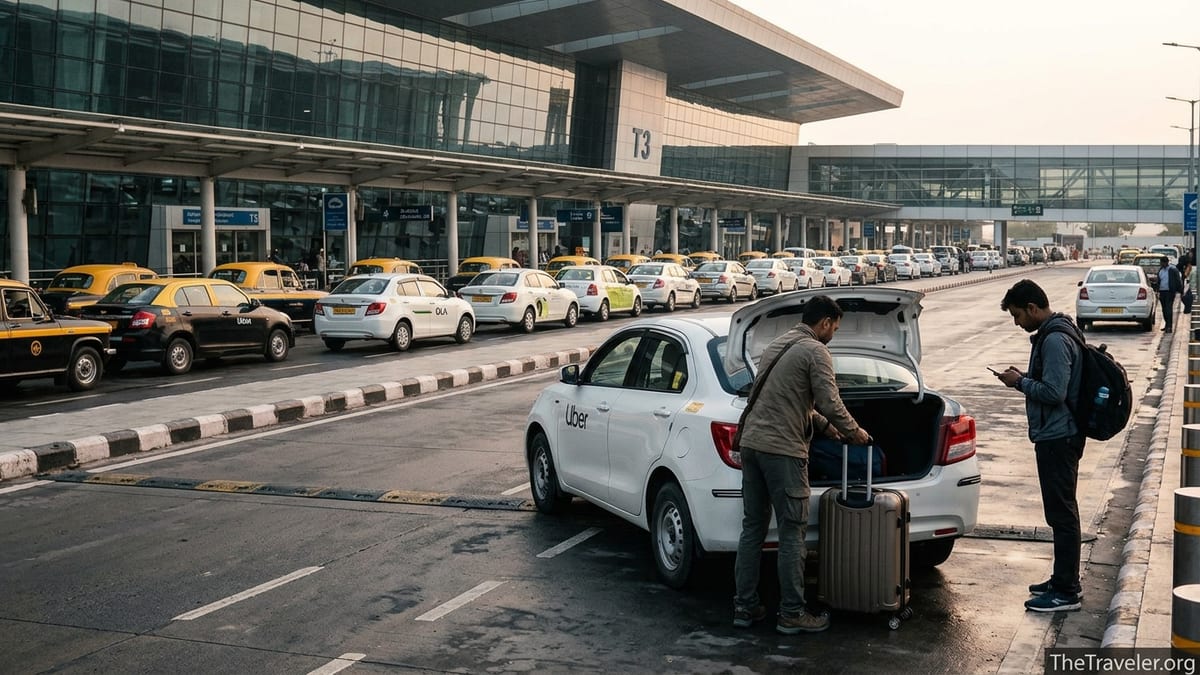
App‑based cabs such as Uber and Ola operate from all main terminals at Delhi Airport with clearly marked pick‑up zones. After collecting your luggage at Terminal 3, you follow signs to “App Cabs” or “Radio Taxis,” then open the app, enter your Noida hotel address and book a ride. Popular categories include Uber Go or Ola Mini for small groups with light luggage, and Uber Premier or Ola Sedan for more comfort and boot space.
Fares fluctuate by time of day, demand and exact sector. As a broad benchmark, travellers recently report typical Uber or Ola fares from Terminal 3 to central Noida (Sector 18 or 16) in the range of roughly ₹900 to ₹1,400 in a standard car, including tolls, during ordinary evening or weekend periods. At very busy times or late at night, surge pricing can briefly push this above ₹1,500, particularly to farther areas like Noida Extension or Greater Noida. In contrast, an off‑peak daytime trip to a closer sector such as 15 or 16 can sometimes come to the mid‑₹700s plus tolls.
These rides are almost always taken via the DND Flyway or the newer express links between Delhi and Noida, and your app will show separate line items for road tolls. It is useful to remember that the amount shown in the app at the time of booking usually includes tolls, so you should not pay anything extra in cash unless you are using an out‑of‑app arrangement. For a family of three checking into a hotel near DLF Mall of India, for instance, an Uber Go from Terminal 3 in mid‑afternoon might cost around ₹1,000 door to door and take about an hour depending on traffic.
Using app cabs avoids haggling and fare disputes, and your route and payment are logged. This is particularly reassuring if you are arriving at night or traveling alone. The trade‑offs are surge pricing during busy peaks, occasional waits of 10 to 20 minutes for a driver to reach your terminal, and the need for mobile data to book and coordinate the ride. If you land around 8 am on a weekday and need to reach a sector along the Noida Expressway, you might face both morning office‑hour congestion and higher app fares, so it can be worth waiting 20 to 30 minutes at the terminal for prices to settle unless you are in a hurry.
Prepaid and Regular Taxis from the Airport
Alongside app cabs, Delhi Airport has prepaid taxi counters regulated by the Delhi authorities. These booths quote fixed fares to destinations across Delhi and the wider NCR, including popular Noida landmarks such as Amity University on the Expressway or the commercial centre around Sector 18. You pay in advance at the counter and receive a slip to hand to the driver waiting in the taxi queue outside the terminal building.
The advantages of prepaid taxis are price certainty up front and an official slip listing your destination and vehicle details. Travellers heading to Noida often find that the prepaid fares are broadly comparable to or slightly below app cab prices during surge periods, though not always cheaper than Uber or Ola at calm times. For example, a late‑evening prepaid non‑AC taxi fare from Terminal 3 to a Noida landmark around 35 kilometres away might come to somewhere in the low‑to‑mid thousands of rupees once night charges and tolls are factored in. Air‑conditioned options cost more but are more comfortable in Delhi’s heat.
The main downsides are queues and vehicle condition. During busy arrival banks, you may spend 20 to 40 minutes in line at the prepaid counter, and most taxis are older sedans with basic interiors. While the fares are fixed, travellers occasionally report drivers attempting to negotiate extra cash for tolls or “luggage” after departure. Keeping the prepaid slip until you reach your destination and politely insisting on the printed fare can reduce such issues. If you prefer a guaranteed newer car and app support but do not want to wait in a long queue, an Uber or Ola booked from the designated pick‑up area is usually the more comfortable option.
Metered yellow‑and‑black cabs waiting outside the terminal that are not linked to the official prepaid system are generally best avoided for airport to Noida trips. They sometimes quote vague or inflated fares, and you have less recourse if the driver takes a long route or demands extra money on arrival.
Metro and Cab Combinations: When They Make Sense
The Delhi Metro Airport Express line connects Terminal 3 with New Delhi Railway Station in about 20 to 25 minutes. From there, you can transfer to the regular Delhi Metro network and travel toward Noida on the Blue Line. This combination appeals to budget‑conscious solo travellers or those arriving during heavy rush‑hour traffic who want to avoid sitting in a taxi on the Ring Road. A typical route from Terminal 3 to Sector 18 might be Airport Express to New Delhi, Yellow Line one stop to Rajiv Chowk, and then Blue Line toward Noida City Centre, alighting at Sector 18 or Noida Sector 16.
Fares on the Airport Express and Delhi Metro are modest by international standards. As an illustration, a complete metro journey from Terminal 3 to Noida Sector 18 station usually costs only a small fraction of a taxi fare, often under ₹150 in total per person. The trade‑off is time, transfers and managing luggage. Including walking inside stations and waiting for trains, you should allow 70 to 90 minutes door to door from the airport terminal to a Noida metro station, plus additional time if you then take an auto or taxi from the station to your hotel.
This approach works best if your hotel is very close to a metro stop. For example, travellers staying in Sector 18 itself, Sector 16, or near Noida City Centre in Sector 32 can simply walk or take a short auto‑rickshaw ride from the station. Visitors booked into budget hotels near Botanical Garden station or guesthouses in nearby Sectors 27 and 37 can also manage easily with a metro plus a brief e‑rickshaw hop. In contrast, if your destination is along the Noida Expressway around Sectors 93, 104 or 132, or in Noida Extension and Greater Noida, you will almost certainly need a longer taxi ride from the metro, which reduces the time and cost advantage.
Because the Airport Express and Delhi Metro generally stop running around midnight, metro combinations are not suitable for late‑night arrivals. After roughly 11 pm, travellers heading to Noida should plan on a direct car transfer, whether via Uber, Ola, a prepaid taxi or a prearranged hotel car. Likewise, if you are carrying two large suitcases and traveling with young children, the effort of multiple station transfers and escalators is usually more hassle than the savings justify.
Private Transfers and Hotel Cars
Many mid‑range and upscale hotels in and around Noida either offer their own airport pick‑up services or work with trusted local car operators. Business‑focused properties near Noida Sector 16 and the Film City area, as well as larger hotels along the Noida Expressway and in Greater Noida, often quote a fixed rate for airport pick‑up in a sedan or SUV. These prices are typically higher than standard Uber or Ola fares but may be attractive if you value predictability, meet‑and‑greet service in the arrivals hall and assistance with luggage.
For example, a four‑star hotel near Sector 18 or Film City might charge around ₹2,000 to ₹3,000 for a one‑way airport transfer in a private car, depending on the vehicle type and time of day. Larger SUVs or late‑night arrivals can cost more. These rates usually include tolls and parking, and the car waits even if your flight is delayed. For a small group of colleagues arriving on the same international flight and billing the transfer to a corporate account, this can be a reasonable trade‑off against the relatively low additional cost.
Independent car rental and chauffeur services also operate in Delhi and Noida, offering point‑to‑point airport transfers for fixed prices quoted in advance by email or messaging. These can be useful if your arrival is at an odd hour or you need a large vehicle for bulky equipment. A production crew heading to a media office in Sector 16A, for instance, might prebook an innova‑type vehicle to carry camera gear directly from the terminal to their office rather than squeezing into two smaller app cabs.
The main drawback of private transfers is cost for solo or budget travellers. If you are visiting Noida for an exam or short training course and paying out of pocket, a standard Uber or Ola is usually the most economical comfortable option, with the metro‑plus‑cab combination reserved for those who are both cost‑sensitive and confident using public transport.
Traffic, Tolls and Timing Your Journey
Traffic conditions on the corridor between Delhi Airport and Noida are highly variable. Morning rush hour toward central Delhi and the DND Flyway usually builds from about 8 am to 11 am, while evening congestion toward Noida can be heavy between roughly 5 pm and 9 pm, especially near the Ring Road and the approaches to the river bridges. During these windows, car journeys from Terminal 3 to sectors like 18, 16 or 32 can push toward 75 to 90 minutes rather than the 45 to 60 minutes seen in lighter traffic.
Tolls are another factor to keep in mind. Most routes between the airport and Noida involve at least one paid express link or flyway. In app cabs, these are usually itemized within the fare estimate shown before booking. In prepaid or regular taxis, they may be listed separately, or drivers may ask you to cover them in cash. A traveller taking a prepaid taxi from Terminal 3 to a hotel near Sector 62, for instance, might see a fare card that lists a base amount plus a percentage surcharge at night, with tolls collected on the way. While individual toll amounts are modest by global standards, they add up over a long trip and can sometimes feel disproportionate compared with the base fare.
For early morning international arrivals, it can be tempting to jump into the first cab you see. If you land around 4 am, however, traffic will still be relatively light until the city wakes up, and both Uber and Ola fares are often lower outside peak hours. In such cases, an app cab to Noida can be both efficient and comparatively affordable. Conversely, if you land around 6 pm, you might face both heavy traffic and surge pricing; watching the app fare for 10 or 15 minutes inside the terminal sometimes reveals noticeable fluctuations as demand rises and falls.
Weather also affects travel time. During the monsoon, waterlogged patches on key roads can slow traffic dramatically, especially in low‑lying underpasses. In winter, heavy fog in the early morning or late night can reduce visibility and lead to slower speeds and occasional diversions. Building in an extra buffer of 30 minutes to an hour for airport to Noida transfers during these seasons is wise, particularly if you are heading straight to a time‑sensitive appointment such as an exam or business meeting.
Best Options by Noida Sector and Hotel Area
The most practical transfer option from Delhi Airport to Noida changes slightly depending on where you are staying. For the busy commercial and shopping core around Sector 18 and nearby Sectors 15, 16 and 27, both taxis and the metro work well. A couple staying at a mid‑range hotel near Noida Sector 18 station, for example, might choose an Uber or Ola if they arrive late at night, but during the day they could comfortably ride the Airport Express and Blue Line, then walk or take a short e‑rickshaw from the station to their hotel.
For the Film City and media hub around Sector 16A and the adjoining cluster of offices and hotels, app cabs and prepaid taxis are generally the easiest door‑to‑door method. The area is close to the DND Flyway and has good road access, so a direct car ride from the airport typically takes around an hour in moderate traffic. Metro is an option if you alight at Sector 16 station and take a short cab or auto to Film City, but travellers carrying laptops and presentation materials often prefer a single uninterrupted car journey.
Guests heading to hotels and serviced apartments along the Noida Expressway in Sectors 44, 93–104 or 132 will almost always be best served by a direct cab from the airport. Although metro and feeder buses exist, the expressway stretches away from the Blue Line and Aqua Line stations, and last‑mile connections can be patchy or time‑consuming. For someone booked at an IT park guesthouse in Sector 135, an Uber or Ola from Terminal 3 provides a clear, predictable route along the expressway instead of a multi‑step journey involving metro, autos and office shuttles.
Travellers staying in New Noida, Noida Extension or Greater Noida face the longest journeys from Delhi Airport. Straight‑line distances can reach 50 kilometres or more, and app cab fares rise accordingly. Recent reports put some late‑night Uber and Ola quotes from Terminal 3 to Greater Noida well above ₹1,200 in smaller cars and higher still for larger vehicles. For cost‑sensitive solo travellers, one pragmatic compromise is to share a cab from the airport with others heading in the same general direction, then transfer to a local auto or cab at a major junction such as Sector 62, Sector 51 or Pari Chowk. This requires confidence and coordination but can reduce the overall fare.
Choosing the Right Option for Your Luggage and Comfort
How much luggage you carry matters in Delhi’s transport system. App cabs and prepaid taxis handle standard airline baggage with ease, but metro coaches, escalators and station corridors feel very different with two large suitcases. As a rule of thumb, if you have more than one large checked bag per person, or are traveling with children or elderly family members, a door‑to‑door car from the airport to your Noida hotel is usually worth the extra cost.
For solo travellers or couples with only cabin baggage, metro combinations become more appealing. A backpack and a small roller bag are easy enough to manage through New Delhi and Rajiv Chowk, especially outside the sharpest rush hours. Someone flying in from Bengaluru on a mid‑day flight and staying at a guesthouse near Botanical Garden station, for instance, might comfortably ride the Airport Express and Blue Line, then take a quick auto to their accommodation, spending a small fraction of what a taxi would cost.
Security and personal comfort also play a role. Official app cabs, prepaid taxis and the Delhi Metro system are widely used by local commuters and visitors alike. Women traveling alone or those unfamiliar with the city sometimes feel more comfortable inside the metro’s clearly marked coaches and CCTV‑covered stations during the day. After dark, however, especially late at night, many prefer the convenience of a booked cab that drops them right at their hotel lobby in Noida rather than connecting through a series of stations and streets.
If you are carrying expensive electronics or important documents, minimizing transfers is sensible. A software consultant heading to a tech park in Sector 62 with a laptop and prototype hardware, for example, might choose a single Uber Premier ride despite the higher fare, simply to reduce the chances of jostling or misplacing items in a crowded metro carriage.
The Takeaway
Traveling from Delhi Airport to Noida is straightforward once you understand how distance, traffic and sector layout interact. For most visitors, especially those arriving with luggage or at night, a direct Uber, Ola or regulated prepaid taxi from the terminal to their Noida hotel offers the best balance of comfort, safety and simplicity. Fares are higher than inner‑city trips but predictable, and routes via the DND Flyway or express links are well established.
The metro becomes a smart alternative for confident travellers with light baggage heading to sectors close to Blue Line stations, particularly around Noida Sector 16, 18, 27, 29 or City Centre. Using the Airport Express to New Delhi and then changing lines can save both money and, in heavy traffic, sometimes time. Private hotel cars and chauffeur services sit at the premium end of the spectrum, offering meet‑and‑greet convenience for business travellers and families willing to pay more for a seamless experience.
Ultimately, the best option depends on when you land, where in Noida you are staying and how much you value cost versus convenience. With a realistic sense of travel times, a rough idea of current cab fares and a plan tailored to your sector, your first journey from Delhi Airport to Noida can be a smooth introduction to the wider Delhi–NCR region rather than a stressful scramble.
FAQ
Q1. How long does it usually take to travel from Delhi Airport to central Noida?
In light traffic, a taxi or Uber from Terminal 3 to central Noida sectors like 16 or 18 often takes around 45 to 60 minutes; in peak hours, expect 75 to 90 minutes.
Q2. What is the typical cost of an Uber or Ola from Delhi Airport to Noida?
For most central Noida destinations, recent app fares in standard cars tend to fall roughly between ₹900 and ₹1,400 including tolls, depending on time of day and demand.
Q3. Is the metro a good option from Delhi Airport to Noida?
Yes, if you have light luggage and are staying near a Blue Line station such as Noida Sector 16, 18 or City Centre, the Airport Express plus metro combination is cost‑effective though it involves transfers.
Q4. Are prepaid taxis at Delhi Airport safe and reliable for Noida trips?
Prepaid taxis from official counters are generally safe and reliable, with fixed fares paid in advance; keep your receipt, confirm that tolls are included or clarified, and avoid unmetered taxis outside the system.
Q5. Which option is best if my hotel is along the Noida Expressway?
For hotels and offices along the Noida Expressway in sectors like 44, 93–104 or 132, a direct Uber, Ola or hotel car is usually best, as metro connections often leave a long last‑mile by road.
Q6. What should solo female travellers consider when choosing a transfer?
Many solo female travellers prefer app cabs or prepaid taxis for door‑to‑door service at night, and the Airport Express plus Delhi Metro during the day, sticking to well‑lit, staffed areas when changing lines.
Q7. Are there late‑night public transport options from Delhi Airport to Noida?
After around midnight, metro services largely stop, so late‑night arrivals should plan on a taxi, Uber, Ola or prebooked hotel car to reach Noida.
Q8. How much extra time should I allow in bad traffic or bad weather?
During peak rush hours, heavy rain or dense winter fog, it is sensible to add 30 to 60 minutes of buffer time to the usual airport‑to‑Noida journey estimate.
Q9. Can I share a cab from the airport to reduce costs to Greater Noida or Noida Extension?
Informal cab sharing does happen among travellers heading in the same direction, which can lower individual costs, but it requires coordination and comfort with sharing a ride with strangers.
Q10. What is the most comfortable option for families with children and multiple bags?
For families with young children and several suitcases, a direct Uber, Ola, hotel car or prepaid taxi from the terminal to the Noida hotel is generally the most comfortable and least stressful choice.