


More news on this day
Delta Air Lines passengers at Austin-Bergstrom International Airport faced hours of delays and cancellations after a widespread ground stop cascaded across the carrier’s U.S. and Mexico network, stranding travelers and complicating summer schedules at an already busy gateway.
Get the latest news straight to your inbox!
Ground Stop at Austin-Bergstrom Quickly Spreads Across Network
Reports from airline trackers and airport operations indicate that a broad Delta Air Lines ground stop originating on Friday rapidly disrupted departures at Austin-Bergstrom International Airport, with multiple outbound and inbound flights held at gates or removed from schedules. The pause in operations, affecting aircraft movements on the ground, translated into rolling delays that extended well into the day as the airline worked to reset its schedule.
Publicly available data shows that Austin, a growing focus city with dense connections to major Delta hubs, became an early pressure point. Flights to Atlanta, Salt Lake City and Los Angeles were among those delayed, creating knock-on effects for passengers connecting onward to destinations across the United States and Mexico. The disruption was compounded by high summertime demand, leaving limited spare seats on alternative services.
Although the official ground stop order was lifted after a period of time, the impact on the operation was far from over. Crews and aircraft were left out of position, and recovery flights departed late or not at all. For many travelers, the practical effect was a full-day disruption, with rebookings pushing journeys into the weekend.
The situation at Austin-Bergstrom echoed scenes last year when a separate system outage triggered a global ground stop for major U.S. carriers. Those events demonstrated how quickly a halt to departures, even for a few hours, can generate days of schedule instability once aircraft and crews fall out of sync.
Ripple Effects Reach Major Hubs and Mexico Gateways
As the Austin-Bergstrom disruption unfolded, network data and flight-status services showed delays fanning out across Delta’s core hubs, including Atlanta and other large connecting airports that serve as gateways to Mexico. Aircraft that were scheduled to operate onward from Austin could not depart on time, placing additional pressure on already tight turnarounds.
Passengers connecting in Austin to Mexico leisure destinations such as Cancún and coastal resort cities were among those most affected. With summer holiday demand elevated and many flights operating close to capacity, same-day reaccommodation options were limited. Some travelers reported being moved to later departures or rerouted through alternate hubs, lengthening overall journey times.
Operational records from recent months show that Austin-Bergstrom has been steadily expanding its international portfolio, including seasonal and new services into Mexico. When a carrier with a major domestic footprint such as Delta encounters a ground stop at a fast-growing airport, the effect quickly extends beyond point-to-point routes and into the broader cross-border network.
The wider U.S. air traffic system has also been under strain from weather events and staffing limitations at various airports and control centers in recent weeks. Against that backdrop, a carrier-specific ground stop can act as a multiplier on existing congestion, particularly for passengers relying on tight connections.
Travelers Confront Cancellations, Long Lines and Limited Options
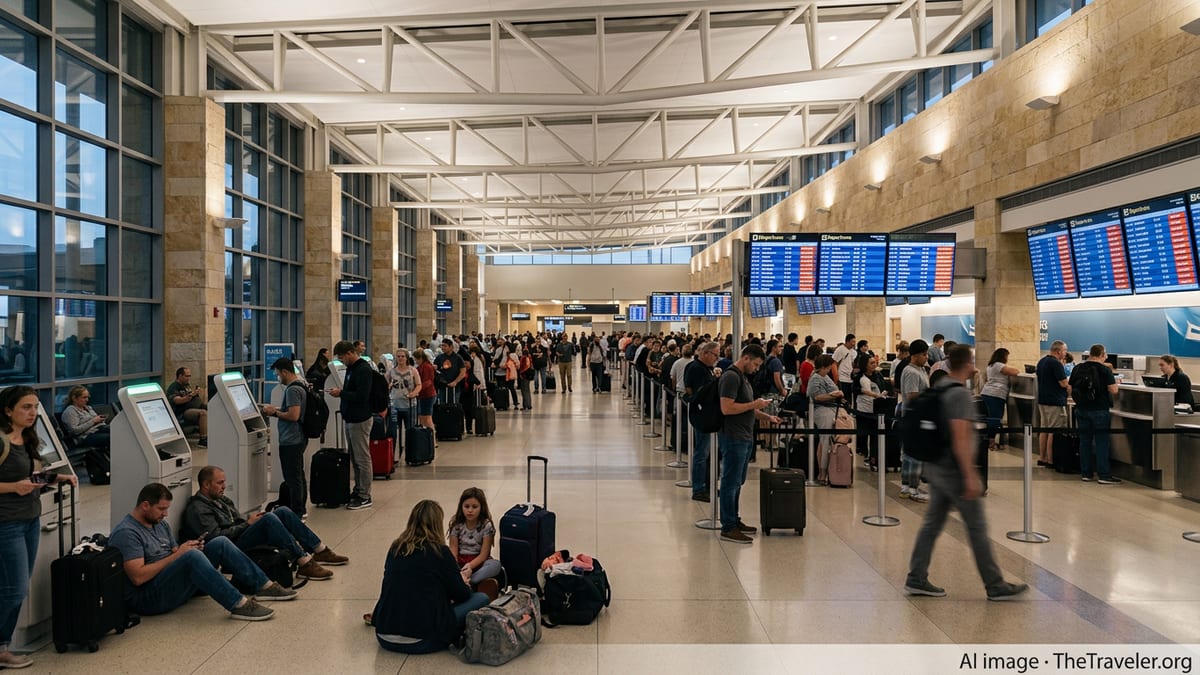
Inside Austin-Bergstrom’s terminal, the operational disruption was visible in growing queues at check-in counters, gate podiums and customer service desks. As cancellations mounted, travelers sought rebooking assistance, hotel vouchers and information about how long the disruption would last. With many flights sold close to capacity, reassigning passengers became increasingly difficult.
Across social media and traveler forums, accounts described long waits to speak with airline staff, frequent app notifications about schedule changes and confusion over revised departure times. Some passengers reported being advised to accept later flights over the weekend, while others opted to cancel trips entirely when suitable alternatives could not be found.
Families heading to Mexico for vacations and business travelers on tight itineraries were among those scrambling to adjust plans. The knock-on delays also affected baggage handling, with some checked bags diverted or delayed as aircraft rotations were modified at short notice. For travelers attempting to make international connections, uncertainty over whether they would meet onward departures added further stress.
Publicly available guidance from consumer advocates highlights that during widespread disruptions, digital tools can be critical. Passengers often have better odds rebooking through airline apps or websites while also joining airport service queues, rather than relying on a single channel. In large-scale events, however, even digital self-service options can be stretched as thousands of customers attempt to modify itineraries simultaneously.
Context: An Industry Still Grappling With Disruption Risk
The latest wave of cancellations and delays affecting Delta operations at Austin-Bergstrom arrives against a broader backdrop of heightened concern over airline resilience. In the past two years, major carriers have contended with weather-driven ground stops, staffing shortages and high-profile technology incidents that temporarily grounded flights across multiple continents.
Public records from 2024 show how a global information-technology outage linked to a third-party software provider triggered a sweeping ground stop that particularly affected Delta, leading to thousands of cancellations and an extended recovery period. U.S. transportation data released afterward underscored how deeply a single disruptive event can cut into an airline’s on-time performance and customer satisfaction metrics for weeks.
Industry analyses published since then note that carriers have invested heavily in backup systems and contingency planning, yet the interconnected nature of modern air travel continues to leave operations vulnerable to cascading failures. When a ground stop intersects with peak travel periods, the margin for recovery narrows even further, as there are few spare aircraft or crews to absorb the shock.
At the same time, Austin-Bergstrom’s own growth trajectory has turned it into a bellwether for regional air travel conditions. As more airlines add routes, particularly to Mexico and other international destinations, the airport’s role in the broader network becomes more critical. Disruptions that once might have been contained locally now reverberate across international itineraries.
What Passengers Should Watch in the Coming Days
In the near term, passengers booked on Delta flights through Austin-Bergstrom, as well as those connecting onward in the United States and Mexico, are likely to feel residual effects as the airline works through aircraft and crew imbalances. Even after the initial wave of cancellations, schedules may remain fragile for several days, with isolated delays and last-minute swaps still possible.
Travel planners suggest that affected travelers monitor their reservations frequently, arrive at the airport earlier than usual and consider carrying essential items in hand luggage in case of unexpected overnight stays. Flexible tickets or itineraries that can be rerouted through alternate hubs may offer additional security while the network stabilizes.
From a broader perspective, the Austin-Bergstrom episode underscores how quickly localized operational issues can transform into a cross-border travel event when large network carriers are involved. For destinations in Mexico and elsewhere that rely on connecting traffic through U.S. hubs, any sustained disruption can have implications for tourism flows and business travel patterns.
Observers expect closer scrutiny of how airlines communicate during such episodes and how rapidly they are able to restore normal operations. For travelers moving through Austin and other key nodes in the Delta system, the latest disruption serves as another reminder to build extra time into itineraries and to keep contingency plans ready during peak travel seasons.