

More news on this day
Delta Air Lines is urging roughly 400,000 passengers traveling through its largest hub in Atlanta over the next five days to prepare for possible delays, long security lines and schedule changes, as the carrier works to protect operations during a period of heavy demand and ongoing system strains.
Get the latest news straight to your inbox!
Atlanta Megahub at the Center of New Alert
Publicly available data show that Hartsfield-Jackson Atlanta International Airport is Delta’s largest hub by daily departures and passenger volume, with the airline operating well over 1,000 flights a day from the facility in peak periods. The new advisory targets customers connecting through or originating in Atlanta during a concentrated five-day window of high traffic and lingering operational pressures.
According to published coverage and airline schedule data, the alert covers close to 400,000 passengers booked on Delta and Delta Connection flights touching Atlanta over the next several days. The guidance urges travelers to closely monitor flight status, arrive earlier than usual at the airport and be ready for gate or timing adjustments as the carrier fine-tunes schedules.
Reports indicate that Atlanta’s position as a global transfer hub amplifies the impact of any disruption. When delays or cancellations occur at the airport, missed connections can ripple quickly across Delta’s domestic network and long haul routes to Europe, Latin America, Africa and Asia.
Operational analyses of recent disruptions at Atlanta highlight how even short-lived bottlenecks can cascade into hours of queues at security and crowded concourses. The current warning is framed as a proactive step aimed at reducing those knock-on effects rather than a response to a single sudden outage.
Lessons From Recent Disruptions Weigh on Planning
The decision to issue a broad five-day advisory is widely seen in the context of Delta’s experience with recent disruptions, including last year’s global tech outage tied to a third-party software provider that left the airline struggling to recover normal operations for days. Public records of that event describe thousands of cancelled flights and more than a million affected customers across the network.
Industry reporting notes that, compared with some peers, Delta’s recovery from that outage was slower, in part due to the complexity of its crew-tracking and scheduling systems. The resulting congestion at Atlanta highlighted how vulnerable a megahub can be when technology failures collide with peak travel patterns.
Analysts say that history appears to be informing the current approach. By pushing out an early travel warning attached to specific dates and passenger counts, Delta is signaling that it wants more customers to rebook or adjust plans in advance, easing pressure on the most crowded banks of flights and on-the-day customer service channels.
Travel operations specialists point out that such pre-emptive alerts can reduce last-minute gate crowding and long lines at service desks, but they also rely on passengers paying attention to notifications and airline apps. The Atlanta-focused notice is effectively an attempt to spread demand across the day and across the five-day period, rather than letting a surge peak all at once.
What Passengers Can Expect Over the Next Five Days
For travelers booked to fly through Atlanta during the warning period, the most immediate change is likely to be increased messaging through airline apps and email. Publicly available guidance encourages customers to reconfirm departure times repeatedly in the 24 hours before travel and to build in extra time for check-in and security, particularly at peak morning and late afternoon banks.
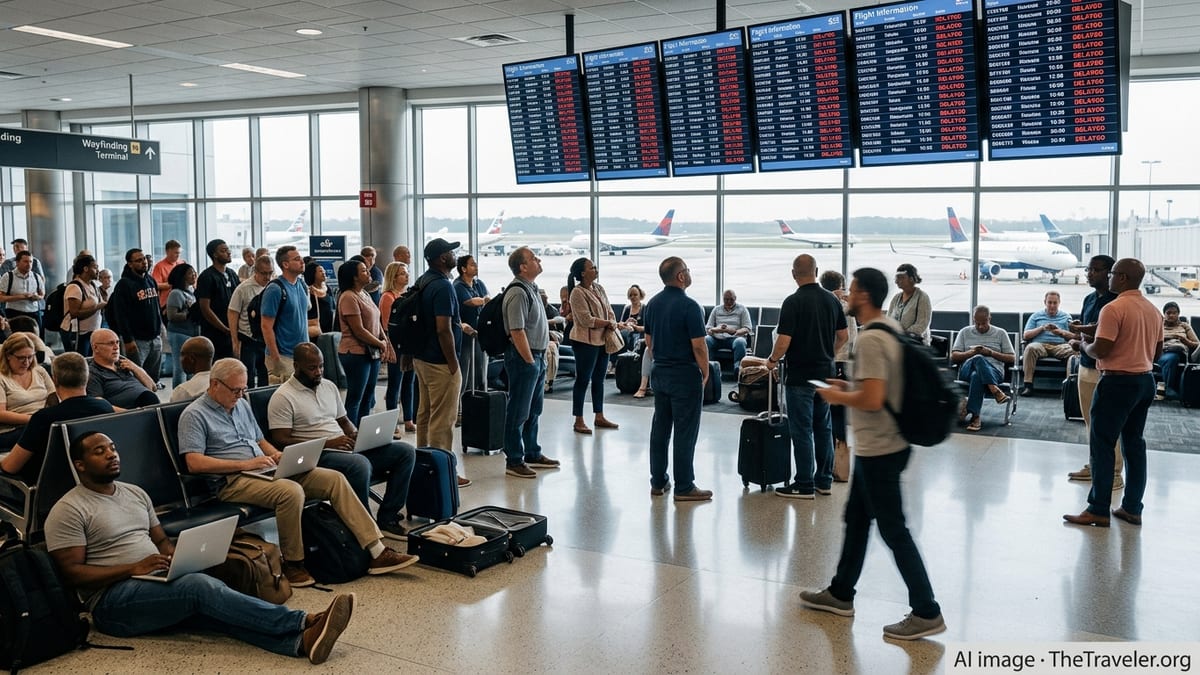
Airport crowding is another key concern. Reports on recent busy days at Hartsfield-Jackson describe security queues stretching out of the main checkpoint areas and snaking toward baggage claim and curbside doors. The latest advisory suggests that similar patterns are possible and encourages passengers to use less congested checkpoints if their terminal layout allows.
In the terminals, travelers may notice more frequent gate changes as the airline consolidates lightly booked flights or re-times departures to smooth connections. Public information on Delta’s standard playbook in such situations indicates that the carrier typically prioritizes maintaining connectivity at the hub, which can mean shifting aircraft to protect key bank structures even if that requires delaying some point-to-point services.
While no specific weather or single technology failure has been cited as the trigger, the combination of high seasonal demand, air traffic control constraints and the inherent complexity of hub operations is driving a conservative stance. For customers, that translates into a higher-than-normal risk of rolling delays and longer connection times, even if most flights ultimately depart.
Network-Wide Ripples Beyond Atlanta
Because Atlanta functions as a central node for Delta’s domestic and international operations, even localized slowdowns can generate wider effects across the network. Industry schedule data and past disruption patterns indicate that delays originating at the hub often propagate quickly to spoke airports in the Southeast, Midwest and along the East Coast, as crews and aircraft arrive late or rotate out of sequence.
Published analyses of previous Atlanta-centered disruptions show that passengers flying through secondary hubs such as Detroit, Minneapolis and Salt Lake City can also feel the impact, particularly on connection-heavy itineraries. When Atlanta banks back up, aircraft and crew reassignments sometimes ripple into those markets, creating a patchwork of minor delays rather than a single concentrated hotspot.
The current five-day warning, although focused on the Atlanta hub, is therefore being watched closely by airports and travelers across the United States and on transatlantic and Latin American routes. Even modest adjustments in departure times at the megahub can shift arrival waves at overseas destinations, tightening connection windows for flights operated by partners or other carriers.
Travel experts say passengers departing from non-hub cities should pay attention to whether their itinerary includes an Atlanta connection during the affected dates. Those holding flexible tickets or with alternative routing options through other hubs may find it worthwhile to compare connection times and pick the most robust option, particularly on long haul journeys.
Practical Guidance for Affected Travelers
Consumer advocates and travel planners analyzing the situation are broadly aligned on several practical steps for the roughly 400,000 passengers potentially affected. The most consistent recommendation is to treat the travel warning seriously, even if an individual flight is currently listed as on time, because conditions can change as the hub absorbs daily traffic.
Arriving earlier than usual at the airport is widely advised, especially for morning departures when security queues can build quickly. For connecting passengers, opting for longer layovers where possible can create a buffer against minor delays in the first leg and reduce the risk of misconnecting in Atlanta’s sprawling concourses.
Observers also stress the value of traveling with carry-on luggage only when feasible, since checked bags can complicate same-day rebooking options if a connection is missed. Passengers are encouraged to proactively review their booking details, seat assignments and any messages about voluntary change waivers that may be offered during the five-day period.
While the travel warning underlines the strains facing one of the world’s busiest hubs, it also reflects a broader shift toward more transparent, data-driven communication with passengers. For those prepared to adapt plans, closely monitor information and build in extra time, the coming five days may be less about crisis and more about managed congestion at the heart of Delta’s network.