


More news on this day
Bulgaria and North Macedonia are taking concrete steps toward building a cross-border rail tunnel that would finally connect their rail networks along the long-delayed Pan-European Corridor VIII, signaling renewed momentum for east–west transport across the southern Balkans.
Get the latest news straight to your inbox!
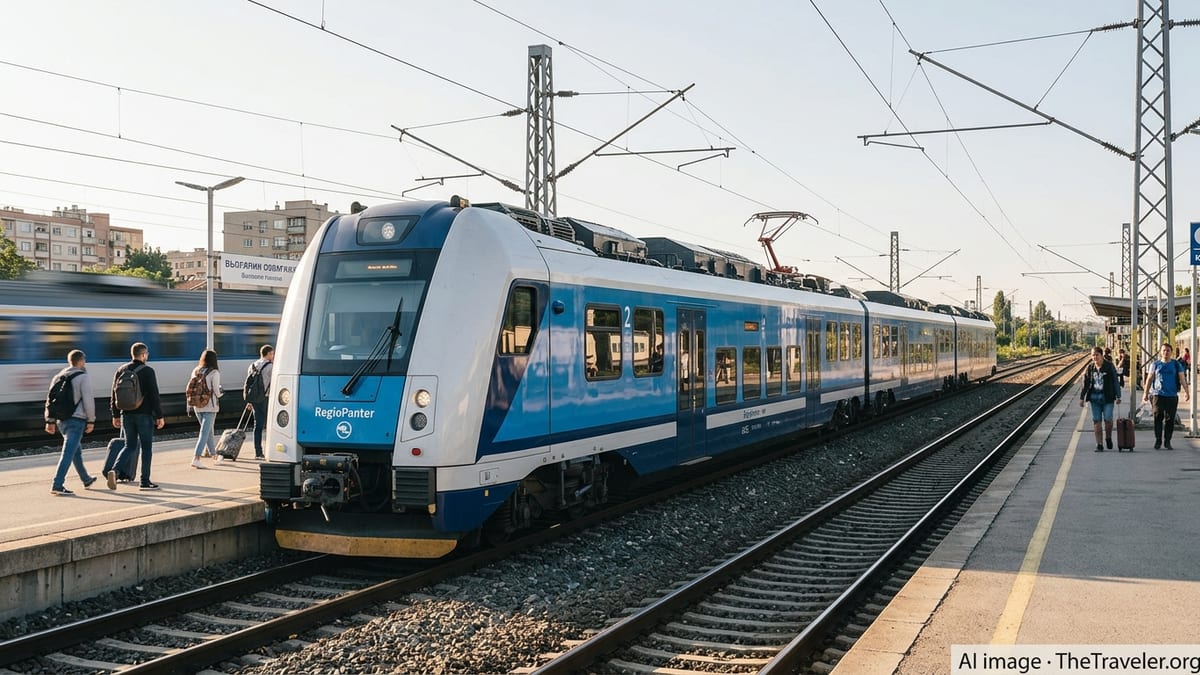
New Agreement Puts Cross-Border Tunnel on Track
Recent European Parliament documentation highlights the conclusion of an intergovernmental agreement between Bulgaria and North Macedonia covering the preparation, construction and operation of a cross-border railway tunnel along Corridor VIII. The text describes the deal as a decisive step toward completing the rail link between the two countries, after decades in which the connection remained only partially designed or repeatedly postponed.
According to publicly available information, the tunnel is foreseen on the section connecting North Macedonia’s Kriva Palanka area with the Bulgarian border near Gyueshevo, where Bulgaria already has a short stretch of line reaching the frontier. The new structure is expected to sit at the heart of the final missing segment of the Kumanovo to Bulgarian border railway in North Macedonia, a priority investment for integrating the country into the wider Trans-European Transport Network.
Reports on draft resolutions in Brussels indicate that the tunnel agreement is framed not only as a national infrastructure project, but as part of a broader push to strengthen connectivity along the Black Sea to Adriatic axis. Corridor VIII is described as having strategic importance for both the European Union and NATO, by opening an additional secure land route across the Alliance’s southern flank.
Public documents also note that the agreement comes after a series of high-level regional meetings where governments from the Western Balkans and neighboring EU states reiterated support for completing Corridor VIII. The tunnel has been singled out in these discussions as one of the most technically demanding missing links, but also one of the most transformative for cross-border rail.
Closing the Last Gap on North Macedonia’s Eastern Rail
The cross-border tunnel is closely linked to North Macedonia’s ongoing Rail Corridor VIII program, which is divided into three main sections between Kumanovo and the Bulgarian border. Project documentation from the European Bank for Reconstruction and Development describes works already under way on the Kumanovo to Beljakovce and Beljakovce to Kriva Palanka segments, both single-track lines designed to modern standards.
The final segment from Kriva Palanka to the border, approximately 23 kilometers in length on North Macedonian territory, includes a series of tunnels and bridges through mountainous terrain. Environmental and technical reports outline a route that follows the Kriva River valley before climbing toward the frontier, where it would connect directly with the planned cross-border tunnel and on to the existing Bulgarian line at Gyueshevo.
Regional transport masterplans classify this eastern branch of Corridor VIII in North Macedonia as a combination of works already financed and projects in preparation. The Kriva Palanka to border section is listed as a new construction initiative aligned with EU interoperability standards, including electrification and modern signaling, to ensure compatibility with the core Trans-European network once the cross-border tunnel is complete.
Publicly available national strategy papers from Skopje explain that the completion of the Kumanovo to border railway would, for the first time, create a continuous east–west rail axis across the country, linking the internal network not only to Bulgaria and the Black Sea, but also, via future investments, to Albania and the Adriatic Sea.
Bulgaria’s Role and Required Works on Its Side of the Border
On the Bulgarian side, the Corridor VIII concept foresees upgrades and limited new construction between the capital Sofia and the border station of Gyueshevo, where rail tracks already reach close to the frontier but stop short of a full connection. Publicly accessible overviews of Bulgaria’s rail network describe this as a relatively short section in terms of distance, but technically significant because of the mountainous frontier and the need to integrate a new tunnel into existing infrastructure.
Analyses of Corridor VIII prepared by regional transport observers note that Bulgaria’s task focuses on modernizing and adapting the line from Sofia westward, including track improvements and signaling upgrades to support higher speeds and greater capacity. The cross-border tunnel itself is expected to extend from near Gyueshevo on the Bulgarian side under the border crest toward North Macedonian territory, creating a seamless alignment between the two national networks.
Commentary on corridor development frequently points out that Bulgaria has made more progress on its internal east–west rail than its neighbors, particularly between Sofia, Plovdiv and the Black Sea ports. Against that backdrop, the Gyueshevo connection and the shared tunnel with North Macedonia are often presented as the remaining piece needed to convert a largely domestic corridor into a genuine regional route linking the Adriatic and Black Sea basins.
Public planning documents in the European Union reference the joint tunnel project as a component of the core Orient/East-Med corridor extension toward the Western Balkans. This classification is seen as important for mobilizing European funding and technical assistance, especially for complex civil engineering works such as long rail tunnels in mountainous terrain.
Strategic Corridor With Long-Delayed Potential
Pan-European Corridor VIII has been on regional and EU policy maps for decades. It is conceived as a multi-modal route that begins at Italian Adriatic ports, crosses Albania and North Macedonia, and reaches Bulgaria’s Black Sea harbors. While road sections have advanced more quickly, rail investments have lagged, leaving the network fragmented, with isolated sections operating far below the corridor’s theoretical capacity.
Published analyses of corridor implementation describe the Bulgaria–North Macedonia rail gap as one of the most striking examples of this fragmentation. Despite relatively modest distances, the lack of a cross-border railway has meant that freight and passengers must rely on indirect routes through Serbia or Greece, or shift to road transport, adding time and cost to regional trade flows.
Studies prepared for regional transport initiatives in recent years classify the Corridor VIII rail projects into categories ranging from works already under construction to priority projects still awaiting full preparation. The cross-border tunnel and associated border approaches are commonly placed among the highest priorities, both because of their symbolic value in finally connecting two neighboring rail systems and because they unlock the full functionality of investments already made on either side.
Observers of Balkan transport policy often note that, for many years, governments in Skopje and Sofia focused more heavily on the north–south Corridor X axis, which links Central Europe with Greece. The renewed emphasis on Corridor VIII, culminating in the tunnel agreement, is interpreted as a shift toward balancing these directions and diversifying the region’s transport options.
Economic and Regional Integration Implications
Public assessments by European and regional institutions suggest that completing the Corridor VIII rail link, including the cross-border tunnel, would deliver tangible economic benefits. These are expected to include shorter transit times for freight between Black Sea and Adriatic ports, lower logistics costs for exporters in both Bulgaria and North Macedonia, and new opportunities for intermodal transport combining sea, rail and road.
Analytical work prepared in support of the Western Balkans transport agenda argues that improved east–west rail connectivity could help rebalance trade flows that currently depend heavily on north–south routes. By providing an alternative path for goods moving between southeastern Europe, the eastern Mediterranean and central EU markets, the corridor is presented as a way to enhance resilience and reduce bottlenecks on existing mainlines.
Tourism and cross-border mobility are also cited as potential beneficiaries. A direct rail connection, made possible by the tunnel, would allow for future passenger services linking Sofia and Skopje, as well as intermediate towns, more efficiently than current road options. Over time, improved reliability and frequency could support more sustainable travel patterns and encourage cultural and economic exchange.
From a political perspective, the project is frequently mentioned in the context of North Macedonia’s EU accession process and broader regional cooperation. By aligning technical standards with the Trans-European network and concluding a detailed intergovernmental agreement on a joint piece of infrastructure, Bulgaria and North Macedonia are portrayed in public documents as advancing not only a transport project, but also a concrete example of neighborly collaboration within the European framework.