


More news on this day
Flights bound for Dallas Fort Worth International Airport are moving again after a temporary ground stop, yet a continuing ground delay program is expected to ripple through the evening schedule for one of the nation’s busiest hubs.
Get the latest news straight to your inbox!
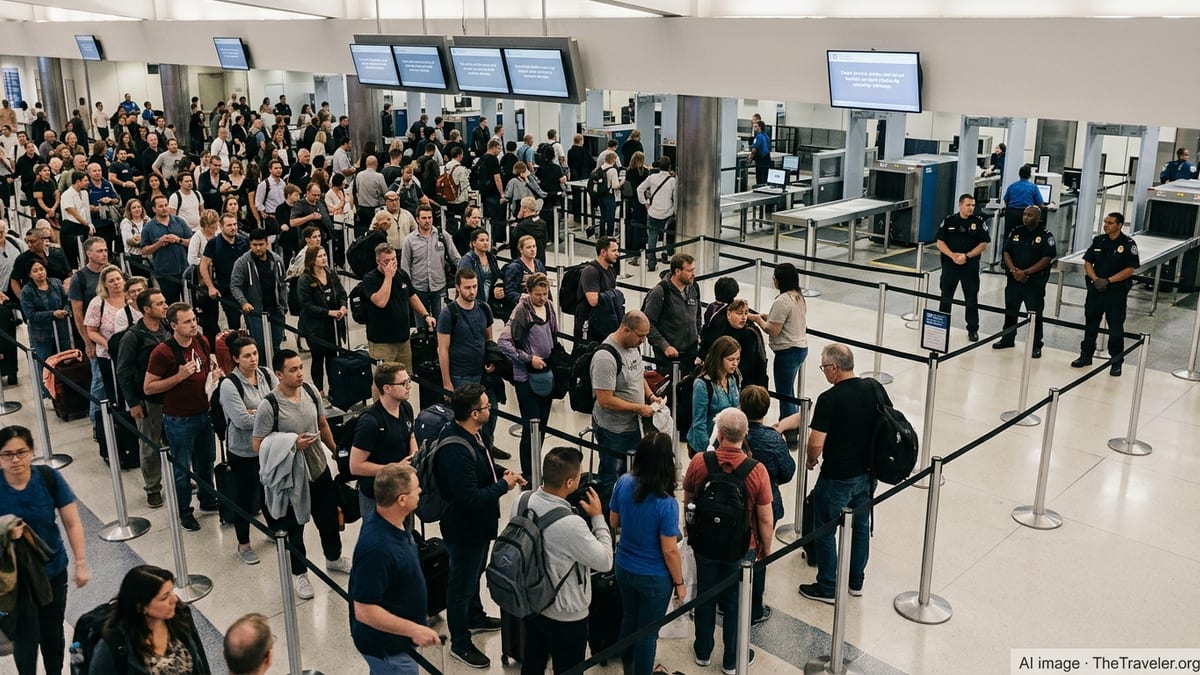
Ground stop ends as DFW works through backlog
Publicly available air traffic management data indicates that a ground stop affecting traffic to Dallas Fort Worth International Airport was lifted after a period of restricted arrivals tied to airspace and security constraints in the Dallas area. The interruption coincided with a temporary flight restriction connected to VIP movements over North Texas on the evenings of September 9 and 10, which narrowed the available airspace and reduced arrival capacity into both Dallas Fort Worth and Dallas Love Field.
According to impact summaries compiled by industry groups, the temporary flight restriction created a ten nautical mile protected ring centered near the Dallas Fort Worth airport complex, sharply limiting general aviation operations and compressing commercial traffic into narrower time windows. During the most restrictive periods, flights departing for Dallas from other airports were held at their origin, a standard tool used by traffic managers to avoid airborne holding and excess congestion near the hub.
Once the restriction periods expired, departures to Dallas Fort Worth gradually resumed, but the pause left a queue of flights waiting for takeoff slots and gates, particularly for American Airlines, which operates an extensive hub at the airport. Travelers connecting through North Texas reported extended ground waits and tight connection times as airlines worked to re-sequence aircraft and crews.
FAA operations planning advisories show Dallas Fort Worth frequently appears among airports where ground stops or ground delay programs are possible during periods of convective weather, equipment constraints, or special-use airspace. This most recent disruption follows a pattern in which even brief traffic-management measures at the hub can reverberate across the national system for hours.
Ground delay program extends impact into the evening
Even after the ground stop was lifted, a ground delay program for Dallas Fort Worth remained in effect to meter inbound traffic through the evening. Ground delay programs assign controlled departure times at origin airports so that arrivals are spaced out in a way that matches an airport’s reduced capacity. Industry trackers that aggregate FAA data show that, as of midday Thursday, a limited number of U.S. airports were under active delay programs, with Dallas Fort Worth highlighted as a key constraint due to a combination of airspace and runway limitations.
Under these programs, each affected flight receives an expected departure clearance time and, by extension, an estimated arrival time. When weather, runway closures, or other constraints reduce how many aircraft an airport can accept per hour, these tools are used to avoid airborne holding and diversions. For passengers, however, the result is often longer waits at the gate, rolling departure estimates, and a higher risk of missed connections, particularly in the evening banking periods at major hubs.
Operations advisories for recent weeks also reference ongoing runway work at Dallas Fort Worth, noting that runway 18L/36R is closed for an extended construction project running from mid‑August 2026 into May 2027. With one of the airfield’s parallel runways out of service, the airport’s arrival and departure capacity is more sensitive to any added constraint, from thunderstorms to special-use airspace. When layered on top of a VIP restriction, that reduced capacity increases the likelihood that air traffic managers will resort to formal delay programs.
Historical advisory records show that Dallas Fort Worth has experienced similar combinations of ground stops and delay programs in previous years, sometimes tied to severe weather in the Dallas–Fort Worth metroplex and sometimes to equipment issues. Those episodes often generated multi-hour delays that stretched well into the night, especially when they intersected with peak connecting banks.
What travelers can expect for tonight’s flights
For travelers with evening departures involving Dallas Fort Worth, the clearing of the ground stop does not necessarily mean a smooth trip. As airlines work through the backlog created during the restriction window, passengers may continue to see schedules shift as aircraft rotate back into position and connecting flows are rebuilt. Longer-than-usual tarmac waits for a gate on arrival, as well as last-minute gate changes for departures, are both possible as operations stabilize.
Passenger accounts shared in aviation-focused online forums following recent Dallas disruptions describe a pattern of cascading delays whenever the airport’s tightly scheduled operation is interrupted. When a bank of arrivals is pushed back by even an hour or two, aircraft arriving late may displace later departures, while crews can time out of their duty limits, forcing additional cancellations or re-crewing. That dynamic can be particularly acute in the late afternoon and evening, when there are fewer remaining flight options to absorb disruptions.
Industry trackers and FAA data suggest that passengers with tight connections through Dallas Fort Worth on the night of the disruption face the biggest risk of missed onward flights. Those booked on the last flight of the day to smaller destinations may have limited rebooking options if their inbound connection arrives significantly behind schedule. In previous events, travelers have reported being automatically rebooked onto next-morning departures as airlines sought to reset their operations.
Published planning advisories point out that, when ground delay programs are active, diverted flights are not automatically exempt from the metering process. Aircraft that divert to alternate airports during the disruption often still need new, controlled departure times for their eventual arrival into Dallas Fort Worth, which can add further complexity and uncertainty for passengers already off their original route.
How to monitor your flight and minimize disruption
Travelers can reduce uncertainty by closely monitoring both their airline’s mobile app and publicly available air traffic tools that track ground stops and delay programs. FAA-supported trackers and independent services using government data provide near-real-time snapshots of which airports are under active constraints and the national scope of delays. These tools can help travelers gauge whether a localized issue at Dallas Fort Worth is resolving or expanding into a broader system disruption.
Airline guidance for irregular operations typically recommends that passengers keep contact information current in their booking profiles to receive automated rebooking notices if connections are missed. Same-day change features and standby lists accessed through airline apps can sometimes offer alternatives when a connecting flight is at risk, though options may be limited later in the evening. At large hubs like Dallas Fort Worth, the sheer number of daily flights can provide more opportunities compared with smaller stations, but heavy evening disruptions may still push many rebookings to the following day.
For travelers who have not yet started their trips, publicly available information suggests considering longer connection times when routing through North Texas during periods of active construction or seasonal storms. Historical records of FAA advisories and recent events show that Dallas Fort Worth’s role as a primary connecting hub, combined with runway projects and periodic airspace restrictions, can translate relatively small disruptions into multi-hour delays across a wide network of flights.
Those already at the airport may find that delays associated with ground delay programs ebb and flow as conditions improve or as traffic-management initiatives are adjusted. FAA planning documents often reference the potential for early cancellation of delay programs when capacity improves more quickly than forecast, which can allow some later flights to operate closer to schedule even after an afternoon of significant disruption.
Context: a hub under recurring operational pressure
The latest ground stop and subsequent ground delay at Dallas Fort Worth arrive in the context of a summer marked by repeated operational pressures on the airport. FAA planning advisories from April and August highlight multiple occasions when thunderstorms in North Texas or regional weather patterns led to ground delay programs and first-tier ground stops for the airport, activating special coordination hotlines to manage flows into the Dallas–Fort Worth area.
In mid-July, a separate advisory documented the activation of a diversion recovery program for Dallas Fort Worth, signaling that a combination of weather and traffic volume had pushed a significant number of flights off their planned routings. That tool is intended to help prioritize the return of diverted aircraft once capacity becomes available, but published guidance notes that flights involved in diversion recovery still remain subject to any active ground delay programs or ground stops, underscoring how layered and complex the operational picture can become.
Earlier this summer, American Airlines also experienced a nationwide ground stop that briefly halted its flights after an information-technology outage, an episode that underscored how quickly technical or operational issues at a major carrier can propagate across hubs like Dallas Fort Worth. While the latest disruption is tied to airspace and capacity issues rather than a system outage, the result for passengers is similar: full flights, constrained spare capacity, and little margin to absorb additional problems.
Viewed together, these events illustrate how Dallas Fort Worth’s scale and hub role amplify the effects of any constraint, whether caused by weather, airspace restrictions, construction, or technology. Even as today’s ground stop lifts and traffic begins to normalize, the lingering ground delay program is likely to keep the airport under strain well into the night, with travelers across the country feeling the downstream effects.
FAA Current Operations Plan Advisories
NBAA VIP TFR impact statements for DFW/DAL