


Digital banking in Spain is highly developed by international standards, with widespread online access, powerful mobile applications and an advanced instant payments ecosystem. For individuals considering relocation, understanding how Spanish residents access, use and trust digital banking services is important for evaluating day to day financial practicality in the country.
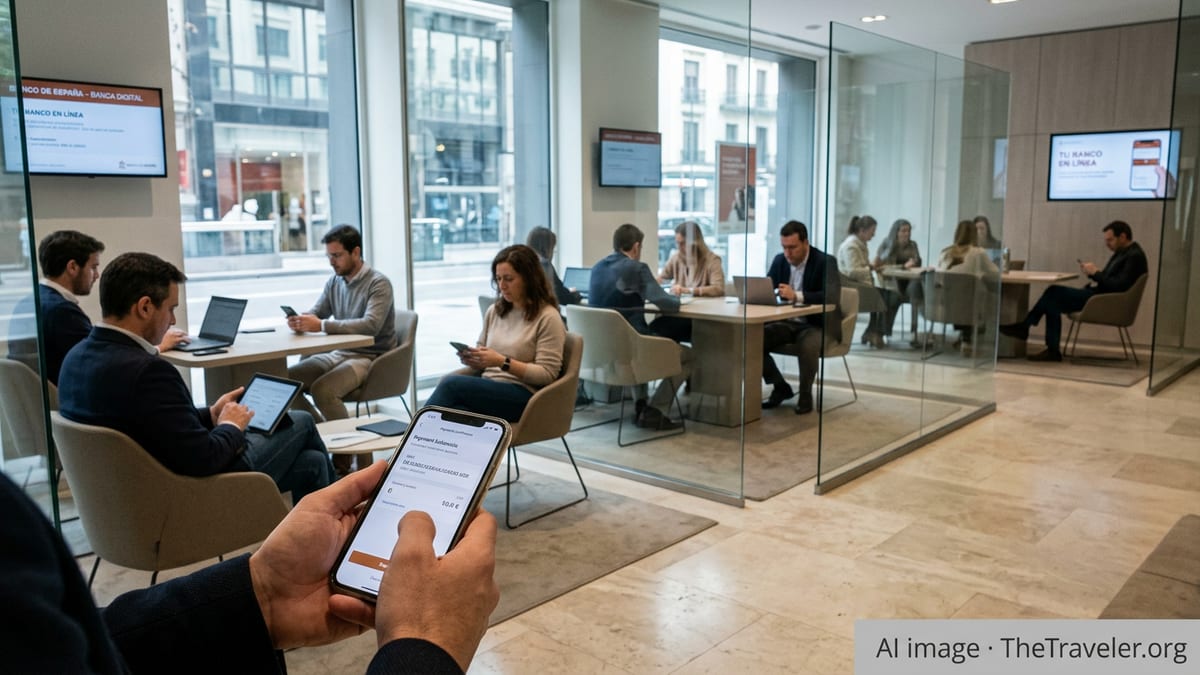
Overview of Spain’s Digital Banking Landscape
Spain is one of the more digitized retail banking markets in Europe. Recent data from Eurostat and market research sources indicate that roughly 70 to 75 percent of residents use internet banking services, up from around a quarter of the population in 2010. Usage is especially high among working age adults, with close to 80 percent of those aged 25 to 44 using digital channels as their primary interface with banks.
The traditional banking sector remains concentrated but technologically sophisticated. Large incumbents such as CaixaBank, Santander, BBVA and Banco Sabadell have invested heavily in mobile apps, biometric authentication and integrated personal finance tools. CaixaBank alone is reported to reach close to half of Spanish digital banking users through its digital offerings, illustrating the continued dominance of large universal banks even in a digital environment.
In parallel, Spain has become a priority market for European and global digital only banks. Neobanks such as Revolut, N26 and Openbank have expanded aggressively, with Revolut announcing several million users in Spain and positioning itself at a scale comparable with mid tier national banks. Despite the growth of neobanks, they tend to complement rather than fully replace traditional banks for complex services such as mortgages or long term savings, and many residents use both types of providers in tandem.
For relocating individuals, the practical implication is that digital banking access is broadly comparable to leading EU markets. A newcomer who is familiar with mobile and online banking in other European countries will find a similar or more advanced environment in Spain, especially in major cities.
Internet and Mobile Banking Adoption Patterns
Internet banking in Spain is now a mainstream activity. National statistics office surveys show that around seven in ten residents aged 16 to 74 use online banking, with usage rising to the mid seventies in the latest available 2024 data. Growth has been strongest since the mid 2010s, supported by higher smartphone penetration, which now exceeds 80 percent of the population, and by wider home broadband coverage.
Mobile banking has become the preferred access channel for many users. Bank specific studies and independent surveys suggest that a growing majority of digital interactions now occur via smartphone apps rather than desktop browsers. Younger segments in particular may rarely visit a physical branch once their account is established, relying almost exclusively on apps to check balances, initiate transfers, and manage cards.
There is still a noticeable urban rural divide. Large metropolitan areas such as Madrid, Barcelona, Valencia and Bilbao exhibit near universal digital banking usage among banked adults, while rural regions and older demographics show lower adoption and a stronger preference for in person services. However, the proportion of the Spanish population without any in person access to basic banking services has been reduced significantly according to recent financial inclusion monitoring, partly due to additional ATMs and mobile service points, which indirectly supports broader digital usage.
For foreign professionals, this pattern means that living in a major city will almost certainly provide seamless digital banking experiences, while relocation to smaller municipalities may still involve some reliance on in person visits for account opening or complex procedures, even if routine operations can later be handled online.
Key Digital Banking Platforms and Providers
Spain’s digital banking environment combines strong domestic universal banks, specialized digital brands and international neobanks. Among traditional institutions, CaixaBank, Santander and BBVA are particularly advanced in mobile user experience and breadth of features, including instant payments integration, card control functions and investment modules within their apps.
Several dedicated digital brands play a prominent role. Imagin, a mobile only platform owned by CaixaBank, has several million users and targets younger and more digitally native customers with a fully app based proposition. Openbank, part of the Santander group, operates primarily as an online bank, offering current accounts, savings, investment products and credit with minimal branch presence. Other domestic players such as EVO Banco also emphasize fully digital account opening and servicing.
International neobanks have made Spain a strategic market. Revolut in particular has rapidly expanded to an estimated user base in the mid single digit millions within Spain alone, following the introduction of Spanish IBANs, local deposit protection arrangements and integration with local payment schemes. N26, Wise and other cross border fintechs also maintain active Spanish user communities, although they are generally positioned as secondary accounts for travel or foreign currency management rather than full service domestic banks.
Newcomers should be aware that some digital only providers restrict account opening to tax residents or to those with a Spanish national identity number, while others accept non residents. Policy details change frequently, so a relocating professional should verify onboarding requirements at the time of account selection. In practice, many expatriates combine a large Spanish bank for salary payments and local obligations with one or more international neobanks for multi currency needs.
Instant Payments and Bizum Ecosystem
A distinctive feature of Spanish digital banking is the near universal role of Bizum, a domestic mobile based instant payment scheme. Bizum is integrated directly into the mobile apps of more than 90 banks in Spain and allows users to send and receive funds in real time using only a mobile number as the identifier. The payment is processed as an underlying instant bank transfer, but the user experience is that of a simple peer to peer app.
Bizum has achieved very high penetration. By 2023 it processed close to one billion person to person transfers and tens of millions of e commerce payments, with both volumes growing strongly year on year. Residents increasingly use Bizum instead of cash or card transfers for splitting bills, small person to person transactions and payments to small merchants, charities and professional services that accept Bizum as a method of payment.
The service is supported by almost all major banks and many smaller institutions, and activation typically requires only a few steps within the bank’s mobile app, linking a single mobile phone number to a primary account. For a relocating individual, acquiring a Spanish mobile number and opening a local bank account that supports Bizum will effectively unlock full participation in common payment practices among residents.
Spain is also connected to wider European efforts in real time payments. Bizum participates in a European payments alliance that aims to make domestic instant schemes interoperable across multiple countries, and Spain is also expected to adopt broader EU instant credit transfer requirements. Over time this could further simplify cross border payments within the euro area for digital banking users in Spain.
User Experience, Language and Accessibility Considerations
In terms of user experience, Spain’s leading digital banks rank competitively in European comparisons. Most major banking apps support biometric login, quick balance views, real time card controls such as freezing and unfreezing cards, setting transaction limits and managing online purchase authorization. Integration of instant payments and QR based transfers is common, and some banks provide advanced personal finance dashboards with spending categorization and budgeting tools.
Language support is an important factor for relocating professionals. User interfaces are consistently available in Spanish, and many major banks also offer English versions of their mobile apps and online banking portals, though the depth of translation can vary from core functions to full coverage. Additional regional language options such as Catalan, Basque or Galician may also be available in specific territories. However, some digital only brands are still optimized primarily for Spanish speaking users, and system messages, error prompts or contractual documentation may default to Spanish even when navigation menus are localized.
Accessibility in the sense of usability for visually impaired or older users has improved but remains uneven. Larger incumbent banks generally comply with accessibility guidelines and support features like screen reader compatibility and high contrast modes. Some neobanks emphasize minimalistic design that is intuitive for younger demographics but can be challenging for users unfamiliar with smartphone interfaces. For a relocating individual supporting older dependents, it may be more practical to select a bank with a strong physical branch network and a traditional interface in addition to digital channels.
Responsiveness of customer service via digital channels is another differentiator. Spanish banks typically provide secure messaging within apps, telephone hotlines and, increasingly, chat based support augmented by automation. Service standards vary, so professionals who expect to manage most issues remotely may wish to test support response times during the account opening process.
Security, Fraud and Regulatory Environment
Spain’s digital banking operates within the European regulatory framework, including strong requirements for strong customer authentication under payment services rules. Multi factor authentication for online access and payments is standard, often combining biometric identification on mobile devices with one time codes delivered via app or SMS. Card transactions frequently require additional verification for e commerce purchases through bank apps or security portals.
Despite relatively robust controls, fraud and scams remain a material concern. Surveys conducted in 2024 indicate that a large majority of Spanish consumers have received scam attempts, particularly related to real time payments and account takeover phishing. A significant minority reports having suffered financial loss, highlighting the importance of user awareness alongside technical security. Consumer attitudes toward bank responsibilities are evolving, with many residents expecting banks to refund scam victims in most cases, but policies vary by institution and scenario.
Regulators and tax authorities have tightened oversight of electronic payments. From 2026, new reporting requirements oblige banks to provide the tax administration with more granular information on electronic transfers, including those executed via Bizum, not only large one off payments. While these measures are primarily aimed at combating undeclared economic activity, they underscore the degree to which digital banking transactions in Spain are monitored and traceable.
For relocating individuals, the security environment implies both benefits and responsibilities. Digital channels are generally safe when used with up to date devices and cautious behavior, but users should expect frequent authentication prompts and monitoring of unusual activity. It is advisable to familiarize oneself with common local scam patterns, such as fake delivery messages, fraudulent Bizum requests or spoofed bank communications, and to understand each bank’s reimbursement policies for unauthorized or misdirected payments.
Inclusion Gaps and Practical Issues for Newcomers
While digital banking in Spain is advanced, some gaps are relevant to those relocating from abroad. Account opening often still requires face to face identification at a branch, especially for full service accounts intended for salary deposits or credit products. Some banks now support remote onboarding via video identification, but such options may be limited to residents who already hold a Spanish identity number or registered address. Short term arrivals may therefore need to plan for an initial in person appointment to establish banking relationships before relying entirely on digital channels.
Another practical consideration is the linkage between mobile numbers, identity documents and digital services. Bizum and certain security features rely on a Spanish mobile number registered in the user’s name, and some banks will not enable full mobile functionality until the number is verified. Foreign numbers may be accepted for basic communications but can be problematic for instant payment activation. Relocating professionals should align the timing of obtaining a local SIM card with the process of opening a bank account to avoid delays.
Digital literacy among older or less technologically confident residents remains an area of policy concern. Studies on financial inclusion highlight that although the proportion of residents without access to branches has declined, a part of the population still struggles with online interfaces or feels uncomfortable conducting complex transactions digitally. As a result, Spanish banks have committed to maintaining minimum physical service standards and providing assisted digital services, such as staff supporting customers at in branch kiosks or through dedicated telephone lines for seniors.
For expatriates, these inclusion initiatives can be relevant where language barriers or unfamiliarity with Spanish administrative procedures make online processes more complex. Some banks offer specialized expatriate or international customer desks that combine digital tools with guided support in multiple languages, which can smooth the initial transition even in an otherwise highly digital environment.
The Takeaway
Overall, Spain offers a mature and sophisticated digital banking environment compared with many other European countries. High levels of internet and smartphone usage, the strong presence of technologically advanced incumbent banks, and the ubiquity of mobile based instant payments through Bizum provide a robust foundation for day to day financial management by residents.
Relocating professionals can expect to conduct the vast majority of routine banking activities through well designed apps or online portals, particularly in urban areas. The combination of domestic institutions and international neobanks offers a wide range of options for multi currency needs and cross border payments, although careful selection is needed to ensure compatibility with salary payments, direct debits and local tax requirements.
At the same time, Spain’s digital banking system is tightly regulated and increasingly data rich, with enhanced monitoring of electronic payments and active efforts to combat fraud. Newcomers must therefore balance convenience with caution, maintaining strong security practices and staying aware of local scam trends. Inclusion efforts provide safety nets for less digital users, but practical obstacles such as identification requirements, language limitations and the need for a Spanish mobile number still require advance planning.
For individuals assessing Spain as a place to live and work, digital banking conditions can generally be rated as favorable, provided that account opening, documentation and local connectivity are addressed early in the relocation process.
FAQ
Q1. How common is digital banking use in Spain compared with other EU countries?
Digital banking usage in Spain is high by European standards, with roughly seven to eight out of ten adults using internet banking, putting the country slightly above the EU average.
Q2. Can a newcomer to Spain rely entirely on mobile banking, or are branches still necessary?
Most routine activities can be handled via mobile apps, but opening a full local account or arranging credit products may still require at least one in person visit, depending on the bank.
Q3. What is Bizum and why is it important for daily life in Spain?
Bizum is a mobile instant payment service integrated into Spanish banking apps that allows transfers using phone numbers, and it is widely used for splitting bills, small purchases and peer to peer payments.
Q4. Do major Spanish bank apps offer English language options?
Several large banks provide English interfaces in their apps and online banking, though the completeness of translation varies and some system messages or documents may remain in Spanish.
Q5. Are international neobanks like Revolut or N26 sufficient for managing finances in Spain?
International neobanks are useful for card payments and foreign currency, but many residents still maintain at least one Spanish bank account for salaries, direct debits and full access to local services such as Bizum.
Q6. How secure are digital banking and online payments in Spain?
Security standards are strong, with multi factor authentication and strict EU regulations, but scam attempts are frequent, so user vigilance and awareness of phishing techniques remain important.
Q7. Is a Spanish mobile phone number necessary to use digital banking features?
A Spanish mobile number is often required to activate key features such as Bizum and certain security codes, so obtaining a local SIM card usually improves the digital banking experience.
Q8. What challenges might older family members face with Spanish digital banking?
Older users may find app based interfaces difficult and prefer in person service, though banks offer assisted digital support and have pledged to maintain accessibility for senior customers.
Q9. Can digital banking in Spain be used effectively from abroad?
Most Spanish banks allow online and mobile access from other countries, but some functions may be restricted for security reasons, and strong authentication via registered mobile numbers remains essential.
Q10. How are Spanish authorities increasing oversight of digital payments?
New rules require banks to report more detailed information on electronic transfers, including instant payments, to tax authorities, increasing the traceability of digital banking activity.