


More news on this day
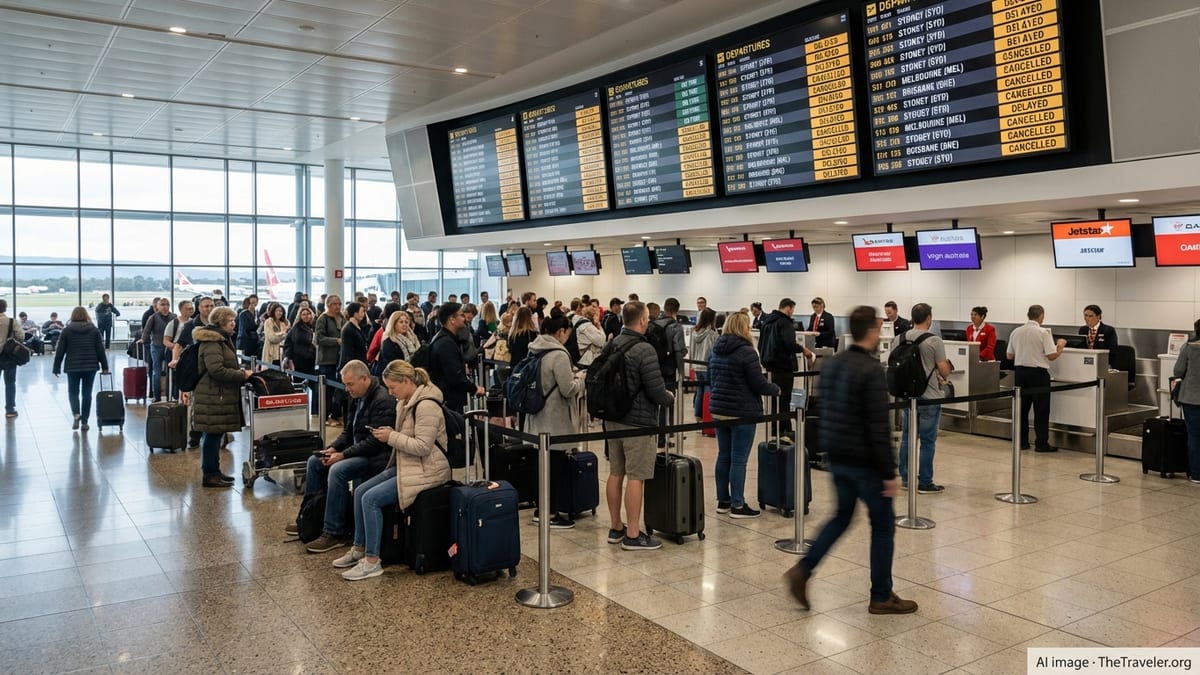
Hundreds of travelers have been left stranded across Australia and New Zealand as a fresh wave of flight delays and cancellations hit services operated by QantasLink, Virgin Australia, Air New Zealand and several regional carriers on Friday, disrupting schedules at Melbourne, Sydney, Auckland, Christchurch and other key airports.
Get the latest news straight to your inbox!
Network Disruptions Hit Major Trans-Tasman Hubs
Published airport departure and arrival boards for 29 May show a growing list of delayed and cancelled services across the Tasman and on key domestic corridors, particularly around the Sydney to Melbourne trunk route and flights linking Auckland and Christchurch with Australian cities. Flight-tracking dashboards indicate knock-on impacts across morning and midday banks, with some services delayed by more than an hour and others withdrawn from schedules at short notice.
At Auckland Airport, live departure data for Friday highlights multiple services to Sydney and domestic centers operating off schedule, alongside cancellations affecting international routes. In one high-profile incident a day earlier, an Auckland to Hong Kong service operated by Air New Zealand was cancelled after a bird became stuck in the cockpit area, illustrating how even isolated operational problems can feed into wider disruption when aircraft and crews are tightly rostered.
Melbourne and Sydney, the two busiest airports in Australia, are reporting a succession of delayed departures on joint Qantas and Virgin Australia routes, including several codeshare services marketed under multiple airline brands. Real-time route summaries for Sydney to Melbourne show dense peak-hour schedules where delays to early services risk cascading across subsequent rotations, contributing to congestion in terminal departure areas as passengers wait for updated information.
Trans-Tasman services, which connect major Australian cities with Auckland and Christchurch, are similarly feeling the strain. Recent on-time performance reports for routes such as Melbourne to Auckland and Christchurch to Melbourne already indicated vulnerability to disruption, and today’s conditions appear to have exposed those weak spots, leaving travelers facing lengthy rebooking queues or unscheduled overnight stays.
Weather, Airspace Constraints and Crew Shortages Combine
While airlines have not provided a single overarching explanation, publicly available aviation and meteorological information points to a combination of adverse weather, airspace restrictions and staffing pressures driving the current wave of disruption. Australian aviation warnings issued on Friday show active advisories for turbulence and significant weather systems in parts of the country’s flight information regions, factors that can lead to tighter spacing between aircraft or temporary rerouting of services.
Industry analyses released in recent months by competition and transport regulators in Australia and New Zealand have highlighted how weather-sensitive the region’s domestic and trans-Tasman operations remain. Strong crosswinds, low cloud and storm cells around major hubs often require air traffic controllers to reduce arrival and departure rates, leading to ground delays that ripple through network schedules. Airlines typically respond by building buffer time into rosters but, when several factors coincide, even those buffers can quickly be exhausted.
Staffing and aircraft availability are another key element. Recent public commentary and consumer complaints about flight reliability have drawn attention to ongoing crew shortages and maintenance bottlenecks, particularly when earlier delays cause pilots or cabin crew to reach regulated duty time limits. When this occurs, airlines may have to cancel or significantly delay a later sector if no replacement crew is available, a pattern that aligns with some of the same-day cancellations and long delays visible on flight-tracking platforms on Friday.
Observers also point to lingering pandemic-era structural issues, including leaner spare aircraft fleets and fragile supply chains for parts, which can turn a minor technical issue into an extended aircraft outage. When multiple carriers share codes on a single physical flight, as is common between Australia and New Zealand, a single cancellation can affect ticket holders from several airlines at once, amplifying the number of passengers stranded at the airport.
Recent Pattern of High Disruption Days
The latest wave of delays and cancellations comes on the heels of other recent high-disruption days across Australasia. In late April, passenger rights platforms documented a major disruption event spanning Sydney, Melbourne and Auckland that saw more than 30 cancellations and several hundred delays recorded within a single day, affecting both full-service and low-cost carriers. Analysts at the time noted that this level of disruption, while not unprecedented, was elevated compared with historic averages.
Data compiled by regulators on cancellation and delay rates from early 2024 through early 2026 show that some Australian domestic routes, particularly into slot-constrained hubs such as Sydney, continue to post higher-than-normal cancellation percentages. Although rates have improved from the peaks seen during the early post-pandemic recovery, they remain volatile, with monthly figures influenced by storms, industrial action in related sectors, and air traffic control staffing shortages.
In New Zealand, official on-time performance publications also reveal persistent punctuality challenges on certain trunk and regional services. Seasonal weather patterns, including strong westerlies and low cloud over key airports such as Wellington and Christchurch, regularly force airlines to hold, divert or cancel flights, especially when runways are operating near crosswind limits. When this is combined with tight aircraft utilisation on trans-Tasman routes, schedule recovery can take several days.
Against this backdrop, aviation commentators argue that what travelers are experiencing in Melbourne, Sydney, Auckland and Christchurch this week is part of a broader pattern rather than an isolated event. While today’s circumstances may be driven by specific meteorological and operational triggers, they sit within a longer narrative of fragile resilience in the region’s airline networks.
Passenger Impact and Limited Options for Relief
The operational consequences for passengers are evident in images and descriptions circulating across news outlets and social media, showing long check-in and rebooking queues, crowded departure lounges and families seeking last-minute accommodation after missed connections. With multiple airlines affected simultaneously, opportunities to switch to alternative services can be limited, particularly on popular trans-Tasman sectors where flights often depart with high load factors.
Travel advocacy groups note that travelers’ rights in disruption scenarios vary depending on the airline, ticket type and whether the journey falls under regimes such as European-style compensation rules on certain international itineraries. Weather-related disruption is often classified as outside an airline’s control, reducing the scope for financial compensation, although passengers may still be entitled to assistance such as meals, hotel rooms or rebooking support on the next available service.
Recent public guidance materials produced for Qantas and Air New Zealand customers emphasise that where cancellations are driven by factors within an airline’s control, such as rostering or some technical issues, passengers may have the choice of rerouting or obtaining refunds. However, the process of securing those remedies can be time-consuming when call centres and airport service desks are inundated, as appears to be the case during the current disruption.
Consumer forums in both countries have, in recent months, carried a rising number of posts describing multi-day rebookings, missed events and additional accommodation costs linked to flight cancellations or significant delays. Friday’s events are likely to fuel further scrutiny of how quickly airlines communicate with affected customers, what proactive options are offered, and whether current compensation frameworks are adequate in an era of increasingly frequent disruption days.
Airlines Adjust Schedules as Peak Winter Season Looms
The latest turbulence in schedules arrives as airlines on both sides of the Tasman continue to adjust their networks ahead of the Southern Hemisphere winter. In Australia, recent business reporting has highlighted capacity cuts and route suspensions by some carriers in response to higher fuel costs and softer demand on selected domestic and leisure routes, a recalibration that leaves less spare capacity to absorb shocks when disruptions occur.
QantasLink, which serves many regional communities from hubs such as Melbourne and Sydney, is in the midst of a fleet transition program that will eventually replace older aircraft types with newer models. Industry coverage suggests that during such transitions, operators can experience periods of constrained flexibility as they juggle pilot training, maintenance slots and aircraft retirements, a factor that may compound the impact of any sudden spike in weather or airspace-related delays.
Virgin Australia has also been refining its domestic and short-haul international schedules, with recent announcements flagging the withdrawal or suspension of certain routes later in the year. Analysts note that while these changes are aimed at shoring up financial performance, they can reduce the number of alternative flights available for rebooking when services are cancelled at short notice, especially on thinner trans-Tasman and regional links.
As winter approaches, aviation analysts expect airlines and airports in Australia and New Zealand to face further stress tests from storms, fog and strong wind events. The experience of passengers stranded across Melbourne, Sydney, Auckland and Christchurch this week underscores how quickly network complexity, tight staffing and volatile weather can converge, leaving hundreds of travelers suddenly grounded and searching for a way to reach their destinations.