


More news on this day
A disabled United Airlines passenger says she was left locked alone on a jet bridge for more than 20 minutes without a wheelchair or staff present, an episode that is renewing questions about how U.S. airlines handle assistance for travelers with mobility impairments.
Get the latest news straight to your inbox!
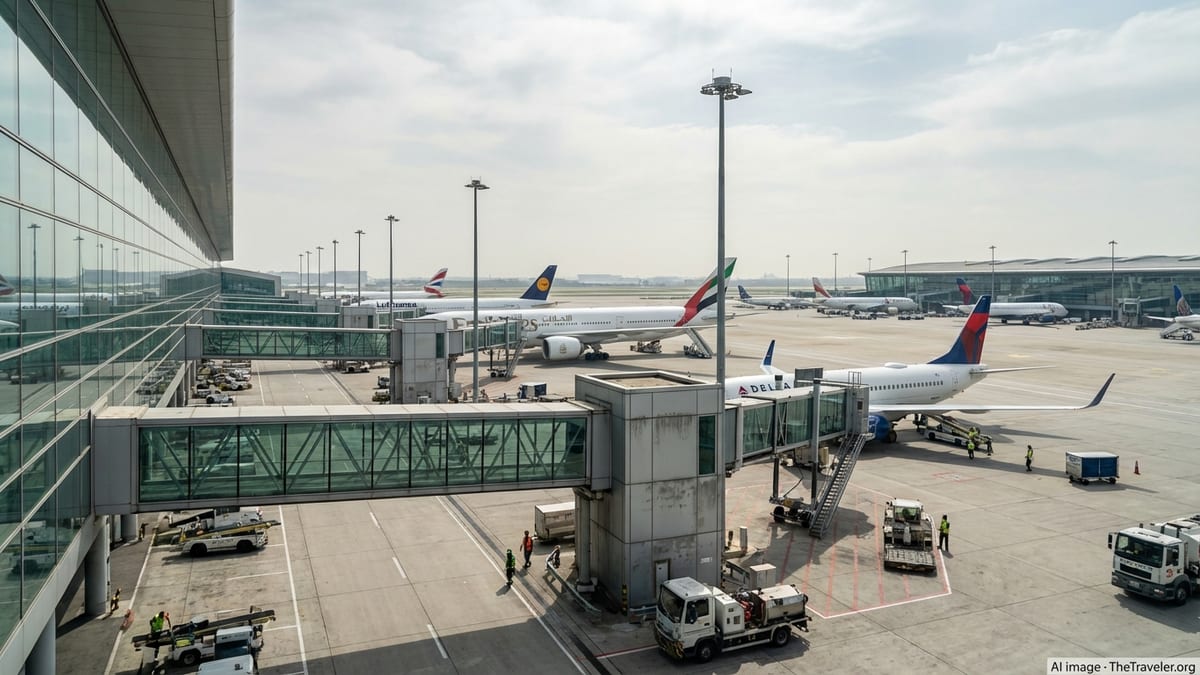
Passenger describes being stranded between plane and terminal
According to accounts shared publicly in September 2026, the incident occurred after a United flight arrived at its destination and a passenger who uses mobility aids requested wheelchair assistance to deplane and reach the terminal. Coverage of the case indicates that the traveler was escorted off the aircraft and into the jet bridge, but no wheelchair or additional support staff were waiting.
Reports state that a gate agent closed the aircraft door and moved away from the area, leaving the passenger alone in the enclosed corridor with her walker and carry-on bags. The traveler later wrote that she realized the door back to the aircraft was shut, the way into the terminal was locked, and no staff member remained in sight, prompting her to record part of the experience on her phone.
In subsequent posts that have been cited in news and aviation coverage, the passenger said she remained isolated on the jet bridge for roughly 20 to 30 minutes before help arrived. She described “shaking” with fear and frustration as it became clear there was no immediate way to reach either the aircraft crew or airport workers inside the terminal.
When staff finally returned, reports indicate that a wheelchair attendant escorted her into the terminal and through arrival formalities. United has not publicly disputed the general timeline outlined by the traveler, but the airline’s detailed internal findings have not been released.
United acknowledges incident as scrutiny over disability access grows
United Airlines has faced questions about the episode as it coincides with broader scrutiny of how major carriers accommodate passengers with disabilities. In statements described in travel and consumer reporting, the airline has emphasized that it “takes seriously” the needs of customers who require wheelchairs and indicated that it has been in contact with the traveler to discuss what happened.
Separate analytical coverage examining disability-related complaints notes that the incident has not, at this stage, been linked to any specific enforcement action or formal finding of a regulatory violation. Commentators point out that airline statements and a passenger’s public account, by themselves, do not determine whether federal accessibility rules were breached, and any regulatory conclusion would depend on an official investigation.
The story has nonetheless resonated widely among disabled travelers, many of whom have shared their own experiences of delayed assistance, misplaced mobility devices or confusion over who is responsible for providing help between the aircraft door and the main terminal. Advocates argue that the jet bridge, often treated as a transitional space, can become a particularly vulnerable area when support breaks down.
United has previously publicized investments in accessibility initiatives, including expanded disability training programs and pilot projects aimed at improving service for wheelchair users at some hubs. Analysts note that incidents like the reported jet bridge strand can undercut those efforts in the public eye, especially when they involve passengers who already face heightened barriers to independent travel.
What federal rules require for disabled air travelers
The episode is drawing renewed attention to federal obligations under the Air Carrier Access Act and its implementing regulations in Title 14 of the Code of Federal Regulations, Part 382. Those rules prohibit discrimination on the basis of disability in air travel and spell out carriers’ responsibilities for providing assistance on the ground as well as in flight.
Publicly available regulatory guidance states that airlines serving U.S. airports must, on request, assist passengers with disabilities in moving through the terminal, connecting between gates and getting to key locations such as baggage claim or security checkpoints. Carriers are also required to coordinate with airport operators and contracted service providers so that assistance is continuous and reasonably prompt, rather than fragmented between separate handoffs.
Experts on aviation accessibility note that the jet bridge is generally considered part of the path of travel where these obligations apply. If a passenger who has requested assistance is left in that space without a safe way to reach the terminal or return to the aircraft, it can raise concerns about whether the carrier met its duty to provide adequate help.
Enforcement data released by the U.S. Department of Transportation in past years show thousands of disability-related complaints annually across the airline industry, including issues involving wheelchair assistance and deplaning delays. However, individual incidents rarely result in public enforcement orders unless regulators identify broader patterns of noncompliance or repeated failures to correct known problems.
Why jet bridges can be a risk point for disabled travelers
Travelers and disability advocates describe the jet bridge as a physical and procedural “gap” in the journey for passengers who need assistance. Once a traveler leaves the cabin and the door closes, responsibility for their safety can fall into a gray area if communication between flight crew, gate agents and contracted wheelchair services is not tightly coordinated.
In many U.S. airports, wheelchair attendants and escort staff are employed not by the airline but by third-party contractors working on tight schedules and low margins. Aviation analysts say that when staffing is thin or multiple arrivals converge, wheelchair users can face long waits at the aircraft door or may be brought partway toward the terminal before the next staff member is available, increasing the risk of someone being left alone in the jet bridge.
The physical environment also poses challenges. Jet bridges can feel isolated, with limited seating and sometimes steep inclines that are difficult to manage with mobility devices and luggage. If doors at either end are closed, a person with limited mobility may have no practical way to seek help other than a cell phone, which might not always have a signal or sufficient battery at the end of a long flight.
Accessibility specialists note that clear communication and redundant checks are critical. When crew members, gate agents and wheelchair providers share exact information about who needs assistance, what equipment is required and where handoffs will occur, the likelihood of a passenger being stranded between plane and terminal is reduced significantly.
What this case signals for future airline accessibility efforts
The reported experience of being locked alone on a jet bridge has intensified calls from disability rights organizations and frequent flyers for more systematic safeguards. Proposals discussed in recent commentaries include mandatory visual checks of the jet bridge before doors are secured, automated alerts when a passenger requiring assistance is scanned off a flight, and clearer identification of who is responsible for a traveler at each stage of the journey.
Industry observers say airlines are under mounting pressure to turn voluntary accessibility pledges into specific operational changes that passengers can see. Some carriers have begun adding accessibility liaisons at major hubs, expanding training for contract staff and testing new tracking tools for mobility devices. Advocates argue that similar tools could be adapted to track customers who request wheelchair or escort services from boarding to baggage claim.
For now, the United jet bridge case highlights the disconnect that can exist between written commitments and the lived experiences of disabled travelers. While the reported wait time and isolation are unusual in their severity, disability advocates stress that the underlying problem is familiar: when coordination fails at a critical handoff point, the result can be fear, loss of dignity and a lasting reluctance to fly.
Regulators, airlines and airport operators are all watching how stories like this influence public debate around accessibility in air travel. Whether the episode leads to formal investigations, new enforcement actions or voluntary reforms, it has already become a reference point in ongoing discussions about how safe and inclusive the journey really is for passengers who rely on others for assistance between the aircraft and the terminal.