


I pulled into the sandy parking lot at Higbee Beach with low expectations. After a week of crowded boardwalks and umbrella cities on the Atlantic side of Cape May, I was just looking for somewhere quiet to stretch my legs before catching the Cape May Lewes Ferry. A friend had mentioned a “hidden” beach on the bay, but the gravel road and small, unmarked lot did not inspire confidence. Ninety minutes, I told myself. Just enough time for a quick walk. Instead, I stayed for hours.
Get the latest updates straight to your inbox!
First Impressions of a Hidden Cape May Pocket
Higbee Beach sits on the Delaware Bay side of the Cape May peninsula, inside the Higbee Beach Wildlife Management Area in Lower Township. You do not stumble on it by accident. From central Cape May, it is about a 10 to 15 minute drive past motels and marinas, then into a quieter stretch of woods and wetlands. The last approach is a bumpy gravel road that makes you slow down whether you intended to or not, and that pause is a good preview of what the place is asking you to do: ease off the gas and pay attention.
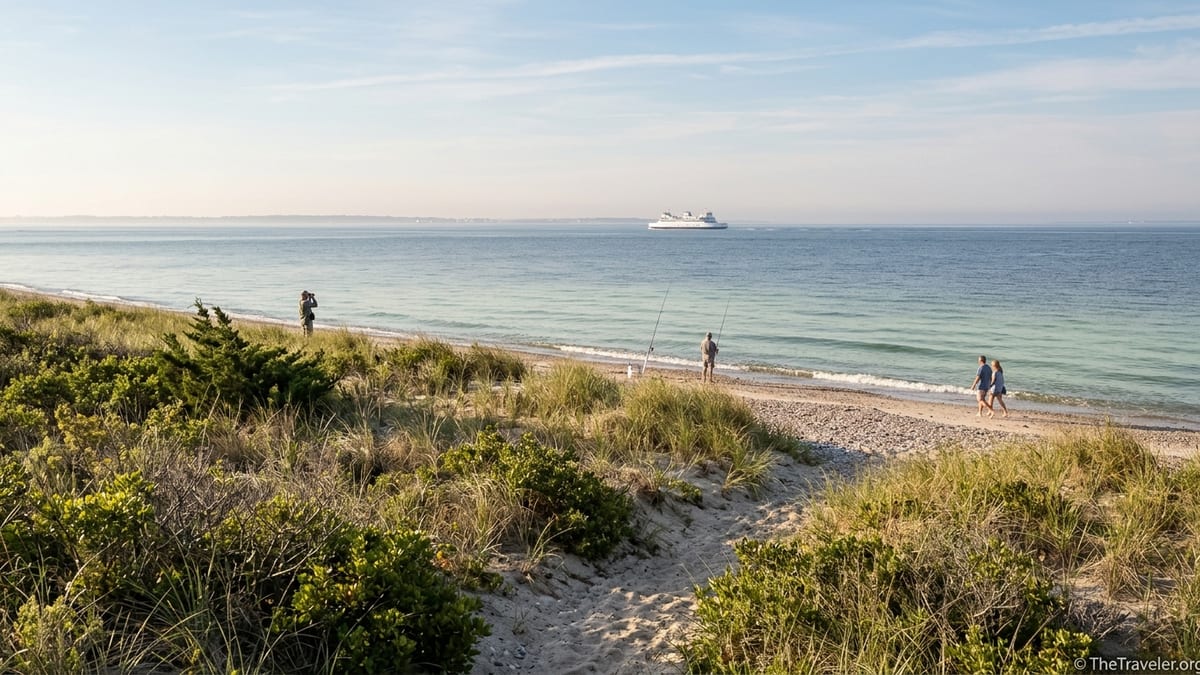
From the main lot off Higbee Beach Road, a short sandy path threads through low dunes and bayberry scrub before the view opens to the Delaware Bay. Unlike the wide Atlantic beaches lined with Victorian homes and rental chairs, Higbee feels compact and intimate. The beach is narrower, backed by modest bluffs and scrub forest instead of condos. On my late spring visit, there were only a few anglers, a pair of birders with binoculars already lifted, and one couple sitting in camp chairs near the tideline. The nearest lifeguard stand or snack bar was miles and a mental world away.
There are no restrooms, no changing cabanas, no surf shops selling last-minute towels. This is state wildlife land, managed primarily for birds and habitat rather than beachgoers. That means you need to arrive prepared: bring your own water, snacks, and a trash bag, and understand that this is closer to a backcountry trailhead than a resort beach. Once I adjusted my expectations from “amenities” to “quiet,” Higbee’s appeal snapped into focus.
As I walked onto the sand, the first thing I noticed was not the view but the sound. Instead of the constant crash of surf you hear along Beach Avenue, the bay whispers here. Waves lap instead of pound, and over that soft soundtrack you hear the calls of gulls, oystercatchers, and songbirds filtering from the woods behind you. The Cape May Lewes Ferry slid past in the distance like a floating apartment block, a reminder that civilization was not far away, even if it felt like it.
Hours Lost to Sand, Water, and Cape May “Diamonds”
I had arrived in old sneakers, assuming I would walk the high tide line and leave. Within ten minutes, my shoes were looped over my backpack and my feet were in the water. Officially, swimming is prohibited in this wildlife management area, and there are no lifeguards, but plenty of people wade on calm days. The Delaware Bay here is typically gentler than the open ocean, with smaller waves and a gradual drop-off, though the water can be murky. I kept to knee-deep and treated it more like a cool bath than a place to swim laps.
The sand tells a different story than the silky strands east of town. Higbee’s beach is a mix of coarse sand and pebbles, and before long I was hunched over like everyone else, scanning the wet line for Cape May “diamonds.” These are not gemstones but quartz pebbles, tumbled smooth and cloudy-clear by the bay. On any given day, you will see visitors crouched near the shore, sorting through stones. I watched a father help his daughter pick out a handful, later rinsing them in a water bottle to inspect the translucent pieces. It is the kind of simple, absorbing task that can steal an hour without your noticing.
About halfway up the beach, I spotted a fisherman working several rods anchored in the sand, their bright tips quivering with each ripple. He told me he drives down from Philadelphia a few Saturdays each month, parking at Higbee at sunrise to cast for weakfish and striped bass along the bay. Prices for a saltwater day license in New Jersey are modest compared to many states, and he said the real draw is not just the fishing but the ability to spread out. Even at peak summer, he rarely finds himself shoulder to shoulder as he might in more developed towns.
By the time I wandered back toward the access path, the low expectations I carried in had been completely undone. I realized I had not checked my phone in over an hour. The combination of slow water, scattered company, and something as small as searching for quartz had created the kind of unplanned stillness that many travelers go to great lengths to find. At Higbee, it just happens if you give yourself permission to linger.
Into the Trails: Birds, Dunes, and the Feeling of Elsewhere
What makes Higbee different from a simple bayside pull-off is what lies behind the beach. The Higbee Beach Wildlife Management Area covers more than a thousand acres of dunes, shrublands, old fields, and woods crisscrossed by about two miles of informal trails. After an hour on the sand, I followed one of the sandy tracks into the interior, where the dunes give way to a mix of red cedar, sassafras, and holly trees that feel almost Southern compared with the typical northern beach town boardwalk scene.
Cape May sits on one of North America’s major migratory bird flyways, and Higbee is legendary among birders. In peak migration periods in September and October, you will see people with spotting scopes and long camera lenses lining up along Signal Hill and other vantage points by first light, counting warblers, hawks, and falcons that funnel down the peninsula. On my late spring walk the show was quieter but still constant: blue grosbeaks singing from exposed branches, prairie warblers buzzing from the scrub, and swallows strafing low over a small pond edged with reeds.
The trails themselves are uncomplicated but demand respect. This is not a manicured city park; paths are sandy, occasionally muddy, and in places overgrown. In summer, biting insects and ticks are real considerations. I passed a local couple in lightweight long pants and hiking shoes who looked far more prepared than I did in shorts. They carried a small daypack, and when we stopped to chat they mentioned they always bring bug repellent and a liter or two of water per person, even for short outings, because there is nowhere inside the area to refill or buy drinks. Their approach felt like useful advice for anyone used to beach promenades where a lemonade stand is never far away.
What struck me most in the interior was how quickly the sense of being “at the beach” dropped away. Within five minutes of leaving the sand, I was surrounded by woods and birdsong. Occasionally, a gap in the trees revealed the glint of the bay or the wake of the passing ferry, but much of the time it felt like a coastal forest hike rather than a shore excursion. Travelers who like variety will appreciate that Higbee can offer a full morning of activity without ever unrolling a towel.
Rules, Realities, and the Quiet Culture of the Beach
Higbee is not a free-for-all, even if it looks rustic. As part of New Jersey’s wildlife management system, the area operates under specific regulations. Signs at the main entrances spell out the basics: no camping, no fires, no alcohol, no picnicking infrastructure, and carry in, carry out for all trash. The land officially closes at night, typically between 9 p.m. and 5 a.m., except for certain hunting or fishing activities in season. While enforcement can seem light on a random weekday morning, wardens and local police do patrol, and visitors are expected to respect closures and posted notices.
The beach has a complicated history as a site where people once treated it as clothing optional, even though it was never formally designated one. In the late 1990s, reports of nude sunbathing and related complaints led New Jersey legislators to strengthen anti-nudity enforcement in the area. Today, while you might still hear whispers about “anything goes” sections, the law is clear: public nudity is not permitted, and citations are still issued from time to time. For travelers, the best practice is straightforward. Treat Higbee as you would any other public beach in the state, dress normally, and leave the folklore at the level of campfire story rather than behavior guide.
Another layer of complexity comes from seasonal and project-related closures. Portions of Higbee Beach have been temporarily closed for habitat restoration, particularly around the Pond Creek area, and some sections are expected to remain off-limits into 2026. On the ground, this translates into certain parking areas roped off, trails blocked with signs, or stretches of beach marked with “Area Closed” posts to protect nesting birds or ongoing work. During my visit, one side trail that once cut toward a marsh viewpoint was closed, and a local birder told me they check state wildlife updates each season before planning longer hikes.
The net effect is a place with its own quiet culture. People who come to Higbee regularly tend to treat it with more reserve than a typical resort strand. Conversations stay low, music is rare, and you see more binoculars than Bluetooth speakers. Families bring small coolers for snacks but rarely full picnic spreads. Dogs, where allowed in shoulder seasons, are typically leashed. Striking that balance between recreation and respect is the unspoken ticket of admission here, and it is part of what keeps the beach feeling like a pocket of calm even as Cape May’s popularity grows.
Planning Your Visit: Access, Seasons, and Practicalities
Reaching Higbee Beach is part of the experience. If you are arriving via the Cape May Lewes Ferry, the access road is only a short drive from the Cape May terminal, making it an easy stop before or after a crossing. Visitors often park at the ferry’s free lot for a coffee or to watch boats, then continue down Route 9 and local back roads toward Higbee. The final stretch along Higbee Beach Road is narrow and unpaved in places, so it is wise to take it slowly, especially after heavy rain when puddles can form.
Parking itself is free but limited. In recent seasons, some lots closer to sensitive habitat have been closed during peak summer months, which pushes more cars into the main lot. On a sunny weekend in July, you may find that spaces fill by mid-morning. Locals often aim for early starts, arriving between 7 and 9 a.m., or visiting in the late afternoon when day-trippers peel off for dinner in town. There are no meters, and there is no overflow garage. When the lots are full, the responsible choice is to move on rather than squeeze onto verges that can damage vegetation.
Seasonality matters. Spring and fall are ideal for hiking and birding, with cooler temperatures and active migration. Summer brings warmer bay water and longer days but also stronger sun and insects. Winter, while quieter, can feel stark and windswept, though some visitors cherish the solitude. Travelers used to boardwalk towns should remember that cold-weather services are minimal. There is no nearby coffee shop that stays open late solely for beach walkers. If you want a hot drink after a January walk, you will likely be driving back toward central Cape May or the ferry terminal for it.
Because services are so sparse, packing thoughtfully makes the difference between an effortless visit and an uncomfortable one. A small daypack with at least one reusable water bottle per person, snacks that tolerate heat (nuts, dried fruit, crackers), a simple first-aid kit, sun protection, and insect repellent goes a long way. On my visit, I also wished for a lightweight camp chair after borrowing a driftwood log as seating. Cape May’s rental shops mainly serve the oceanfront, so if you like comfort on the sand, it is wise to bring your own folding chair or blanket from your lodging.
Dogs, Kids, and Who Higbee Beach Is Best For
Higbee Beach attracts a different mix of people than the lifeguarded strands off Beach Avenue. You will see solo birders, couples on quiet walks, small groups of anglers, and the occasional family with older children happy to explore trails and hunt for stones. It is less ideal for toddlers who need constant access to bathrooms, ice cream, and flat stretches of supervised sand. Parents I chatted with described it as their “second-day” beach, a place they visit once the novelty of arcade games wears off and the kids are up for something more exploratory.
Leashed dogs are part of the Higbee scene in the cooler months, and the area is often mentioned on dog travel blogs and forums as one of Cape May County’s more dog-friendly beaches. However, the specifics can be confusing because rules differ between the city beaches, county parks, and state-managed wildlife areas, and they change seasonally. In recent years, many locals have treated Higbee as a place where dogs are welcome in the off-season, particularly between early fall and late spring, while respecting shorebird nesting closures in sensitive zones. By mid-summer, restrictions typically tighten across the region to protect wildlife and manage crowds.
If you are traveling with a dog, the safest approach is to check the latest state wildlife regulations before you go and to follow posted signs on-site. Even when leashed dogs are technically allowed, consider whether your pet will be comfortable with the environment. There is little shade on the beach at midday, sand can become very hot underfoot, and there are no water fountains. Responsible owners I met during my visit carried collapsible bowls, extra water, and waste bags, and were quick to steer dogs clear of signed habitat areas or fishing lines.
For many travelers, the question is simply: is Higbee worth carving out half a day for, especially when Cape May’s main beaches and shopping streets already fill an itinerary? The answer depends on what you are seeking. If your ideal shore day revolves around rides, bars, and people-watching, you might find Higbee too quiet. But if you crave a sense of old-fashioned, lightly managed coastline where the main attractions are birds, tides, and the texture of sand beneath your feet, it becomes not just a side trip but a highlight.
Ghost Stories, History, and the Sense of Place
Part of Higbee’s pull lies in stories layered over its landscape. Long before it became a wildlife management area, this strip of shore hosted taverns, farms, and sand-mining operations. In the 19th century, the Higbee family ran a small hotel and landing point here, welcoming passengers arriving by water from Philadelphia. Rail tracks were later laid along the beach to haul sand, remnants of which still surface from time to time after storms in the form of eerie “ghost tracks” emerging from the surf before being reburied.
Local lore runs even deeper. Cape May is famous for its ghost tours, and Higbee often appears in those tales. Stories circulate of a phantom black dog that roams the dunes and of an apparition said to be Joseph or Thomas Higbee himself, walking the shoreline in a long coat on foggy evenings. I did not see anything more supernatural than a pair of cormorants drying their wings on a sandbar, but as the light softened in late afternoon, it was easy to see why the place invites imagination. The combination of quiet and the sense of things half-buried in sand encourages you to think about what and who has passed through before you.
Even without embracing the ghost stories, you feel the historical layering underfoot. A short walk inland takes you past old field edges and hedgerows that hint at past agriculture. Place names like Davey’s Lake and Pond Creek, marked on some birding maps, recall earlier uses and owners. Unlike Cape May’s Victorian district, where preservation is visible in painted porches and restored inns, Higbee’s history is subtler. It is present in the shape of the land, in the odd piece of old metal washed onto the tide line, and in the way the trails follow former roads and property lines now half reclaimed by trees.
For travelers who like to connect the dots, pairing a few hours at Higbee with a visit to one of Cape May’s small museums or a guided trolley tour in town can be especially rewarding. You get both sides of the peninsula’s story: the showpiece architecture and hospitality on the oceanfront, and the scruffier, working landscape and wild edge that made that prosperity possible. Standing on Higbee’s sand, watching the ferry move across the bay toward Delaware, you appreciate Cape May as a crossroads as much as a destination.
The Takeaway
When I turned off Higbee Beach Road that morning, I thought I was squeezing in a quick curiosity stop before more conventional sightseeing. Instead, Higbee rearranged the shape of my Cape May day. What I had imagined as a barebones strip of bayfront turned out to be a layered landscape of beach, forest, history, and migration, all packed into a modest corner of the peninsula. The absence of amenities became an asset, stripping the experience down to water, sky, and the rustle of wings overhead.
Travelers headed to Cape May often build their plans around familiar markers: the painted ladies on the oceanfront, the bustling Washington Street pedestrian mall, sunset at the Point. Higbee Beach sits slightly outside that circuit, both geographically and mentally, which is precisely why it is worth the detour. It offers a slower, quieter counterpoint where you can spend hours doing almost nothing and come away feeling like you have seen a side of the shore that has vanished from many other places.
If you go, go prepared and go gently. Bring your own water and patience, respect the posted rules and the needs of the wildlife that make this area special, and leave the sand a little cleaner than you found it. In return, Higbee will offer you something that is increasingly rare on the Northeast coast: the chance to feel, if only for an afternoon, that you have stumbled onto a pocket of beach that is still more habitat than attraction, more secret than scene.
FAQ
Q1. Where exactly is Higbee Beach located?
Higbee Beach is on the Delaware Bay side of the Cape May peninsula in Lower Township, New Jersey, within the Higbee Beach Wildlife Management Area, a short drive from both downtown Cape May and the Cape May Lewes Ferry terminal.
Q2. Is there an entrance fee or parking charge at Higbee Beach?
There is currently no entrance fee, and parking in the wildlife management area lots is free, though spaces are limited and can fill up on busy summer days.
Q3. Are there restrooms, lifeguards, or snack stands at Higbee Beach?
No. Higbee has no restrooms, no lifeguard coverage, and no food or drink concessions, so visitors should arrive prepared with water, snacks, and a plan to use facilities elsewhere before or after their visit.
Q4. Can you swim at Higbee Beach?
Swimming is officially prohibited because the area is managed for wildlife and there are no lifeguards, but visitors often wade in the shallows of the Delaware Bay; anyone entering the water does so at their own risk and should be cautious.
Q5. Are dogs allowed on Higbee Beach?
Leashed dogs are commonly seen in the off-season, but rules can change and may be different during bird nesting periods, so it is important to check current state wildlife regulations and obey all posted signs before bringing a dog.
Q6. What is the best time of year to visit Higbee Beach?
Spring and fall are excellent for hiking and birdwatching during migration, summer offers warmer bay water but more insects and sun, and winter is quiet but can be cold and windy; your ideal season depends on whether you prioritize wildlife viewing, mild temperatures, or solitude.
Q7. Is Higbee Beach suitable for young children and strollers?
Families do visit, but the lack of facilities, uneven sandy paths, and absence of lifeguards make it better suited to older children who enjoy walking and exploring; it is not especially stroller-friendly compared with paved boardwalk areas.
Q8. How long should I plan to spend at Higbee Beach?
A quick visit can be done in an hour, but many travelers find that between walking the beach, looking for Cape May “diamonds,” and exploring a trail or two, two to four hours passes easily.
Q9. Are there marked hiking trails, and do I need special gear?
There are informal sandy trails through dunes and woods, some of which are shown on birding or local maps; sturdy walking shoes, sun protection, water, and insect repellent are usually sufficient for casual hikes.
Q10. Is Higbee Beach really a nude or clothing-optional beach?
No. Although it once had a reputation for nude sunbathing, public nudity is not legal here and regulations are enforced; visitors should treat it as a standard public beach and dress accordingly.