


Ask a Cape May local where they actually go to the beach on a summer day, and many will not send you to the famous boardwalk, the packed lifeguard stands, or the high-rise motels of Wildwood. Instead, they will point you down a narrow gravel lane lined with bayberry and scrub oak, toward a mile of undeveloped shoreline on the Delaware Bay. Higbee Beach Wildlife Management Area is where the people who know the Jersey Shore best come to escape it, and the reasons go far beyond simple crowd avoidance.
Get the latest updates straight to your inbox!
A Wild Stretch of Shore, Not a Resort
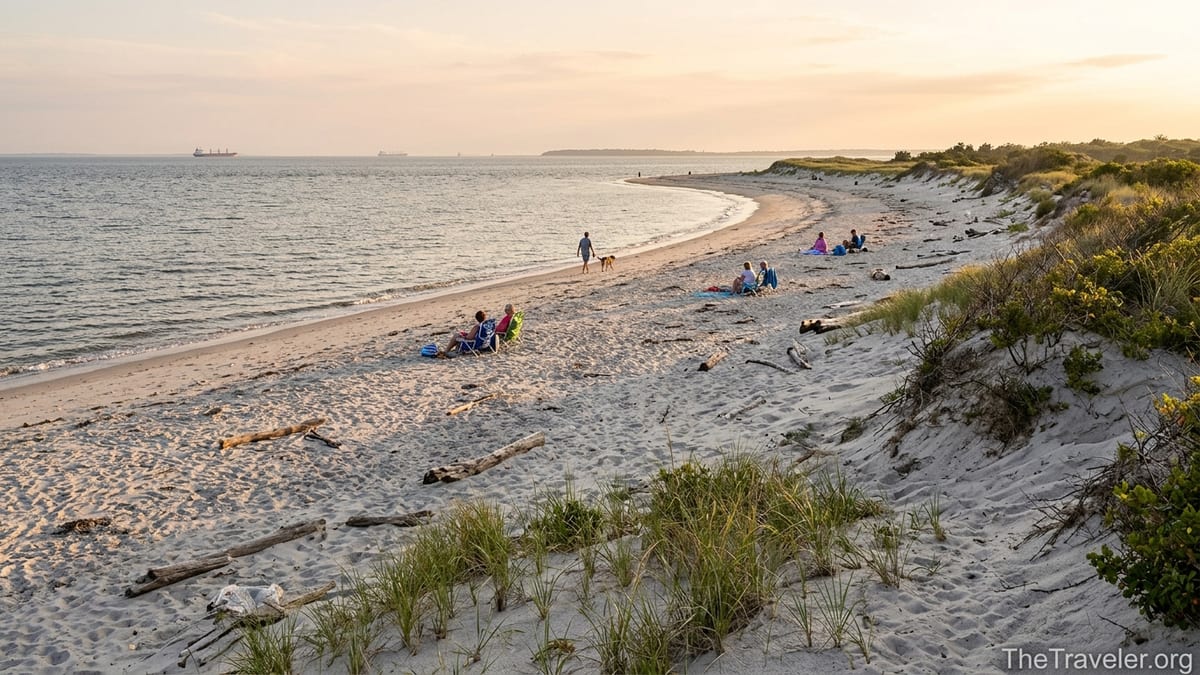
Higbee Beach sits on the Delaware Bay side of Cape May, within more than 1,100 acres of protected dunes, meadows, and scrub forest managed as a Wildlife Management Area. Instead of condos and motels, the access road is a rutted gravel track through woods where you are more likely to see a white-tailed deer than an ice cream truck. The final parking area holds only a few dozen cars, which creates a natural cap on how many people can reach the sand on any given day. For locals, that limited access is a feature, not a bug: it keeps Higbee feeling more like a nature preserve than a day-use attraction.
Once you step over the low dune and onto the sand, the difference from the Atlantic-facing resort towns is immediate. There are no lifeguard towers, no rental umbrellas lined up in military formation, and no music leaking from packed beach bars. Instead, the horizon is a wide horizontal band where the Delaware Bay meets the sky, with big container ships sliding past in the distance on their way to and from the ports of Philadelphia and Wilmington. Locals talk about how, even in peak July humidity, the sounds here are more likely to be waves lapping and osprey calling than thumping Bluetooth speakers.
That raw, unpolished character is exactly what draws many year-round residents back. People who spend their workdays dealing with Cape May’s tourist economy say they value that Higbee “doesn’t try to entertain you.” You bring your own chair, your own shade, your own snacks, and you settle in as a guest in a wild landscape, not a customer in a beach resort.
Compare that with Cape May’s main oceanfront, where beach tags are checked at every entrance and a family of four can easily spend more than forty dollars per day on badges in high season. At Higbee Beach there are no beach fees, because the shoreline is part of a state wildlife area, not a municipal guarded beach. For locals who go to the shore several times a week all summer, that difference adds up quickly.
Quieter Days, No Boardwalk Frenzy
To understand why Higbee is such a favorite with locals, it helps to picture what they are often trying to avoid. Drive twenty minutes up the coast to Wildwood on a Saturday in August and you will find multi-lane traffic inching toward the boardwalk, flashing ride lights visible from blocks away, and shoulder-to-shoulder crowds along the waterline by midday. The water is warm and the amusement piers are fun, but it is not a place many residents choose when they are off duty.
Higbee, in contrast, has no boardwalk, no arcade, and no ferris wheel on the horizon. On a weekday morning in June you might find a few birders with binoculars, a pair of surf casters working the drop-off, and perhaps a couple of dog owners walking along the tideline well before the heat of the day. Even at sunset in high summer, when Cape May’s bayfront pockets like Sunset Beach and the North Cape May bayside fill with chairs and cameras, Higbee usually feels spread out. People cluster loosely near the paths over the dunes, but you can still walk five minutes north and find yourself nearly alone.
Locals say this quieter energy changes how they use the beach. Instead of timing their day around lifeguard hours or the next round of funnel cakes, they treat a Higbee visit more like a hike with a swim at the end. Many will park at the main lot, follow a signed trail through the dunes and patchy older forest, and only then drop a towel on the sand. The journey becomes part of the ritual: you leave the traffic, then the pavement, then even the sound of engines behind before you arrive at the water’s edge.
Parents who live in Cape May or Lower Township often keep the busy boardwalk towns in their back pocket for a special evening of rides and pizza, but on a random Tuesday they are more likely to head to Poverty Beach on the quieter northeast end of Cape May’s oceanfront or out to Higbee for a less stimulating day. In conversations and local forums, people mention how much easier it feels to keep an eye on kids when there are only a few families within sight instead of hundreds compressed between jetties.
No Badges, Plenty of Space, and Fewer Rules
One of the most practical reasons locals gravitate toward Higbee is cost. Cape May’s municipal beaches require daily or seasonal beach tags during the main season, which can be excellent value for week-long visitors but add up quickly for someone who only needs an hour on the sand after work. Wildwood’s beaches are famously free, but parking near the boardwalk can be costly and elusive on busy days. At Higbee, there is no badge checker, no kiosk, and no long line at a tag booth. You simply park in the gravel lot, respect posted regulations about wildlife and closures, and walk in.
The trade-off is that amenities are minimal. There are no restrooms on the sand, no food vendors, and no rental chairs. For locals accustomed to the layout, that is part of the appeal. They toss a small cooler in the back of the car, bring a folding chair from home, and stop at a Cape May deli or supermarket on the way in to stock up on sandwiches and drinks. For a couple on a budget, a picnic and an afternoon at Higbee can cost less than what they would spend on just parking and snacks at a busier beach.
Another draw is the sense of “room to breathe.” Higbee’s shoreline is relatively narrow at high tide but stretches on for roughly a mile, and most people cluster near the main access points. If you are willing to walk ten or fifteen minutes along the firm wet sand, you can usually set up with no one within several umbrella-lengths of your towel. Compare that with Atlantic City or Seaside Heights on a hot weekend, where towels often butt up against each other in the peak midday hours and personal space can feel like a luxury.
Regulations here are shaped by the fact that Higbee is managed first as habitat, not a recreational beach. Swimming is technically allowed but always at your own risk because there are no lifeguards. Portions of the area have been periodically closed for habitat restoration projects, and visitors must pay close attention to signs about restricted nesting zones for shorebirds. Locals, familiar with these nuances and closures, are often more comfortable navigating them than first-time tourists who just want a simple “open or closed” answer. That comfort with a more self-reliant, lightly regulated experience is part of why Higbee feels like a locals’ place.
A Sanctuary for Birders and Nature Lovers
Higbee Beach is famous among birders far beyond New Jersey. The Cape May peninsula funnels millions of migrating birds south every fall, and Higbee’s mix of meadows, scrub, and forested dunes functions as a critical rest stop. On September mornings, birders gather on small observation platforms and along field edges to watch warblers, flycatchers, and hawks move through in dense pulses just after sunrise. For many Cape May residents who are also bird enthusiasts, the idea of their favorite beach doubling as a world-class migration hotspot only deepens its appeal.
Even if you are not an avid birder, the wildlife presence is hard to miss. Osprey platforms occupied by nesting pairs dot the marsh behind the dunes, and it is common to see them circling with fish in their talons. Horseshoe crab shells often stud the high-tide line in late spring, a reminder of the bay’s role in one of the Atlantic coast’s great ecological events, when spawning crabs provide a feast for migrating shorebirds. This sense that the beach is alive and constantly in motion is something locals often contrast with the more manicured feel of heavily groomed resort beaches where tractors smooth the sand at dawn.
Trail networks just inland from the beach give residents options even on windy or cool days when swimming is less appealing. A yellow-blazed loop through maritime forest, old farm fields, and low dunes offers a few miles of easy walking. Locals talk about starting early, hiking under the cover of scrub and pitch pine while songbirds call in every direction, then emerging on the bayfront with the whole beach nearly to themselves. In spring and fall, that mix of walking and short beach time makes Higbee a go-to for those who want fresh air without committing to a full beach day.
The area’s protected status also gives locals a sense of long-term security. While other parts of the Jersey Shore wrestle with where to allow new hotels or how high new homes can rise, Higbee’s land is dedicated to conservation. There may be debates about how to manage marsh restoration or access points, but most residents who love the place take comfort in knowing that they will not wake up one summer to find a new high-rise overlooking their once-secluded stretch of sand.
Warmer, Gentler Water and Stunning Sunsets
Because Higbee faces the Delaware Bay instead of the open Atlantic, its water has a different personality than the surf at Ocean City, Wildwood, or Long Beach Island. The bay’s shallower, semi-enclosed basin often makes water temperatures a few degrees warmer than on the ocean side, especially in late spring and early fall. Locals who are eager to start their swimming season early often find that they can comfortably wade in at Higbee or other bay beaches while the Atlantic side is still bracingly cold.
The wave energy is usually gentler too. There can be a noticeable drop-off and strong currents, so caution is still essential, but you will not typically find the heavy breaking shore waves that knock kids over on some Atlantic beaches during rough spells. For older residents or parents with small children, that softer lapping bay surf can feel more inviting for simple wading and floating on a hot afternoon, provided they understand and respect that there are no lifeguards present.
Sunsets are another major reason locals head for the bay side. On the oceanfront, the sun slips behind hotels, dunes, or inland trees long before it reaches the horizon. At Higbee, the view is full west across open water. On clear evenings, the sky can go from gold to tangerine to deep mauve, with silhouettes of cargo ships and distant lighthouses punctuating the color. Residents from across Cape May County talk about grabbing a takeout dinner, driving down the sandy lane, and sitting in low beach chairs at Higbee to watch the day end, even if they never touch the water.
Those sunsets feel different from the ones at better-known spots like Sunset Beach or the North Cape May bayfront, which have grown steadily more popular over the years. At Sunset Beach, nightly flag-lowering ceremonies, a small cluster of shops, and the presence of the famous concrete ship offshore can draw sizable crowds in July and August. Higbee offers essentially the same westward view, but the lack of facilities means there are fewer people. It is a place where a local can tuck into the sand with a book, glance up at the colors, and hear little but wind in the dune grass.
A Complicated Past and an Evolving Present
Longtime residents remember when Higbee Beach was known less as a quiet local hideout and more as a destination for nude sunbathing. For years, the lack of active management and its off-the-beaten-path feel attracted people seeking a clothing-optional experience, sometimes alarming nearby homeowners and more traditional beachgoers. After legal disputes and increased enforcement, the state designated the area as clothing-required, and visible nudity has largely disappeared. Many locals today mention that history only in passing, more amused than anything, but it still shapes how outsiders sometimes perceive the place.
In recent years, Higbee has also been the focus of large-scale environmental projects. Sections of the marsh and creek systems behind the beach have been undergoing restoration, including work around Pond Creek aimed at improving tidal flow, restoring native vegetation, and enhancing resilience to sea-level rise. Parts of the Wildlife Management Area have been temporarily closed off as heavy equipment and planting crews do their work, and that has changed how locals use the site from season to season. Regulars check state notices or ask around town to find out which trails and access points are open before making the drive out.
These projects have sparked debates locally about balancing access and conservation. Some residents worry about losing their traditional routes to the sand or about increased restrictions on where people can walk dogs or cast fishing lines. Others emphasize the long-term benefits of healthier marshes that can better absorb storm surges and provide habitat for birds and fish. Many locals fall somewhere in between, accepting short-term inconvenience for restoration but relying on state agencies to keep at least some access available throughout the process.
For travelers, the practical takeaway is that Higbee is not a static place. Paths may shift, parking arrangements can change, and a cove that was open one summer may be temporarily off-limits the next while plants establish. What remains consistent is the underlying character: a wild-feeling shoreline where the natural world gets first priority and human recreation has to fit around it. That dynamic, evolving relationship with the landscape is part of what keeps locals engaged and attached.
How Visitors Can Experience Higbee Like a Local
Part of the reason locals continue to favor Higbee Beach, even as awareness of it spreads, is that the area tends to filter out people looking for instant gratification. There are no obvious signs from the main roads pushing you toward the entrance, and the final approach down the rough gravel lane can make nervous drivers second-guess themselves. For residents, that little bit of friction helps preserve the peace. For visitors willing to lean into it, though, approaching Higbee the way locals do can make for a rewarding day.
Plan as if you are heading into a small state park rather than a serviced beach. Bring everything you need: water, snacks, sunscreen, a trash bag, and shade if you plan to stay a while. Expect no lifeguards and take that seriously. Locals stress that swimmers must know their limits, keep an eye on tides, and avoid venturing too far out, particularly on days with strong currents or storms in the wider region. Some regulars simply skip swimming altogether here and enjoy wading, shell collecting, and watching wildlife instead.
Timing also matters. Residents who work in Cape May often slip out early, arriving at Higbee around sunrise before their shifts begin. In that first hour of light, the lot is quiet, songbirds are most vocal, and the sky over the bay glows softly. Others favor late afternoons in shoulder season, like May or late September, when the water is still reasonably warm but day-tripper traffic has thinned. On hot July and August weekends, even Higbee can feel busy, so locals might pivot to less obvious corners of the bayfront or simply adjust their hours to avoid the midafternoon peak.
Respect is the last and perhaps most important ingredient. Locals pack out every bit of their trash, keep dogs under control and away from posted bird-nesting zones, and avoid trampling dune vegetation to create new shortcuts. Many know that the same state agencies protecting piping plover nests and restoring marshes are the ones allowing continued public access. Visitors who match that ethic find that they are warmly welcomed into an unofficial community of people who appreciate Higbee not just as a free beach, but as a shared backyard that needs care.
The Takeaway
At first glance, it would be easy to explain Higbee Beach’s popularity among locals as a simple reaction to crowds. Why battle for towel space on a packed municipal beach or pay for daily tags when a free, quieter alternative exists just a short drive away? But the real reasons residents favor Higbee run deeper. This stretch of Delaware Bay shoreline offers a rare combination of wildness, warmth, and routine: a place where you can watch world-class bird migration in the morning, wade into relatively gentle water by afternoon, and sit under an open western sky at sunset without a single neon sign in view.
Higbee demands more from its visitors than the typical Jersey Shore resort. You must bring your own comforts, take responsibility for your own safety, and pay attention to the needs of the landscape and its wildlife. In return, you get something that has become increasingly scarce along the East Coast: a beach that still feels like a natural place first and a recreational amenity second. That is why, when the workday ends for Cape May bartenders, servers, shop managers, and teachers, many of them do not head for the boardwalk. They toss a chair in the trunk, point their cars toward the bay, and bump their way down a sandy road to spend their free time at Higbee Beach.
FAQ
Q1. Where exactly is Higbee Beach, and how do you get there?
Higbee Beach sits at the northwest corner of Cape Island in Lower Township, just inland from the Delaware Bay and a short drive from downtown Cape May. Access is via a narrow gravel road off the main highway near the Cape May Canal area, and signage is modest, so visitors often rely on local directions or navigation apps to find the parking area set back in the woods.
Q2. Is there a fee or beach badge required to use Higbee Beach?
No. Higbee Beach is part of a state-managed Wildlife Management Area rather than a municipal guarded beach, so there are no beach badges or daily fees required. Parking is also currently free, although spaces are limited and can fill quickly on peak summer days.
Q3. Are there lifeguards on duty at Higbee Beach?
No lifeguards are stationed at Higbee Beach. Swimming is strictly at your own risk, and local authorities emphasize that conditions can change quickly with currents and tides. Many regulars choose to wade close to shore, paddle, or simply enjoy the water from the sand rather than swim far out.
Q4. What facilities and amenities should I expect at Higbee?
Facilities are minimal. There are no restrooms or showers on the beach itself, no chair or umbrella rentals, and no food vendors. Visitors should come prepared with water, snacks, sun protection, and a plan to pack out all trash. This lack of commercial amenities is part of why the area remains relatively quiet.
Q5. Is Higbee Beach dog-friendly?
Rules can vary by season and are subject to wildlife protection measures, but generally Higbee has been more dog-friendly than many municipal beaches, especially outside the core summer hours and months. Owners are expected to keep dogs leashed where required, avoid posted nesting or restoration zones, and clean up thoroughly. It is always wise to check current local guidance before bringing a pet.
Q6. Can I visit Higbee Beach during ongoing restoration projects?
Yes, but access may be partially restricted. Marsh and habitat restoration projects have led to temporary closures of specific trails or sections of the shoreline. Before visiting, locals often check recent state announcements or local news to see which areas are open, then adjust their plans accordingly.
Q7. How does Higbee compare to better-known Cape May beaches like Sunset Beach or Poverty Beach?
Sunset Beach and Poverty Beach each have their own appeal, from iconic shipwreck views to quieter oceanfront sands, but they sit closer to development and, in the case of Sunset Beach, small shops and ceremonies that draw larger crowds. Higbee, by contrast, feels more removed from town, with no storefronts or organized events, and offers a more immersive natural setting.
Q8. Is Higbee Beach suitable for families with children?
Higbee can be a rewarding outing for families who are comfortable with a more self-reliant experience. There are no lifeguards, playgrounds, or nearby bathrooms, so parents must be prepared and vigilant. The gentler bay waves can be inviting for wading, but adults should supervise closely, set clear boundaries, and consider shorter visits tailored to their children’s ages and stamina.
Q9. What is the best time of year to enjoy Higbee like a local?
Locals often favor the shoulder seasons of late spring and early fall, when temperatures are pleasant, water in the bay is relatively warm, and crowds are thin. Early mornings and late afternoons in summer can also be excellent, offering cooler air and dramatic light, while avoiding the hottest and busiest midday hours.
Q10. What should first-time visitors do to be respectful when visiting Higbee Beach?
First-time visitors can show respect by staying on established paths over the dunes, obeying all posted signs, especially around nesting birds or restoration areas, keeping noise levels low, and packing out every piece of trash. Treating Higbee as a shared natural sanctuary rather than just a free beach helps preserve the quiet, wild character that locals value.