


Newfound Gap Road is the dramatic spine of Great Smoky Mountains National Park, climbing from Gatlinburg, Tennessee, to Cherokee, North Carolina, across 31 miles of ridgelines, coves, and high passes. It is also one of the most misunderstood drives in the park. First-time visitors often treat it like a simple scenic shortcut between two tourist towns, only to be surprised by tight curves, sudden fog, scarce parking, unpredictable wildlife, and fast-changing mountain weather. Knowing the mistakes most people make before you go can help you enjoy the views instead of white-knuckling the wheel or idling in a logjam of brake lights.
Get the latest updates straight to your inbox!
Underestimating a True Mountain Road
On paper, Newfound Gap Road is just a 31-mile section of US 441. In reality, it is a two-lane mountain highway that climbs to roughly 5,000 feet at Newfound Gap, with continuous grades, blind curves, and steep drop-offs. Park rangers routinely remind visitors that motor vehicle accidents are a leading cause of serious injuries in the Smokies, in part because people arrive expecting an easy parkway and instead find themselves descending long, winding slopes with no guardrail between them and a rhododendron-filled ravine. Treating the road like a suburban commuter route is one of the biggest mistakes visitors make.
You see this most clearly in the way some drivers handle curves and speed limits. The posted limit is generally 35 miles per hour through the park, but it is a maximum, not a goal. In summer you will often encounter rental SUVs hugging the center line to “straighten” curves, which forces oncoming traffic dangerously toward the edge. On wet days or in fallen leaves, that kind of shortcutting can send a vehicle into a skid. The more experienced drivers are the ones easing into each bend, keeping to their lane, and assuming there could be a motorcycle, a cyclist, or a park maintenance truck just out of sight around the next corner.
Another common miscalculation is distance and time. Visitors see 31 miles and expect a 45-minute drive, then book a timed ticket for an attraction in Gatlinburg or Cherokee with less than an hour of buffer. In peak season, traffic can slow to a crawl around busy overlooks, or for something as simple as a family of wild turkeys crossing the road near Chimneys Picnic Area. Add in construction zones, which historically have included single-lane paving work along eight-mile stretches between Chimneys and Newfound Gap, and it is easy for that “quick hop over the ridge” to become a two-hour journey. Planning your day around realistic drive times prevents a lot of frustration.
Ignoring Weather, Closures, and Elevation Changes
Newfound Gap Road climbs more than 3,000 vertical feet from either side, and that elevation swing creates its own microclimate. A mistake many visitors make is dressing and planning for Gatlinburg or Cherokee weather and assuming conditions will be similar at the pass. In reality, Newfound Gap and nearby Clingmans Dome can be 10 to 15 degrees Fahrenheit cooler than the gateway towns, with more wind and dramatically different visibility. It is common to leave a warm, sunny Gatlinburg in May and step out at Newfound Gap into a chilly fog with a sharp breeze that makes a light T-shirt and sandals feel wildly inadequate.
Winter and shoulder seasons introduce a more serious version of this problem. Despite efforts to keep the pass open year-round, Newfound Gap Road often closes temporarily during and after winter storms. Ice can linger on the shaded, higher-elevation curves long after the pavement near Oconaluftee Visitor Center or Sugarlands Visitor Center looks clear and dry. One of the most frequent errors is relying entirely on a phone navigation app for conditions. Google Maps may show a free-flowing gray line over the crest while the National Park Service has the road closed at the gates near Smokemont Campground and Sugarlands due to black ice or downed trees. Smart travelers check the park’s recorded road status line or the official conditions page before committing to the climb, especially between November and March.
Even in summer, sudden weather shifts can catch drivers off guard. Thunderstorms routinely build along the ridgeline on hot afternoons, dropping sheets of rain and creating near-whiteout conditions through low-hanging clouds. Many visitors continue barreling along at highway speeds, tailgating the car ahead as if the painted lane lines are still visible. A better approach is to slow significantly, turn on low-beam headlights, and use the many paved pullouts, such as those near Carlos Campbell Overlook or Morton Overlook, to wait out the worst of a storm. A ten-minute pause at a safe turnout is far preferable to hydroplaning into a rock wall because you felt pressure from the line of vehicles behind you.
Misusing Pullouts, Overlooks, and Parking Areas
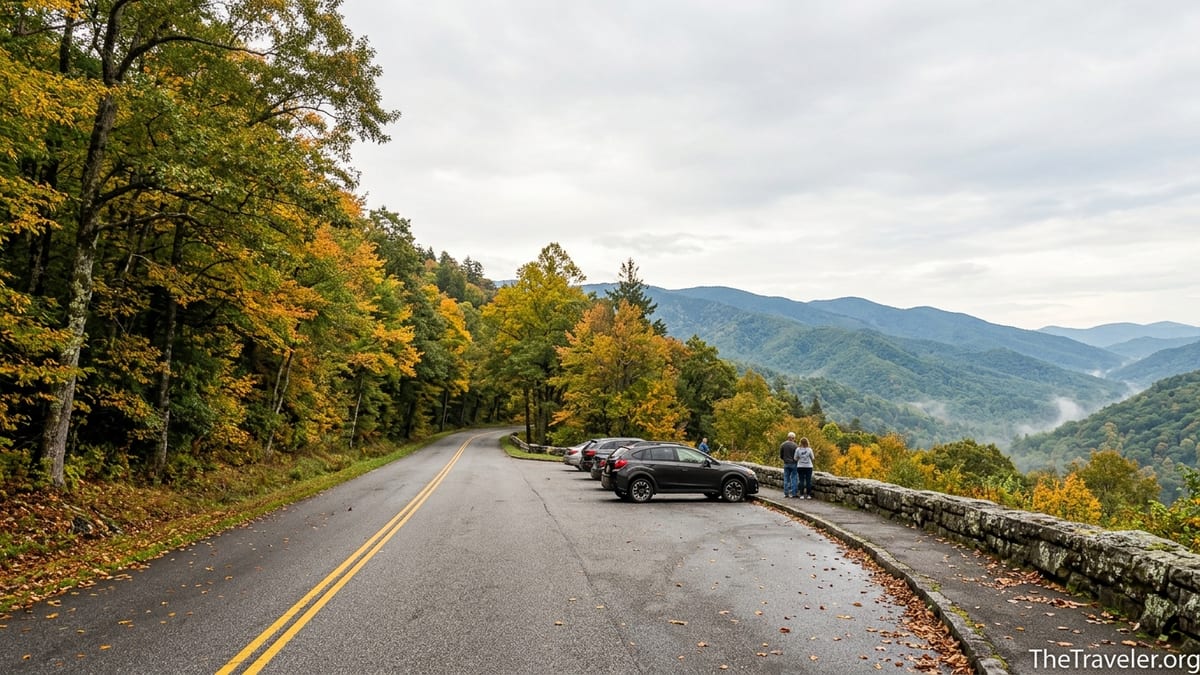
Much of the drama of Newfound Gap Road comes from its overlooks. Morton Overlook, the Rockefeller Memorial at Newfound Gap, and the pullouts with views up toward Chimney Tops are some of the most photographed spots in the Smokies. Unfortunately, visitor behavior at these stops is also one of the road’s biggest headaches. A typical mistake is treating pullouts like casual shoulders rather than designated, fully paved parking areas. Instead of driving a few hundred yards to a proper overlook, you will often see vehicles half-parked in the travel lane near an interesting vista, hazard lights blinking as if that makes them invisible to an approaching motorcoach.
The Rockefeller Memorial at Newfound Gap illustrates another recurring issue: overflow parking and congestion. On busy October weekends, the small lot often fills early with cars angling for a spot to stand on the Tennessee–North Carolina state line or access the Appalachian Trail. Latecomers begin circling slowly or stopping in the roadway with turn signals flashing, waiting for someone to back out. This gridlock spills into both directions, trapping through-traffic and emergency vehicles alike. The smarter strategy is to accept when a lot is full, continue a short distance to a less popular pullout, and enjoy an only slightly different perspective on the same ridges. In many cases, views just up or down the road are nearly as expansive and far less crowded.
An overlooked detail is how visitors exit overlooks. Many pullouts along Newfound Gap Road are angled or reverse-angle, requiring a bit of care to re-enter the flow. A common mistake is pulling out in one smooth, fast motion without looking carefully for motorcycles or downhill traffic that may appear more quickly than you expect. Drivers in large pickup trucks and RVs should take extra time, using mirrors and windows, to be certain there is enough space and that their tail swing will not cross into the opposite lane. A slow, deliberate re-entry with a clear signal is not just polite; it is essential on a road where sightlines are often limited.
Getting Too Close to Wildlife
Newfound Gap Road slices through living habitat, not a drive-through zoo. Yet one of the most consistent and dangerous mistakes visitors make is treating elk and black bears as roadside attractions for close-up photos. On the North Carolina side, around Oconaluftee Visitor Center and the Mountain Farm Museum, elk graze in the fields, occasionally wandering close to the highway. It is not uncommon to see a line of cars stopped in the travel lane while people lean out of windows, phones extended, or even step into the ditch to creep a little closer. This creates a traffic hazard and puts both animals and humans at risk.
The National Park Service urges visitors to remain at least 50 yards from bears and elk, which is about the length of four buses. In practice, that means staying inside your vehicle or well back from the road’s edge. Park biologists have documented unsettling incidents, such as a large bull elk near Oconaluftee that learned to approach people for food and eventually charged visitors, forcing rangers to remove its antlers for public safety. Similar stories play out with black bears that associate cars with snacks. Once an animal loses its fear of people and vehicles, it often must be relocated or euthanized. Handing a child a cracker to toss toward a bear near an overlook is not just illegal; it may seal that animal’s fate.
Driving behavior also matters around wildlife. Many visitors slam on the brakes the moment they spot an animal, without checking their rearview mirror. On a downhill stretch above Kephart Prong, where fog can cling to the trees, that kind of sudden stop can trigger a chain-reaction collision. A better practice is to slow gradually, pull completely into a designated turnout if you want to watch, and use your hazard lights only once fully off the travel lane. If there is no safe place to stop, enjoy the fleeting glimpse and continue on. The Smokies are full of wildlife; you will have other chances that do not end with sirens and flashing lights.
Driving Vehicles That Are Poorly Suited for the Route
Newfound Gap Road is open to most passenger vehicles, but that does not mean every vehicle is a good choice. The road’s continuous grades and tight curves can be punishing on long, heavily loaded rigs. In recent years, the park has highlighted crashes involving large car haulers and semi-trucks whose brakes overheated and caught fire on the descent. Commercial vehicles are prohibited on US 441 through the park, with the exception of a short connector known as the Spur, yet navigation apps sometimes route professional drivers over the pass anyway. Even for private visitors, towing large campers over Newfound Gap is rarely worth the stress when alternate approaches to developed campgrounds exist.
Among vacationers, oversized Class A motorhomes and long travel trailers are a regular sight climbing slowly out of Gatlinburg, engines straining, only to grind their way down toward Cherokee in low gear with the smell of hot brakes wafting through the windows. The mistake is assuming that because the road is paved and well maintained, it must be suitable for any road-legal vehicle. What the map does not show is the combination of hairpin curves, narrow shoulders, and limited recovery space if you misjudge a downhill corner. Renting a more modest SUV in Pigeon Forge or Knoxville and leaving the big rig in a full-service campground on one side of the park is often the safer, more enjoyable choice.
Even in normal passenger cars, mechanical preparation matters. It is surprisingly common to see vehicles pulled into the Chimneys Picnic Area or the large Newfound Gap lot with hoods up and steam rising, or with a flat tire after hitting a pothole at speed. There are no gas stations or repair shops on Newfound Gap Road itself. Checking tire pressure, coolant levels, and brake condition before you depart Gatlinburg, Cherokee, or Bryson City is more than a chore; it can be the difference between a memorable overlook stop and a long wait for a tow truck that must navigate the same switchbacks to reach you.
Overpacking the Day and Skipping Safety Basics
Because Newfound Gap Road connects two busy tourist hubs, many travelers try to stuff it into a packed itinerary: breakfast in Gatlinburg, a quick drive to Clingmans Dome, lunch in Cherokee, shopping in Bryson City, and back over the gap by sunset. The result is a day with little margin for surprise. Any delay from wildlife jams, road maintenance, or weather means rushed visits and risky driving decisions, such as trying to “beat” twilight down the mountain because you are worried about dinner reservations. A simpler plan that allows several hours just for the drive, with time for at least a couple of short walks like Kephart Prong Trail or the paved path at the Rockefeller Memorial, creates a much calmer experience.
Basic safety gear is often overlooked in this rush. Cell service along much of Newfound Gap Road is spotty or nonexistent, which surprises visitors who are used to constant coverage on interstate highways. Relying entirely on a ride-hailing app or a streaming music service can leave you frustrated and, in an emergency, unable to quickly call for help. Carrying a printed park map, a small first-aid kit, extra water, and some simple snacks is wise even if you never leave the pavement. If your car breaks down between Sugarlands and Oconaluftee, it may be some time before a ranger or tow truck reaches you, especially on shoulder-season weekdays.
Another small but important detail is lighting and visibility. Mountain tunnels and heavily wooded stretches can be unexpectedly dark, especially when clouds sit low over the ridge. Many visitors rely on automatic headlights that do not always switch on in these conditions. Turning your lights on manually when you enter the park improves your visibility to others, particularly motorcycles and cyclists that may be using the road. It also helps when you pass through short tunnels or shadowed cuts, where alternating bright and dark can momentarily blind drivers who are not prepared.
The Takeaway
Newfound Gap Road earns its reputation as one of the classic drives in the southern Appalachians precisely because it is more than a simple connector between two towns. It concentrates the Smokies into a narrow corridor where weather, wildlife, scenic views, and human impatience all collide. The most common mistakes visitors make are less about skill behind the wheel and more about mindset. Treating the road as a rushing shortcut, ignoring elevation and weather, cutting corners on parking and pullouts, pushing oversized vehicles where they do not belong, and underestimating wildlife all erode both safety and enjoyment.
With a bit of preparation and humility, the experience is transformed. Checking official road conditions before you go, building generous travel time into your itinerary, choosing an appropriate vehicle, packing basic supplies, and committing to respectful distances from animals will let you savor the ridgeline views instead of worrying about the next blind curve. Think of Newfound Gap Road not as a hurdle between attractions but as the attraction itself. If you give the drive the respect a high mountain pass deserves, the Smokies will reward you with one of the most memorable stretches of pavement in the national park system.
FAQ
Q1. How long does it usually take to drive Newfound Gap Road?
Most visitors should plan 60 to 90 minutes for the 31-mile drive one way in normal conditions, and up to two hours during peak foliage, heavy wildlife activity, or road work.
Q2. Is Newfound Gap Road open year-round?
The road is generally open year-round, but it frequently closes temporarily in winter and early spring during and after snow or ice storms, especially around the 5,000-foot pass.
Q3. Can I drive an RV or tow a trailer over Newfound Gap?
Private RVs and trailers are allowed, but the grades and curves make the drive challenging. Commercial vehicles are prohibited, and large rigs are better off using alternate approaches rather than crossing the pass.
Q4. How much colder is it at Newfound Gap compared with Gatlinburg or Cherokee?
Temperatures at the gap are often 10 to 15 degrees Fahrenheit cooler than in the gateway towns, with more wind and a higher chance of fog or precipitation.
Q5. What should I do if I see a bear or elk from my car?
Stay in your vehicle, keep moving if traffic allows, and never feed or approach wildlife. If you stop, pull fully into a designated turnout and maintain a large distance.
Q6. Are there gas stations or food stops on Newfound Gap Road?
No. There are no gas stations, restaurants, or convenience stores on the road itself, only picnic areas and overlooks. Fill your tank and bring snacks and water from Gatlinburg, Cherokee, or nearby towns.
Q7. Can I rely on GPS and cell service along the route?
Cell coverage is limited and unreliable along much of the road, and navigation apps do not always reflect temporary closures. It is wise to carry a paper park map and check official road conditions before you depart.
Q8. When is traffic heaviest on Newfound Gap Road?
Traffic peaks on summer weekends, holiday periods, and during October leaf season, especially midday. Early morning and late afternoon on weekdays are generally less congested.
Q9. Are there safe places to pull over for photos?
Yes. The road has many paved pullouts and overlooks, including Morton Overlook, Carlos Campbell Overlook, and the Newfound Gap parking area. Use only designated pullouts and avoid stopping in travel lanes.
Q10. Do I need special equipment to drive Newfound Gap Road in winter?
In winter-like conditions, good all-season tires, fully functioning brakes, and cautious driving are essential. During active snow or ice, the park may close the road entirely rather than require chains, so always verify conditions in advance.