


Landing in Doha for the first time can feel a little overwhelming. Hamad International Airport is large, glossy and filled with art, luxury boutiques and quiet corners. The good news is that, unlike many big hubs, the layout is simple once you understand how the single main terminal and its five concourses fit together. This guide walks you step by step through that layout, using real examples to show you what to expect from the moment you land until you reach your gate or the city.
Get the latest updates straight to your inbox!
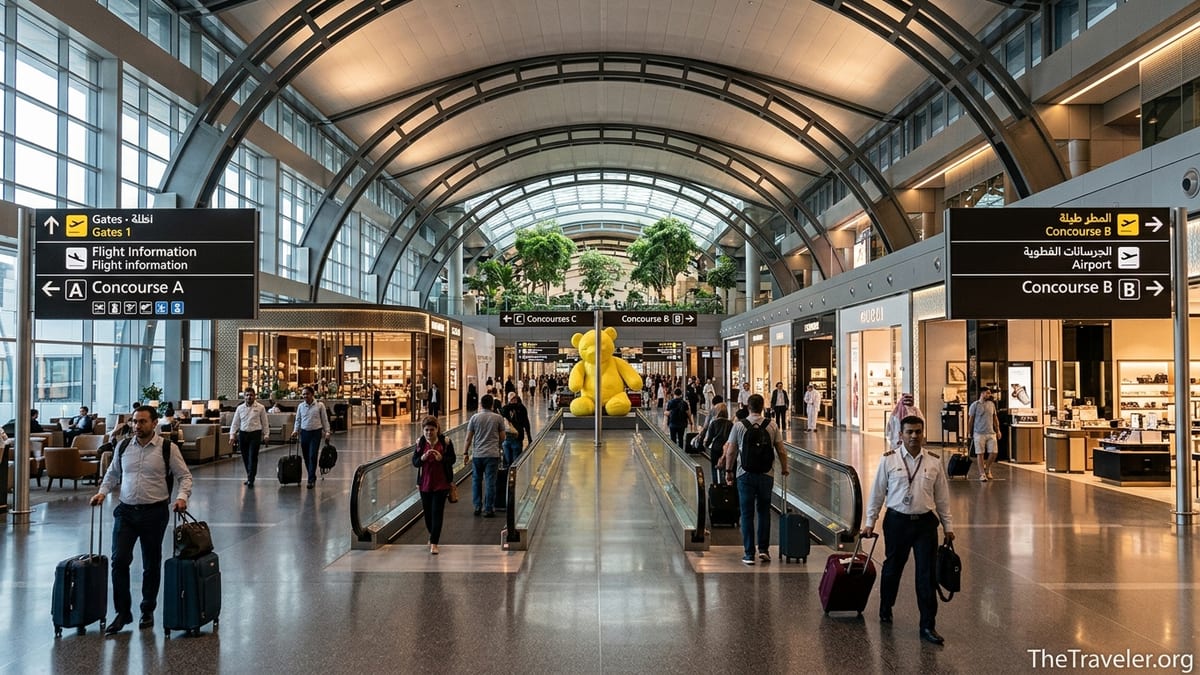
How Hamad International Airport Is Really Laid Out
Hamad International Airport in Doha uses one main passenger terminal rather than separate numbered terminals. Inside that single building, everything is organized around five concourses: A, B, C, D and E. Concourses A and B sit on the south side of the terminal, D and E on the north side, and Concourse C forms the central spine that connects them. For travelers, this means you do not need to change terminals, only move between concourses to reach your gate.
Most passengers experience the airport in the same sequence. You arrive at the main terminal building, either at the Departures level if you are flying out, the Arrivals level if you are entering Qatar, or directly at a gate if you are in transit. From security and immigration, you walk into a vast central hall. This is where the famous giant Lamp Bear sculpture and one of the main duty free plazas sit, and from here the concourses branch out like arms in different directions.
To picture the layout, imagine standing at Lamp Bear. Turn left and you are heading toward Concourse A; turn right and you are on your way to Concourse B; walk straight and you will follow Concourse C until it splits out to Concourses D and E at the far end. Concourse C is the busiest spine, and if you have a long‑haul Qatar Airways flight to Europe, Asia or the Americas, there is a good chance your gate number will start with C, D or E.
The airport is large, and while transfers are straightforward, distances can be longer than first‑timers expect. Walking from the center of Concourse C all the way down to the furthest D or E gates can easily take 15 to 20 minutes at a normal pace, even with moving walkways. Leave extra time if you are traveling with children, carrying a lot of cabin baggage or arriving during the late‑night peak when the corridors are busiest.
Understanding the Five Concourses: A, B, C, D and E
Each concourse is essentially a long pier of gates with its own mix of shops, cafes and services, but there are some useful differences. Concourses A and B, with around 10 contact gates each, are closest to the main check in hall and are often used for a mix of regional and some long‑haul flights. If your boarding pass shows a low gate number like A3 or B7, you will likely have one of the shorter walks from security to your aircraft.
Concourse C, the central backbone, is the busiest and has the largest number of gates, including several that can handle Airbus A380 and Airbus A350 aircraft. It connects directly to the newer North Node that feeds Concourses D and E. Many flagship Qatar Airways services depart from C gates. If you are connecting between two major Qatar Airways long‑haul flights, such as Sydney to London, there is a good chance you will arrive and depart somewhere along Concourse C or just beyond it in D or E.
Concourses D and E are part of a major expansion aimed at increasing capacity for events such as the FIFA World Cup and ongoing Qatar Airways growth. At the far end of Concourse C, the corridor splits into a V shape, with Concourse D running to the left and E to the right. Between them they add well over a dozen more gates, including stands designed for widebody aircraft. These newer concourses tend to feel slightly quieter and more spacious, with newer seating areas and additional lounge and spa options.
To move between the south side (A and B) and the north side (D and E), you can either walk through Concourse C or use the internal automated people mover, sometimes described in airport materials as a cable liner. This shuttle runs airside, within the secure area, and can save crucial minutes if you are rushing from a late incoming flight at a B gate to a tight connection departing from a far E gate. Signage overhead clearly indicates directions to the shuttle and to each concourse, and staff in distinctive uniforms are easy to spot if you are unsure which way to go.
Departures: Check In, Security and Getting to Your Gate
If Doha is your starting point, your journey begins at the Departures level of the main terminal. This vast hall contains long banks of check in desks organized by airline, along with self‑service kiosks for carriers such as Qatar Airways and several partner airlines. For example, a Qatar Airways economy passenger on a morning flight to Bangkok might use a self‑check in kiosk to print boarding passes, then drop bags at a staffed counter nearby. Business and first class passengers, including those flying on oneworld partners, are directed to dedicated premium check in zones with separate entrances and more seating.
After check in, all departing passengers converge on the same security and immigration area. Hand luggage goes through screening, and you proceed to passport control if you are leaving Qatar. Wait times can vary by time of day, but the hall is designed to keep queues orderly and moving. Once cleared, you emerge into the main duty free plaza, with high‑end boutiques, electronics stores and convenience outlets arranged around the Lamp Bear in Duty Free Plaza South.
From here, head toward the overhead signs listing gate ranges. For instance, gates A1 to A11 will be signed clearly to your left, while gates B1 to B10 are to the right. Gates C1 to C93 and on to D and E are straight ahead. A traveler on an evening flight to Frankfurt from gate C12 might spend 20 minutes browsing in the central shops, then follow the C gate signs along the main corridor, passing additional cafes and kiosks every few minutes before reaching the gate about 10 minutes later.
Once you arrive at your gate area, seating is usually plentiful, and most gates feature floor‑to‑ceiling windows with views of the ramp. Power outlets are scattered around the seating rows and near charging stations. Many gates use direct boarding bridges, but for some regional flights you may board a bus at ground level that takes you to a remote stand. The gate displays will make this clear, and staff will direct you accordingly, so simply listen for announcements and follow the queue when boarding is called.
Arrivals and Transfers: What First‑Time Passengers Can Expect
For passengers arriving in Doha and entering Qatar, the process begins as soon as you step off the aircraft. Signs guide you toward passport control and baggage claim. If you have an e‑gate registration or eligible passport, some lanes allow automated processing, while others are staffed by border officers. After passport control, you descend to the baggage hall where large carousels handle luggage from individual flights. Screens indicate which carousel serves your flight number, so a newly arrived traveler from London on QR2, for example, would follow signs to the carousel labeled with that flight.
Once you have collected your luggage, you pass customs and emerge into the Arrivals hall. This area features currency exchange counters, car rental desks, an arrivals information desk and access to ground transportation. To the right of the Arrivals exits is the bus pavilion for city buses operated by the local company, and just outside the main doors is the taxi rank where the official turquoise and blue Karwa taxis wait in a managed line. Ride‑hailing services like Uber generally cannot pick up directly at the terminal, so first‑time visitors should plan on using Karwa taxis, pre‑arranged hotel transfers, or the Doha Metro from the airport station.
If Doha is only a connection point, you will usually remain airside and follow Transfer signs rather than Arrivals. In many cases, your cabin baggage may still go through a quick security screening, but you will not pass through immigration or collect checked bags if they are tagged to your final destination. Transfer desks for Qatar Airways and partner airlines are located throughout the concourses; for instance, a traveler whose onward boarding pass did not print correctly at their origin might head to a purple Qatar Airways transfer counter near the central duty free area or along Concourse C to have a new pass issued.
The airport is designed for easy international transfers. Typical minimum connection times for Qatar Airways itineraries are often around 45 minutes to 1 hour, and many passengers report making shorter connections when flights arrive on time. However, if your incoming flight is delayed and you find yourself with 30 minutes to connect from a B gate to a far E gate, make use of the moving walkways and consider the automated people mover if directed by staff. Gate staff are accustomed to tight connections and will often pre‑screen boarding passes at the concourse entrance to funnel passengers quickly to the correct side of the pier.
Lounges, The Orchard and Other Key Facilities Between the Concourses
Between the concourses, the main terminal is more than just a corridor. It is filled with art installations, quiet seating zones and several major facilities worth knowing about. One of the most striking is The Orchard, a dramatic indoor garden opened as part of the airport’s expansion. Surrounded by luxury boutiques and food outlets, it offers a space of greenery, waterfalls and subdued lighting where passengers can sit between flights. A traveler on a six‑hour layover between Melbourne and Paris might spend an hour strolling through The Orchard, then settle at a nearby cafe overlooking the trees before continuing to their connecting gate.
Hamad International Airport is also dense with lounges. Qatar Airways operates flagship lounges for its business and first class passengers and eligible oneworld frequent flyers, while independent lounges such as the Al Maha lounges at both the North (near The Orchard) and South nodes serve travelers with Priority Pass or other lounge memberships or those willing to pay at the door when space allows. For example, an economy passenger connecting from Nairobi to Milan might purchase access to the Al Maha North lounge to enjoy a buffet meal, showers and a quieter space to work before heading to gate D6.
Most concourses also offer prayer rooms, family rooms and dedicated smoking lounges located airside, so smokers do not need to exit the secure area during transit. Clear pictogram signage points to these rooms. Along the length of Concourse C and into D and E, you will also find spa services such as Be Relax, where passengers can pay for short massages or treatments while waiting for a flight, and an in‑terminal hotel, Oryx Airport Hotel, positioned around Concourse B with rooms bookable for overnight stays or a daytime block.
Free Wi‑Fi is available throughout the terminal, and power outlets are common in seating areas and at many dining tables. The mix of affordable and high‑end food options is broad: you can grab a fast coffee and pastry at a chain cafe for around the price of a typical European airport snack, or sit down at a mid‑range restaurant serving Middle Eastern dishes, burgers or Asian noodles for a more relaxed meal. Menus are generally displayed at entrances so you can quickly gauge price levels before committing, which is particularly helpful on longer layovers.
Getting Between the Airport and Central Doha
From the main terminal, reaching central Doha is relatively straightforward, and knowing your options helps control both cost and travel time. The airport is located roughly 15 kilometers southeast of the city center by road. Official Karwa taxis wait outside the Arrivals hall and operate on a meter with an airport flag‑fall charge. As a rough guide, a typical ride from Hamad International Airport to a hotel in West Bay or near the Corniche might cost in the range of 40 to 70 Qatari riyals depending on traffic and time of day. Payment is usually in cash or card, and drivers are accustomed to common hotel names like Marriott Marquis City Center or Sheraton Grand Doha.
For budget minded travelers, the Doha Metro’s Red Line connects Hamad International Airport with key downtown stations. The airport metro station is linked directly to the terminal via an air‑conditioned walkway. A standard single journey on the metro is typically priced in the low single‑digit riyal range per adult, making it significantly cheaper than a taxi. For example, a traveler landing at midday might tap a contactless travel card at the airport station, ride the Red Line roughly 15 to 20 minutes to Msheireb station in the city center, then transfer to another line or walk to a nearby hotel.
Public buses operated by the national company run from the bus pavilion near the Arrivals area to various districts across Doha and beyond. These buses are modern and air‑conditioned, but they can be slower and less intuitive for first‑time visitors who are carrying luggage. They are most useful for travelers staying near major bus corridors or for residents who already understand the route map. Bus fares are generally inexpensive, often only a few riyals per journey when using the appropriate travel card.
Many hotels in Doha, especially upscale properties, offer private transfer services. These might range from shared shuttle vans to individual sedans or SUVs booked in advance. A five‑star property on The Pearl or in Lusail, for instance, could arrange a private car to meet you at Arrivals with a driver holding a sign, then drive you directly to the hotel for a fixed fee that might be higher than a taxi but includes meet and greet convenience. When arriving late at night, this can be the least stressful option, particularly for families or travelers unfamiliar with the region.
Practical Tips for First Time Travelers Using the Terminals
For a smooth first experience at Hamad International Airport, time management and wayfinding are your best tools. Always check your gate number as soon as it appears on the departure screens, and note both the letter and the number. A gate labeled B4 is on the right hand side concourse relatively close to the central plaza, while a gate like E7 indicates a longer walk through Concourse C and into the right fork of the North Node. If you are transiting and your connection is under an hour, head toward your next gate first and only stop for coffee, shopping or a quick shower once you know exactly how long it takes to walk there.
Keep an eye on local time, as many long‑haul flights arrive and depart late at night or early in the morning. It is common, for example, for a traveler to land from Europe around midnight and connect to an Asia‑bound flight in the early hours. During these peaks, security and transfer areas, as well as the taxi rank outside Arrivals, can be particularly busy. If you know you will be arriving around midnight and heading straight into the city, it may be worth allowing a little extra time for queues or considering the metro on the following day if you are staying overnight near the airport.
Facilities are spread quite evenly along the concourses, but some popular services cluster at key nodes. The main duty free and Lamp Bear area, for instance, is an excellent reference point if you become disoriented; from there, you can reorient yourself toward any concourse. Information desks staffed by multilingual agents are scattered near that central plaza and at various intersections along the concourses. If you find that your gate changes, which can happen with widebody aircraft, simply look for the nearest flight information display screen and reconfirm the concourse letter before moving.
Finally, keep your travel documents and boarding passes handy, as random checks sometimes occur when entering certain concourse segments or approaching gates for flights to specific destinations. If you are connecting without a printed boarding pass, head straight to the nearest transfer desk or airline service counter. Staff are used to dealing with mis‑printed or missing boarding passes for complex itineraries and can usually reissue them quickly, so do not wait until boarding time to resolve any ticketing or seating issues.
FAQ
Q1. Is Hamad International Airport in Doha just one terminal or several terminals?
Hamad International Airport operates as a single main terminal building with five connected concourses labeled A, B, C, D and E, so you do not change terminals, only concourses.
Q2. How long does it take to walk between the different concourses?
From the central Lamp Bear area to nearby A or B gates can take around 5 to 10 minutes, while walking all the way to the furthest D or E gates can take 15 to 20 minutes at a normal pace.
Q3. I have a short connection in Doha. Is the airport easy for transfers?
Yes, the airport is designed for smooth international transfers. If your baggage is checked through and you already have a boarding pass, you usually follow Transfer signs, clear any necessary security check and walk to your next gate without leaving the secure area.
Q4. How do I know which concourse my flight uses?
Your boarding pass and the flight information screens will show a gate such as A5, C12 or E3. The letter indicates the concourse, and the airport’s overhead signs direct you there from the main plaza.
Q5. Are there lounges in every concourse?
There are multiple lounges spread across the main terminal, including Qatar Airways lounges and independent lounges such as Al Maha. While not every individual gate has a lounge beside it, there are lounges within reasonable walking distance in both the South and North nodes.
Q6. Can I smoke inside the terminal during a layover?
Yes, there are designated smoking rooms within the secure area across the concourses, so you do not need to leave the terminal or pass through immigration just to smoke.
Q7. What are my options for getting from the airport to downtown Doha?
You can take an official Karwa taxi from outside Arrivals, ride the Red Line of the Doha Metro from the airport station to central stops such as Msheireb, or use public buses and pre‑arranged hotel or private transfers.
Q8. Is the Doha Metro cheaper than a taxi from the airport?
Typically yes. A metro journey from the airport to central Doha usually costs only a few Qatari riyals per person, while a taxi to popular downtown areas often costs several times more depending on distance and traffic.
Q9. What should I do if I arrive without a boarding pass for my connecting flight?
Follow signs to the Transfer area and look for your airline’s transfer or customer service desk. Staff at these counters can usually issue or reprint your boarding pass and confirm your gate before you continue to the concourse.
Q10. Is there a hotel inside Hamad International Airport?
Yes, Oryx Airport Hotel is located within the terminal complex near Concourse B, offering rooms for overnight stays or shorter daytime blocks so you can rest without leaving the secure area.