


More news on this day
Air travel across the Gulf is undergoing another wave of disruption as Emirates, Etihad Airways and other Middle East carriers adjust flight schedules, routings and capacity through Dubai and Abu Dhabi in response to volatile regional airspace and heightened geopolitical tensions.
Get the latest news straight to your inbox!
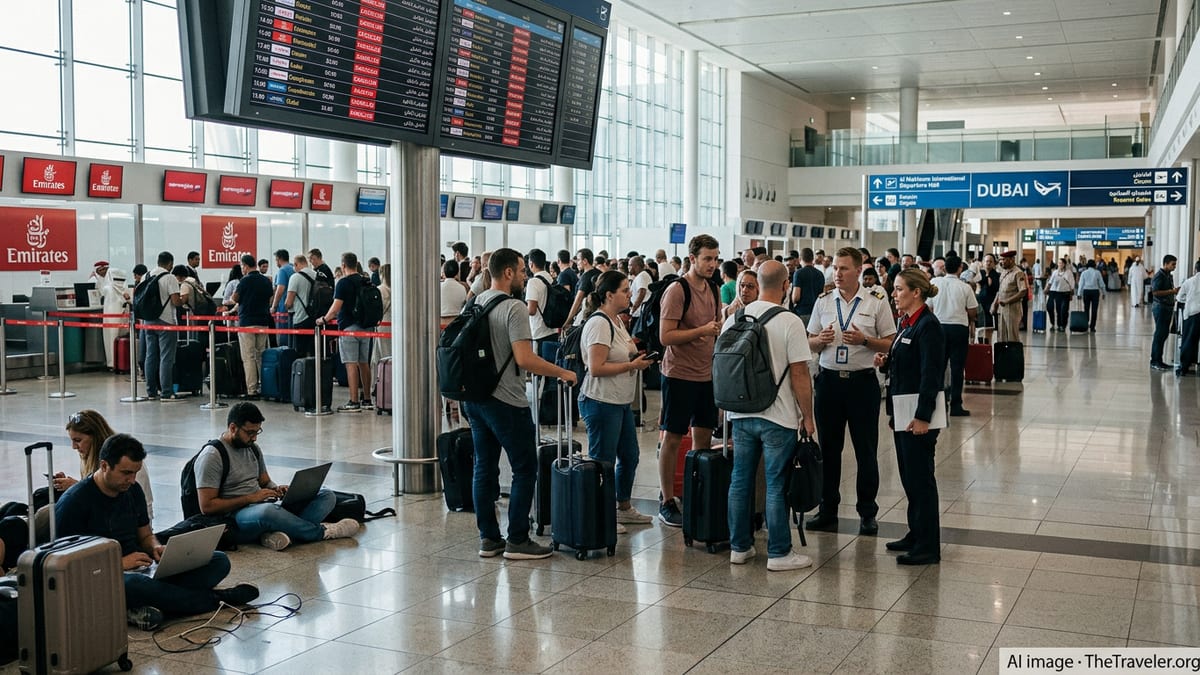
Gulf hubs under pressure from shifting airspace constraints
Dubai International and Abu Dhabi International remain among the busiest transit hubs worldwide, but the 2026 Iran conflict and associated airspace closures have forced airlines to repeatedly redraw their flight plans. Aviation risk assessments describe elevated threats around the Gulf, including intermittent restrictions in Iranian and adjacent flight information regions, which have constrained key east–west corridors and triggered extensive rerouting.([safeairspace.net](https://safeairspace.net/qatar/?utm_source=openai))
Publicly available traffic data and airport statements indicate that Dubai International continued to “sustain global connectivity” through the disruption, even as regional airspace bottlenecks limited the number of movements airlines could operate at peak times. The operator of Dubai International reported that as capacity gradually returned, it worked with home carriers and foreign airlines to phase back additional flights and restore network links while prioritizing safe and stable operations.([mediaoffice.ae](https://www.mediaoffice.ae/en/news/2026/may/04-05/dubai-international-dxb?utm_source=openai))
Industry analysis suggests that these constraints have compounded an already tight global aviation system marked by strong demand, high fuel prices and lingering capacity shortages. Recent coverage of the summer travel season highlights the Middle East as one of several pressure points where conflict-driven rerouting is adding time, cost and complexity for long-haul carriers.([axios.com](https://www.axios.com/2026/08/18/air-travel-summer-disruption?utm_source=openai))
For passengers, the immediate impact is most visible in longer flight times on some routes, last-minute departure retimings and, in some cases, cancellations or extended layovers as airlines work around congested or temporarily closed airspace segments.
Emirates trims frequencies and warns of dynamic schedules
Emirates, Dubai’s largest carrier, has maintained a broad global network through the latest phase of disruption while acknowledging that its schedules remain subject to change. The airline’s network and flight-status pages show operations to more than 130 destinations, but with select routes operating at reduced frequencies or slightly altered timings compared with earlier in the year.([emirates.com](https://www.emirates.com/us/english/manage-booking/flight-status/?utm_source=openai))
Travel advisories issued to trade partners and passengers earlier in the year emphasized that Emirates was operating a limited schedule at the height of regional airspace closures, with timetables described as “dynamic” and liable to short-notice adjustment as restrictions shifted. Recent operational question-and-answer material continues to urge travelers to monitor flight status closely and avoid going to the airport unless they have a confirmed seat on a rebooked service in the event of cancellation.([emirates.com](https://www.emirates.com/pt/english/about/operational_updates/press_center/questions_answers.aspx?utm_source=openai))
Separate consumer reporting from Dubai notes that a number of foreign airlines have temporarily suspended or slowed the resumption of certain Dubai routes, citing the Middle East security environment and altered overflight permissions. Those changes have had knock-on effects for Emirates, which has stepped in to accommodate disrupted passengers where possible while managing its own constrained slots and crew resources.([gulfnews.com](https://gulfnews.com/business/aviation/flying-from-dubai-these-airlines-have-suspended-routes-1.500567430?utm_source=openai))
Despite the headwinds, Emirates reports that it has restored the bulk of its pre-crisis network and continues to add back capacity as conditions allow. The carrier has highlighted strong transfer flows through Dubai and ongoing demand for connections between Europe, Asia and Oceania, even as schedules are periodically rebalanced to reflect the latest operational picture.([emirates.com](https://www.emirates.com/media-centre/emirates-is-reconnecting-the-world-through-dubai-with-96-of-its-global-network-restored/?utm_source=openai))
Etihad extends interim schedules and cancels selected services
Abu Dhabi-based Etihad Airways is also operating under a revised timetable shaped by regional airspace availability. Network filings for the northern summer 2026 season show a series of interim schedules, including capacity reductions and equipment changes on routes to Europe and Asia, introduced as a response to what is described as a fluid regional situation.([aeroroutes.com](https://www.aeroroutes.com/eng/260314-eyns26?utm_source=openai))
Trade notices circulated to travel partners earlier this year cite “regional airspace closures” as a continuing constraint on Etihad’s operations, particularly on services to and from Abu Dhabi. The documents advise that all itineraries remain subject to modification, and they recommend that passengers avoid traveling to the airport until they have been contacted with confirmed alternative arrangements when flights are canceled.([aaaviation.my](https://www.aaaviation.my/b2b/pdf/03-03-2026-1772531458.pdf?utm_source=openai))
Airport statistics from Soekarno-Hatta International Airport in Indonesia illustrate how those schedule changes are playing out on the ground. The airport recently reported multiple cancellations on Middle East routes in a single day, including Etihad services between Abu Dhabi and Jakarta, as carriers adjusted flying programs amid escalating tensions and altered risk assessments.([en.antaranews.com](https://en.antaranews.com/news/406811/soekarno-hatta-airport-records-15-middle-east-flights-cancellation?utm_source=openai))
Passenger accounts compiled on public forums also point to last-minute cancellations, reroutings through alternative hubs and changes in aircraft type. While anecdotal in nature, these reports are broadly consistent with formal communications that emphasize the possibility of short-notice operational changes linked to regional conditions.([reddit.com](https://www.reddit.com/r/etihad/comments/1tu8r93/etihad_cancelled_my_japan_flight_due_to_regional/?utm_source=openai))
Rerouting around high-risk zones adds time and complexity
Independent airspace-risk databases tracking the 2026 Iran conflict document repeated closures and restrictions across parts of the Gulf and adjacent waters, particularly around the Strait of Hormuz and the Gulf of Oman. Airlines operating between Europe and Asia have responded by routing flights further south or via Pakistan and the Arabian Sea, a pattern that has been observed on commercial flight-tracking platforms and noted in regional media reports.([safeairspace.net](https://safeairspace.net/qatar/?utm_source=openai))
Such diversions lengthen some journeys by up to an hour or more, depending on the route, and require additional fuel planning and crew duty-time management. Aviation business coverage notes that this rerouting comes on top of existing detours around Russian airspace for many European and North American carriers, intensifying cost pressures and reducing schedule resilience when disruptions occur.([axios.com](https://www.axios.com/2026/08/18/air-travel-summer-disruption?utm_source=openai))
Regional traffic statistics show that, even with these complications, Dubai International has preserved a significant share of global transfer flows, particularly on links connecting South Asia, Europe and North America. The airport operator indicates that it is gradually increasing movements as airspace capacity improves, but stresses that the pace of restoration is calibrated against evolving security and regulatory constraints.([mediaoffice.ae](https://www.mediaoffice.ae/en/news/2026/may/04-05/dubai-international-dxb?utm_source=openai))
For airlines such as Emirates, Etihad, flydubai, Qatar Airways and others, these routing decisions involve constant coordination with regulators and air navigation service providers along with real-time risk monitoring. Publicly available guidance from pilot and operator communities underscores that operators must be prepared for rapid changes in NOTAMs and risk advisories as the situation evolves.([safeairspace.net](https://safeairspace.net/qatar/?utm_source=openai))
Passengers urged to monitor bookings and build in extra time
Consumer travel advisories and airport communications across the region consistently encourage passengers to stay closely informed about their itineraries. Emirates’ customer information pages advise travelers to check flight status on the airline’s website or app before leaving for the airport and to ensure contact details are up to date so they can receive notifications of any changes.([emirates.com](https://www.emirates.com/us/english/manage-booking/flight-status/?utm_source=openai))
Dubai International and other major hubs similarly highlight the importance of verifying departure and arrival times on official channels, given that schedules may shift as airlines adapt to evolving airspace restrictions. In some cases, airports recommend arriving earlier than usual for departures to accommodate enhanced security screening and potential congestion at check-in and passport control.([emirates.com](https://www.emirates.com/us/english/help/travel-updates/?utm_source=openai))
Travel industry guidance also suggests that passengers connecting through Middle East hubs may wish to allow longer layovers than pre-crisis norms, particularly on itineraries involving multiple carriers. With some long-haul flights operating on revised routings and subject to airspace-related delays, a wider connection window can provide additional buffer against missed onward flights when operations are disrupted.([axios.com](https://www.axios.com/2026/08/18/air-travel-summer-disruption?utm_source=openai))
While airlines across the region emphasize that safety remains the overriding priority in any decision to reroute or cancel flights, publicly available information makes clear that further timetable changes remain possible as geopolitical conditions and airspace permissions continue to evolve.
Emirates flight status and network updates
Etihad interim schedule adjustments analysis
Dubai International traffic and capacity update