


More news on this day
Travel through Dubai and other key Middle East hubs remains unsettled as regional and international airlines extend selected route suspensions and diversions in response to the escalating conflict between the United States and Iran, keeping pressure on one of the world’s busiest aviation corridors.
Get the latest news straight to your inbox!
Extended fallout from March airspace shutdowns
The latest wave of disruptions traces back to late February and early March 2026, when coordinated United States and Israeli strikes on Iranian targets and subsequent retaliatory attacks prompted sweeping airspace closures across Iran and much of the Gulf. Published coverage at the time described skies over Iran, Iraq, Kuwait, Israel, Bahrain, the United Arab Emirates and Qatar as virtually empty, as civil aviation authorities shut routes and restricted overflights.
Dubai International, normally the world’s busiest international hub, was among the airports hit during the initial exchanges, with operations in Dubai, Abu Dhabi, Doha and Kuwait significantly reduced or halted for several days. Airlines across Europe, Asia and the Middle East responded with large scale cancellations and last minute rerouting, triggering one of the sharpest shocks to global aviation since the pandemic.
Although a temporary ceasefire announced in April allowed a partial restoration of services, industry analyses indicate that March’s closures left a lasting mark on network planning. Carriers began reassessing routings that crossed Iranian and Iraqi airspace, while regulators in Europe and North America updated conflict zone guidance and urged operators to apply conservative risk assessments when planning flights through the Gulf region.
That cautious stance is now shaping the pattern of ongoing route suspensions into the summer travel peak, even as aircraft movements at some Gulf airports have largely resumed.
Renewed tension keeps key corridors constrained
The breakdown of the US Iran ceasefire in July has revived safety concerns for airlines using Middle East transit hubs. Specialist airspace risk briefings describe renewed military activity and attacks around the Strait of Hormuz, along with continuing missile and drone threats in southern Saudi Arabia and parts of Iraq. Advisories highlight Iran’s past use of advanced air defences near busy civilian routes and note that the security situation can deteriorate with little warning.
Risk maps used by many operators continue to flag Iranian and Iraqi airspace as high risk, with varying degrees of caution applied to portions of the Gulf, including the flight information regions over Kuwait, Qatar and parts of the United Arab Emirates. While the UAE’s controlled airspace itself is classified as open, operators are urged to carry out detailed risk assessments for any routing that might intersect nearby conflict zones or military activity.
These advisories are not binding for most non US carriers, but they strongly influence internal safety policies. Airlines that typically rely on the shortest great circle routes between Europe or Asia and Dubai now face a trade off between flight time, fuel burn and perceived security risk. The result is a patchwork of diversions, altitude restrictions and, on selected city pairs, outright suspensions where alternative routings are commercially or operationally unviable.
Recent airline commentary has also pointed to a squeeze on viable north south and east west corridors in the wider region as multiple conflicts have reduced available airspace. Industry forecasts suggest this compression is likely to remain in place for as long as the US Iran confrontation continues to produce sporadic strikes and counter strikes.
Gulf and international airlines adjust networks
Publicly available airline notices and travel alerts show that a number of carriers have yet to restore pre conflict schedules into Dubai and other Gulf hubs, even as airports reopen and local airlines gradually rebuild operations. Low cost carriers serving secondary markets in Europe and Central Asia, as well as some Asian and African airlines, have extended temporary suspensions into July and August where routes rely heavily on airspace that remains closed or constrained.
Travel industry bulletins circulated to corporate clients describe a continuing suspension of certain Dubai services by European and Asian airlines, alongside limited frequencies on others. In several cases, carriers have cited the persistence of Iranian and Iraqi airspace closures, as well as insurance and crew safety considerations, as factors weighing against an immediate resumption of normal schedules.
Regional giants based in the United Arab Emirates and Qatar have focused on restoring core trunk routes while trimming or pausing thinner services that are harder to operate via longer detours. Where flights do operate, many are routed south through Oman and over the Arabian Sea to avoid higher risk areas, adding up to an hour or more to journey times between Europe and South or Southeast Asia when transiting Dubai.
Industry commentary suggests these network decisions are being revisited week by week in line with security developments, regulatory advisories and demand patterns. However, with conflict related risk premiums still elevated and the outlook for the ceasefire uncertain, airlines are signalling that some suspensions may persist beyond the peak northern summer season.
Impact on passengers connecting via Dubai and the region
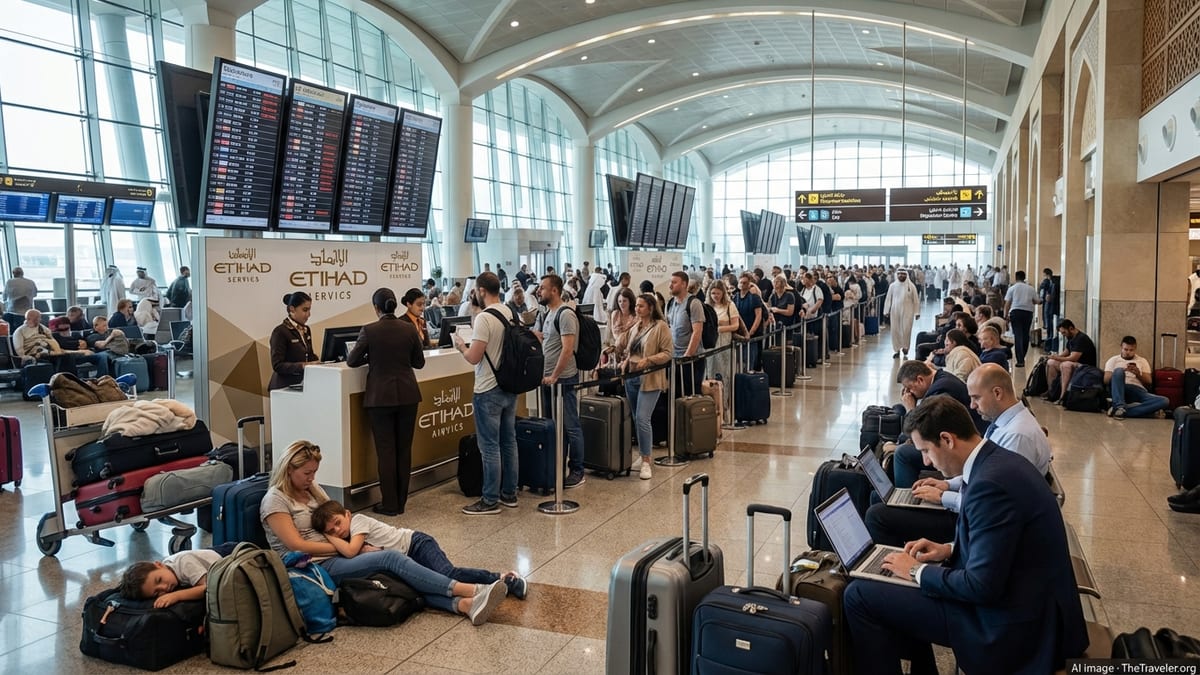
The ongoing route suspensions and diversions are most acutely felt by travellers who rely on Dubai and neighbouring hubs as connection points between Europe, Asia and Africa. Reports from passenger forums and travel agencies over recent weeks describe travellers facing last minute cancellations, multi day delays and re routings via alternative hubs such as Istanbul, Muscat and major European gateways.
Longer detours around closed airspace are also pushing up flight times on many services that do operate, eroding the time savings that have historically made Gulf connections attractive for itineraries linking secondary cities. Some travellers transiting Dubai have reported extended layovers or overnight stays when missed connections cascade through tightly timed bank structures at hub airports.
For those with upcoming trips, travel advisors are urging close monitoring of booking status in airline apps and willingness to accept alternative routings, even when they involve backtracking or additional stops. Flexible ticket conditions introduced during the initial crisis remain in place on many carriers, allowing date changes or rerouting without standard change fees, although fare differences may still apply.
There are concerns that further military escalation or additional missile incidents could trigger rapid new rounds of airspace closures with little warning, as seen in late February. In that scenario, passengers already in transit could again face widespread disruption and unplanned stays in intermediate cities while airlines work through backlog and reposition aircraft.
Outlook for Middle East aviation recovery
Before the latest flare up, data from industry analysts showed Middle East seat capacity approaching or exceeding pre pandemic levels, with Dubai remaining a dominant intercontinental hub. The March shock, combined with the renewed breakdown of the ceasefire in July, has complicated that recovery trajectory by introducing recurring operational uncertainty into one of the world’s most important aviation regions.
Economic studies on the conflict’s aviation impact point to higher fuel costs from longer routings, crew scheduling challenges and aircraft utilisation inefficiencies as key pressure points. Airlines with heavy exposure to Gulf transit traffic face particular strain, while carriers with strong point to point networks outside the affected corridors have been more insulated.
For now, analysts expect airlines to maintain a cautious stance on using higher risk airspace, suggesting that a full restoration of the pre conflict route map will depend not only on ceasefire agreements but on a sustained reduction in perceived military threat. Even if a political deal is reached, many carriers are likely to phase back operations gradually while monitoring insurance conditions and regulatory guidance.
For travellers, that means Dubai and other Middle East hubs will continue to function, but with a more fragile and changeable network than in recent years. Until geopolitical tensions ease decisively, extended flight times, selective route suspensions and short notice schedule changes are expected to remain features of the regional travel landscape.