


More news on this day
Passengers traveling through Manchester Airport are facing another day of disruption today, with live departure boards showing a mix of delayed services, short-notice cancellations and rolling knock-on impacts from earlier schedule issues across Europe.
Get the latest news straight to your inbox!
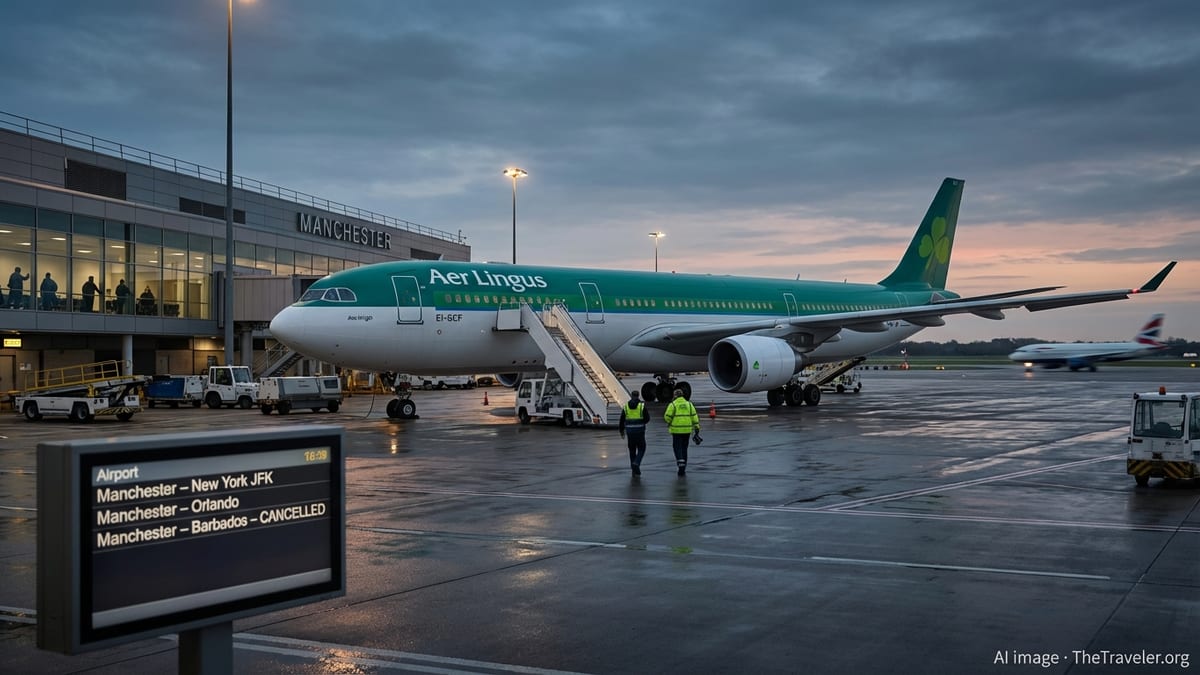
Live picture of delays and cancellations at Manchester Airport
Publicly available departure and arrival boards for Manchester Airport this morning show a familiar pattern for regular travellers, with a cluster of early services running late and several rotations removed from the schedule entirely. Short delays of 15 to 45 minutes are common across a range of European and domestic routes, while a smaller number of flights have been cancelled outright, forcing passengers to rebook or reroute.
Disruption is not concentrated on a single carrier. Low cost operators, leisure airlines and legacy flag carriers all show a mix of late departures and late inbound services. In several cases, aircraft arriving late from overnight or early morning operations appear to be driving subsequent delays on their next legs out of Manchester.
The impact is visible across all three terminals, from short haul flights to nearby European hubs to longer leisure routes to the Mediterranean. While the majority of services are still operating, the uneven on time performance means passengers are being advised through airline channels and airport screens to monitor their individual flight status closely.
Arrivals are also affected, with incoming flights from major European cities landing behind schedule. That pattern adds further pressure to stand availability and turn times for outbound services, increasing the likelihood of rolling delays into the afternoon and evening peak periods.
Weather, congestion and knock on operational factors
There is no single headline event driving today’s disruption at Manchester Airport, such as a runway closure or major power outage. Instead, data and published coverage point to a combination of factors that commonly affect on time performance at busy European hubs, including regional weather patterns, wider air traffic flow restrictions and residual congestion from earlier days.
Across Europe, weather systems and air traffic control constraints can reduce available airspace capacity, triggering holding patterns and departure slot restrictions. When aircraft and crews arrive late on one leg, schedules quickly become compressed, particularly for airlines operating tight turnaround times. That effect is especially visible at airports like Manchester that serve as bases for multiple carriers and handle a high volume of leisure and low cost traffic.
Industry research on flight delays highlights the importance of historical delay rates, congestion and weather in predicting the likelihood of disruption. When those conditions align, even relatively modest issues can spiral into a more noticeable pattern of late running services and occasional cancellations, as airlines work to reset their operations and prioritise certain rotations.
For passengers, the result today is a patchwork of experiences: some flights departing close to on time, others facing manageable delays, and a minority cancelled where schedules can no longer absorb accumulated disruption from earlier rotations.
Airlines reshuffle schedules to stabilise operations
According to live flight information, several airlines using Manchester Airport have adjusted their schedules today, removing selected services or consolidating frequencies where possible. Cancelling a round trip, while disruptive for those booked on it, can help restore stability across a wider network by freeing up aircraft and crew for other flights.
Low cost and leisure carriers in particular often respond to repeated delays by trimming less critical rotations, especially on routes with multiple daily frequencies or strong alternative options for rebooking. That can be seen today on some short haul services, where a cancellation appears alongside other flights on the same route operating with delays but still running.
Legacy carriers linking Manchester with major hubs are also managing tight connection windows. When inbound flights arrive late, airlines may opt to hold some departures for connecting passengers while letting others leave on schedule to protect the broader network. This balancing act contributes to the uneven pattern of punctual and delayed flights showing on Manchester’s boards.
Publicly available information further indicates that ground handling resources and crew duty limits remain important constraints. As busy summer schedules continue, even a small mismatch between planned and actual timings can push some crews toward their regulated duty limits, creating additional reasons to cancel or reschedule specific flights.
What today’s disruption means for passengers
For travellers using Manchester Airport today, the most visible effect of the disruption is additional time spent airside and uncertainty around departure times. Check in and security remain busy during the morning and evening peaks, and passengers whose flights are delayed may find themselves waiting longer at the gate as revised departure estimates are updated.
Public guidance from airlines and consumer agencies consistently stresses the importance of checking flight status before leaving for the airport and again after clearing security. On a day like today, when Manchester’s departures board includes a mix of slight, moderate and more serious delays, real time updates from airline apps and text alerts can be critical for understanding whether a flight is simply running late or at risk of cancellation.
Passengers whose flights are cancelled or heavily delayed may be entitled to rebooking options, meal vouchers or compensation, depending on the circumstances and applicable regulations. While entitlements vary by airline and cause, published consumer guidance notes that travellers should keep records of boarding passes, notifications and receipts if they incur additional expenses as a result of disruption.
Connecting passengers face additional complexity. Those routing through other European hubs from Manchester may see missed or tight connections if their first leg departs late. Airlines generally prioritise longer haul and high demand services when managing these situations, but options can be limited during peak travel periods, making early communication and flexibility particularly important.
How Manchester compares and what to watch in the hours ahead
Manchester Airport is one of the United Kingdom’s busiest aviation hubs outside London, handling a large number of European leisure flights alongside long haul services. That role as a major northern gateway means it can be particularly exposed to wider system pressures on peak travel days, as seen again in today’s pattern of delays and cancellations.
Recent analysis of UK airport performance has noted that Manchester has attracted a higher than average volume of passenger complaints, with delays, crowding at peak times and difficult connections among the recurring themes. Today’s disruptions are likely to reinforce that perception for some travellers, even as many flights continue to operate close to schedule.
Looking ahead to the rest of the day, the key variables for passengers will be how quickly airlines can turn around late arriving aircraft, whether regional weather or air traffic control issues worsen, and how much flexibility remains in crew rosters. If inbound punctuality improves through the afternoon, the airport could see a gradual recovery in on time performance into the evening.
For now, the overall picture at Manchester Airport is one of partial disruption rather than full scale shutdown. Most services are still operating, but today’s delays and cancellations serve as a reminder of how finely balanced airline schedules can be, and how quickly minor issues can ripple through a busy international airport’s operations.