


More news on this day
Flights linking Dubai with Tel Aviv remain suspended in late November 2026 after a flydubai co-pilot allegedly tried to crash Flight FZ1073 on 30 September, leaving Emirates and flydubai refusing passengers whose final destination is Israel and reshaping how travelers route Israel-linked journeys through the Gulf.
Get the latest news straight to your inbox!
From cockpit emergency to suspended Israel services
Flydubai Flight FZ1073 departed Dubai for Tel Aviv on 30 September 2026 and diverted to Tabuk in northwestern Saudi Arabia after a violent incident inside the cockpit. Investigators and multiple official statements describe an alleged attack by the co-pilot on the captain, triggering distress signals, a rapid descent and a diversion, before the aircraft landed safely with no crash and no fatalities reported.
UAE and foreign authorities have treated the case as a serious security and safety incident, and UAE prosecutors have since said the diversion is part of an ongoing terror-related investigation. A preliminary international incident report also lists the event on 30 September near Tabuk, confirming Flight FZ1073 as a Dubai to Tel Aviv service that made an emergency landing in Saudi Arabia.
Later the same day, flydubai announced that it was suspending all flights to and from Tel Aviv while the incident was investigated. A subsequent Israeli government briefing paper noted that on 30 September the airline formally notified authorities it was halting Israel operations, and flydubai’s own online operational updates page continues to list Israel flights as suspended until further notice in late November.
What Emirates and flydubai now allow on Israel-linked itineraries
Following flydubai’s suspension, Emirates confirmed it was terminating its own Dubai–Tel Aviv route and suspending all flydubai codeshare services to Tel Aviv. In a statement carried by local and Israeli media on 30 September and 1 October, Emirates said that “passengers whose final destination is Tel Aviv will not be accepted for travel at their point of origin,” even if their first sector was only a feeder flight into Dubai.
In practice this means that, through late November 2026, Dubai cannot be used as a connecting point on Emirates or flydubai tickets to or from Tel Aviv. Travelers attempting to book itineraries that include Tel Aviv as the final destination or starting point are blocked or must be rebooked via other carriers still serving Israel. The UAE General Civil Aviation Authority separately confirmed on 5 October that it had completed the transfer of stranded passengers to Tel Aviv after flydubai’s temporary suspension, but there has been no public indication that either airline plans to reinstate scheduled Tel Aviv flights imminently.
These restrictions are itinerary-specific. There is no announced blanket ban on Israeli passport holders or travelers who have previously visited Israel using Emirates or flydubai for other routes. For passengers whose journeys do not begin or end in Tel Aviv, Dubai’s role as a global hub remains broadly unaffected, subject to general security and regional conflict-zone advisories.
How other Gulf hubs are handling Israel routes and transit
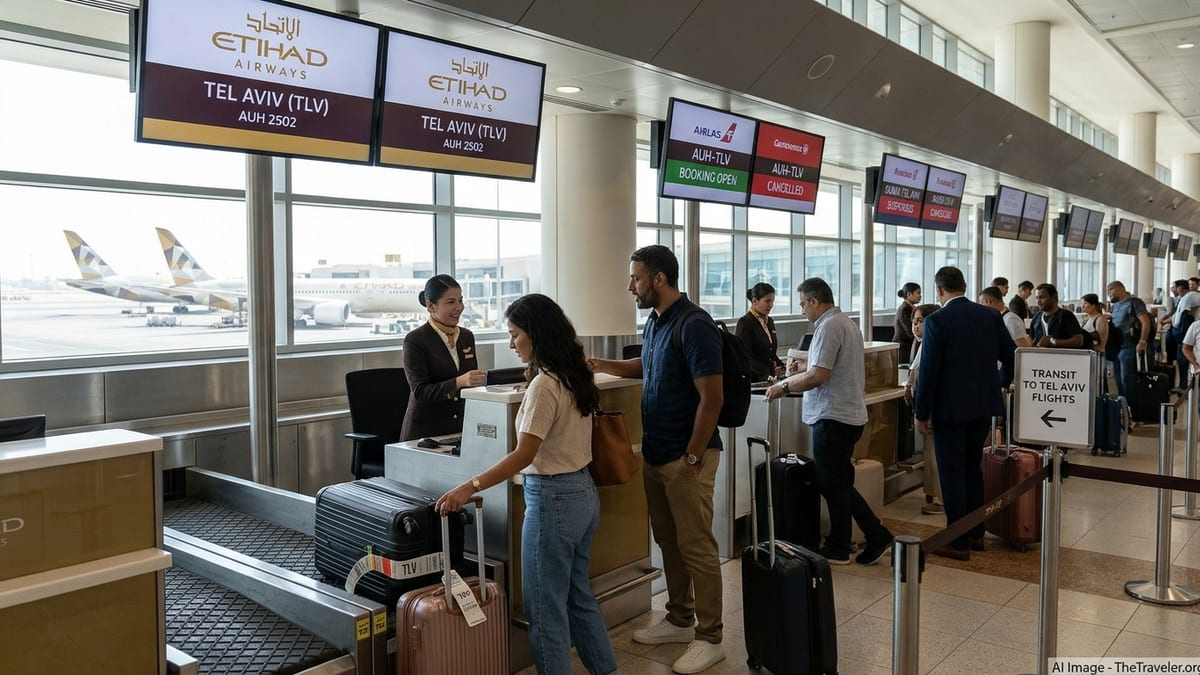
The policy shift in Dubai contrasts with the approach at other Gulf airports. In Abu Dhabi, schedules and third-party timetable data show Etihad Airways continuing to operate multiple daily Abu Dhabi–Tel Aviv flights in November and into December 2026, using Airbus A320 and A321 aircraft. Tel Aviv appears as a standard destination in Etihad’s network, and there has been no comparable public notice refusing passengers whose final destination is Israel.
Qatar Airways, based in Doha, and Gulf Air, based in Bahrain, continue to operate extensive regional and long-haul networks under heightened security guidance related to the wider Middle East situation. While their exact Israel policies vary over time and by bilateral agreement, there is currently no across-the-board advisory from these carriers or their governments mirroring Emirates’ explicit refusal to carry Tel Aviv-bound passengers on any leg.
Saudi airports, including Riyadh and Jeddah, have handled diversions such as Flight FZ1073 into Tabuk but remain open for regular passenger operations. As with other Gulf gateways, Saudi carriers and regulators are adjusting routings around higher-risk airspace rather than closing hubs outright. For travelers, that means options still exist to reach Israel via regional carriers, most notably Etihad and Israel’s own airlines, even as the Dubai–Tel Aviv corridor remains shut.
Conflict-zone advisories and what travelers should check next
The European Union Aviation Safety Agency maintains an active Conflict Zone Information Bulletin for the airspace of the Persian Gulf and Gulf of Oman, updated in mid November 2026, which highlights elevated but managed risks for flights transiting the region. Separate bulletins cover Iran’s airspace. These documents, along with national guidance, influence how airlines plan routings but have not resulted in a general ban on using Gulf hubs such as Dubai, Abu Dhabi, Doha, Bahrain or Muscat for through-travel.
Recent travel advisories from the United States and United Kingdom refer to increased threats linked to Iranian activities and regional tensions, including drone and missile incidents, yet they stop short of prohibiting transit via the UAE, Qatar, Bahrain or Oman. Instead, they advise heightened situational awareness and checking airline status for flights that might overfly higher-risk areas.
Because schedules and security policies are changing frequently after the 30 September cockpit incident, travelers planning trips to or from Israel that previously relied on Dubai should, at the time of booking and again before departure, verify current notices from Emirates and flydubai, confirm that Etihad or other carriers are still operating their chosen routes, and review the latest EASA conflict-zone publications and their own government’s travel advisories for the Middle East.