


More news on this day
East Midlands Railway has urged passengers not to travel on key routes into and out of London after two high-speed trains collided near Bedford on 19 June, causing serious disruption and reports of multiple injuries.
Get the latest news straight to your inbox!
Serious collision on busy London to East Midlands corridor
The collision occurred on the main line between London St Pancras and the East Midlands, near Bedford, one of the busiest intercity rail corridors in the United Kingdom. Early information from rail-focused forums and local reporting indicates that a moving East Midlands Railway service struck the rear of a stationary train on the same line.
Images and video shared online show significant emergency response activity around the site, with multiple fire, ambulance and police vehicles converging on the railway. Witness accounts circulating on social media describe passengers thrown forward by the impact and several people lying on the carriage floor.
Online posts referencing local hospital statements suggest that Bedford Hospital has asked residents to attend emergency departments only for urgent needs, an indication of the scale of the medical response. Precise numbers of injured passengers or staff had not been formally confirmed in public reporting at the time of writing, but several accounts describe serious injuries.
The incident has occurred at a time of generally high demand on intercity routes, compounding the impact on travellers heading between London, Leicester, Nottingham and Sheffield.
Passengers told not to travel as services suspended
Publicly available information on East Midlands Railway’s website and journey planners shows that trains are currently unable to run between London St Pancras and Leicester in the immediate aftermath of the crash. Services on the London to Nottingham, London to Sheffield and London to Corby routes are suspended or heavily curtailed, with long-distance trains unable to pass the affected area near Bedford.
In online updates reproduced by rail industry news outlets, East Midlands Railway is advising customers not to travel on the affected routes while emergency services and rail engineers deal with the incident. Passengers already en route are being warned to expect very long journey times, significant diversions and replacement road transport where this can be arranged.
Other operators using the Midland Main Line, including Thameslink services that normally pass through Bedford, are also experiencing disruption as signalling is blocked and lines are closed around the crash site. Real-time journey planners show widespread cancellations and severe delays extending north and south of Bedford.
Travellers who must complete essential journeys are being advised via public information channels to check live departure boards, consider alternative mainline routes from London, and allow substantial extra time. Many reports suggest that road congestion around Bedford has increased as passengers switch from rail to car, taxi or coach.
Early focus on signalling and train protection systems
Commentary from railway specialists and enthusiasts, shared widely online, points to a likely focus on signalling and train protection systems as investigators begin to examine how two trains came to be on the same section of track. Several posts referencing early coverage in national media state that one East Midlands Railway service came to a stop after a possible issue with the Automatic Warning System, a safety mechanism designed to intervene if a train passes a caution or danger signal.
In normal operation, a stationary train on a main line would be protected by signals and interlocking systems that prevent a following train from entering the same block of track. Discussions among rail professionals online suggest that investigators will be looking at whether any equipment malfunction, human error or a rare type of signalling failure allowed the moving train to approach the rear of the stopped service.
Technical analysis posted by experienced rail users also highlights the role of train speed at the moment of impact, the crashworthiness of the rolling stock involved and the performance of onboard braking systems. East Midlands Railway’s intercity fleet includes both older units and newer high-speed trains, with different front-end designs and safety features that may influence the extent of damage and injuries.
Formal findings from the Rail Accident Investigation Branch are likely to take many months, but initial site work typically begins within hours of a serious incident, running alongside the urgent task of restoring infrastructure and rolling stock to a safe condition.
Major disruption and passenger rights
The collision has effectively severed the main rail link between London and large parts of the East Midlands for much of the day, with knock-on disruption expected to continue into the evening and potentially into the weekend. Timetables are being substantially rewritten at short notice, and some trains are being turned short of their normal destinations to reduce congestion.
Consumer advice services and transport commentators are reminding travellers via social channels that passengers who decide not to travel because of disruption are generally entitled to ticket refunds from their retailer, and that those who attempt journeys but arrive late may qualify for compensation under existing delay schemes. The exact arrangements depend on ticket type and route, but operators typically publish guidance on their websites after major incidents.
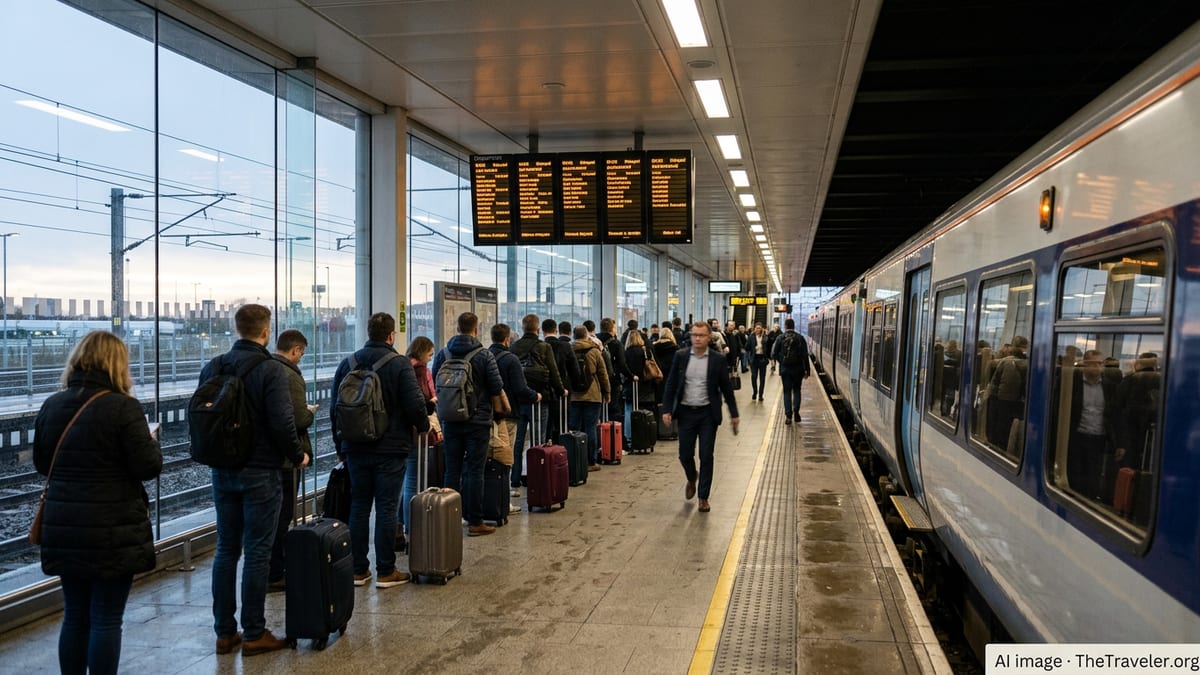
With images of crowded concourses already emerging from central London and key interchange stations, rail user groups are urging passengers to follow station staff instructions, avoid blocking access routes for emergency teams, and make use of remote working options where possible until services stabilise.
Experience from previous rail incidents suggests that even once lines reopen, residual delays can persist as trains and train crews are out of position and speed restrictions remain in place around the crash site. Industry observers therefore expect East Midlands Railway and Network Rail to continue advising caution about non-essential travel on the route for some time.
Safety record and next steps for the network
The crash near Bedford will draw renewed attention to the safety record of Britain’s railways, which remains comparatively strong by international standards despite a series of high-profile incidents in recent decades. Serious collisions between modern passenger trains on main lines are rare events, but they attract intense scrutiny because of the potential for mass casualties.
Transport analysts note that when major crashes do occur, they often lead to significant changes in signalling technology, operational rules or train design. Previous accidents in the United Kingdom have prompted upgrades to automatic train protection, the redesign of level crossings and improvements in crashworthiness standards for new rolling stock.
According to publicly available information, East Midlands Railway operates intercity services linking London with key cities such as Leicester, Derby, Nottingham and Sheffield, as well as regional routes across the East Midlands and parts of northern England. The immediate priority for the operator will be supporting affected passengers and staff, restoring a basic level of service and working with infrastructure managers on recovery.
As the investigation progresses, rail passengers across the country are likely to see continued messaging encouraging early journey planning, the use of live information tools and flexibility in travel times, particularly on the busy London to East Midlands corridor now overshadowed by this latest serious incident.