


easyJet is a fully digital airline, which means your trip usually starts long before you reach the airport. In 2026, most problems and extra fees arise when passengers do not understand the difference between online check in, bag-drop cut offs, security queues and boarding gate closing times. This guide brings together the latest official rules and real-world airport examples so you can check in smoothly, keep your boarding pass safe and avoid missed flights.
Get the latest updates straight to your inbox!
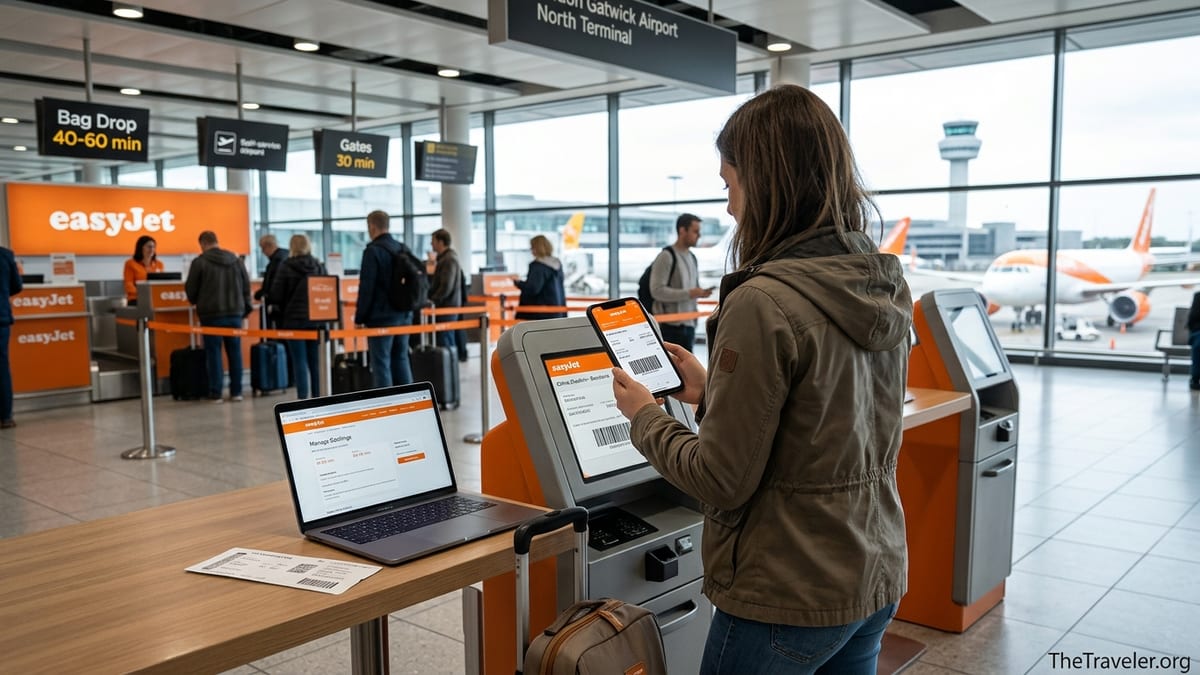
Online check in times and what they really mean in 2026
According to data collated from easyJet’s own check in pages and specialist check in trackers reviewed in late 2026, easyJet online check in normally opens 30 days before departure and closes 2 hours before your scheduled flight time. In practice, a passenger flying from London Gatwick to Barcelona at 13:00 on a Friday can usually check in any time from 30 days before, but must complete check in before about 11:00 on the day of travel. These times are counted back from the original scheduled departure, and easyJet confirms that check in and bag-drop cut offs usually still apply even if the flight is delayed, unless the airline specifically changes them.
Online check in closing 2 hours before departure is separate from both bag-drop and boarding times. For example, if your online check in closes at 11:00, bag drop at Gatwick for the same flight may stay open until 12:00 and your boarding gate may not close until 12:30. Many passengers confuse these steps and assume that as long as they are at security 40 minutes before departure they are safe, which is how people end up arguing at the gate when it has already closed.
Because rules can change, always double-check your specific flight in the easyJet app or under “Manage bookings” on the website in the 24 hours before travel. If a local airport has stricter times, your digital boarding pass and the airport departure screens usually reflect those local rules. Treat the earlier of the two times as the one that matters.
How to check in online via website or app
easyJet strongly encourages all passengers to check in online or in the mobile app. On the website, start at the “Check in” or “Manage bookings” section and enter your surname and either your booking reference or the email address used for the reservation. For example, if a family of four booked London Luton to Faro through a package company, they can still retrieve their easyJet booking directly with the easyJet reference shown on the travel company confirmation.
Once your booking displays, you will be asked to confirm passenger details such as full names, date of birth, contact information and, for some international routes, passport or national ID card details. If you added seats or hold baggage during booking, these will appear automatically. If you need to add a 23 kg hold bag for one passenger, this can usually be done here for a lower price than at the airport, because easyJet’s fees page shows higher “airport bag” charges compared with online pre-booking.
On the mobile app, the flow is similar but optimised for a small screen. After logging in or typing your booking reference, you tap through each passenger, confirm or enter identity details and then tap “Check in”. Many tour operators, such as European package brands that use easyJet flights, now explicitly instruct customers to complete this step in the easyJet app themselves, because it allows them to manage seats, luggage and notifications directly instead of relying on the tour company’s systems.
At the final step, the website or app will generate boarding passes for each passenger. You must complete check in for all people in the booking who intend to travel. If you leave one person unchecked, that traveller will not have a boarding pass and may need assistance at the airport, which can delay the whole group.
Boarding passes: mobile, printed and backup options
easyJet is set up for mobile boarding passes across most of its network. After online check in, the app lets you add each boarding pass to your device wallet or keeps it available offline in the app itself. A couple flying from Manchester to Nice, for instance, can each have a pass on their own phone, or one person can carry passes for both travellers in the same app, which is useful when one partner is less tech confident.
When using mobile passes, ensure your phone is charged and can display a clear barcode. Airport scanners often struggle with cracked screens or very low brightness. Many frequent easyJet passengers take a screenshot of each pass so they can retrieve it quickly even if the app is slow or airport Wi-Fi is poor. This screenshot does not replace the pass in the system, but it makes it faster to present it at security and at the gate.
Printed boarding passes remain accepted at most airports served by easyJet. You can print at home on regular A4 or US letter paper as soon as you complete check in. Some airports, such as Geneva and Manchester, have easyJet self-service kiosks where you can reprint a boarding pass if needed, often near the bag-drop zone. If those kiosks are out of service or not available, staff at an easyJet desk can usually print passes, although you may be asked to queue and you should arrive earlier to allow time for this.
If you cannot download or display a boarding pass because of a technical fault, broken phone or app problem, go to the airline’s bag-drop or customer service desk as soon as you reach the terminal. Explain that you checked in online but cannot access your pass. Agents can typically locate your booking using your passport and booking reference and then print a boarding pass without a separate “airport check in” fee, as recent comparisons of low cost carriers show that easyJet does not currently charge a general airport check in surcharge, unlike some rivals.
Bag drop, cabin baggage rules and airport-specific deadlines
After check in, passengers with hold luggage must use bag drop. easyJet publishes detailed tables of bag-drop opening and closing times by airport. As of mid 2026, typical opening times are 2.5 to 3 hours before departure, with closing times either 40 or 60 minutes before scheduled take off depending on the airport and route. For example, flights from Manchester, London Gatwick, London Luton and Birmingham normally see bag drop closing 60 minutes before departure, while other European airports may close at 40 minutes.
Some airports offer special options. At Manchester Airport, easyJet’s Twilight Bag Drop allows travellers on early-morning flights to drop checked bags between 18:00 and 21:00 the evening before if their flight leaves before about 08:30 the next morning. This is particularly useful for families staying at the airport hotel who want a calmer start with children, or passengers facing long security queues at peak times. Other airports sometimes trial similar evening bag-drop schemes, so it is worth checking your departure airport’s website a week or two before travel.
Cabin baggage rules matter at check in because staff may check bag sizes at the gate and sometimes at bag drop. easyJet’s current standard includes one small cabin bag that must fit under the seat in front. Larger cabin bags for the overhead locker and all hold baggage usually require payment, either as part of a fare bundle such as an Inclusive Plus fare or as an extra. Real travellers regularly report that oversize cabin bags are placed in the hold at the gate with an additional airport bag fee, which is higher than the cost of pre-booking the same luggage online. Measuring and weighing your bags at home is therefore part of a smart check in strategy, not an optional detail.
Because bag-drop and gate deadlines are calculated from the scheduled departure time, not when boarding actually starts, arriving late to either can result in denied boarding even if the aircraft still appears at the gate. A traveller in Glasgow who reaches the bag-drop desk 35 minutes before departure on a route where the cut-off is 60 minutes is likely to be refused, then rebooked on a later flight at their own expense unless the airline has caused the delay.
From security to gate: understanding all the different cut offs
To avoid confusion, think of your journey as a series of deadlines: online check in closes first, then bag drop, then security, then boarding, and finally gate closure before departure. easyJet’s own boarding guidance confirms that boarding gates close 30 minutes before scheduled departure across the network, and both independent guides and airport documents echo this 30-minute gate closure as the critical last cut off.
Security screening is controlled by the airport, not by easyJet. Many European hubs, including London Gatwick, Luton and Geneva, advise passengers on short haul flights to arrive at the terminal about 2 to 3 hours before departure to ensure enough time for queues. In practice, during busy summer Saturdays or school holidays, security waiting times may exceed 45 minutes, especially for families unfamiliar with the process. If you reach the gate after the airline has closed it, the fact that you were “still in the security line” offers little protection.
The scheduled departure time printed on your ticket is not the time you should arrive at the gate. For a 10:00 departure, boarding at many easyJet stations tends to start between 09:15 and 09:30, while the gate officially closes at 09:30. That means the last safe moment to arrive at the gate is usually closer to 09:15 than to 09:29, because boarding may already be in its final stages.
To protect yourself, work backwards from your departure time. For a 07:00 Luton to Amsterdam flight with 60-minute bag-drop closure and 30-minute gate closure, a cautious plan is: reach bag drop by 05:30, clear security by 06:00 and be at the gate before 06:20. Delays earlier in the chain, such as a long queue at the airport train station or bag-drop, then have less chance of triggering a missed flight.
Problems and edge cases: late arrival, wrong details and lost passes
When passengers arrive after bag-drop closes, easyJet staff generally cannot accept hold luggage. In some situations, if you only have cabin baggage that meets size rules and have already checked in online, you may still be allowed to proceed through security and board, as long as you arrive at the gate before it closes. However, if you require bag drop and arrive late, you are typically treated as a no-show. In that case, rebooking is often at the passenger’s expense, although travel insurance may help if an external event, such as a road closure, caused the delay.
If you forget to check in online altogether, airport staff can usually complete check in at a kiosk or desk if there is still time before bag-drop closure. Since easyJet emphasises that it is a “digital airline,” queues at staffed desks can be long, especially at popular bases like Gatwick North Terminal. Recent traveller discussions indicate that while easyJet does not currently apply a specific fee just for checking in at the airport, you lose the convenience and time savings of online check in and you may have fewer seat choices remaining.
When incorrect personal information is entered during online check in, the impact depends on the error. Minor mistakes such as a missing middle name often do not cause problems within Europe if they broadly match your passport. However, if your last name is misspelled or your date of birth or passport number is wrong, you should correct it through “Manage bookings” at least 2 hours before departure or speak to an agent at bag drop. easyJet’s general guidance suggests most changes can be made online up to about 2 hours before departure, and at the airport up to around 60 minutes before, but changes such as full name corrections can involve change fees or even require support through customer service channels.
Lost or inaccessible boarding passes are usually solvable at the terminal. If your phone battery dies while you wait at the gate, gate staff can often look up your booking by name and passport and manually scan you in, though this slows down boarding and is not guaranteed at all airports. Printing a spare copy at home or carrying a second device is the safest fallback for critical journeys, such as early morning flights to international connections.
Families, groups, special assistance and international flights
Families and groups often face extra pressure during check in because they move more slowly through airports. easyJet’s boarding order gives priority to customers who booked “Speedy Boarding” and to families with children under 5, but this priority only helps if you have already cleared security and reached the gate in time. A real-world example from Bristol and Manchester shows families missing flights despite being in the terminal more than 90 minutes early because they spent too long organising at the check in area before joining security queues.
For groups booked together, one organiser can usually check in everyone under the single easyJet booking reference. It is wise for each adult to keep their own boarding pass on their phone or on paper, while one adult manages the passes for children. If a group is split in security, this avoids the situation where one person with all the passes is stuck behind while others are cleared to go ahead.
Passengers needing special assistance should request it at the time of booking or as early as possible, ideally no later than 48 hours before departure, through the special assistance options on the easyJet website or app. easyJet’s 2025–2026 customer journey documents explain that assistance customers are boarded first at the gate, ahead of Speedy Boarding and families, when they are present on time. Airport staff can help escort you from check in or a designated meeting point through security to your gate, but these services are often provided by the airport rather than easyJet itself, so procedures vary by country.
On international routes, document checks at the gate are more frequent. Flights from the United Kingdom to non-Schengen destinations such as Egypt, Morocco or Israel may include an extra passport or visa verification point before boarding. At some of these airports, easyJet’s own tables show stricter bag-drop or gate cut offs, often 60 minutes before departure for bag drop, to account for these checks. Always allow more time if you need a visa check, have an onward connection on a separate ticket or are unfamiliar with local border arrangements.
Third party bookings and when airport help is available
Many travellers now book easyJet tickets through online travel agencies, tour operators or corporate booking tools. Even if you booked through a third party, easyJet still expects you to use its own website or app for check in. Your agent’s confirmation should include the six-character easyJet booking reference. For instance, a customer who buys a ski package to Geneva through a major European tour operator will typically receive an email stating “operated by easyJet” along with an airline reference that can be entered directly at easyJet check in.
Airport help is usually available at easyJet bag-drop desks and, at some bases, separate customer service counters. These desks can assist with issues such as reprinting boarding passes, confirming seat allocations, adding last-minute hold luggage, or dealing with errors in names or dates of birth. However, they are not a full replacement for advance check in. During peak summer weekends, queues at these desks may exceed 30 to 45 minutes at busy bases like Gatwick or Manchester, effectively consuming the time you thought you were saving by not checking in the night before.
As of late 2026, there is no widely advertised flat fee just for checking in with an agent at easyJet airports, unlike the explicit “airport check in” fees used by some rival low cost carriers. Charges are more likely to arise from added services such as paying for an additional hold bag, changing the name on a ticket, or upgrading to a seat with extra legroom. Several traveller reports from UK airports confirm that agents can help produce boarding passes without additional payment where the passenger has a valid booking and is within check in deadlines.
For complex issues, such as disputed spelling differences between your ticket and passport or a problem with a child’s travel consent documents, front line staff may need to call supervisors or central support teams. This takes time, so you should arrive earlier than usual if you expect any document discussion at the airport, especially for international flights outside the European Union or Schengen Area.
Airport deadline comparison, troubleshooting checklist and key answers
A useful way to visualise easyJet’s timing rules across airports is to compare a few common examples. At London Gatwick, official guidance and summary tables indicate that bag drop usually opens about 2.5 hours before departure and closes 60 minutes before, while the gate closes 30 minutes before. Manchester Airport publishes similar timings, with the added option of Twilight Bag Drop for early flights. At Geneva, airport information shows easyJet passengers can use self bag-drop machines with slightly different opening and closing times, often with a 50-minute bag-drop closure and the same 30-minute gate closure noted in easyJet’s boarding guidance.
When planning your own flight, start with four numbers: online check in closure 2 hours before departure, local bag-drop closure (40, 50 or 60 minutes before), boarding gate closure 30 minutes before, and your personal “arrive at airport” time, typically 2 to 3 hours before for European short haul. Adjust these based on your situation: add time if you have children, mobility needs, checked bags or a high-risk connection later that day. For a simple, hand-luggage-only trip on a quiet midweek afternoon, you might be comfortable arriving at a regional airport 90 minutes before departure, but that would be risky on a school-holiday Saturday at a large hub.
If something goes wrong with check in, run a quick troubleshooting checklist. First, verify that the name and booking reference you are entering match your confirmation exactly, and check that online check in is still open for your flight. Second, try both the website and the app, and switch between Wi-Fi and mobile data. Third, if you still cannot check in but are within 2 hours of departure, head to the airport early and ask at an easyJet desk, explaining that online check in failed and showing screenshots or error messages if possible. These steps do not guarantee a fix, but they improve your chances of being checked in without added stress.
Common passenger questions have practical, time-based answers. If you miss online check in but arrive at the airport 2 hours before departure, you can usually still be checked in at a desk if bag drop has not yet closed. If you lose your boarding pass but have your passport and booking reference, staff can generally reissue it, although it may require waiting in a queue. If your personal details are slightly wrong, try to correct them online; if you cannot, bring printed proof of your booking and allow time for a conversation at bag drop. Above all, remember that each deadline is separate and none of them automatically shift just because you are already inside the terminal.
By understanding easyJet’s current check in rules in 2026, planning around your departure airport’s specific times and building a small safety margin into your schedule, you can dramatically reduce the risk of missed flights and unexpected costs. Combine early online check in, clear boarding pass backups and realistic expectations about security and boarding queues, and your easyJet journeys will usually start with a relaxed coffee in the departure lounge instead of a sprint down the concourse to a closed gate.