


Elia Beach on Mykonos is often described as the island in microcosm: glam but relaxed, family friendly yet famously gay and nudist tolerant, organized but still with pockets of quiet. For first-time visitors, it can be hard to picture how all of that fits on one long curve of sand. This guide breaks down what families, couples and solo travelers can actually expect at Elia today, with concrete details on prices, services, transport and the on-the-ground atmosphere.
Get the latest updates straight to your inbox!
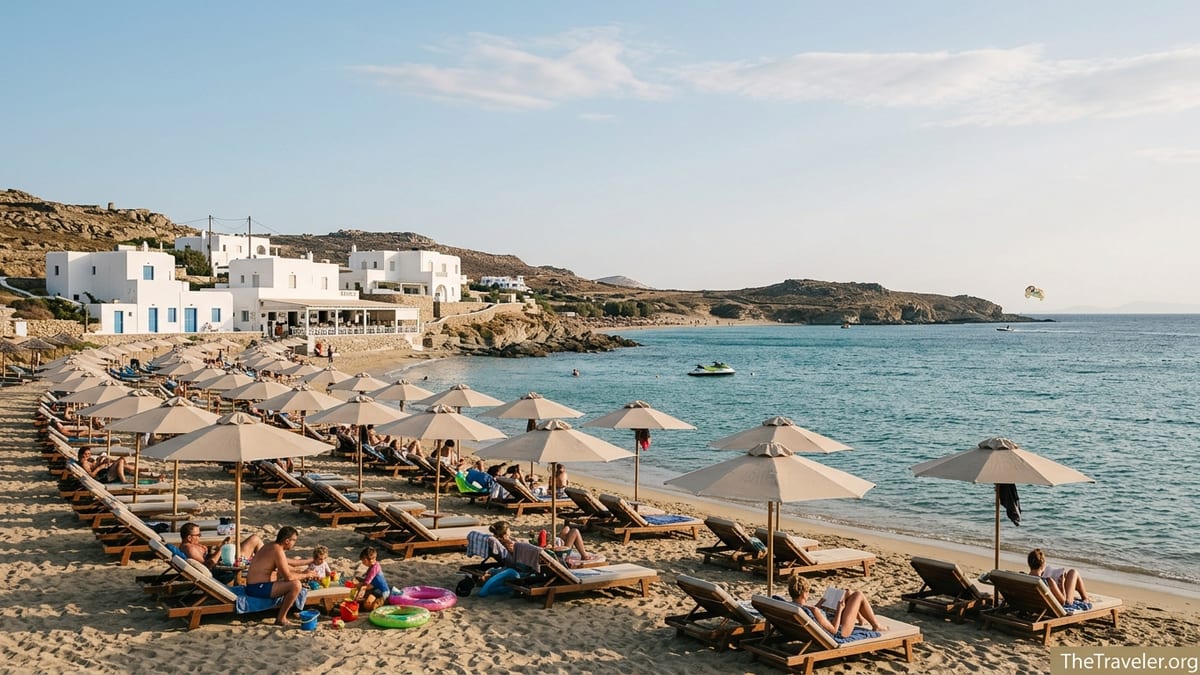
Getting Oriented: The Look, Feel and Layout of Elia Beach
Elia sits on the southeastern coast of Mykonos, around 10 to 11 kilometers from Mykonos Town, and is widely cited as the island’s longest continuous stretch of sand. In practice, that means a broad bay of light golden sand with room for several clusters of sunbeds, a few beach clubs and restaurants, plus small free sections where you can just throw down a towel. Behind the beach rise low, rocky hills dotted with whitewashed villas and hotels, so the setting still feels more natural than some of the island’s denser resort areas.
The sea here is textbook Cyclades: clear, intense blue that turns turquoise in the shallows. The bay is relatively sheltered and, compared with windier northern beaches, usually offers calm, swimmable water. Visitors in recent seasons commonly describe the entry as a mix of soft sand and small pebbles at the shoreline, then a flatter rock or hard sand base once you are a step or two in, which is easier on the feet than it sounds and actually makes standing in the water comfortable.
The main organized zone stretches in front of beachfront hotels such as Elia Mykonos Resort and Arte & Mare Elia Suites, where the sand is tightly lined with parasols and sun loungers. Walking to the far right, toward Agrari, the layout becomes progressively quieter and more informal, with scattered umbrellas and then wilder rocky coves. That gradual change along the bay is what allows Elia to serve very different travelers at the same time.
Sound-wise, Elia falls somewhere between sleepy cove and full-on club beach. There is music from the beach bars, particularly around midday and afternoon, but compared with the constant party vibe at Paradise or Super Paradise, most visitors describe it as more relaxed, with volume that still allows normal conversation. This balance is one reason it attracts families and couples who want atmosphere without chaos.
Prices, Sunbeds and Eating on the Beach
For most visitors, a day at Elia revolves around renting sunbeds. Because prices change by season, row and operator, you should expect a range rather than a fixed number. Reports from 2025 into early 2026 suggest that two loungers with an umbrella in the main organized sections typically run from around 40 to 80 euros per set in high summer, depending on proximity to the water and the level of service. Front-row beds operated by hotels or higher-end beach clubs are usually at the top of that range, while fourth or fifth rows, or smaller independent sections, can be significantly cheaper.
Many families are surprised to discover that children are often expected to have their own paid lounger if they are going to occupy one, even if they are very young. On busy August days, staff may insist that every person on a bed is counted for the set price, so parents who are happy to share a lounger themselves sometimes opt to keep kids mostly on towels and in the sand to avoid extra cost. If you arrive later in the afternoon, particularly after 3 or 4 pm, travelers routinely report that attendants are more willing to negotiate lower prices on remaining rows.
If you want to avoid sunbed fees altogether, there are small free sections at either end of the main organized zone where you can use your own towel or travel umbrella. These fill quickly during peak season but can be ideal for budget-conscious solo travelers or couples who do not mind sitting slightly away from the serviced areas. You can still walk a few steps to order takeaway coffees, water or snacks from nearby kiosks or restaurants.
Food and drink options range from hotel-run beach restaurants to simpler tavern-style spots set just off the sand. A typical late-morning coffee might cost 4 to 6 euros, a 0.5-liter bottle of water around 1 to 2 euros from a mini market and more from beach service, and a casual lunch of a Greek salad plus grilled chicken or calamari can run 18 to 30 euros per person before drinks. More upscale venues with sea-view terraces may charge slightly higher prices for dishes like lobster pasta or fresh fish by the kilo, which couples often reserve for a lingering sunset lunch.
Atmosphere by Traveler Type: Families, Couples and Solos
Elia has a reputation as a mixed-use beach, and that is accurate on the ground. Families with children cluster mostly around the center-left portion of the bay, where hotels, lifeguard presence in high season and easier access from the parking area create a more conventional resort feeling. Here you will see kids building sandcastles, teenagers queuing for jet skis and parents lounging within quick reach of restrooms and shaded restaurant seating.
Couples gravitate toward both the organized middle zones and the slightly quieter rows closer to the rocky ends of the bay. Many choose Elia because it offers sunbed and bar service, background music and a sociable but not overpowering crowd. A pair might spend the morning under an umbrella enjoying iced coffees, then take a shared parasailing ride in the early afternoon, and finish with cocktails from one of the hotel bars while the light softens on the water. It is a natural fit for honeymooners who like the idea of Mykonos but do not want to be locked into an all-day party scene.
Solo travelers will find Elia welcoming but should be aware of its different micro-zones. The central sections are good if you enjoy people-watching and chatting with neighboring loungers; staff are used to solo guests and will usually place you wherever a single bed fits, though on busy days you may need to take a bed in a back row. Solo visitors looking for a more social, LGBT-oriented vibe often continue to the right-hand side of the beach, where the rainbow flag usually marks the area most popular with gay travelers and nude sunbathers. The etiquette there is relaxed and friendly, but as with all beaches, respect for personal space and local norms is expected.
In the height of summer, Elia can feel busy but rarely as tightly packed as the smaller, more famous party beaches. If you are traveling with a stroller, elderly parents or anyone who prefers not to navigate through dense crowds, this more spacious layout can make a real difference. Conversely, solo travelers set on meeting lots of new people might prefer to time their visit for late afternoon, when groups return from town and the beach becomes more animated.
Nudist and LGBT-Friendly Sections: What to Expect in Practice
Elia is widely described as Mykonos’s main gay and nudist-friendly beach. In practice, that does not mean the whole bay is clothing-optional or majority gay, but rather that certain parts, particularly toward the far right end as you face the sea, have evolved into spaces where nudity and same-sex couples are common and generally unremarkable. You will often see a rainbow flag planted in the sand or flying near informal sunbed sections that cater specifically to this crowd.
For families and more conservative visitors, it helps to understand that the main organized central area, closest to the parking and bus stop, typically skews mixed and mostly clothed, with many straight couples and families. Nudity is less common there, and when it does appear, it tends to be discreet topless sunbathing rather than full-body exposure. As you walk further right, past the main rows of loungers and onto the rocks and smaller coves, you will encounter more nudity and a higher proportion of gay men, particularly in July and August.
If you are part of the LGBT community or simply prefer a clothing-optional experience, these right-hand coves offer a comfortable environment where holding hands, kissing a same-sex partner or sunbathing nude is treated as normal. Some visitors describe Elia’s gay section as having a sociable beach-club energy without the heavy club soundtrack, with groups mixing in the water and at nearby pop-up bars. Most travelers report feeling safe and welcome, whether arriving alone, as a couple or with friends.
Whichever part of the beach you choose, local law still applies: public behavior that would be considered explicit anywhere else is not tolerated on Elia either. Discreet photography is acceptable, but pointing cameras at strangers, especially nude sunbathers, is strongly frowned upon. As a practical tip, if you are traveling with children and would like to minimize encounters with nudity, simply stay toward the central and left-hand sectors and avoid walking the rocky path toward Agrari.
Water Sports, Activities and Day Planning
Elia is one of the best-equipped beaches on Mykonos for water sports. The long, relatively sheltered bay and clear water make it an ideal base for both high-speed activities and calmer options like paddleboarding. A dedicated water sports center operates from the beach, offering jet ski rentals, wakeboarding and waterskiing behind specialist boats, parasailing, flyboarding and various inflatable rides such as bananas, rings and sofas. The operators emphasize licensed instructors and safety gear, and you are typically given a short briefing before setting off.
Prices vary by season and exact activity, but travelers in recent years report jet ski rides starting from roughly 40 to 60 euros for a short shared session, with longer or solo high-performance runs costing more. Parasailing, a popular choice for couples, tends to be priced per flight rather than per person, which can be cost effective if you go up as a pair. Families often choose more budget-friendly inflatables, which give children the thrill of speed and splashing at a lower cost per head, especially if several kids share one ride.
Aside from motorized sports, the calm water and gently sloping seafloor are well suited to swimming and snorkeling. While you will not find coral reefs, the rockier patches at either end of the bay shelter small fish and sea life that children enjoy spotting with basic masks. Many visitors bring their own snorkel gear to avoid rental fees, packing compact sets in carry-on luggage for island-hopping.
A typical day plan might look like this: arrive by mid-morning to secure reasonably priced sunbeds in a preferred zone, break up the late-morning heat with a short jet ski or paddleboard session, enjoy a long lunch at a beachfront restaurant, then shift to relaxed swimming and reading through the afternoon. Couples may stay until early evening to watch the light change over the bay, while families with younger children often leave a little earlier to avoid late-day tiredness and the slightly livelier mood that builds after 4 or 5 pm.
How to Get to Elia and Practical Logistics
Reaching Elia is straightforward by public bus, water taxi or car. From Mykonos Town, buses to Elia typically depart from the Old Port or northern bus station, with more frequent services in high summer. The ride takes roughly 20 to 30 minutes, passing through the inland village of Ano Mera before descending to the bay. Tickets are sold at kiosks or on board, and bus travel is usually the cheapest and most predictable option, especially in July and August when road traffic and demand for taxis peak.
Another scenic way to reach Elia is via the south-coast water taxi that connects beaches like Platis Gialos, Paraga, Paradise, Super Paradise, Agrari and Elia. In recent seasons, day passes have typically cost around 20 euros per person for unlimited hops, with single rides cheaper. Boats run regularly during the main part of the day when the weather permits, and arriving by sea gives a striking view of the cliffs and coves that is hard to appreciate from the road. This option works especially well for couples and solo travelers who want to try a different beach in the morning and finish the day at Elia.
If you rent a car, scooter or ATV, you can drive to the large parking area behind the beach. However, parking near many Mykonos beaches can be crowded in peak months, and maneuvering larger vehicles in tight spaces takes patience. Families traveling with car seats or a lot of beach gear often still choose a rental car for door-to-beach convenience, but it is wise to arrive early in the day to find a comfortable spot and avoid parking stress.
On arrival, you will find basic facilities behind or close to the sand: restrooms associated with beach clubs and restaurants, outdoor showers to rinse off salt, and small shops or kiosks selling sunscreen, hats, inflatable toys and bottled water. Card payment is widely accepted across Mykonos, but for sunbed rentals and small snack purchases it is still practical to carry some cash, since card terminals occasionally struggle with connection on busy days.
Seasonality, Wind and When Each Traveler Type Will Be Happiest
Like the rest of Mykonos, Elia’s character shifts with the seasons. In late May and June, the beach is usually quieter, with milder temperatures and more availability on sunbeds and in hotels. Couples who prefer a laid-back ambiance and solo travelers who want space to read or work between swims often find this the ideal time. Sunbed and room prices can be noticeably lower than in late July or August, though they are still higher than on many other Greek islands.
High summer, roughly late June through August, is peak season. The sand fills with a mix of families on school holidays, groups of friends, gay travelers and day-trippers from cruise ships or neighboring islands. The atmosphere is energetic and social without usually tipping into the full party mode seen at beaches like Paradise. Families will appreciate the full range of water sports, lifeguard presence and kids’ company, but should also be ready for higher prices, stronger sun and later-night noise drifting from bars.
September often delivers some of the best conditions for Elia. Sea temperatures remain warm, winds can be a little softer and crowds start to thin, while most services and water sports centers continue to operate on full or nearly full schedules. This shoulder season sweet spot suits couples and solo travelers looking for a more adult-oriented beach experience, with fewer very young children and slightly calmer evenings. By October, services start winding down, and some beach clubs pack up loungers entirely, turning the bay into a much quieter, more local-feeling place.
Wind is an important factor on Mykonos, known as the island of the meltemi. Elia’s position on the south coast offers some shelter compared with open north-facing beaches, but breezy days are still common. On moderate wind days, travelers often appreciate the natural cooling effect. When gusts become strong, sand can whip around the loungers and swimming may be less comfortable, particularly for small children. Checking the wind forecast the night before can help you choose which days to dedicate to Elia versus more protected coves elsewhere.
The Takeaway
Elia Beach brings together many of the strands that define modern Mykonos: polished beach-club comforts, clear water and water sports, a live-and-let-live approach to nudity and sexuality, and just enough space that families, couples and solo travelers can all carve out their own corners. Families can expect well-organized facilities, gentle water and plenty of activities, albeit at prices that reward early planning and a realistic budget. Couples will find a setting that is romantic without being secluded, with several spots to linger over a long lunch or a drink by the sea.
Solo travelers, whether straight or LGBT, benefit from Elia’s open social scene and the clear division between quieter central zones and more overtly gay, clothing-optional sections toward the right. The key is to understand the beach’s layout, seasonal rhythms and transport options so you can match Elia’s many micro-environments to your own comfort level and priorities. With a little planning, Elia can be more than just a day trip from town: it can become the place where your version of Mykonos finally clicks into focus.
FAQ
Q1. Is Elia Beach suitable for young children?
Yes, many families bring young children to Elia. The sea usually shelves gradually and is relatively calm, and the central area offers organized loungers, nearby restrooms and easy access to food. Parents should still supervise closely, especially on windier days or when water sports traffic is heavier.
Q2. How expensive are sunbeds at Elia Beach?
Prices change by season and row, but in recent years a set of two loungers with an umbrella in the main organized areas has often cost roughly 40 to 80 euros in high summer. Back rows and smaller independent operators may offer lower prices, especially later in the afternoon.
Q3. Do I have to rent a sunbed or can I just use a towel?
No, you do not have to rent a sunbed. There are small sections at either end of the main organized zone where you can lay your own towel for free. These fill more quickly, so arrive earlier in the day if you prefer to avoid rental costs.
Q4. Is Elia Beach really a nudist and gay beach?
Elia is mixed. The central portions are mostly textile and attract a broad crowd, including many families and straight couples. The far right-hand side, toward the rocks and coves, is where you will find a more clearly gay and nudist-friendly scene, especially in July and August.
Q5. What is the best way to reach Elia from Mykonos Town?
The most practical option for many visitors is the public bus from Mykonos Town’s northern bus station, which usually runs regularly in summer and takes about 20 to 30 minutes. Alternatively, a south-coast water taxi connects Elia to other beaches such as Platis Gialos and Super Paradise, combining transport with a scenic boat ride.
Q6. Are there affordable food options on Elia Beach?
Yes. While some hotel restaurants are upscale, there are also simpler tavern-style spots and kiosks offering snacks, salads and grilled dishes. Expect to pay mid-range Mykonos prices, with casual lunches often around 18 to 30 euros per person before drinks.
Q7. What water sports are available at Elia?
Elia hosts a full-service water sports center, typically offering jet skis, waterskiing, wakeboarding, parasailing, flyboarding and various inflatable rides. Calm water also makes the bay suitable for swimming, basic snorkeling and paddleboarding.
Q8. When is the best time of year to visit Elia Beach?
June and September are often ideal, with warm water, active services and somewhat lighter crowds than late July and August. Families tied to school holidays may prefer peak summer for the liveliest atmosphere, while couples and solo travelers often enjoy the slightly calmer shoulder seasons.
Q9. Can I find shade if I do not rent an umbrella?
Natural shade is limited because the beach is open and the surrounding hills do not cast large shadows onto the sand for much of the day. If you are not renting an umbrella, consider bringing a compact travel sunshade or planning your visit for morning or late afternoon to avoid the harshest midday sun.
Q10. Is Elia Beach noisy or more relaxed compared with other Mykonos beaches?
Elia generally feels more relaxed than the island’s famous party beaches like Paradise and Super Paradise. There is music from beach bars and a social buzz, especially in the afternoon, but most visitors find it possible to talk comfortably and read a book without feeling overwhelmed by noise.