

More news on this day
Emergency services are attending the scene of a collision between two passenger trains near Bedford in central England, an incident that has halted major rail routes north of London and prompted a large-scale response late on Friday.
Get the latest news straight to your inbox!
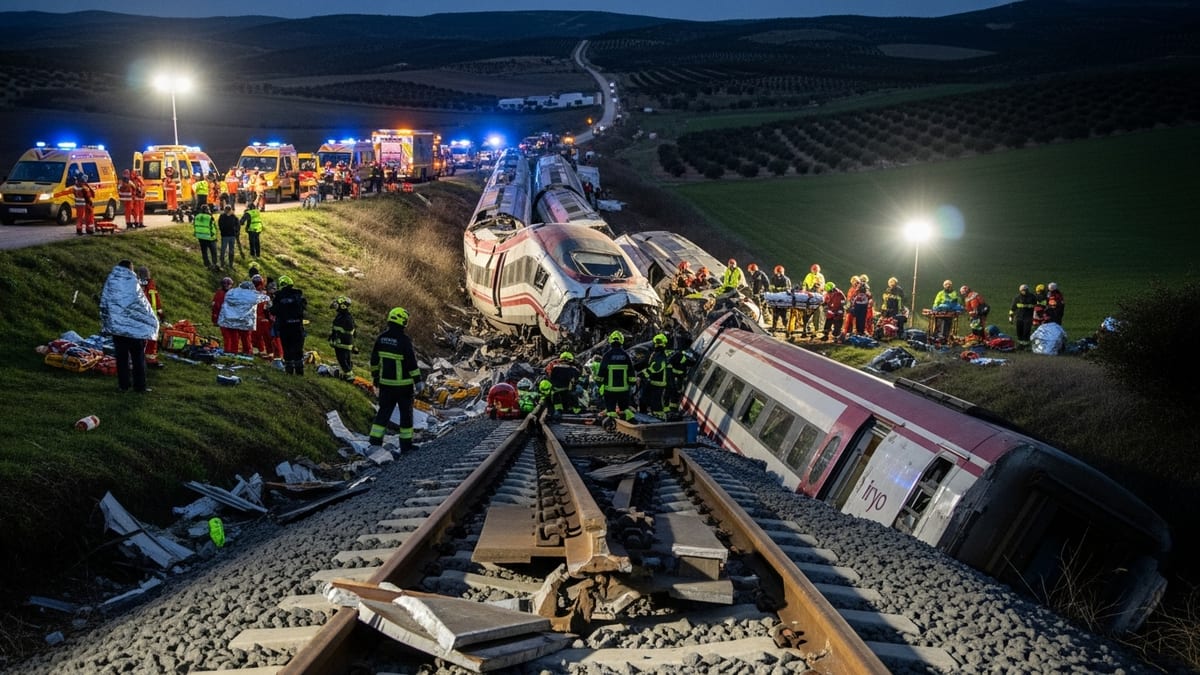
Collision on busy London to Midlands corridor
Initial reports indicate that the crash occurred on the main line linking London St Pancras with towns and cities in the East Midlands and South Yorkshire, on a stretch of track just south of Bedford. The line is one of the country’s busiest northbound corridors, carrying high-speed and commuter services between the capital and destinations including Leicester, Nottingham and Sheffield.
Coverage from national and regional outlets describes two East Midlands Railway services involved in the incident, with one train believed to have struck the rear of another on the approach to Bedford. Early images from the scene show both trains upright but visibly damaged, with crumpled ends and shattered glass, and at least one carriage reported to have partially derailed.
The collision occurred in the early evening, a peak travel period for commuters and long-distance passengers heading out of London. Published accounts describe a sudden jolt and rapid deceleration inside the carriages, with travellers thrown from their seats as luggage and fittings were dislodged.
Rail operations data shared in rail enthusiast communities suggests that one of the trains had been delayed and came to a stop before being struck from behind, but the exact sequence of events remains under investigation. There is no official confirmation yet of the speeds involved at the moment of impact.
Major emergency response and reports of multiple casualties
Publicly available information shows that a significant multi-agency response has been deployed to the crash site. Bedfordshire Fire and Rescue Service announced that crews were sent after receiving reports of a collision involving two trains in the Bedford area shortly before 6:45 p.m. local time. Ambulances, air ambulances and police units have also been observed at and around the scene.
Images circulated on social media and in early news photography show passengers being treated beside the tracks and on station platforms, some with dressings to head and facial injuries. Several people appear to have been assisted away from the trains on foot, while others have been moved on stretchers toward waiting ambulances.
Local hospital planning information referenced in press coverage indicates that Bedford’s main hospital was placed on heightened alert to receive a large number of casualties, with preparations reportedly made for scores of potential patients. As of the latest updates, detailed figures on injuries and any fatalities have not been formally released.
Rail accident specialists have been dispatched to the area to begin gathering evidence. The Rail Accident Investigation Branch has confirmed that inspectors are on site to examine the condition of the rolling stock, the layout of the track and signalling, and data from onboard recorders.
Severe disruption to rail travel for passengers
The two-train collision has caused extensive disruption for rail travellers across a wide stretch of central and eastern England. Service updates from East Midlands Railway and other operators report that all lines between London St Pancras and key junctions to the north are currently blocked while emergency operations and safety checks continue.
Long-distance services to and from Nottingham, Sheffield and other destinations on the Midland Main Line have been cancelled or heavily delayed, with trains terminated short of the affected section or redirected where diversions exist. Rail operators are advising passengers not to attempt to travel on the route this evening unless journeys are absolutely essential.
Replacement road transport is being arranged in some areas, although congestion on nearby roads and limited coach availability are constraining options. Travellers stranded at stations along the route have been advised in public updates to expect significant waits and to check for the latest information before starting journeys.
The incident also has knock-on effects for connecting services in London and beyond, as trains and crew are displaced from their planned diagrams. Timetables for the remainder of the evening and into the weekend are expected to be revised while the damaged trains are recovered and infrastructure is inspected.
Investigators focus on signalling and train protection systems
With two passenger trains coming into conflict on a heavily signalled main line, early attention from rail specialists is turning to how multiple layers of protection may have been breached or failed. The UK’s main intercity routes are designed with modern signalling and train protection systems intended to prevent a train from entering an occupied section of track.
While it is too early for any firm conclusions, rail safety commentators note in public discussion that investigators are likely to examine whether there were any technical faults with signals, track circuits or onboard safety equipment, as well as any issues related to operating procedures or human performance. The position of the trains, braking distances and recorded speed profiles will be central to that analysis.
The collision comes at a time when rail safety remains a highly sensitive topic, following several recent international incidents involving rear-end and side collisions. Comparisons are already being drawn in specialist forums with previous investigations where combinations of signalling issues, communication breakdowns and operational decisions contributed to accidents.
For now, officials responsible for the national rail network are emphasising, through written public statements, that a thorough, methodical investigation will be carried out. Any interim safety recommendations are expected to be shared with train operators and infrastructure managers as soon as patterns or potential risks are identified.
Passengers recount moments of impact and escape
Accounts shared with broadcasters and on social media by those on board give a sense of the shock inside the trains at the moment of impact. Several passengers describe being thrown forward as the train suddenly lurched, with some comparing the force to an explosion as windows shattered and ceilings panels shifted.
Photographs from inside one of the trains show debris scattered across the floor and seats twisted out of alignment. Passengers report using emergency hammers to break remaining glass and assisting each other to reach vestibule areas and doors. In some accounts, individuals with first aid training stepped in to help those with visible injuries while awaiting paramedics.
Others describe a tense wait in darkened carriages before being guided along the track to a place of safety. Many travellers have spoken of their gratitude for the calm response of fellow passengers and railway staff, as well as for the rapid arrival of emergency crews visible from the train windows within a relatively short time after the collision.
As daylight fades, work continues at the site to account for everyone on board and to stabilise the damaged rolling stock. For passengers and local communities around Bedford, the incident has turned a routine rail journey into a stark reminder of the importance of robust safety systems on some of Britain’s busiest tracks.