


More news on this day
Emergency services and rail teams mounted a large response on Friday, June 19, after two passenger trains collided on a main line near Bedford in central England, disrupting travel on one of the country’s busiest intercity corridors.
Get the latest news straight to your inbox!
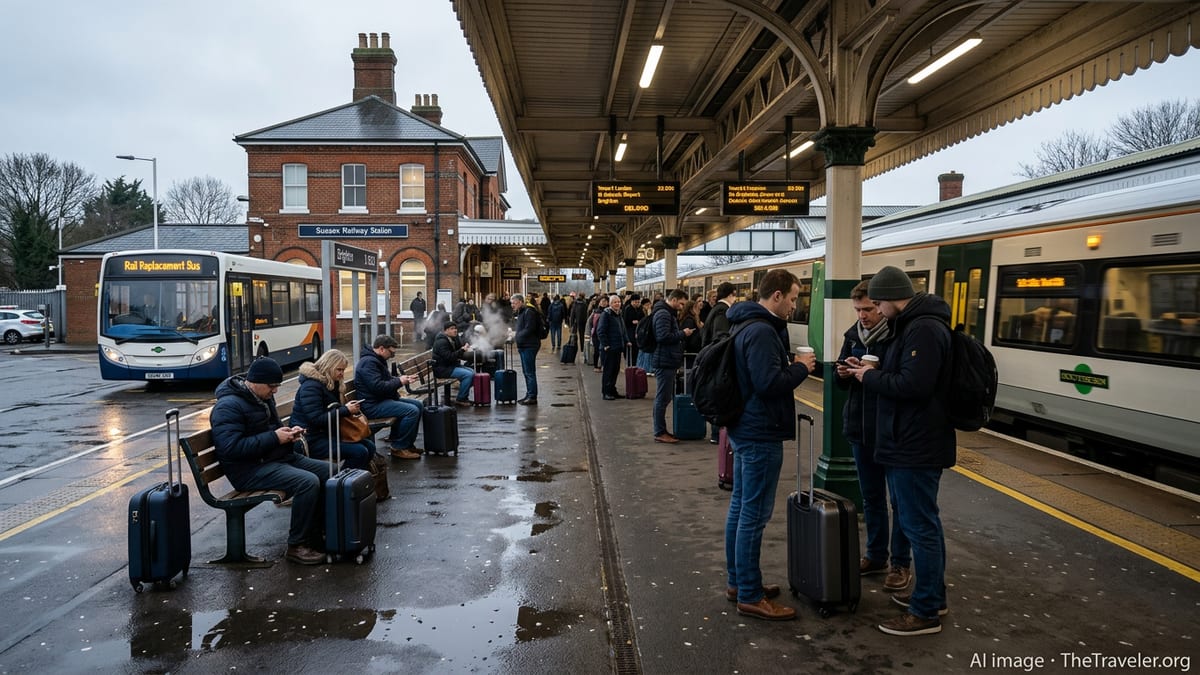
Collision on main route north of London
Publicly available information indicates that the collision occurred on the Midland Main Line just south of Bedford, on tracks linking London St Pancras with destinations including Leicester, Nottingham and Sheffield. The incident involved high speed services operated by East Midlands Railway and a Luton Airport Express service, both running on the electrified route that carries thousands of passengers each day between the capital and central England.
Initial reports suggest the impact took place in the early evening, around the peak period when commuters and leisure travelers rely heavily on the corridor. Images and video shared on social media show two trains stopped on the line with visible damage to the front of at least one unit, as well as a significant presence of emergency vehicles positioned alongside the tracks.
Local news coverage and passenger accounts describe a low to moderate speed collision, with some travelers inside the carriages knocked from their seats as one train apparently struck the rear of another. While the exact sequence of events remains the subject of official investigation, the crash occurred on a portion of line that is normally governed by modern signaling and train‑protection systems designed to keep trains separated.
The section where the trains came together is a key artery not only for long‑distance East Midlands services, but also for airport‑bound traffic serving Luton Airport Parkway. Any extended closure or capacity reduction on this stretch has an immediate knock‑on effect for both regional and international journeys.
Large emergency operation and early injury reports
According to publicly available reports, police, fire and ambulance services were deployed in large numbers to the scene within minutes of the first calls. Images circulated by passengers show paramedics working alongside firefighters and police officers on trackside embankments, with temporary triage areas established close to the stopped trains.
News agency coverage indicates that some passengers sustained head injuries and possible fractures, with individuals seen leaving the scene with visible bandages and supported by medical staff. Local hospital services were placed on alert for a potential influx of patients, although as of Friday evening there were no confirmed figures on the total number of injured or the severity of all cases.
Rescuers appeared to focus initially on stabilizing the trains, assessing structural damage to the carriages and ensuring power to the overhead lines was isolated before moving passengers to safety. Once the area was secured, travelers were escorted along the tracks to safe access points where buses and taxis could be arranged, a standard procedure on busy electrified routes.
Social media clips from inside one of the trains shortly after the impact show shaken passengers assisting one another, with luggage scattered across aisles and ceiling panels dislodged in some carriages. These early images underline how even a relatively low speed collision on a modern railway can result in a chaotic and distressing environment for those on board.
Severe disruption for rail passengers
The collision quickly triggered major disruption across the East Midlands Railway network and on services to and from London St Pancras. Information posted on rail operator channels states that trains between London and key cities such as Nottingham, Sheffield and Corby were delayed, diverted or cancelled, with no clear indication in the first hours of when full service would be restored.
Passengers were advised via journey planners and operator statements to check their routes before setting out and to expect significantly extended journey times. According to service updates, tickets were being accepted on alternative routes run by other train companies, allowing some travelers to reroute via different main lines into London and through the Midlands where capacity permitted.
For many travelers, particularly those connecting to international flights at Luton Airport or continuing beyond Nottingham and Sheffield, the disruption added missed connections, overnight changes of plan and crowded replacement services to the immediate shock of the incident itself. Friday evening leisure travel and weekend getaway plans were also affected, with some passengers stranded at intermediate stations while the line remained blocked.
Rail industry updates indicate that engineers would need to complete a detailed inspection of track, overhead power equipment and the damaged trains before any reopening of the affected lines. Even once one track is restored, services typically resume with reduced frequency and speed restrictions, meaning knock‑on delays can persist well into subsequent days.
Investigation likely to focus on signaling and train protection
Given the collision involved two modern passenger trains on a busy main line, attention is already turning to how such an event could occur on a network widely regarded as one of Europe’s safer rail systems. Commentators referencing recent rail safety discussions note that British main lines are protected by layered signaling and train‑protection technology intended to prevent a train from entering an occupied section of track.
Online discussion among rail specialists points to several possible lines of inquiry, including whether there was any failure or misinterpretation of signals, an issue with train detection systems, or a problem with braking performance at low speed. At this early stage there is no confirmed explanation, and any formal investigation is expected to examine data from on‑board recorders, signaling logs and driver accounts.
Previous crash reports on comparable networks in Europe have highlighted the role of automatic train protection systems in mitigating the severity of incidents, even where human error or technical problems occur. Observers suggest that, in this case, the relatively modest speed at the moment of impact and the crashworthiness of modern rolling stock may have helped limit the consequences for passengers compared with more severe past collisions.
For now, safety agencies and infrastructure managers are expected to focus on securing the site, removing damaged rolling stock and restoring the line, while also preserving evidence needed for a thorough technical analysis. The outcome of that work will be closely watched by both the rail industry and frequent travelers on the busy route.
What travelers need to know in the coming days
For passengers planning journeys over the weekend and into early next week, publicly available travel advisories stress the importance of checking for the latest information before setting out. Real time journey planners and operator service updates are likely to remain fluid as repair work progresses, and some trains may be retimed, rerouted or continue to be cancelled at short notice.
Travelers heading between London and cities such as Leicester, Nottingham, Derby and Sheffield may find that longer, indirect routes via alternative main lines are the most reliable option until full capacity is restored near Bedford. In some cases, journeys that normally take little more than an hour from the capital may temporarily require much longer schedules and carefully planned connections.
Passengers heading to or from Luton Airport should also allow extra time and confirm the status of rail links on the day of travel. Short notice replacement road transport, heavier crowding on surviving services and altered stopping patterns can all lengthen transfer times to and from the airport terminals.
As investigations continue, the incident north of London is likely to prompt further discussion of resilience on vital intercity corridors, including how quickly services can be restored after a major disruption and how effectively passengers are kept informed. For the many travelers affected on Friday, the priority remains safely completing interrupted journeys while the railway around Bedford slowly returns to normal operation.