


More news on this day
Holidaymakers flying from Dubai with Emirates this summer are being urged to rethink when they leave for the airport, after the carrier updated its peak season guidance for one of the busiest travel periods the hub has ever seen.
Get the latest news straight to your inbox!
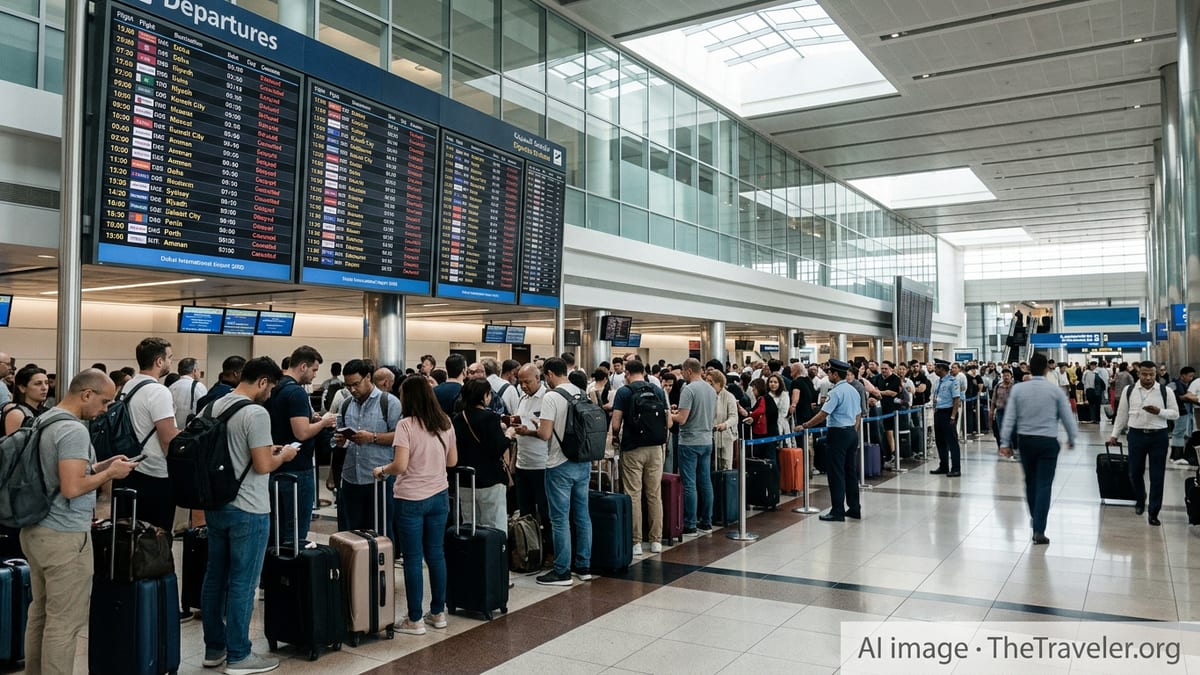
Updated summer advisory resets expectations at Dubai International
Publicly available guidance from Emirates now focuses on a clear three hour arrival window for departures from Dubai, replacing earlier messaging that encouraged passengers to leave home as early as possible to beat anticipated congestion. The latest advisory, updated in late June and reiterated as the summer rush began in early July, stresses that travelers should arrive at Dubai International Airport around three hours before departure, pass immigration 90 minutes before their flight, and be at the gate 60 minutes prior to take off.
The shift comes as Dubai International prepares to handle around three million passengers in the first half of July, with daily traffic regularly expected to exceed 200,000 travelers. Airport operators have activated peak season plans, but airlines are now cautioning that showing up excessively early may not translate into a smoother experience and can instead contribute to crowding in check in halls and security lanes.
Recent coverage from regional outlets highlights that Emirates is aligning its guidance with these operational realities. Rather than framing the situation as uncontrolled disruption, the airline is emphasizing predictable processing times provided travelers stick closely to the three hour rule and make full use of online and app based check in options.
The updated message effectively replaces emergency style language used during past disruption periods, when passengers were urged to reach the airport far earlier than usual or avoid travelling altogether unless instructed otherwise. For most holidaymakers departing in July, the advisory now reads as a structured checklist rather than a warning to brace for chaos.
What the new timing means for your departure plans
For travelers, the practical change is that there is no longer a broad call to head to Dubai International many hours ahead of schedule. Emirates is advising customers to time their journey so they arrive roughly three hours before their scheduled departure, allowing for traffic on routes to the airport but avoiding long stretches spent waiting at the terminal before check in counters open.
The guidance underscores that check in and bag drop typically open several hours before departure, not throughout the entire day, which limits the usefulness of arriving extremely early. Passengers who reach the airport too far in advance may find that desks and self service facilities are not yet available for their flight, creating additional queues as larger numbers of people wait for operations to open.
Published information also points out that security and immigration are calibrated around the three hour window. When passengers arrive significantly earlier, screening areas can become congested outside their normal peaks, potentially complicating efforts by airport teams to spread demand efficiently across the day.
For families, large groups and travelers connecting from other parts of the United Arab Emirates, the updated message suggests building in modest extra time for road traffic while still aiming to hit the three hour mark rather than doubling it. The aim is to keep flows steady rather than creating new bottlenecks by funnelling everyone into the terminal at the earliest opportunity.
Why the airline stepped back from an emergency tone
Dubai’s aviation sector has faced several high pressure periods in recent years, including weather related disruption and regional security incidents that temporarily altered flight schedules and airspace access. During those episodes, advisories sometimes urged passengers not to travel to the airport until they had received direct confirmation from airlines, or conversely to allow far more time than usual because of unpredictable queues and rebookings.
Reports from early summer 2026 indicate that Emirates and Dubai International entered the current peak season in a more stable operating environment. While demand is intense, schedules are broadly predictable and terminal capacity has been planned around the expected three million travelers moving through the hub in the first half of July.
In that context, the airline’s move away from language that resembled an emergency warning reflects confidence that standard operating procedures can handle the volume, provided passengers follow the specified timings. The emphasis has shifted from contingency instructions to consistent, repeatable steps such as checking in online, using dedicated bag drop kiosks and registering for biometric processing where available.
This recalibration also helps set expectations for international visitors who may have seen headlines about previous disruption at Dubai but are now travelling during a more orderly period. The message is that the airport will be busy, but it is functioning normally with additional staff and processes in place to support the summer surge.
How Dubai airport is preparing for record July crowds
Dubai International’s operator has signalled that it expects sustained pressure across all terminals as schools break up and residents head abroad for extended holidays. Forecasts published this week suggest that July 12 could be one of the busiest days of the season, with passenger numbers on that date alone tipped to surpass 225,000.
To cope, the airport has activated a summer readiness plan designed to keep passenger journeys moving. This includes additional staff in check in halls and security zones, closer coordination with airlines on gate allocations, and operational adjustments to absorb surges in transfer traffic connecting between long haul flights.
The broader transport network feeding into the airport is also part of the equation. Dubai’s metro and road links are expected to play a key role in easing car park congestion and curbside drop off delays, particularly for those departing from Emirates Terminal 3 during the first major holiday weekend from July 3 to 5.
Transport and aviation reports note that daily traffic levels at Dubai International are already running high compared with previous years, underlining why airlines are reinforcing precise timings rather than keeping advice vague. Peak season this year is less about crisis management and more about encouraging disciplined travel habits at scale.
Tips to navigate peak season without unnecessary airport time
Although Emirates is no longer encouraging passengers to rush to the airport excessively early, its updated advisory still carries a clear message that preparation is essential. Travelers are urged through public guidance to complete as many steps as possible before leaving home, from checking in on the airline’s website or app to confirming baggage allowances and ensuring travel documents are valid and easily accessible.
Once at the airport, the priority is to move steadily through formalities rather than lingering in landside areas. That means proceeding to bag drop where required, continuing directly to security screening, and then heading to the gate area in time for boarding, which for Emirates flights is generally advised at around 60 minutes before departure.
Passengers connecting in Dubai are being reminded that the same principles apply even if they do not pass through immigration. Transfer signage, connection times and gate changes should be monitored closely, especially on days flagged as particularly busy, to avoid last minute rushes through crowded concourses.
For many holidaymakers, the key change in messaging is simple: do not leave for the airport in a panic hours earlier than necessary, but do treat the three hour guideline and associated timings as firm. In a season when Dubai International is expected to handle millions of passengers in a matter of weeks, that balance between punctuality and over preparation is likely to determine how smooth each individual journey feels.