


More news on this day
Emirates is pushing its Premium Economy product closer to business-class territory with the launch of what it describes as the world’s first electrically powered Premium Economy seat, featuring a full-height adjustable privacy screen between every seat on its new Airbus A350 aircraft.
Get the latest news straight to your inbox!
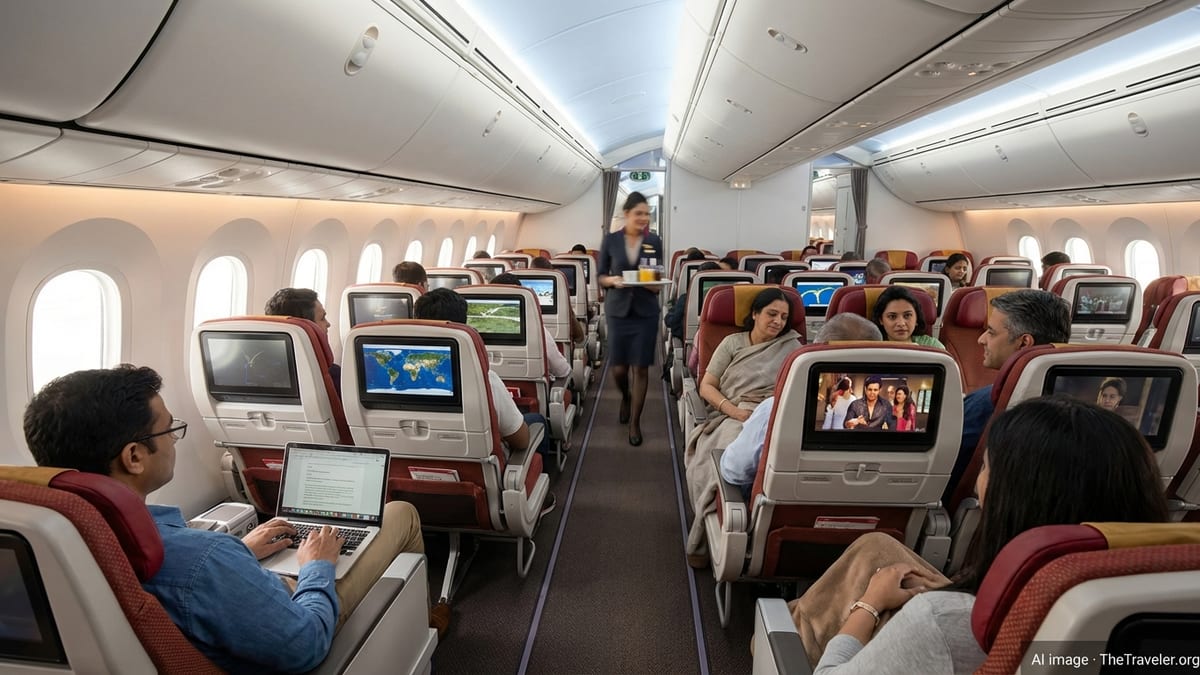
World-First Seat Debuts on Emirates Airbus A350 Fleet
According to publicly available information, the new electric Premium Economy seat is being introduced on Emirates’ freshly delivered Airbus A350s, where it will appear in a compact 28-seat cabin arranged in a 2-3-2 configuration. The design is intended to give travelers a more exclusive environment than a larger Premium Economy cabin while preserving a familiar widebody layout familiar to long haul flyers.
Reports indicate that Emirates positions this product as a further upgrade to its Premium Economy concept, first introduced in 2022 and already rolled out across a growing number of routes. On the A350, seat width is listed at about 20 inches, with pitch of up to 39 inches, allowing for a cradle-style recline that does not significantly intrude into the space behind. The electric mechanism gives passengers more precise control over their seating position than traditional mechanical recline systems.
Industry coverage notes that the new seat continues Emirates’ broader strategy of using its A350 fleet to showcase cabin innovations. The airline has already emphasized quieter cabins and updated inflight entertainment on the type, and the electric Premium Economy seat is being framed as a flagship comfort feature to differentiate Emirates from competitors in the increasingly contested middle cabin segment.
Initial deployment is focused on newly delivered A350 aircraft, with Premium Economy offered on selected routes where Emirates expects high demand from leisure travelers seeking extra space and amenities without paying for lie flat business class. Observers note that this approach also allows the airline to test customer response before considering any wider retrofit program.
Full-Height Electric Privacy Screen Redefines Personal Space
The standout innovation is a full-height, electrically adjustable privacy screen between every Premium Economy seat. According to Emirates’ published materials, the divider extends to the top of the seatback, a configuration described as a first for this cabin class globally. Unlike partial dividers commonly found between economy or premium seats, this design aims to create a more defined personal zone for each passenger.
At the touch of a button, travelers can raise or lower the divider and lock it into place using integrated seat controls. Coverage of the launch explains that the feature is designed to support multiple use cases: raised for added seclusion while resting or working, or lowered to allow easier interaction when traveling with companions. This level of adjustability aligns more closely with the privacy options usually seen in business class suites than in Premium Economy cabins.
Commentary from aviation analysts highlights that privacy is emerging as a key differentiator within the premium economy category, where hard product differences between airlines can be subtle. By bringing full-height screens into this space, Emirates appears to be betting that many passengers will place a high value on being able to tune out the surrounding cabin on long haul flights without upgrading to a higher class of service.
The privacy screen also has implications for how space is perceived in the cabin. While the 2-3-2 configuration remains relatively dense compared with business class, the dividers visually segment the cabin into smaller zones. Photographs released alongside the announcement show pairs of travelers using the screens to create semi-enclosed pods, particularly at window pairs, which may appeal to couples and solo travelers seeking a quieter environment.
Comfort Upgrades: U-Dream Headrest, Electric Footrest and New Controls
Beyond privacy, the new seat introduces a range of ergonomic refinements. Emirates materials and independent reporting highlight the inclusion of the U-Dream headrest, developed by Safran Seats, which features multiple adjustable “wings” designed to cradle the head and neck. This is intended to reduce the reliance on personal travel pillows and provide better lateral support when resting, particularly on overnight flights.
The Premium Economy chair is also fully electric, controlled via an integrated passenger control unit rather than a mechanical lever. Published details describe preset modes such as a more upright position for dining and a reclined “lounge” setting for resting, with fine adjustments available at the touch of a button. This electric actuation is unusual in Premium Economy and more commonly associated with long haul business class products.
An electrically deployable leather footrest complements the recline system, allowing passengers to raise their legs without encroaching on the space in front. Reports indicate that the cradle-style motion is engineered so that seat movement has limited impact on the person behind, addressing a frequent point of friction in dense cabins. Combined with the generous pitch, this is expected to make extended periods of seated rest more comfortable than in many standard economy layouts.
These enhancements build on Emirates’ previous Premium Economy features, which already include larger seatback screens and upgraded soft products. By refining the physical seat around head, back and leg support, the airline is clearly aiming to position this cabin as a distinct step up in comfort rather than a marginally expanded economy seat.
Technology Additions: Wireless Charging and Enhanced Entertainment
Alongside the structural changes to the seat, Emirates is introducing new technology touches that reflect evolving passenger habits. According to multiple reports, the A350 Premium Economy seat now incorporates wireless charging, a first for this cabin on the airline. The charging pad is designed for compatible smartphones and small devices, reducing reliance on cables during long flights.
Published details indicate that the seat also includes a dedicated phone holder integrated into the tray table area, allowing devices to be positioned as a “second screen” while dining or working. This responds to a growing trend of passengers using their own content alongside the airline’s inflight entertainment, whether for productivity or casual viewing.
Earlier A350 documentation from Emirates pointed to 4K-capable inflight entertainment screens in Premium Economy, and current reports around the electric seat reiterate an emphasis on high-resolution displays and an upgraded user interface. This places the new seat within a broader push toward more premium-feeling digital experiences, with smoother navigation and higher picture quality than is typical in standard economy cabins.
Power outlets and USB charging remain part of the specification, ensuring that passengers can keep laptops and other electronics powered for the duration of long haul sectors. Taken together with the wireless charging option, the seat appears designed to function as a more versatile personal workspace as well as a place to rest.
Premium Economy’s Role in Emirates’ Competitive Strategy
Since Emirates formally launched Premium Economy in 2022, the product has rapidly become a centerpiece of the carrier’s long haul offering. Industry coverage notes multiple awards for the cabin, including recognition from regional travel industry publications for its combination of space, dining and service. The new electric seat and privacy screen can be seen as the latest step in a strategy of positioning Premium Economy as a near-business alternative on select routes.
Analysts observe that as more airlines introduce or refresh Premium Economy, there is growing pressure to differentiate on more than just seat pitch and meal quality. By introducing electric controls and full-height privacy into this cabin, Emirates is attempting to move the category upmarket, potentially attracting travelers who might otherwise have remained in economy or traded up to business class.
Reports also suggest that the A350 platform gives Emirates additional flexibility in tailoring cabins to specific markets. Where there is strong demand for an intermediate product, a relatively small but well-specified Premium Economy cabin may help optimize revenue while maintaining clear distinctions between classes. The airline’s decision to unveil its most advanced Premium Economy seat on the A350 underlines the strategic importance of the type in the next phase of its fleet development.
As the new seats enter service, attention will likely focus on route selection and pricing, and on whether elements such as the full-height privacy screens begin to appear in future refits or new aircraft orders. For now, the electric Premium Economy seat on Emirates’ A350s stands out as one of the most ambitious interpretations of the cabin category, further blurring the line between enhanced economy and traditional business class experiences.