


More news on this day
The executive behind Villa Vie Residences’ so called “endless cruise” has spoken publicly for the first time since more than 200 long term passengers were told with only hours’ notice to leave the MV Odyssey in Cambodia, accepting that he is now seen as “the villain” of a failed dream of life at sea.
Get the latest news straight to your inbox!
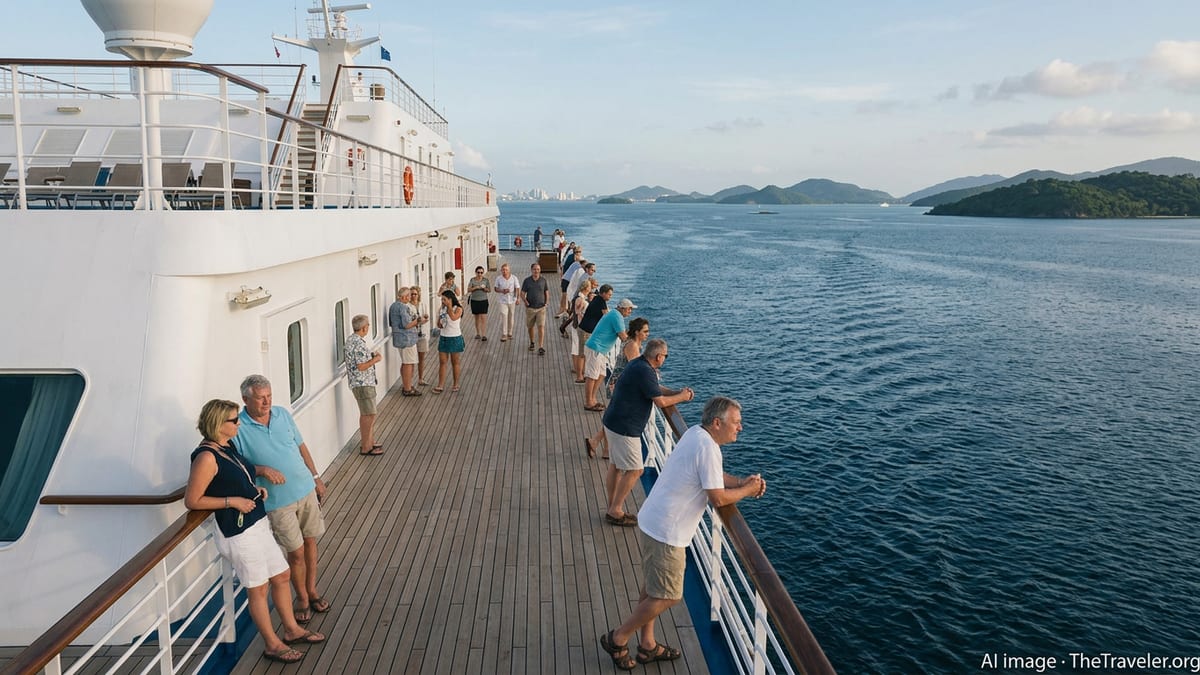
A radical cruising experiment comes to an abrupt stop
The MV Odyssey, operated by Florida based Villa Vie Residences, had been marketed as a residential, never ending world voyage, with cabins sold as long term or even permanent homes. Publicly available information shows that some residents paid from about $120,000 to more than $400,000 for cabins, with additional monthly fees, and in several cases sold their houses and most possessions to fund life on board.
The ship launched its continuous program in late 2024 and settled into a slow moving circuit across multiple continents, spending several days in many ports so residents could treat it as a mobile neighborhood rather than a conventional cruise. For nearly two years, social media channels and blogs from passengers documented a lifestyle built around the promise that the voyage would keep going into at least 2027.
That promise unraveled in late October 2026. Company statements and media reports indicate that Villa Vie told residents earlier in the week that operations were being “suspended” while the Odyssey was in Sihanoukville, on Cambodia’s southern coast. Passengers were then instructed via internal messages on board to pack up and leave the ship within a matter of hours, effectively ending the supposed endless cruise.
Local officials in Cambodia have said the ship is expected to refuel and depart the country, but it remains unclear whether it will sail again with residents on long term contracts or operate in another role while Villa Vie reviews its options.
Founder blames fuel shock and accepts ‘villain’ label
In a series of interviews cited in global coverage, Villa Vie founder and executive chairman Mikael Petterson framed the collapse of the Odyssey’s residential program as the result of a severe and sudden spike in fuel prices linked to the war involving the United States, Israel and Iran. He described a “cascading effect” in which bunker fuel costs, already a major line item for any cruise operator, rose far beyond the levels assumed in the company’s business model.
Figures released by Villa Vie and repeated across multiple outlets put the historic fuel cost at about $1,800 per cabin per month before the conflict, increasing to an estimated $6,000 to $8,000 per cabin as the war disrupted global energy markets. Petterson has also said that the Odyssey was paying from roughly $2,000 to $3,000 per ton of fuel in recent months, up from around $700, with the vessel reportedly consuming up to 800 tons a month.
Petterson has argued that passing the entire increase directly to residents would have made life on board unaffordable and undermined the core promise of the product. He has acknowledged that Villa Vie stretched payrolls, slowed the itinerary to save fuel and sought new investors, but ultimately ran out of cash. Public comments credited to Petterson describe him as feeling “awful” about the outcome and accepting that, in his words, “I’m the villain in the story,” while insisting that he is trying to support residents in finding solutions.
Company representatives have also indicated that Villa Vie plans to seek Chapter 11 bankruptcy protection in the United States, a move that would allow it to reorganize under court supervision, though detailed filings and any proposed restructuring terms have not yet been made public.
Hundreds stranded in Cambodia after sudden disembarkation
For passengers, the business collapse translated into a practical emergency. Reports from residents and local authorities suggest that about 200 to 203 passengers, along with more than 150 crew members, were on board when the order came to disembark in Sihanoukville. Many of those passengers were retirees or long term remote workers whose main residence and possessions were on the ship.
Blog posts from on board describe an early morning notice on internal communication channels stating that residents had to be off the ship by early afternoon, giving them less than a full working day to pack up cabins that, for some, had been home for two years. One resident blogger recounted being taken by shuttle buses from the port to the middle of town and left to find their own accommodation, saying that no hotel list or financial assistance was initially provided.
Subsequent updates from the same accounts state that Villa Vie later circulated information on local hotels and offered some assistance, but that many travelers had already scrambled to arrange rooms, onward flights or temporary apartments. Publicly available coverage quotes several residents describing fellow passengers as “heartbroken,” “in disbelief” and, in some cases, effectively homeless after committing the bulk of their retirement savings to the Odyssey.
Cambodian provincial officials have said that some passengers quickly flew out of Sihanoukville or traveled onward by land, while others have remained nearby in the hope that an investor or resident led consortium might eventually revive the ship’s residential program. For now, those efforts remain speculative and unfunded.
Residents count the cost of a failed sea home
Stories emerging from the stranded community underline the financial and emotional shock. Coverage from multiple outlets has highlighted couples who spent several hundred thousand dollars on long term or permanent cabins, alongside monthly maintenance or service fees reported in the range of $3,500 to $6,000. One pair estimated their total outlay at around $460,000 over two years, combining cabin purchase and regular charges.
Others have described selling homes, cars and most belongings ashore to embrace what had been sold as a low stress, all inclusive life at sea. In interviews, some passengers have said they do not expect to recover much, if any, of their investment, depending on how any eventual bankruptcy or restructuring proceeds. Legal questions around the status of cabin purchase contracts and residents’ place in a potential creditor hierarchy remain unanswered in public documents.
Despite the financial shock, several passengers quoted in broadcast and online reports have also spoken of the previous two years on board as a “magical” or “extraordinary” experience, pointing to long port stays, onboard community life and the chance to explore dozens of countries without packing and unpacking. Some have said that, even knowing how the story ends, they would still have taken the risk.
Others have been more critical of the company’s communication, citing earlier warning signs such as appeals to residents for fuel related contributions, reduced provisioning and sporadic internet outages linked to unpaid connectivity bills. For these passengers, the final hours in Cambodia have reinforced concerns about how early and how clearly the scale of the financial problems was communicated.
Uncertain future for residential cruising dreams
The Odyssey’s grounding in Cambodia is being watched closely across the cruise and travel industries because Villa Vie was part of a broader wave of residential or long duration cruise concepts that promise an alternative to conventional retirement or remote work on land. Petterson has noted that, in his view, “nobody that’s tried residential cruising has succeeded,” while arguing that Villa Vie moved the concept further than previous experiments before being overtaken by geopolitical and economic shocks.
Travel industry analysts have suggested that the collapse will likely make lenders, regulators and prospective residents more cautious about similar offerings, at least in the short term. The combination of high capital costs, volatile fuel prices and the need to maintain hotel style services at sea over many years poses a complex challenge even in stable times, and the events in Cambodia highlight how quickly a niche product can unravel when a key assumption, such as energy costs, changes.
Villa Vie, for its part, has said in public statements that it is “working with residents to coordinate disembarkation and temporary living arrangements” while evaluating restructuring and new funding options over a period of about 60 days. As of late October, there has been no firm public commitment on whether the Odyssey will resume any form of residential service, nor on what compensation, if any, long term residents might receive.
For now, the ship that was meant to circle the globe indefinitely is moored in Southeast Asia, and the people who built their lives around it are scattered across hotels, short term rentals and flights home. Whether the “endless cruise” model can recover from what has happened in Cambodia is likely to remain a key question for would be sea residents and travel innovators alike.